Modern Bodhisattva’s Way of Life: Emptiness of the Four Noble Truths

(9.40ab) (Hinayanist) “Since we can attain liberation by gaining a direct realization of the four noble truths,
What is the point of striving to realize emptiness, lack of true existence?”

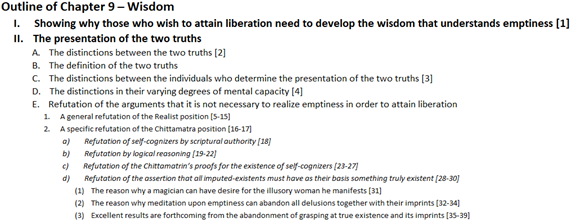
Realizing the emptiness of the Prasangikas is hard. Further, our ignorance will come up with all sorts of excuses as to why we do not actually have to realize emptiness. For example, we are often very happy to read Dharma books about love, compassion, our precious human life and so forth. But the idea of picking up Ocean of Nectar and studying intricate debates about emptiness seems a daunting task to say the least. We get lost and we do not see the point, and just like we did with math while we were in school, we think we will never need this so why bother trying?

Here, the Hinayanists are doing the same thing. They are saying we merely seek to attain individual liberation, and Buddha explained we can do so through realizing the Four Noble Truths, so why should we bother listening to all you Prasangikas babble on about lack of true existence and the nonexistence of self-cognizers and so forth? 

What are the Four Noble Truths? The first is true suffering, which means recognizing that we are trapped within samsara. The second is true origins, which means understanding the root of our suffering in samsara, namely delusions. The third is true cessations, which refers to the cessation of true origins within our mind. And the fourth is true paths, which is the method for attaining true cessations.

(9.40cd) It is necessary because the scriptures explain that without the path of wisdom realizing this emptiness,
It is impossible to attain even the small enlightenment of self-liberation.

The Prasangika answer to this objection is the wisdom realizing the emptiness of inherent existence is implied within the Four Noble Truths.  For Prasangikas, the source of all delusions is the ignorance grasping at inherent existence. And true cessations are realizing that all of the things that we normally see do not exist at all. This is attained through true paths, which are meditations on the correct view of emptiness. Without realizing emptiness, it is not possible to eliminate all of our delusions, and therefore escape from samsara. Thus, even to attain individual liberation of a Hinayanist requires realizing emptiness.

The basis for this view comes from the Mahayana scriptures explaining emptiness.  

(9.41-4) (Hinayanist) “Because we do not believe in the Mahayana, your quoting from Mahayana scriptures is pointless.”

The Hinayanist objection to the Prasangikas saying emptiness is implicit within the Four Noble Truths is the basis for the Prasangika view is the Mahayana scriptures. But the Hinayanists reject the Mahayana scriptures as being actually taught by Buddha, so therefore they say quoting from them is pointless.

We both believe that the Hinayana scriptures are valid;
So you should apply your reasons for believing the Hinayana equally to the Mahayana.
Thus, we understand that both are the holy Dharma taught by Buddha himself.

First of all, in the real world we would never try to disagree with someone who follows another path. If their path works for them, then we are happy for them, even if they reject our own path. We do not need to convert anybody to the mahayana view, but we are happy to clarify points if someone is actually open minded. If they are not open minded then we just leave them to their path and that’s it.

In this context, we are assuming that the person we are speaking with is a Buddhist and is open minded about the possibility of mahayana scriptures, and so therefore we simply ask the questions to try overcome their doubts. But in the context of our own individual contemplation of Shantideva’s guide, we should recognize all the objections as doubts we may have within our own mind. Perhaps we ourselves doubt whether the mahayana or the vajrayana or the ganden oral lineage and so forth was actually taught by Buddha. This may cause is to doubt the authenticity of the instructions that we receive.

Shantideva’s answer to the Hinayana’s objection is they should apply whatever is the criteria they use for assessing the validity of the Hinayana scriptures to assessing whether the Mahayana scriptures are also valid. It is fair to say if the criteria is good enough for their scriptures then that same criteria should be good enough for evaluating other scriptures.

Happy Tsog Day: Offering the five objects of desire

In order to remember and mark our tsog days, holy days on the Kadampa calendar, I am sharing my understanding of the practice of Offering to the Spiritual Guide with tsog.  This is part 9 of a 44-part series.

Delightful bearers of forms, sounds, smells, tastes, and objects of touch –
Goddesses of outer and inner enjoyments filling all directions.

This refers to the practice of offering the five objects of desire according to Highest Yoga Tantra. There are two ways of engaging in this practice referred to here – viewing the five objects of desire as offering goddesses and offering countless knowledge women skilled in the sixty-four arts of love. These will be explained in turn, but first we need to say a few words about why we generate bliss in our tantric practices and what that exactly means.

Bliss as we normally understand it usually refers to the pleasure we enjoy from particularly good objects of attachment. But this is just changing suffering and ultimately not real bliss since it is contaminated by attachment. Bliss in a spiritual context refers to inner peace that is so pleasant, it is blissful. As explained above, the cause of happiness is inner peace. When our mind is peaceful, we are happy. Enlightenment is sometimes referred to as “supreme inner peace.” It is also called the bliss of enlightenment. This shows that “bliss” and “supreme inner peace” are synonymous. There are two different ways of generating inner peace in the Dharma – concentration on virtue and the absorption of our inner winds into our central channel. Concentration on virtue is referred to as the “bliss of suppleness,” and normally is explained in the context of the teachings on tranquil abiding. With tranquil abiding, our mind is completely free form all forms of gross and subtle mental sinking and excitement for as long as we want. This enables our mind to absorb single-pointedly on our objects of Dharma, giving rise to the bliss of suppleness of tranquil abiding. Sometimes we think of tranquil abiding as the highest form of concentration we can attain, but Geshe-la explains in Ocean of Nectar that tranquil abiding is only attaining the concentration of the lowest form realm god. Our body remains that of a human, but our mind ascends to that of a the lowest of the god realms. There are many, many layers of the god realms – form and formless realm gods – each one corresponding to an ever deeper level of concentrative bliss all the way up to the concentration of the absorption of the peak of samsara, the highest mind of a samsaric being. But these concentrations are not the inner peace of great bliss of tantric practice. These forms of bliss are all our gross mind, not our subtle or very subtle mind. The bliss of tantric practice is far superior to even the greatest bliss arising from concentration.

The bliss of tantric practice arises from our inner energy winds absorbing into our central channel. Our mind possess three levels – gross, subtle, and very subtle. When our winds begin to absorb into our central channel, we proceed into these deeper levels of our mind. The first four winds that dissolve – which correspond with the dissolution of the earth, water, fire, and wind elements – are all gross winds. The next three winds that dissolve – the wind supporting the mind of white appearance, the wind supporting the mind of red increase, and the wind supporting the mind of black near attainment – are all subtle winds. And when the wind supporting the mind of black near attainment dissolves, our very subtle level of mind of clear light becomes manifest. The wind supporting this is our very subtle wind, also known as our root wind, our continuously abiding wind, or our very subtle wind. With each dissolution, our mind becomes increasingly subtle and blissful. When we reach the clear light directly, our mind attains meaning clear light, which is the same nature as the great bliss of full enlightenment. In the beginning, we may only have this bliss for a few moments, but through further training we gain the ability to maintain this bliss for longer and longer periods of time until eventually we experience it forever. At that point, we have attained enlightenment. I believe the bliss we experience when our gross wind element wind dissolves, the bliss we experience is the same as that experienced by a god who has attained the peak of samsara, but I am not 100% sure of this. I remember reading something along these lines, but cannot find it. Perhaps somebody reading this knows for sure and can clarify in the comments. Regardless, it is something in this direction.

Why do we want to attain this great bliss? Because the supreme inner peace of great bliss is able to mediate easily on emptiness. Emptiness is a very subtle object, so to realize it fully we need a very subtle mind. Bliss, quite simply, is what a realization of emptiness feels like. The mind of great bliss is utterly free from distraction because our mind has no desire to go anywhere else. Normally our mind becomes distracted because we think we can find more happiness thinking about some other object that we do our object of Dharma. But when we are experiencing the great bliss of tantric practice, any other mind is necessarily less pleasant. It can be likened to dropping the marble of our mind into a bowl. At some point, the marble settles exactly at the very bottom of the bowl and will not move from there.

When we offer the five objects of desire in these two ways (as objects of the senses and as knowledge women), we imagine that both our Guru who we are offering these things to and ourself experience the great bliss of tantric practice. The principal function of these offerings is to create the merit to be able to experience great bliss directly. To offer the five objects of desire according to the first method, we imagine that all the objects of our senses – sights, sounds, tastes, smells, and objects of touch – all transform into different types of offering goddesses. I find it easiest to imagine that every object is made of offering goddess atoms arranged in the shape of the objects of our senses. For example, the computer screen I am looking at is comprised of offering goddess atoms in the shape of my computer screen. This enables me to engage with the world as it normally appears to me exactly as normal, while mentally seeing it all as part of the pure land. As we or others encounter these purified objects of the senses, we imagine that they experience great bliss from their every sensory experience.

To offer the five objects of desire according to the second method of the countless knowledge women will be explained below in the secret offering.

Happy Tara Day: Tara can dispel all outer and inner obstacles

This is the sixth installment of the 12-part series sharing my understanding of the practice Liberation from Sorrow.

Praising Tara by her divine actions of dispelling conflicts and bad dreams

Homage to you who are honoured by the kings of the hosts of gods,
And the gods and the kinnaras.
Through your joyful and shining pervasive armour
All conflicts and bad dreams are dispelled.

These are particularly practical ways we can rely upon Tara.  We all, from time to time, experience conflict and bad dreams in our life.  Every time we find ourself in some sort of conflict, we can recall Tara’s swift ability to dispel conflicts, and recite her mantra with strong faith requesting that she do so.  Ultimately, all conflict is sustained by anger, attachment, and self-grasping – in either ourself of those we are in a conflict with (usually both).  When we recite her mantra, we should request that she dispel the inner causes of our conflict from all concerned.  For myself, much of my work revolves around the U.S.-China relationship, which is obviously plagued by different types of conflict.  To help dispel this conflict, I try generate pure view of my work and those I encounter as emanations of Tara and request that through them both, all conflict between China and the United States can be dispelled. 

Tara is also helpful for dispelling bad dreams.  When I was very young, I had a few particularly scary bad dreams, and became terrified of having more.  Every night when I would go to sleep, I would pray, “please please please please (repeated millions of times) protect me from bad dreams.”  It actually worked, and after I started praying like this when I went to bed, I had very few bad dreams.  Later, when I became a father myself, my kids started having bad dreams, and I taught them Tara’s mantra and gave them small Tara statues to hold in their hand as they went to sleep to protect them against bad dreams.  Their bad dreams became much less afterwards, almost without fail.

Praising Tara by her divine actions of dispelling diseases

Homage to you whose two eyes, like the sun or the full moon,
Radiate a pure, clear light.
Saying HARA twice and TUTTARA,
You dispel the most violent, infectious diseases.

When the Coronavirus first broke out, Geshe-la advised Kadampas around the world to do Tara practice due to her power to dispel violent, infectious diseases.  Some centers did 24-hour Tara pujas on Tara day every month for some time.  The way these work is every four hours, one engages in the Liberation from Sorrow sadhana, and recites the praises to the twenty-one Taras seven times each session.  While it is true the coronavirus still spread all over the world, we cannot say it would not have spread worse if such actions were not performed.  If we have faith in Tara, there is no doubt that such actions help and perhaps saved many, many lives. 

Praising Tara by her divine actions of subduing evil spirits and zombies

Homage to you who have the perfect power of pacifying
Through your blessing of the three thatnesses;
Subduer of the hosts of evil spirits, zombies and givers of harm,
O TURE, most excellent and supreme!

In many ways, this verse is like the summary of all of the previous verses.  It refers to her power to pacify, bestow blessings (in particular of the wisdom realizing emptiness, or thatness), and subdue outer and inner obstructions.  She truly is most excellent and supreme!

This concludes the praise of the root mantra
And the twenty-one homages.

Normally, we talk of these praises as to the twenty-one Taras, but here we are also reminded that these are also praises of Tara’s mantra.  In Buddhism, we often describe things as existing at gross, subtle, and very subtle levels.  Green Tara is the gross deity, her mantra is like a subtle emanation of Tara, and the Dharmakaya is the very subtle version of Tara.  In this way, we can understand the mantra as like a bridge between the Tara we normally know and definitive Tara.  With sufficient faith in and understanding the nature of the mantra, reciting the mantra has exactly the same function and power as reciting the twenty-one homages. 

Benefits of recitation of this Sutra

The wise who recite this with strong faith
And perfect devotion to the Goddess,
In the evening and upon arising at dawn,
Will be granted complete fearlessness by remembering her.

A qualified mind of refuge has two main parts, fear of samsara and faith in the three jewels.  Normally, we don’t have much difficulty generating faith, but for our faith to have any meaning, it must be informed by an appropriate fear of samsara.  Without this, our Dharma practice just becomes feel-goodism.  But with healthy wisdom fears of samsara and faith in the three jewels, we are pushed to engage in Dharma practices, such as relying upon Mother Tara.  Through this we attain fearlessness in two ways.  First, because we will have a powerful protector at our side; and second, because we will gain inner Dharma realizations, which provide us with permanent protection from all suffering.  In particular, we need the wisdom that knows how to transform adversity into the path to enlightenment.  Normally we fear things that can harm us.  Most of samsara’s sufferings can harm us only because we don’t know how to transform experiencing them into causes of our enlightenment.  But through relying upon Tara, we can gain this wisdom, and then we will have nothing to fear.  We receive this protection merely “by remembering her” because wherever you imagine a Buddha, a Buddha actually goes; and wherever a Buddha goes, they perform their function, which is to bestow blessings.  In other words, by merely remembering Tara, she comes swiftly to our side and then blesses our mind to gain wisdom realizations.  The sadhana says we need to rely upon her with perfect devotion.  What does that mean practically?  It means we move beyond simply having faith in her to actively working to accomplish her wishes in the world.  Somebody who is devoted moves beyond inner faith to practical action.  Tara’s main wish is for the pure Kadam Lamrim of Atisha to flourish throughout the world, both externally and internally.  If we are to enjoy complete fearlessness, we need to not only rely upon her, but to actively devote ourselves to realizing her pure wishes.

Through the complete purification of all negativity
They will destroy all paths to the lower realms.
They will swiftly be granted empowerment
By the seventy million Conquerors.

The cause of lower rebirth is negative karma on our mind.  The quality of mind we generate at the moment of our death determines the quality of our next rebirth – a negative mind will activate negative karma resulting in a lower rebirth, a positive mind will active virtuous karma resulting in an upper rebirth, and a pure mind will active pure karma resulting in a rebirth outside of samsara.  Avoiding a negative mind at the time of death will help protect us from a lower rebirth, but the only way to destroy all paths to the lower realms is through the complete purification of all our negative karma.  If we have no negative karma remaining on our mind, even if we generate a negative mind at the time of death, there will be no negative throwing karma to activate and it will be impossible for us to take lower rebirth.  Tara’s blessings can help us purify swiftly all of our negative karma, and we can recite her mantra as a practice of purification similar to Vajrasattva practice. 

Relying upon Tara also creates the causes for us to receive the empowerments of all the Buddhas.  What is an empowerment?  During an empowerment, our Spiritual Guide places within our mental continuum a personalized emanation of the deity who will remain with us between now and our eventual attainment of that deity.  This emanation is our personal yidam, or personal deity.  By virtue of this emanation, we can gradually learn to identify with the pure body and mind of the deity and gain the ability to use these as if they were our own.  Tara is the mother of all Buddhas, and all Buddhas respect and are devoted to their mother.  When we rely upon Tara, all of her children – the Buddhas – then come into action to help fulfill their mother’s wish for us.  They do so by granting us empowerment.

Happy Turning the Wheel of Dharma Day: Taking our Place in the Lineage

Today is Turning the Wheel of Dharma Day when we celebrate and remember Buddha’s kindness in teaching Dharma to the beings of this world.  Today is a particularly blessed day when the karma we create is multiplied by ten million times, so it is a good idea to make every second count.  As Kadampas, June 4th is also Venerable Geshe-la’s birthday.  Of course it is, what other day would he be born on?  To mark this day, I would like to share my thoughts on why it is important to regularly engage in the Request to the Holy Spiritual Guide Geshe Kelsang Gyatso from his Faithful Disciples, how we can appreciate Buddha’s kindness in turning the Wheel of Dharma, what it means to turn the Wheel of Dharma over time, and the many different ways we can choose to take our place in the lineage.

Understanding How Holy Days Work

There are certain days of the year that are karmically more powerful than others, and the karmic effect of our actions on these days is multiplied by a factor of ten million!  These are called “ten million multiplying days.”  In practice, what this means is every action we engage in on these special days is karmically equivalent to us engaging in that same action ten million times.  This is true for both our virtuous and non-virtuous actions, so not only is it a particularly incredible opportunity for creating vast merit, but it is also an extremely dangerous time for engaging in negative actions.  There are four of these days every year:  Buddha’s Enlightenment Day (April 15), Turning the Wheel of Dharma Day (June 4), Buddha’s Return from Heaven Day (September 22), and Je Tsongkhapa Day (October 25).  Heruka and Vajrayogini Month (January 3-31), NKT Day (1st Saturday of April), and International Temple’s Day (first Saturday of November) are the other major Days that complete the Kadampa calendar. 

A question may arise, why are the karmic effects of our actions greater on certain days than others?  We can think of these days as like a spiritual pulsar that at periodic intervals sends out an incredibly powerful burst of spiritual energy or wind.  On such days, if we lift the sails of our practice, these gushes of spiritual winds push us a great spiritual distance.  Why are these specific days so powerful?  Because in the past on these days particularly spiritually significant events occurred which altered the fundamental trajectory of the karma of the people of this world.  Just as calling out in a valley reverberates back to us, so too these days are like the karmic echoes of those past events. 

Why it is Important to Regularly Make the Request to the Holy Spiritual Guide Venerable Geshe Kelsang Gyatso from his Faithful Disciples

Not only is today important because it is Turning the Wheel of Dharma Day, but also because today is Geshe-la’s birthday.  Even though he has passed, his birthday for us is like the birth of Buddha Shakyamuni in our lives. Quite literally it is because Venerable Geshe-la is Guru Sumati Buddha Heruka. That’s who Geshe-la always was and that’s how he wants us to remember him. The Request to the Holy Spiritual Guide is like having the direct private Skype of our holy spiritual guide, Venerable Geshe Kelsang Gyatso Rinpoche, and Guru Sumati Buddha Heruka. In short, it is a magical method for how we invoke his presence in our life.

When Geshe-la passed, he requested that the entire global Kadampa community do a retreat of Guru Sumati Buddha Heruka. I think it is safe to say that the nearly universal experience of those who engaged in this retreat – regardless of where you were in the world – was that they felt even closer to Venerable Geshe-la after his death as if the supernova of his purity was released from the shackles of our narrow conception of him in a human body and we started to get a sense of just how enormous of a being he is. These were Geshe-la’s specific instructions for what he wanted us to do.

The spiritual realization everyone came to when he died and we all did this retreat was that Geshe-la is Guru Sumati Buddha Heruka. Like literally, not just a view we hold because it is beneficial. When I first came into the Dharma, Geshe-la had not yet introduced Guru Sumati Buddha Heruka. We had Lama Losang Tubwang Dorjechang, which was the Tibetan name of Guru Tsongkhapa. Lama meant Guru, Losang meant Je Tsongkhapa. Tubwang meant Buddha Shakyamuni. And Dorjechang meant Vajradhara, who from a conventional point of view Buddha appeared as when he taught the tantras, but from an uncommon view Buddha Shakyamuni himself was an emanation of Vajradhara. Vajradhara is the real Spiritual Guide who manifests Buddha, who manifests Je Tsongkhapa, who manifests our present root Guru. Geshe-la’s principal project in life was re-presenting the pure Kadam Dharma of Sutra and Tantra of Je Tsongkhapa into a presentation that works for the people of the modern world. In other words, he took what was a cultural presentation for 14th century Tibetan feudal society and translated the meaning of the Dharma in a way that modern people could easily understand and relate to in their modern lives. He said our main mission, then, is to attain the union of Kadampa Buddhism and modern life. This is our homework from him. He has given us a completely pure – 100% pure without being mixed with anything that is not Kadampa – meaning of the Ganden Oral Lineage instructions through which we can attain union of no more learning – or Buddhahood – in one life. Through the Request to the Holy Spiritual Guide, our main request is that he bestow union in this life. This means that we request him to bestow enlightenment in this life, which can actually be done with the Ganden Oral Lineage. This is the main request Geshe-la wants his faithful disciples to make of him. This is WHY he appeared in our life, to be able to make this request of him. Through his blessings, we will realize how his teachings lead exactly to that attainment.

At this point, the doubt often arrives as to whether we can actually attain enlightenment in this life. That seems farcical, almost, especially when we make an honest assessment of the state of our mind. But Geshe-la is telling us that, no, we actually can attain enlightenment in one lifetime if we follow the instructions he has given us purely and sincerely. Purely means for the sake of our future lives and sincerely means without laziness. But then we think, I don’t know anybody within the tradition who seems even close to that state. The Gen-la’s are great and all, but they also still appear to be normal people, sincere and dedicated and realized practitioners, but they don’t appear to have attained enlightenment. If they haven’t done it, then what chance do we have? It is very easy to start assenting to these sorts of views and get discouraged. When we don’t think it is possible, we don’t really go for it, we often don’t even really believe it. This is either some hype or only true for like a superhero Kadampa who does anything perfectly. But that’s not me, so we accept just kinda plodding along, pretending (even to ourselves) to practice for future lives, but really being mostly interested just trying to stay more or less happy through our very difficult lives.

With the Request to the Holy Spiritual Guide, Geshe-la smashes this sort of discouragement and puts front and center that our primary request to him – who will remain the one and only Spiritual Guide of this tradition forever – is, you Guru Sumati Buddha Heruka, please bestow union in this life. This is what Geshe-la did everything for – to give us everything we need to be able to attain enlightenment in this life. We just have to be willing to totally go for it. What better day for making this determination to really go for it than today.

We use this prayer at the beginning and end of every Festival now as part of the basic ritual for creating the conditions necessary for a Festival. We invoke Geshe-la to come and teach the Festival to us through the different teachers and through everything that appears and arises to us during the festival, whether we are at Manjushri, our local center, or our homes.

We also use these prayers twice a month on Tsog days. Prior to Venerable Geshe-la’s passing, we would alternate between long-life pujas and requesting blessings for the realizations of the stages of the path pujas. But after his passing we just do requesting blessings for the realizations of the stages of the path puja with the Request to the Holy Spiritual Guide.

We should do the same in our personal practice. Whenever we do Tsog days on our own, we should make a point of doing them with the Request to the Holy Spiritual Guide understanding this is our special method for bringing Geshe-la’s direct presence in our life. We can also do so at anytime when we want a one-on-one meeting or communion with Guru Sumati Buddha Heruka, who is none other than our holy Spiritual Guide, Venerable Geshe-la. We engage in the request, through reciting the mantra, then we generate a pure motivation, remember his emptiness, and make personal requests to him, ask him questions, seek clarification of Dharma topics, receive blessings, etc. This prayer brings us back to the source of our spiritual life – Venerable Geshe-la as Guru Sumati Buddha Heruka.

The Spiritual Guide plays an indispensable role in our spiritual life.  It is helpful to consider why different realms appear to different beings.  Generally speaking, with the exception of humans, animals, and some gods, beings of one realm can’t see beings of other realms.  Why is this?  Because the world that appears to anyone being depends upon that person’s karma.  Hell beings don’t see other realms because their minds are so impure they only see impurity.  We do not see god realms for the same reason.  The world of the Buddhas is completely pure, and so utterly beyond our scope of appearance.  As a result, even though pure lands pervade everywhere, we are completely blind to them and the teachings and enlightened actions of the Buddhas are essentially beyond our reach.  But the spiritual guide bridges the pure world of the Buddhas and our impure human world.  Despite their mind being in the pure land, they are nonetheless able to appear in our world and to our minds.  Through developing a relationship with the spiritual guide, we are able to learn about and ultimately gain access to the pure lands and all the blessings of the Buddhas.  Without the spiritual guide appearing in our world, and more specifically in our lives, we would have no idea about the existence of pure worlds, much less the paths for reaching them. 

In Great Treasury of Merit, Geshe-la says:

“It is very important to keep a pure view of our Spiritual Guide’s outer aspect and not to be misled into thinking that just because he appears as an ordinary being he is an ordinary being. We must always remember that his apparent ordinariness is itself a manifestation of his enlightened qualities. If he were to display extraordinary qualities and miracle powers these would not benefit us in the least, but by appearing in a form to which we can relate and giving us unmistaken advice he gives us immeasurable help. Indeed, it is this very ability to appear in an ordinary form while performing the actions of a Buddha that reveals his real miracle powers and skilful means.” We might think this no longer applies to us because Geshe-la has passed, but Geshe-la’s body still appears in this world – it is the bodily actions of everything done by Kadampas for the sake of fulfilling Venerable Geshe-la’s vision for flourishing the Kadam Dharma in this world. His speech is all our speech towards this aim. His thoughts are all our thoughts towards this aim. All of his teachings, all of the teachings given within our tradition, lead towards us becoming his emanations in this world. He even told us as much in Portugal when he gave the teaching about temporary emanations and how he will always be with us. Geshe-la’s body, speech, and mind will continue to appear and operate in this world for as long as the NKT exists. He said many times, I am the NKT. He has imputed his I onto all of us fulfilling his vision. If we allow him to, he can continue to guide us in all of our actions of body, speech, and mind. Indeed, that should be our wish to make all our actions of body, speech, and mind him working through us.

It is also important to remember that the spiritual guide appearing in our life is a dependent-arising.  If we do not create the causes for him to appear in our life, he simply won’t.  If we do create the causes, we will see him directly as the NKT in this world. He comes together especially at the Festivals, which are the special method for preserving this tradition for generation after generation. There are billions of people on earth who have no idea who Geshe-la is, much less having him appear directly in their lives in the form of the NKT.  The difference is we have created the karma for him to appear in our lives and others have not.

I once asked Geshe-la, “I realize that if I continue to find you in all of my future lives without interruption, my eventual enlightenment is guaranteed.  Please give me a method to 100% guarantee that I meet you in all of my future lives without interruption.”  He replied, “concentrate on practicing Dharma and always keep faith.”  The Dharma we practice comes from his instructions.  When we put it into practice, we do two things.  First, we create a closer karmic relationship with him because every instruction functions to take us closer to its origin.  Second, we actually mix our mind with his.  His instructions are not separate from his mind but are rather aspects of his mind.  When we put his instructions into practice, we quite literally are bringing his mind into our mind, or more precisely, we are making his mind manifest in our own.  Geshe-la’s answer also says we need to keep faith.  It is not enough to meet him again in our future lives, but we also need to continue to have faith in him.  Keeping faith now creates the tendencies in our mind to continue to have faith in him when we meet him again in our future lives.

But the supreme method for having him continue to be present in our life is to engage regularly in the Request to the Holy Spiritual Guide. Why?  When we engage in this practice, we are requesting him to continue to be present in this world and that he continue to turn the wheel of Dharma for ourselves and all others through us.  This mental action directly creates the cause for him to be present in our life. 

There are two levels at which we can engage in the Request to the Holy Spiritual Guide – for ourselves and for others. 

For ourselves, we can consider without him being present in our life, we would have no spiritual life at all.  We wish for that to continue and so we pray that he remains present in this world forever.  Sincerely engaging in the Request to the Holy Spiritual Guide is like a spiritual insurance policy against our faith decaying and losing the path.  Further, even if we continue to have deep faith in him, our praying for him to remain present in this world forever creates the causes for him to be reborn in this world and for us to find him again in our future lives so we can pick up where we left off. 

For others, we can think, “it is not enough for him to be present in my life, but he needs to remain forever in this world for the sake of others.”  We have already found him and we know what a difference that has made in our lives, we wish his modern incarnation as the totality of the NKT to continue to be present in this world so he can bring similar benefit to others.  Look at how many hundreds of thousands of people Geshe-la has touched in just his time in the Modern world.  Now imagine him remaining until samsara ends.  As long as Guru Sumati Buddha Heruka remains in this world, he will tirelessly work to lead others to enter into, progress along, and complete the path to enlightenment.  This is how they can escape their samsaric suffering.  Not only do such prayers help others, but by praying that Guru Sumati Buddha Heruka appears for them, we also create the karma for him to appear in all of our future lives because whatever we pray for others, we create the causes to obtain also for ourselves. 

I encourage everyone to take advantage of this holy day by engaging sincerely in the Request to the Holy Spiritual Guide. We can download it here for free: Request to the Holy Spiritual Guide Venerable Geshe Kelsang Gyatso Rinpoche from his Faithful Disciples.  What better way to mark his birthday than to pray for Guru Sumati Buddha Heruka to remain in this world forever turning the Wheel of Dharma?

Appreciating Buddha’s Kindness in Turning the Wheel of Dharma

When Prince Siddhartha left the palace, he promised his parents that he would return to share with them what he learned for how to overcome birth, aging, sickness, and death.  He could have just attained liberation for himself and enjoyed eternal peace, but instead, he decided to attain full enlightenment so he could lead all living beings – including ourselves – to the same state.  In other words, he had us specifically in mind when he attained enlightenment.  He did so for us.  It is for us that he came out of meditative equipoise and began teaching.

If Buddha hadn’t turned the Wheel of Dharma, nobody in this world would have ever even heard of Buddhism, much less had the opportunity to practice it.  How many billions of people over thousands of years have been beneficially touched by his decision to come out of meditation and teach for the rest of us. 

When we consider these things, we need to make it personal.  We need to take the time to imagine what our life would be like if we had never met the Dharma – if Buddha hadn’t turned the Wheel of Dharma.  For me personally, life has been one extremely difficult episode after another, but because I have met the Dharma, I have been able to transform all of these experiences into a rewarding spiritual journey.  When we see how our own lives have been transformed, and how those who are close to us have benefited from our having found the Dharma, we can begin to personally internalize Buddha’s great kindness.  With a feeling of personal appreciation, we can then consider we are just one being, he has done the same for billions.

What does it Mean to Turn the Wheel of Dharma Over Time?

Conventionally speaking, we say there were four turnings of the Wheel of Dharma by Buddha.  As it explains on the Kadampa website

“Forty-nine days after Buddha attained enlightenment, as a result of requests he rose from meditation and taught the first Wheel of Dharma. These teachings, which include the Sutra of the Four Noble Truths and other discourses, are the principal source of the Hinayana, or Lesser Vehicle, of Buddhism.  Later, Buddha taught the second and third Wheels of Dharma, which include the Perfection of Wisdom Sutras and the Sutra Discriminating the Intention, respectively. These teachings are the source of the Mahayana, or Great Vehicle, of Buddhism.”

In the Kadampa Play, which is shown at the end of the Summer Festival every year, we are shown that there was a fourth turning of the Wheel of Dharma when Buddha taught the Vajrayana teachings or the Tantric quick path to enlightenment.  These four turnings of the Wheel of Dharma set Buddhism in motion in this world.

But the turning of the Wheel of Dharma is not limited to just Buddha’s lifetime.  We can also understand the turning of the Wheel of Dharma from a most cosmic scale.  Each founder Buddha engages in the Twelve Deeds of a Buddha, from descent from a pure land, through birth, attaining enlightenment, turning the Wheel of Dharma, and eventually dying.  Our world is just one world and Buddha Shakyamuni was just one founder Buddha.  There are countless worlds and countless founder Buddhas doing the same thing.  It is said in this fortunate aeon, there will be 1,000 founder Buddhas who come in cycles to reestablish the Dharma after it fades from the previous founder Buddha.  All of these are different turnings of the Wheel of Dharma.  On this day, we can rejoice in all of this and create literally infinite merit.

Within just this current cycle of the Dharma of Buddha Shakyamuni in this world, we can also identify very clear major re-turnings of the Wheel of Dharma.  These are special times when new energy and new momentum was created to push the Dharma forward into future generations.  For example, Atisha (980-1054 AD) was viewed by many as the Second Buddha, and his teaching of the Lamrim reignited the Dharma in this world by founding the Kadampa tradition.  Later Je Tsongkhapa (1357-1419 AD) united the Dharma of Sutra and Tantra and founded the New Kadampa Tradition.  And most recently, Venerable Geshe Kelsang Gyatso Rinpoche re-presented the teachings of Je Tsongkhapa for the modern world.  These great masters also engaged in major turnings of the Wheel of Dharma, each in their own way.  I would say that just as Atisha founded the Kadampa Tradition, Je Tsongkhapa Founded the New Kadampa Tradition, we can say Venerable Geshe-la founded the Modern Kadampa Tradition. And this is just within the Kadampa lineage – there are countless other Buddhist lineages, such as Theravada, Zen, and so forth.  No doubt each of these lineages has its own major turning points.  We can rejoice in all of these major turnings of the Wheel of Dharma.

But the turning of the Wheel of Dharma is not limited to these seminal masters, but to each and every lineage guru along the way.  Since Je Tsongkhapa alone, there has been an unbroken lineage of 37 different lineage gurus, who each kept the lineage alive – turning the Wheel of Dharma for future generations.  Why is lineage important?  Buddha’s blessings only transmit through lived experience, not mere intellectual understanding of his teachings.  A lineage is considered a “living lineage” if there is an unbroken series of gurus who have personally realized all of the teachings of that lineage.  When we are part of a living lineage, the lineage gurus serve as an intact pipeline for the unobstructed flow of blessings from Buddha Shakyamuni straight into our heart.  Through the immeasurable kindness of Venerable Geshe-la, the Kadampa lineage remains intact and alive in this world.  This means we can gain direct access to the lineage blessings of our precious instructions, making realizing them infinitely easier. 

Taking Our Place in the Lineage

It is good to rejoice in all of the past turnings of the Wheel of Dharma, but it is not good enough to stop there.  We ourselves need to realize we have a personal responsibility to carry forward the Kadampa lineage for future generations.  If we do not do so, who will?  If we do not do so, this precious lineage that has been kept alive for thousands of years will die in this world.  It is our personal responsibility to carry this lineage forward.  In short, we must each assume our personal place in the lineage.

Gen Tharchin said when somebody new comes into the Dharma center, he views them as “a future holder of the lineage,” and cherishes and respects them accordingly.  When we consider the “great wave” of Je Tsongkhapa’s deeds, we realize that his basic strategy for eventually liberating all living beings is to form new spiritual guides, who in turn form the next generation of spiritual guides, and so forth until eventually every living being has been touched by them.  We are currently on the receiving end of Venerable Geshe-la’s turning of the Wheel of Dharma.  But we ourselves need to assume our place in the lineage.

At first, we might think this is not our job – we have Gen-la Dekyong, Gen-la Khyenrab, Gen-la Jampa, and Gen-la Thubten for that.  We are not going to become a lineage guru ourselves, so this doesn’t mean anything for us personally.  We can rejoice in their deeds, but we have no personal responsibility to carry forward the lineage ourselves.  This way of thinking is completely wrong.  Geshe-la said in one of his last teachings before he retired that, “you are all lineage gurus now.”  How can we understand this? 

At one level, we can say even if we are not likely to be a lineage guru in this life (though, we never know…), at some point in our future lives it will be our turn to assume our place in the lineage.  Just as Gen Tharchin views us, so too we should view ourselves as future holders of the lineage and orient the trajectory of our mental continuum towards assuming that role.  Gen Tharchin also says we have the ability to design our own enlightenment by virtue of the type of bodhichitta we develop as bodhisattvas.  Why is Avalokiteshvara the Buddha of Compassion and Manjushri the Buddha of Wisdom?  Because as bodhisattvas they generated the specific intention to become that type of Buddha.  I have a dear friend who has now passed who wanted to become a deity in Dorje Shugden’s mandala.  Gen Tharchin said he wants to be a Buddha specifically capable of helping the beings in the hell realms because that is where most living beings reside.  We should think about what sort of Buddha we want to become, and begin our long march to assuming our place in the lineage with those special abilities.

At another level, we can say we have internalized a degree of the lineage even if we haven’t realized all of it.  Therefore, we do have the ability to pass on what we have personally realized.  A senior teacher once said if two teachers gave the exact same teaching – word for word with exactly the same intonation and everything – but one of the teachers had personal experience of their truth and the other did not, the lineage blessings would flow primarily through the one who had personal experience, and so those listening would receive infinitely more benefit from the teaching.  Ultimately, this teacher said, teachings are only as powerful as the blessings passing through the person delivering them.  How many blessings pass depends primarily upon the pure view of those listening, but also on the degree of personal experience of the person transmitting the wisdom.  We see this same phenomenon in daily life – those who “speak from experience” are so much more powerful than those who do not.  Each one of us has a degree of personal experience, which means we have the ability to pass on at least those portions of the lineage to the next generation.  Passing on the lineage can occur in many forms, not just formal teachings.  Merely setting a good example is a method for passing on the lineage.

At a much deeper level, we can consider the much broader understanding of our Spritual Guide’s body, speech, and mind discussed above.  When we see our body, speech, and mind as an extension of his in this world, then we can start to see how we are – at this very moment – assuming our place in the lineage.  The closer we draw towards Guru Sumati Buddha Heruka, the more we emulate him, the more we come into alignment with his enlightened actions in this world.  His impact in turning the Wheel of Dharma depends, fundamentally, on us.  This is why he thanked us every time he saw us and said without us helping him fulfill his vision, he would be almost nothing. 

Buddha’s turning the Wheel of Dharma Day is our opportunity to not only celebrate Geshe-la’s birthday, recall Buddha’s kindness, or even that of the lineage gurus, but an opportunity to also see ourselves as an indispensable part of the lineage, and see our spiritual lives as part of the turning of the Wheel of Dharma, not only in this life but for generations to come.  In this way, we ourselves become part of the very Wheel of Dharma the enlightened beings turn. 

Modern Bodhisattva’s Way of Life: If None of it is Real, How do We Accumulate Merit?

(9.38ab) (Other schools) “But if Buddha has no conceptual mind,
How can there be meritorious results from making offerings to him?”

The objection of the other schools here is if buddhas do not have conceptual minds then they do not know they are receiving our offerings and indeed there is no one there so how can we possibly generate merit by making offerings to a non-existent Buddha who does not know we’re doing so?

(9.38cd) It is said in the scriptures that the results will be the same
Whether the Buddha to whom we make offerings is living or has passed away.

(9.39) Moreover, the scriptures say that the results we receive depend upon our degree of faith,
Whether we think Buddha is conventionally or ultimately existent when we make the offerings.
Just as you receive merits from making offerings to a Buddha you consider to be truly existent,
So do we receive merits from making offerings to an illusion-like Buddha.

In Joyful Path, Geshe-la says whenever we visualize Buddha in front of us, our mind becomes like water on a clear moonlit night, and the Buddhas appear in front of us without effort, like a reflection in that body of water.  Very often we think the Buddhas have to make the choice to help us and when we are not receiving benefit, we think they are holding back.  But they are more like the sun, and our mind is like the blinds closed.  If we create the right conditions, the guidance and blessings of the Buddhas will naturally flow in without any intention or effort on their part.

The objection of the other schools arises from falling into the extreme of non-existence. There are two extremes: the extreme of existence and the extreme of non-existence. The extreme of existence says that if things exist, they must exist inherently, from their own side. The extreme of non-existence says if things do not exist inherently, then they do not exist at all. For the other schools if everything is empty, then buddhas do not exist at all. Therefore, we cannot possibly accumulate merit making offerings to a non-existent Buddha. Likewise, they misunderstand non conceptual thought as no thought and no awareness. It is perfectly possible to have non conceptual thought and awareness. Therefore, buddhas do exist and receive our offerings. There are non-conceptual minds are aware of receiving our offerings.

We can understand how this works by considering dreams. We all know that dreams are simply mere projections of our mind. But when we are in the dream our dream coat keeps our dream body warm. Our dream car can take our dream body from one dream place to another dream place. Within the context of the dream, things have dreamlike functions. Our self and buddhas are like dreams. When our dreamlike self makes dreamlike offerings to dreamlike buddhas, it creates dreamlike karma that will ripen in the form of dreamlike appearances. No problem.

We now enter into the third major section of Shantideva’s 9th chapter explaining emptiness. If we look at the macro level structure of Shantideva’s explanation, it is we need to realize emptiness, here is a presentation of the two truths. We really need to realize emptiness, here is an extensive explanation of emptiness. Then yet more encouragement that we need to realize emptiness. The third section of Shantideva’s chapter is once again encouraging us to realize emptiness.

We may find this somewhat redundant. Why does he need to keep telling us that we need to realize emptiness? He does so because we often forget that we need to realize emptiness, so we need constantly to be reminded. But more specifically, there are different objections people make as to why we do not need to realize the emptiness presented by the Prasangikas in order to attain enlightenment. These objections say there is no point realizing the emptiness that the Prasangikas explaine, so why bother engaging in study and debate. To overcome these specific objections, he then provides answers.

Shantideva now explains that even to attain liberation or solitary peace, one must realize lack of true existence, the emptiness that is the lack of true existence.

Happy Protector Day: The nature and function of Dorje Shugden

The 29th of every month is Protector Day.  This is part 5 of a 12-part series aimed at helping us remember our Dharma Protector Dorje Shugden and increase our faith in him on these special days.

In this post, I will explain the nature and function of Dorje Shugden.  In the subsequent posts I will explain how to rely upon him outside of formal meditation and then I will explain how to rely upon him during the formal meditation session. 

What is the nature and function of Dorje Shugden?  In short, his nature is the same as our Spiritual Guide, but in particular he is by nature the Wisdom Buddha Manjushri.  Manjushri assumes two forms, Je Tsongkhapa to lead us along the path and Dorje Shugden to arrange the conditions for our practice of the path.  His function is to arrange all the outer, inner and secret conditions necessary for our swiftest possible enlightenment.

To understand this in more detail, we can consider the meaning of the invitation prayer to Dorje Shugden that we recite every day in the context of our Heart Jewel practice.  The Sadhana beings by saying,

HUM, I have the clarity of the Yidam.

With HUM we dissolve everything into the clear light Dharmakaya and recall that the definitive nature of Dorje Shugden is the Truth Body of our Spiritual Guide.  ‘I have the clarity of the Yidam’ means we engage in our Dorje Shugden practice self-generated as our personal deity.  We do this for two reasons.  First, it is more effective.  Heruka is much closer to Dorje Shugden than we are, so by requesting Dorje Shugden as Heruka we tap into their close karmic connection.  It is similar to knowing somebody who knows somebody very powerful.  We may not know the powerful person ourselves, but if we know somebody who does know them, if they ask the powerful person to fulfill our wishes on our behalf, it is far more likely we will get the response we want.  The second reason why we do this is the practice of Dorje Shugden can be engaged in for the sake of ourself or for the sake of others.  When we eventually become Buddha Heruka our work is not finished – we will still need to lead all other beings to enlightenment.  At that time, we will need powerful allies who can help living beings, such as Dorje Shugden.  Training in the practice of Dorje Shugden while maintaining divine pride of being the deity is a very powerful method for having Dorje Shugden accomplish his function for all those that we love.

Before me in the center of red and black fire and wind.

Here, we imagine that encircling all the living beings we are visualizing around us is a large proection circle of Dorje Shugden made out of five-colored wisdom fires.  It is like a giant sphere which completely envelopes all of these beings and the entire universe.  I like to imagine that all living beings are now inside of the protection circle and everything that happens to them is perfect for their swiftest possible enlightenment. 

On a lotus and sun trampeling demons and obstructors is a terrifying lion powerful and alert.

The function of Dorje Shugden’s lion is to dispel all fear.  It is a bit like in the movie Narnia, when people were in the presence of Aslan, they knew they were safe and they had nothing to fear.  If ever we are in a situation where we are afraid, we can remember the protection circle of Dorje Shugden and we can remember his lion and strongly believe that we are protected and that we receive his blessings which pacify all of our fear. 

Upon this sits the Great King Dorje Shugden, the supreme heart jewel of Dharma protectors.

Dorje Shugden is the principal deity of the visualization.  There are a couple of different analogies we can consider to get a feeling for who he is.  He is our karma manager.  Rich people give their money to money managers to manage their money in an optimal way.  In the same way, Dorje Shugden is the supreme karma manager.  He will manage our karma in an optimal way for our swiftest possible enlightenment.  He is also our personal spiritual trainer.  When people want to get their bodies in shape, they go to a personal physical trainer who gives them the specific exercises they need to get in the peak of physical health.  In the same way, Dorje Shugden is our personal spiritual trainer who gives us the specific exercises we need to put ourselves in the peak of spiritual health, full enlightenment.  He is our spiritual father.  Our father protects us from danger and provides us with everything we need.  In the same way, Dorje Shugden is our spiritual father, who will protect us from all danger and provide for us everything we need to accomplish our spiritual goals.  He is the director of our spiritual life.  When people make movies or plays, there is a director who organizes and puts together all the appearances.  In the same way, Dorje Shugden is the director of our spiritual life, who will create a play of appearances around us for the rest of our life that are perfect for our spiritual path.  In a future post, I will explain how he has the power to help us not just in this life and right now, but in all our past and future lives as well.  Yes, we can go back within our past and transform what happened into a cause of our enlightenment!

His body is clothed in the garments of a monk.

This symbolizes his power to assist us with our practice of moral discipline.  We all have bad habits we are trying to abandon, such as smoking, getting angry at people, and so forth; and vows we are trying to keep, such as our refuge, pratimoksha, bodhisattva, and tantric vows, but we are not very successful in doing so.  Dorje Shugden can give us the strength and wisdom we need to abandon these bad habits.  Whenever we feel tempted to break our moral discipline, we can recall Dorje Shugden in front of us dressed in the garments of a monk and request his special blessings to give us the strength to keep our moral discipline. 

My Thoughts Before the Digital Spring Festival Starts

Spreading the pure Kadam Dharma now makes the pure Kadam Dharma appear in our future. This is how we find each other again and again in our future lives.

The conversations we have and the bonds we create with each other here on Facebook are the threads pulling the Kadampa world together into the emerging digital society.

Our friendships matter for future of the living beings in our world. The whole world is moving increasingly into a digital society where people spend more and more of their lives inside the worlds created by technology.

Geshe-la said we need to go to where the people are. The people are moving digital, so as Kadampas we need to go there too. That’s why I think the Kadampa digital presence is so important. We need to make it feel like a Kadampa community. We are a digital community of Kadampas.

And this is why the Festivals are so important. Geshe-la has said that gathering together at the Festivals is the method for maintaining the tradition for generations to come. This is what he asked us to do – to make a commitment to attend every Festival. In this sense, I’m so grateful for COVID because it enabled the NKT to make the decision to make the Festivals available digitally from our homes. I have VERY difficult karma when it comes to being able to attend the festivals. So being able to attend them digitally was like a huge gush of fresh air to be able to attend all the Festivals as I had done for the years I was in Geneva. I was worried that they wouldn’t continue with the policy after COVID, but I think they realized there are just many people who don’t have the karma to be able to physically make it to the festivals but in their speech and minds they really wanted to be there, and it is possible to transform our personal environment of our room or home into the festival experience. So now they are letting it continue. I honestly think I would have tried to lead a mass petition making the case to continue to allow us to attend the festivals digitally!! But fortunately, that protest moment may be put off to another day!!! Haha.

Regardless, I’m really excited to have a festival dedicated to the Liberating Prayer and our International Refuge Ceremony. Just think about that – we do Liberating Prayer before every group puja, and then we do a refuge ceremony all together simultaneously. Think of the power of that. I can’t ever remember doing an international refuge ceremony of this scale. Gen Tharchin said when we do puja together, we create the karma to refind the same people doing the same practice again in the future.

Think about this, we are about to do an international refuge ceremony – the entire global Kadampa community getting together at the same time to go for refuge TOGETHER as a community. That’s AMAZING. Think about the karma that creates for us – to find each other again in the future engaging in the same practice, namely an international refuge ceremony, which will again launch the same karmic cycle forever until we and all living beings are freed from samsara!!!

And the Librerating Prayer is our primary prayer to Buddha Shakyamuni. When you think about it, we don’t pay a lot of attention to our Spiritual Guide in the aspect of Buddha Shaykamuni, we are usually focused on his Je Tsongkhapa form or his Heruka form. But here, we are paying particular tribute to the Buddha Shakyamuni part of Guru Sumati Buddha Heruka. Buddha Shakyamuni was the founder in this world, he then later appeared as Lama Tsongkhapa and our other lineage gurus, but deeper down, it is Buddha Shakyamuni.

Deeper down than Buddha Skakyamuni is Heruka, and inside Heruka is the HUM, and inside that is the Dharmakaya – our definitive Spirtual Guide. The Spiritual Guide is OUR karmic bridge between where we are now and the minds of all the Buddhas. Indeed, he is the minds of all the Buddhas appearing in forms that can be seen by living beings according to their karmic dispositions. For us, our Spiritual Guide who has emanated everything for us in the so-called ‘modern’ world is Venerable Geshe-la. He has made the Kadampa world available to us without losing a drop of it’s purity in making the cultural transition from Feudal Tibet to the modern world.

We are pure, 100% Kadampa teachings, without being mixed with ANYTHING. We are the pure deal, the undilluted form, or rather we are a distinct flavor. The Kadampa teachings include the Ganden Oral Lineage, through which we can attain enlightenment in one lifetime, even three years! That’s what we are! That is our instruction. That is our uncommon characteristic. Geshe-la has presented the Ganden Oral Lineage appears directly to millions and eventually billions in the modern world. He has made this precious gem from the heart of Je Tsonkghapa available to the people of the modern world.

And who protects our tradition? Dorje Shugden! Our Dharma Protector. How can we know without the slightest doubt that those who misunderstand Dorje Shugden are wrong? Because we know what Dorje Shugden protects us so pure. Only a completely pure being could protect a completely pure Dharma jewel.

And now that Venerable Geshe-la has passed, how does he continue to appear in this world? As the teacher of every Festival. Some people in the future may lament wishing they were able to attend teachings directly with Geshe-la, but I say we all have this opportunity every year for the Spring, Summer, and Fall international festivals. What appears to our eyes may be this Gen-la or that one, but for us we see it is Venerable Geshe-la teaching the festival through everyone and everything related to the festival (not just the teachings).

So even though those of us in the digital world are only getting the recordings 48 hours later, there is nothing preventing us from believing we are at the festival right now. It is happening right now, just appearing to us as whatever is our daily appearance. That’s our festival.

This is what I’m thinking when the festival has already started, but I’m not yet able to attend the teachings. For us in the digital world, this means our festival actually winds up being longer. We get to go until the videos are no longer available. I think this is why they make the vidoes only available for a limited period of time – to ‘force’ us to come together in time.

Modern Bodhisattva’s Way of Life: Building Our Spiritual Reliquary

The doubt can arise how can realizing emptiness bestow upon us the abilities of a Buddha to help each and every living being? It seems that if we simply realized that we are empty, then we are no longer able to actually do anything. Further, we can have the doubt that if we no longer have any conceptual minds, then we can no longer think anything so therefore buddhas cannot do anything. How, then, can Buddhas help once anyone has achieved this resultant state, how is it possible to help living beings?  How can living beings benefit from those who have achieved this state if all conceptuality has ceased and there are no longer any conceptual thoughts?  Shantideva goes on to say:

(9.35) Just as wish-fulfilling jewels and wish-granting trees fulfil the hopes of humans and gods
Even though they have no conceptual mind,
So, through the force of the prayers they previously made and the merit accumulated by fortunate beings,
Buddhas manifest physical forms in this world.

(9.36) For example, although the Brahmin who consecrated
The substance in the reliquary known as the “Garuda”
Has long since passed away,
The reliquary continues to alleviate poisons and so forth.

(9.37) In a similar fashion, a Bodhisattva, while training on the path,
Creates the “reliquary” of a Buddha through his collections of merit and wisdom;
And, although he eventually passes beyond sorrow,
He continues to bestow both temporary and ultimate benefits upon all living beings.

This is absolutely one of my favorite analogies in the Dharma. Gen Tharchin explains that we design our own enlightenment on the basis of the pure wishes we generate as bodhisattvas. For example, Avalokiteshvara generated the special wish to help living beings generate compassion. Tara generated the specific wish to help practitioners of lamrim. Manjushri generated specific wish wishes to help people develop their wisdom, and so forth.

In exactly the same way, we need to design our future enlightenment. What kind of Buddha do we want to become? What are the specific skills and abilities we want to have as a Buddha to be able to help others in the future? For example, Gen Samten has epilepsy. As a result, he generated the wish to become a Buddha who has the ability to help others with neurological diseases in the future. When he becomes a Buddha, his blessings will specifically function to help people with such problems.

In a similar way, the specific beings with whom we have a close karmic relationship while we are bodhisattvas will be the beings with whom we have a special karmic connection to be able to lead to enlightenment. For example, Gen Tharchin was on retreat and he told Geshe-la that if he remained on retreat he would soon attain enlightenment. Geshe-la then told him it was time for him to leave his retreat because if he attained enlightenment he would become a “useless Buddha” because he had very few karmic connections with other living beings. He then sent Tharchin out to go teach, which he did in many different countries developing karmic connections with thousands of Kadampas. We now have close karma with him, and as a result we will be able to receive his special blessings when he attains enlightenment. In this way, through the pure intentions we generate as a bodhisattva and the karmic connections we create with other living beings while we are on the path, we shape the type of Buddha we will become and who we will be able to help. This is our spiritual reliquary.

We have all had many examples where we wished for something, and that wish later ripened once all of the other causes and conditions came together. In the same way, if we generate the wish to be able to help living beings in certain ways, when all of the other causes and conditions come together, we will become a Buddha who has this specific ability. The pure wishes we previously generated planted karma on our mind which then ripened in the form of us having these abilities.

The easiest way to understand the reliquary of a Buddha is to consider spaceships. There is no friction in outer space.  If you set an object in motion in outer space it will keep going forever because there is no friction to slow it down. A short period of thrust will then cause the spaceship to remain in motion forever. In exactly the same way, contaminated karma is like friction for the mind. If we purify our mind of all contaminated karma, we eliminate all of the friction within our mind. Then any thought that we put in motion can remain in motion forever. For example if Gen Samten puts the thought that he wants to be able to become a Buddha to help all of those with neurological diseases attain enlightenment in his mind, and he purifies his mind of all karmic friction, then that pure thought of becoming a Buddha with those special abilities will remain in motion forever. Then any and all beings who have neurological diseases will eventually come into contact with him and he will spontaneously emanate and appear in whatever forms are necessary to help those beings overcome their particular problems. All Buddhas work in exactly the same way.

But this does not answer the question of how a Buddha is able to continue to help living beings after they attain enlightenment if they have only non-conceptual minds?  Can buddhas create new karma? Or do they gradually become increasingly irrelevant overtime as the beings with whom they have a close karmic connection either attain enlightenment or become more karmically distant?  If becoming a Buddha means we can no longer generate new karma with living beings and we eventually become impotent because the karma we previously created exhausts itself, then it would make sense to not become a Buddha because that would limit our ability to help others. It would be better to remain forever a bodhisattva. So clearly that could not be the case.

Buddhas can create new karma, they simply cannot create contaminated karma. Because their minds are free from delusions, they can no longer create contaminated karma with living beings. But that does not them from prevent them from creating pure karma with living beings. They do not need conceptual minds to do that because they can use their non-conceptual minds to do so.  

It is really worth considering how the reliquary works.  We make intentions to perpetually become ourselves whatever living beings need.  When this fully ripens, we spontaneously give to others without having to generate anew the conceptual intention to do it.  We can understand this with pure view.  We practice pure view at 50%, then 75%, then 99%, then 100%.  From that point forward, our view and our action collapse into one and we become like a spaceship sent into space without gravity that continues perpetually without new fuel being needed.  Our inner realizations dedicated to others are our real reliquary, and it is this we need to construct within our own mind.

Happy Tsog Day: Offering the outer offerings

In order to remember and mark our tsog days, holy days on the Kadampa calendar, I am sharing my understanding of the practice of Offering to the Spiritual Guide with tsog.  This is part 8 of a 44-part series.

O Guru, Refuge, and Protector, together with your retinue,
I offer you these vast clouds of various offerings:

When I first started practicing Dharma, I had a big problem with making offerings. There were several layers of resistance. First, I grew up in Oregon at the time of the Bhagwan Rajneesh. He taught love and all the right things, but he was systematically duping his followers, using money to buy Rolls Royces, engaging in secret orgies, mass poisonings, attempted assassinations, you name it – everything that one worries about in a cult. When I encountered making extensive outer offerings in the Dharma, I was like, “no way!” Second, one of the biggest fears Westerners have about Eastern spiritual guides is they are conning us out of our money. There are many examples of so-called spiritual teachers doing exactly that, so the fear is not irrational. Third, it made no sense to me why we should make such offerings – if the Buddhas had already attained everything, why offer to them and not to people in need? And fourth, I have deep imprints of miserliness and the way I was raised reinforced this. My father had millions, but mentally felt himself a pauper and was extremely miserly with how he spent his money; my mother was a single mom working two low-paying jobs just to pay the rent and we grew up on second-hand clothes and Value Village canned food. To this day, I tend to be very miserly as a result. All these obstacles together created many obstacles to embracing the practice of making outer offerings. If I am honest, I still have reluctance on this front.

So how can we overcome these objections? First, these offerings are just imagined, we are not physically giving our spiritual guide these things. Second, anything we do physically give our spiritual guide, he immediately turns around and gives it to somebody else (regifting is a virtue!). Third, we do not make offerings because the Buddhas need these things, but rather we need the merit or good karma of making these offerings. Each type of offering has a different karmic function, and we can want the karmic fruits of these offerings for selfless reasons. Fourth, Geshe-la is very clear that the offering that pleases him the most is an offering of our spiritual practice, showing his real intention is not to scam us. Fifth, it is normal to want to check these things, but after we have conducted a thorough investigation and found nothing to justify our fears, we need to leave them behind and not hold on tightly to baseless doubts. And sixth, it is precisely because I have tendencies for miserliness that I need to train in giving, lest I know the poverty I so fear.

Practically speaking, for each of the outer offerings, we should imagine ourself as Heruka emanates countless offering goddesses from our heart filling the universe with the corresponding offering, which our spiritual guide receives and generates great bliss. We should recall the specific karmic benefits of the specific type of offering with a bodhichitta motivation. Then we reabsorb the offering goddesses and make the next offering. Therefore, what will follow is an explanation of the specific karmic benefits of each type of offering.

The purifying nectars of the four waters gently flowing
From expansive and radiant jewelled vessels perfectly arrayed;

Geshe-la explains in Joyful Path that if we make water offerings, we attain eight special benefits:

“(1) Offering cool water causes us to develop pure moral discipline.
(2) Offering delicious water ensures that we shall always find delicious food and drink in future lives.
(3) Offering light water causes us to experience the bliss of physical suppleness.
(4) Offering soft water makes our mind calm and gentle.
(5) Offering clear water makes our mind clear and alert.
(6) Offering sweet-smelling water brings easy and powerful purification of negative karma.
(7) Offering water that is good for the digestion reduces our illnesses.
(8) Offering water that soothes the throat makes our speech beautiful and powerful.

When we offer water to Buddha we should regard it as pure nectar because that is how it is perceived by Buddha. We can also arrange many sets of seven offering bowls filled with pure water, symbolizing our future attainment of the seven pre-eminent qualities of embrace of a Buddha.”

All these things are qualities we would want to attain. Sometimes we develop some resistance to thinking about the karmic benefits we will receive from our spiritual actions, thinking it is self-cherishing. But we can want all these good qualities for the sake of others. We need moral discipline to attain upper rebirth so we can continue with our spiritual practice, we want to find delicious food and drink so we can stay healthy and engage in the yoga of eating. We want a calm and clear mind so we can help others attain a similar state, etc.

When we make these offerings, we should imagine that we are Heruka and countless offering goddesses fill the entire universe making extensive water offerings while recalling the karmic benefits of making such offerings with a bodhichitta motivation.

Beautiful flowers, petals, and garlands finely arranged,
Covering the ground and filling the sky;

When we make flower offerings, it creates the karmic causes for everything and everyone to appear to us as beautiful and pleasing. This enables three main benefits. First, we are able to keep a balanced mind of equanimity because everything appears to us as beautiful and pleasing, so we are free from strong attachment and aversion. Second, we can easily develop affectionate love towards all beings because they all appear to us as beautiful and pleasing, like they would to a loving grandma. And third, we will easily generate great bliss for our tantric practice; thus, accelerating our quick path.

The lapis-coloured smoke of fragrant incense
Billowing in the heavens like blue summer clouds;

Geshe-la explains in Great Treasury of Merit that offering incense enables us to always encounter pleasant smells and to always be reborn in pleasant places. The value of pleasant smells can be understood from the above explanation on flowers. We want to be reborn in pleasant places so we can focus on our spiritual practice and not basic survival and also because those who are likewise born into pleasant places will be more receptive to spiritual practice.

The playful light of the sun and the moon, glittering jewels, and a vast array of lamps
Dispelling the darkness of the three thousand worlds;

Light offerings temporarily make our mind sharp; thus, making contemplation and meditation easier. Ultimately, light offerings create the cause for great wisdom to dawn in our mind, dispelling the darkness of ignorance. We need both of these things for our bodhisattva training.

Exquisite perfume scented with camphor, sandalwood, and saffron,
In a vast swirling ocean stretching as far as the eye can see;

Perfume offerings create the causes to attain pure moral discipline. Pure moral discipline is the primary cause of fortunate rebirth. If we fall into the lower realms, it will be impossible for us to continue our spiritual training until we are lucky enough to take another upper rebirth, and only then if we refind the Dharma. But the practice of moral discipline ensures that we maintain an uninterrupted continuum of precious human rebirths between now and our eventual enlightenment. We need never attain lower rebirth again.

Nutritious food and drink endowed with a hundred flavours
And delicacies of gods and men heaped as high as a mountain;

Food offerings have two main benefits. First, in the future we will always easily find nutritious food, which we will need to remain healthy and sustain our precious human life. The truth is nutritious food is a luxury good in the modern world. It is expensive and difficult to find, whereas junk food is cheap and plentiful. Second, food offerings create the causes for us to attain pure concentration. Concentration on virtue is like healthy food for the mind. At the beginning of virtually every Dharma book and at the beginning of virtually every introductory course, we explain the cause of happiness is inner peace. Inner peace comes from mixing our mind with virtue. Mixing our mind with virtue depends upon concentration. Without concentration, our mind and virtue will not mix; but with concentration, they will mix inseparably like water mixed with water. The more they mix, the more we create the causes for inner peace, and the happier we will be – in this life and in all our future lives.

From an endless variety of musical instruments,
Melodious tunes filling all three worlds;

By making music offerings we create the causes to only hear pleasant sounds, never hear bad news, and always hear Dharma. The value of only hearing pleasant sounds can be understood from the explanation on flower offerings above. Never hearing bad news has two aspects – external and internal. The external aspect is things simply do not go wrong in the world we inhabit because we have so much merit, so there is not a lot of bad news to hear. Internally, it is a special wisdom that can hear any news as good news because we see how it teaches us the truth of Dharma or gives us an opportunity to train in Dharma. Always hearing the sound of Dharma is essential if we are to continue with our spiritual practice in the future. We have found the Dharma in this life, but there is no guarantee we will find it again in our future lives. Being born human is not enough, we need to be born human where we can hear the sound of pure Dharma. There is no guarantee we will attain enlightenment in this life, so we need to make sure we find the path again in our future lives. Further, there is no guarantee we will continue to hear the sound of Dharma even in this life. Many people come to teachings, even for many years, but then they fade away and gradually lose their practice. They then come to inhabit a private world in which they do not hear the sound of Dharma, which then reinforces their separation from the path until eventually their previous spiritual life they were so enthusiastic about becomes nothing but a fond memory of their past.

“Geshe-la is Teaching this Spring Festival”

I just had a dream with Geshe-la that began where I heard Geshe-la is teaching this Spring Festival. We were late in arriving at the temple and things had already begun. They let us in the back and I had to quietly make my way to an open seat in the back. I passed by somebody who I didn’t know and they looked at me and said, “you look good, what are you on?” I said, “nothing,” but felt like I was lying about it despite actually not being on anything. I then found my seat, it was like an old couch cushion thrown on the floor and then I fell asleep.

When I arose, everybody was arising to do the prostrations after the teacher sits on the throne and then, even though I knew he had passed, I saw directly Geshe-la up there on the throne. He looked old, but was very much right there. I was surprised at how few people were at the Festival and thought about how I missed the last Festival Geshe-la taught at.

We then sat down, and the music for Liberating Prayer started. We then all sang “O Blessed One, Shakyamuni Buddha…” and then Geshe-la interjected and said, “Ohh, happy.” The music then somehow continued and was a long pause without words, just different melodies, and at first I thought something was wrong with the recording, then that perhaps they changed and simplified the Liberating Prayer since Geshe-la was teaching the festival. Then during this time, I started feeling powerful waves of blessings and understood why the pause. Geshe-la was sending out healing blessings to everyone. As they started to fill me, I couldn’t help myself, I just started crying and all my pain that I have been carrying around started coming out. It was painfully deep, wounded crying, but was simultaneously good to be getting it out. I worried about other seeing me cry, about how they would take it because I feared they rejected the Dharma and my practice of it. But I then thought I should let go of such worries and allow myself to have whatever reaction I had. I was reminded of how I cried so much when I first saw the Buddha Shakyamuni play at the festival. I cried almost the whole way through. I then thought, faith in Buddha Shakyamuni has this healing, expelling of deep wounds and sorrow effect. Then I woke up.

Normally, when I do blog posts of my dreams I then write what it meant to me. But here, I don’t think that is necessary.