Happy Tara Day: Bringing our seven-limb prayer to life

This is the eighth installment of the 12-part series sharing my understanding of the practice Liberation from Sorrow.

Prayer of seven limbs

To Venerable Arya Tara
And all the Buddhas and Bodhisattvas
Residing in the ten directions and the three times,
I prostrate with sincere faith.

Actual prostration is an inner wish to become just like whatever we are prostrating to.  When we prostrate to the good qualities of Buddhas, we are not trying to flatter them, rather we are humbly acknowledging that they have qualities we aspire towards, and our prostration is a commitment that we will rely upon them until we gain these same qualities ourself.  When we recite this verse, we should imagine that all of the countless Buddhas and Bodhisattvas of all three times are joining us in prostrating towards Arya Tara, our common spiritual mother.  Every Buddha and every bodhisattva is different, but we all share a common respect for our kind spiritual mother, and we pay respect to her wishing to become just like her.  We might wonder why Buddhas need to prostrate to other Buddhas since they have already attained every good quality.  They do so for two reasons, as a sign of respect recognizing all of the good that Tara does and to show a good example to everybody else by reaffirming that she is the spiritual mother of us all. 

I offer you flowers, incense, lights,
Perfumes, foods, music and other offerings,
Both actually set out and mentally imagined;
Please accept these, O Assembly of Aryas.

Buddhas do not need offerings from their own side since they already have everything they need.  We, however, need to make offerings because we need the merit, or good karma.  Gaining Dharma realizations depends primarily upon three conditions:  a mind free from negative karma, an abundance of merit, and a steady flow of blessings.  This can be likened to sea lanes free from obstacles, good sails, and plenty of wind.  When we recite this verse, we should imagine that ourself and all living beings surrounding us all fill the entire universe with countless breathtaking offerings.  We should imagine that the assembly of Taras accepts our offerings out of delight, knowing that we are now karmically closer to her and our minds our rich with merit she can subsequently bless.

I confess all negative actions,
The five heinous actions and the ten non-virtues,
That I have committed since beginningless time
Through my mind being overcome by delusions.

The strength of our purification depends upon the extent to which we generate the four opponent powers.  The power of regret is admitting that we have made mistakes and recognizing that if we do not purify, we will suffer the karmic consequences – not as a punishment, but more an issue of spiritual gravity.  This primarily purifies the effects similar to the cause.  The power of reliance means we turn to the three jewels for purification of our negative karma and to seek their help so that we can change our ways.  This primarily purifies the environmental effect of our negative karma.  The power of the opponent force is some virtuous action we engage in to counteract or oppose the negative karma we previously created.  Venerable Tharchin explains that negative karma is like tiny vibrations on our very subtle mind, but if we send an opposite wave towards it, we can neutralize our past negative deeds.  This primarily purifies the ripened effect, or the substantial cause of future lower rebirth.  The power of the promise is a personal commitment that we will not repeat our past mistakes, but instead do something positive.  This primarily purifies the tendency to engage again in negative actions.  If all four powers are assembled, we can quickly purify all of our negative karma, but if we fail to generate these four causes, then our purification will be incomplete.  Any virtuous action can be an opponent force if performed motivated by regret. 

To purification in this context, we should first generate regret for all the negative karma that remains in our mind which can result in lower rebirth, create obstacles to our practice of Lamrim, and interfere with our ability to generate pure faith in Arya Tara.  We then recall the assembly of Taras in front of us and generate faith and reliance in them.  When we engage in the opponent action of confession, we are coming clean with our mistakes acknowledging them as mistakes, without our typical rationalization or minimization for why they don’t matter.  Understanding them clearly as the wrong way to go, we then commit to both ourself and Guru Tara that we will change our ways.  We can then imagine that countless purifying nectars stream down from Tara’s heart, filling our heart and purifying all of our negative karma.

 We can sometimes confuse Buddhist confession with Catholic confession.  In Christian traditions, we confess our wrong deeds in the hopes that God will forgive us.  In Buddhism, we do not need some outside power to forgive us, but we do need to receive purifying blessings.  Receiving Tara’s purifying blessings does not depend upon her forgiving us, rather they will spontaneously come down every time the conditions for them to occur arise, just like sunlight will flood in each time we open the blinds without the Sun having to decide to fill our room with light.

I rejoice in the merit of all the virtues
Collected throughout the three times
By Bodhisattvas, Solitary Conquerors,
Hearers, ordinary beings and others.

When we rejoice in virtue we create a similitude of the virtuous karma we are rejoicing in, as if we engaged in the virtuous action ourself.  Since Tara is the Lamrim Buddha and she has committed herself to protecting the followers of Atisha, when we engage in this practice, we should particularly rejoice in all of the virtue of the Kadam lineage gurus and the millions of old and new Kadampa practitioners.  All of these virtuous deeds are inspired by Tara and rejoicing in these Kadampa virtues aligns us with not only her blessings, but the karmic current of the Kadampas.  We can then ride the “great wave” of their deeds all the way to enlightenment.

Please turn the Wheel of Dharma
Of the great, small and common vehicles,
According to the different wishes
And capacities of living beings.

Buddhas appear in countless Buddhist and non-Buddhist form depending upon the karmic dispositions of different disciples around the world.  We don’t in any way need more Buddhists per se, we are content with anybody moving in virtuous directions depending upon wherever they are starting from.  But here, since this is a practice of Tara, in particular we request the turning of the wheel of Kadam Dharma, the Kadam Lamrim.  Geshe-la says everyone needs Lamrim, whether we are Buddhist or not.  Lamrim is inseparable from living with wisdom.  If we look at the world and social media, we can find countless examples of Lamrim-like wisdom appearing in a variety of different forms that are acceptable to different audiences.  This is a wonderful thing, and is the direct result of Kadampa practitioners praying for the turning of the wheel of Kadam Dharma.  Likewise, Milarepa said he does not need Dharma books because everything reveals to him the truth of Dharma.  Part of the Buddhas turning the Wheel of Dharma includes blessing the minds of living beings to learn Dharma lessons from whatever arises in the world.  When we recite this verse, we should strongly request Tara continue to pour down the wisdom of the Kadam Lamrim in this world in whatever form living beings can accept – which usually means Facebook quotes or funny memes!

For as long as samsara has not ceased,
Please do not pass beyond sorrow;
But with compassion care for all living beings
Drowning in the ocean of suffering.

A Buddha is a deathless being.  They have quite literally conquered death and have the ability to remain in this world, life after life, gradually guiding living beings along the path to enlightenment.  They can do so without ever being subject to samsara’s sufferings.  Their emanation bodies will be born, age, get sick, and eventually pass away, but the actual Buddha remains in this world forever.  When we recite this verse, we pray that Buddhas emanations continue to appear forever.  Buddhas are everywhere, but whether they can help living beings depends upon whether they appear or not.  Them appearing helping living beings is a dependent arising, dependent upon our creating the karma for them to appear.  When we recite this verse, we create the karmic causes for them to continue to appear.  It is important that when we recite this verse we do so for the sake of others.  We can sometimes think, “well I’ve already found the Dharma, so why do I need to pray for this?”  The answer is (1) other living beings matter too, and (2) by praying that emanations continue to appear for others we create the karmic causes for them to continue to appear to us in all of our future lives.

May all the merit I have collected
Become the cause of enlightenment;
And before too long may I become
The Glorious Guide of migrators.

Dedicating our merit is like investing our money.  We put it away in for a particular cause and then it continues to work towards the fulfillment of that cause.  There is a big difference between investing our money and spending it on our present needs.  Here, we dedicate all our merit to our swiftest possible enlightenment so we can then help others attain the same state.  In this way, we ourselves become part of the great wave of Tara’s family.

Modern Bodhisattva’s Way of Life: Emptiness of Our Soul

We now enter into a section in which Shantideva refutes the views of the lower schools.  The first view he looks at is the Samkhya schools. The Samkhyas are very similar to how most Christians think about their soul. When you speak with a Christian and ask them about their soul, they will describe it as this permanent thing that goes with them from life to life, and the purpose of the Christian path is to save their soul. Once again, when we go through these debates we should not feel as if they are somehow divorced from our normal reality because none of us have ever heard of the Samkhyas before. We don’t know what their view is and we don’t seem to hold it, so it seems irrelevant to us. But if we can connect the views of the lower schools with views that we see in modern society, then we can appreciate the reputation that shantideva engages in. So when you see the sampek’s, as a shorthand it’s enough to think about a popular understanding of Christianity. And even that is not enough because we might not consider ourselves Christian and so we might think that this is refuting the views of others. In truth we need to find within our self where we still grasp onto notions of relating to our I or our self as something that is permanent and eternal.

(9.60) If, as the Samkhya school asserts, a permanent consciousness is the I,
Then the consciousness that enjoys sound is also permanent;
But how can it continue to enjoy sound
When the object, sound, is no longer present?

(9.61) If it can be a subjective consciousness even though its object does not exist,
Then it follows that even a piece of wood can be a subjective consciousness.
Nothing can be established as a consciousness
If there is no object of which to be conscious.

As we go through Shantideva’s actual refutations it is important to keep in mind what exactly Shantideva is rejecting and what he is not rejecting. Sometimes we can look at these debates and over apply the refutations to see a complete and total rejection of all the views of the lower schools. This is incorrect.  The way to think about the different schools is like a ladder of thought where we gradually abandoned different aspects of things that we mistakenly think are ourselves but in fact are not. But we do not reject everything that was in the lower view because there are elements of the lower schools that we retain within the Prasangika view. In this way, our study of the lower schools enables us to gradually build up the overall framework for understanding the Prasangika.

The Samkhya view is that our self is a permanent consciousness. They say not only is the I inside the permanent consciousness, the I is this permanent consciousness. They think this is our true self that goes with us from life to life. Again, it is very similar to the Christian view.

In Buddhism, when we call something permanent it means that it is unchanging. It never changes.  We need to make a distinction between permanent and eternal. Eternal means lasts forever, permanent means unchanging. It is perfectly possible for something to be eternal but not permanent. For example, the water on this earth is eternal , but it is constantly changing forms and so therefore it is not permanent. It is also possible for something to be permanent but not eternal. For example, the emptiness of my car is permanent in the sense that it never becomes any more or less empty, but it is not eternal because when the car no longer exists, the emptiness of the car no longer exists.

The Samkhyas believe in an I that is both permanent and eternal. The Prasangikas disagree with the permanent part but agree that our actual self is indeed eternal. According to the tantric teachings we understand that at our heart we have our continuously residing mind and continuously residing wind, which is our continuously residing body and mind. These never separate and are eternal. They last forever. But they are not permanent because they are undergoing constant change.

The Prasangikas also retain the idea of consciousness being part of our I.  The difference is the Samkhyas say that our consciousness is our I, whereas the Prasangikas say that consciousness is part of the basis of imputation of are I.  Specifically, we impute our I onto our continuously residing body and our continuously residing mind.  Our consciousness is part of our I but not our I itself.  

So what then do the Prasangikas actually refute of the Samkhya view? First, they refute that the I is permanent. If the consciousness is the I, and the I is permanent, then it follows that once the consciousness perceives something it must perceive that thing forever without change. If the consciousness goes from a state of observing a sound to then not observing the sound, then it implies that the consciousness itself has changed, and therefore is not permanent.

Implicit within the Samkhya view is that this is not a problem because the consciousness just continues to see things and know things as those things move around it. It is like a light that simply shines and illuminates whatever comes in front of it. Shantideva refutes this view by pointing out it is impossible to have a consciousness without an object of consciousness because otherwise what is the consciousness conscious of? Therefore, you cannot have a consciousness that does not change as it becomes aware of different objects.

Modern Bodhisattva’s Way of Life: Is our Mucus our Authentic Self?

(9.57) The teeth, hair, or nails are not the I,
Nor are the bones or blood.
The mucus and phlegm are not the I,
Nor are the lymph or pus.

(9.58) The body’s fat or sweat are not the I,
Nor are the lungs or liver.
None of the other inner organs is the I,
Nor are the excrement or urine.

(9.59) The flesh or skin are not the I,
Nor are the body’s warmth or winds.
The space element of the body is not the I,
Nor are any of the six consciousnesses.

The basic point is rather simple:  Ignorance is when we hold the following view:  The I is one with its basis, yet it is also independent.  When somebody points at our body, we feel they are pointing at us.  Yet, we say, ‘my body’ as if the I was somehow an independent possessor of the body.

Emptiness is when we realize the I is not one with its basis, but it is not entirely separate from it.  We cannot find the I anywhere within its basis, but without the basis there is no I at all.  Emptiness is when the I is a mere name imputed upon the body and mind.  We are able to identify the distinction between the basis of imputation and the imputation itself.

This is not just an academic discussion, but has very practical implications:  If we think our self is one with its basis, we identify with our delusions, thinking they are an intrinsic part of ourselves. For as long as we are doing this, when we apply opponents, we will not actually eliminate our delusions because we are grasping at them.  We can remain like this for decades in the Dharma and wonder why we are not changing.  To actually get rid of our delusions, we have to stop identifying with them as ‘us.’ 

We have all had examples of situations where we thought we had gotten rid of a delusion, but then it came back.  We then think we haven’t really changed.  We think there is this permanent nature to ourselves that doesn’t change.  Our belief in this makes any progress on the path impossible.  We need to stop grasping at the permanence of our self, and realize that we are always changing – in what way depends upon our actions.  This gives us enormous flexibility to change ourselves.  Normally we are afraid to do so.

In popular psychology, people talk about being true to our “authentic self.”  We then even make a moral issue out of ‘being true to ourselves’, ‘this is me.’  So anything that isn’t consistent with ‘who we are’ we think is wrong.  We then think not indulging our delusions is somehow not being true to our authentic self.  We intentionally grasp at some view that prevents us from ever changing for the better.  This is completely wrong.  We are what we identify with, and we have choice about what we identify with.  If we say the angry, jealous, deluded person is “not me,” but rather the patient, loving, and wise person “is me,” then we can change the basis of imputation of our I from a deluded person to a wise one.  In truth, this is more being “true to our authentic self,” because we are not our delusions, we are our Buddha nature.  The self that we normally see is a hallucination, so how can we be true to that?

Happy Protector Day: Tapping into Dorje Shugden’s Power

The 29th of every month is Protector Day.  This is part 7 of a 12-part series aimed at helping us remember our Dharma Protector Dorje Shugden and increase our faith in him on these special days.

The remainder of the sadhana is largely making requests to Dorje Shugden.  Before we get into the specifics, I want to now explain some general advice on how to increase the power of our making requests to him.  These apply equally to the meditation break as well as the meditation session. 

First, the extent to which he can help us depends on the degree of faith we have in him.  If our faith is weak, his protection will be weak.  This is not because he is holding back it is because our mind remains closed so he has few points of entry for bestowing his blessings.  If our faith is indestructible and infinite, then his protection of us will be infinite.  If we understand this we will realize that our primary training in the practice of Dorje Shugden is increasing our faith in him.

Second, he can help us to the extent that our motivation is pure.  When our motivation is pure, it is like we align the crystals of our mind perfectly with the light of the deity.  To improve our motivation, we need to train sincerely in Lamrim.  The main function of Lamrim is to change our heart desires from worldly ones into spiritual ones.  Once we get our motivation right, everything else naturally falls into place.  It is the mental factor intention that determines the karma we create, so intention is the most important.

Third, he can help us to the extent that we realize that he, ourselves and everything else are empty.  The main point is this:  Dorje Shugden isn’t anything from his own side.  He is as powerful as we construct him to be.  We can construct him as an ordinary being or as an infinitely powerful protector.

After the invitation to Dorje Shugden, which has already been explained, we then make offerings and requests as follows:

HUM
Respectfully I prostrate with body, speech and mind. 

Here we imagine that from ourself and from all the beings we previously put within the protection circle, we emanate all of our past and future bodies.  Then with all of these past, present and future emanations of ourself, we prostrate.  This creates special merit with him so that he can provide us protection in all our past, present and future lives.  How Dorje Shugden protects us in our present and future lives is easy to understand.  But how can he provide us protection in our past lives when they have already passed?   He can bless our mind so that everything that happened to us in the past also becomes a cause of our enlightenment. We view our past differently in such a way that it teaches us lessons of Dharma.  In this way, no matter when we start our practice, even if it is when we are very old, it can be as if we effectively have practiced our whole life.  When we go to normal psychological therapists, they help us process our past so that it is no longer a drag on us.  In the same way, by requesting Dorje Shugden to transform our past experiences into a cause of our enlightenment, we receive special blessings to view these events differently.  We may even come to view our greatest past trauma as our greatest life blessing.  Such is the power of Dorje Shugden and the truth of emptiness.

I offer a mass of inner and outer offerings, blissful tormas,
Alcohol, tea, cakes, milk, and curd,
Both actually set out and mentally imagined, filling the whole of space.

The basic idea is this:  whatever we offer to Dorje Shugden, he can then use for our swiftest possible enlightenment.  For example, if I offer my house to him, then everything that happens in my house will be emanated by him for my practice, etc.  So mentally, we offer everything because we want to use everything for our attainment of enlightenment. 

Happy Tsog Day: Making Our Spiritual Life Practical

In order to remember and mark our tsog days, holy days on the Kadampa calendar, I am sharing my understanding of the practice of Offering to the Spiritual Guide with tsog.  This is part 12 of a 44-part series.

Offering medicines, and ourself as a servant

I offer many different types of excellent medicine
That destroy the four hundred and four diseases of the delusions,
And to please you I offer myself as a servant;
Please keep me in your service for as long as space exists.

We have met Geshe-la in this life and he has taught us the stages of the path to enlightenment. If we are lucky and apply full effort with great faith and a pure heart, we may attain enlightenment in this life. But it is also possible we will not complete the path before we die. At that point, it becomes vital that we find the path again in all our future lives without interruption so we can continue on with our spiritual training. Gen Tharchin explains that “if we do our honest best to train in the stages of the path throughout our life, it will be enough to ensure we find the path again in our next life.” But the supreme method to always meet Geshe-la again and again in all our future lives is to offer ourself as a servant for as long as space exists. What does it mean to offer ourself as a servant? It means to promise to dedicate our life to the fulfilment of our Guru’s wishes. What does our Guru wish? He wishes that we attain enlightenment and that we help others to do the same. His special method for leading all beings to enlightenment is to form fully qualified spiritual guides who in turn train other fully qualified spiritual guides, as a “great wave” of virtuous deeds that will – generation after generation – eventually wash over all living beings. To offer ourself as a servant is to make ourselves part of this great wave. Practically speaking we can do this by becoming a qualified Kadampa teacher, a center administrator, or even just a humble practitioner. The point is we do what we can to help cause the Dharma to flourish in this world. It is obvious that if we spend this life fulfilling our Guru’s wishes to cause the Dharma to flourish we will create the karma necessary to refind the Dharma in all our future lives.

Confession

In the presence of the great Compassionate Ones I confess with a mind of great regret
All the non-virtues and negative actions that, since beginningless time,
I have done, ordered to be done, or rejoiced in;
And I promise that from now on I shall not commit them again.

Infinite negative karma is the biggest problem we do not realize we have. Logically, this is not difficult to establish. First, the vast majority of our previous lives have been spent in the lower realms, where we engaged almost exclusively in negative actions. Animals may occasionally engage in virtuous actions, but almost every other action a lower being engages in is negative – each one creating negative karmic seeds on our mind. Second, engaging in virtue takes effort, whereas engaging in negativity comes effortlessly. This shows not only that we have powerful negative tendencies on our mind, but that in the past we have mostly engaged in negative actions and very few virtuous ones. And third, we have made almost no effort to purify our negative karma, even after having been in the Dharma for many years. Before we met the Dharma, we did not engage in purification at all, and since we have found the Dharma, we have done precious little purification. There are only two ways negative karma can be removed from our mind, either by ripening in the form of suffering or through sincere purification practice. Since we have not purified, all these countless negative karmic seeds remain on our mind. Intellectually, this logic is inescapable proof.

But it still does not move our mind. Why? Primarily because we still have on our mind negative karma of holding wrong views rejecting the truth of karma and past and future lives. These negative seeds prevent us from believing the unavoidable truth of our negative karma. So even though intellectually, we know it must be true, we do not really believe this in our heart, and therefore we never generate the appropriate levels of fear for the negative karma that remains. Geshe-la explains in Oral Instructions of Mahamudra that the primary reason we have not yet sincerely put the Dharma into practice is because we have neglected generating rational fear of samsara. In other words, the fact that we do not feel fear of our negative karma is itself a perfect sign that we have much left to purify.

I find it helpful to consider I (and everyone I know) am destined for the lower realms. We are en route for them right now, and if we do not purify, we will inevitably fall. I find it helpful to consider some analogies, such as I am on an island that is rapidly sinking into an ocean of molten fire of the lower realms. I am chained to the deck of the Titanic, and if I do not free myself, I will go down with the ship. I carry in my heart countless karmic time bombs that can explode at any moment.

To purify our negative karma, we need to apply the four opponent powers. The power of regret admits to ourself that we have untold quantities of negative karma remaining on our mind, and if we do not purify it, we will get sucked into a vortex of endless suffering. The power of reliance is turning either to the three jewels or to all living beings to purify our negative karma. The power of the opponent force is any virtuous action motivated by regret and is directed towards either the three jewels (such as Vajrasattva practice of the 35 Confession Buddhas) or living beings (such as engaging in virtuous actions for their benefit). The power of the promise is making internal commitments to refrain in the future from similarly engaging in negative actions. The power of regret purifies the effects similar to the cause. The power of reliance purifies the environmental effects. The power of the opponent force purifies the ripened effect. And the power of the promise purifies the tendencies similar to the cause to engage again in negativity.

I find it helpful to understand how this works by considering how we apologize. When we have wronged someone in some way, if we check, we follow a very clear formula when we apologize. First, we honestly admit what we did and the harm that it caused the other person. Then, we express our apology to whoever we harmed. Then, we do something kind to make amends. Finally, we promise to not do it again. The truth is we have been harming the three jewels and living beings since beginningless time. But we now have an opportunity to correct for this by engaging in sincere purification practice.

Modern Bodhisattva’s Way of Life: If it Exists, It Should be Findable

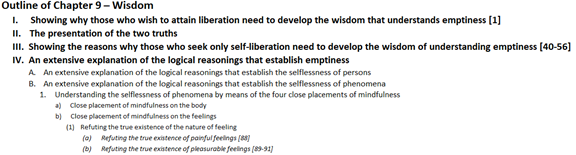
Now Shantideva gives some reasonings establishing that things are empty of true existence. First of all, he shows how persons lack true existence, then phenomena other than persons.

All of us are generally familiar with this meditation. The central point is this: if the I we normally see truly exists, we should be able to find it upon investigation.  If something exists, it should be findable. If it cannot be found, then even though it appears, we can safely conclude it is an illusion.

Geshe-la explains in How to Transform your Life that there are two types of search: a conventional search and an ultimate search. A conventional search for our car, for example, is to look in the parking lot for where our car is. We then find it and say, “there is my car.” But an ultimate search is when we are not satisfied with merely finding our car, but we seek to identify what exactly is our car. We seek to find the thing that is our car.

The car that normally appears to us is one that appears to exist independently of all other phenomena, and certainly independently of our mind. It is a discrete thing that can be identified, and we can point to it and say this is my car. We should be able to separate all the things that are not our car and be left with our car. Conventionally of course we can do this. As we go through the parking lot, we can say that’s not my car, that’s not my car, that’s not my car, but that is my car. But when we perform an ultimate search, we are looking more deeply to identify what is the car itself.

In the same way, we can look for our I. Conventionally, we can go looking for ourselves and then find here I am. But if we are not satisfied with simply conventionally identifying ourselves, but want to look more deeply to identify specifically our self, we need to engage in an ultimate search. Who am I? The I that we normally see, like our car, appears to exist from its own side independent of all other phenomena. We can recall the post from earlier in this series where we talked about identifying the object of negation. Gen Tharchin said 80% of realizing emptiness is identifying the object of negation. We need to identify clearly the self that we normally see so that when we look for it but cannot find it, it has a profound effect on our mind.

When trying to identify the self that we normally see it is important that we not overthink it. It is very easy for us to generate some abstract philosophical notion of our self and then establish that that philosophical notion does not exist. But Geshe-la explains in Mirror of Dharma that this sort of meditation on emptiness of our I is powerless to actually overcome our delusions because the self that we are negating is a fabricated, artificial notion of self, and not the self that we normally see.

What is the self that we normally see? It’s me. It is who I see in the mirror. It is who we refer to when we say I am hungry. I like to ask where am I? Am I in the kitchen? No, I am in the living room. What is the I that I normally see? It is the one that is not in the kitchen but is in the living room. Specifically, when I look at my body or think of my thoughts, I say that’s me. I believe that my I is one with my body and mind. My body and mind is me.

With this background in mind, Shantideva now starts to go look to find our I. He is engaging in an ultimate search. As we read through these verses, it is not enough for us to simply intellectually go through them in the abstract, but we should practically apply them to looking for ourselves. We should be looking for our own I using Shantideva’s words as the pointing out instructions for guiding our own ultimate search for our I.

Our Needs Are Not Our Attachments

For the longest time, I have equated “needs” with “attachments,” and rejected entirely the notion of needs. I thought one of the goals of Dharma practice was to get to the point where we have no needs. I now think this is a big mistake.

The mind of attachment thinks, “I need X external thing to be happy,” and “without X I can’t be happy.” Such thninking is obviously wrong and clearly the mind of attachment. Thinking this towards any external object just sets us up for misery as we chase after X and fall into despair without it. In truth, we don’t actually need these things, therefore it is wrong to even call them needs. Only our ignorance does so.

But this does not mean we don’t have needs. We need Lamrim realizations, for example. It is clear all the stages of the path of Sutra and Tantra are our inner needs, and there is nothing wrong with striving to attain them and thinking we can’t be happy without them. We must rely upon a happy mind alone. This is also fairly clear.

What has been a gray area for me is those external things which are conducive to my inner needs. This is where it gets a bit tricky. Obviously things like adequate food, shelter, and a healthy body are all examples of things we need. But what abour our emotional needs? For example, getting a proper night’s sleep makes a big difference for my mental well-being. Being over-extended or over-committed for long periods of time makes me cranky. Not feeling loved has been a recurring theme in my life, hardening my heart as a defense mechanism. Being appreciated has provided me with great encouragement to continue. Having a happy, functional, healthy family is conducive to the members of it having a happy, functional, and healthy mind. Atisha said avoid places that disturb your mind. The corrolary is seek out conditions that are conductive to inner peace.

The mistake I have made is basically over-applying the definition of attachment to tell myself I don’t “need” any of these things, and when my karma doesn’t provide me with these things, my response has been to harden my heart and say to myself, “this is just attachment, you need to get to the point where you need nothing.”

This is clearly an unhealthy extreme which quickly leads to burnout as we over-extend ourselves or fail to get adequate rest, or it leads to a detached Vulcan-like understanding of the Dharma that it is all about eliminating our emotions, or it leads to thinking we have to go at it alone without friends or support. If I’m honest, these are all extremes I have fallen into, and I don’t think I am alone.

I think the key distinction here is we have to accept where we are at in our heart, not where our intellectual understanding is. Sure, a Buddha might not need these things, but I am not a Buddha yet. So having adequate rest, not over-extending myself, feeling loved by those around me, feeling appreciated for my virtues as encouragement, etc., are all legitimate needs. I don’t need to say I don’t have needs, nor should my goal be to get to the point where I have no needs. I can have legitimate external needs without it being the mind of attachment. There is nothing wrong with acknowledging our genuine needs, knowing them, stating them, and even working towards fulfilling them.

Now, just because we have legitimate needs does not mean we can’t be happy if they go unmet. There will be times when we don’t get adequate rest, when we are shunned by all those around us, when nobody appreciates our efforts, etc., etc., etc. Just because we have legitimate needs does not mean they will always be met. Indeed, they will often not be met. But this does not mean we should deny we have such needs, it means we need to patiently accept our karma when they go unmet.

Thinking about this reminds me of the story of Buddha Shakyamuni in his time with the aesthetics. He tried that path and realized he was just destroying himself in the process and he needed certain things to optimize his ability to practice. We clearly don’t need to be physical aesthetics, but we also don’t need to be emotional aesthetics either. We can have emotional needs and we can pursue their fulfillment, while practicing patient acceptance when these needs go unmet. But we don’t need to deny we have those needs. It is simply where we are at.

If we look at the history of our tradition, it seems there are ample examples of where our failure to understand this has led to burnouts (too many to count!), pre-mature ordinations, repression until disrobings, misplaced self-hatred and guilt, Vulcan interpretations of Dharma, callousness instead of empathy when people are struggling, and moralistic judgments and condemnation of those who are still deluded (which, um, is all of us…).

At a personal level, it also leads to an extreme form of practice which presents a terrible example for others. Our inner understandings of Dharma become distorted, meaning they are not bringing us the inner peace we seek, causing us to eventually reject the Dharma when in truth our problem is our misunderstanding of it. It also leads to us pursuing a self-sacrificing model of Dharma and cherishing others and causes to us enable others to abuse us or others. We give terrible advice to others based upon our own misunderstandings, causing others to become miserable as well and eventually abandon the Dharma altogether. People look at all this and think, “if that’s what it means to practice Dharma, I don’t want that.” This helps nobody.

In short, perhaps, quite simply, we can say the needs of our self that we normally see are attachments, but the needs of our Buddha nature are our legitimate needs. We don’t need to abandon all needs thinking they are objects of abandonment. We can become atuned to what our legitimate needs are moment by moment and pursue them with confidence, all while practicing patient acceptance if those needs are going unmet. This seems a much more healthy way to approach our Dharma practice, more humble, more acceptable to modern society, and frankly more in line with Buddha Shakyamuni’s example.

Dorje Shugden’s Path for Me

I think I need to allow myself to rebuild a completely new relationship with the Dharma.

I have had other rounds of this earlier in my life. The first iteration was from when I found the Dharma in 1994 to about 2000, I got as far as I could relying upon my ordinary intellect for understanding the Dharma, but then I couldn’t go any further. My teacher at the time encouraged me to rebuild from scratch by relying, which eventually led to a new framework of “rely upon the Guru’s mind alone.” This lasted until about 2009 and saw me through my time as a Resident Teacher, the birth of my first three children, etc.

I then had to also completely rebuild my practice after I experienced an external sequence which wiped out entirely the external conditions supporting us remaining in Geneva and me remaining a Resident Teacher – from a major landslide at our house which cost us all our money, losing the tuition for the schooling of our kids, to the birth of my twin sons. This period lasted until essentially my 50th birthday this year and my pilgrimage to Bodh Gaya.

I now also feel I need need to completely rebuild after everything I have been through the last five months in which my family relationship structure as I previously understood it got completely obliterated. I feel like “going with the flow while relying upon Dorje Shugden, together with taking and giving for whatever is going on and creating the space in my mind to both not be OK myself and to be OK with those I love not being OK” is how I will rebuild this next phase. This is my new framework for this next phase of my Dharma life. Integrating the insights I gained in my retreat and after it into my life and simply putting into practice what I have realized is how I will rebuild. This is, I think, how I start to move back deeper into the tradition after having been a bit in the wilderness since 2009. This new phase is how I will prepare for my three-year retreat which I hope to do when I retire from my work in about 8-9 years. After my three year retreat, I hope to once again become a Resident Teacher and dedicate the remainder of my days to largely loving my family and helping the Dharma flourish.

I think it will go in waves like this, where there will be various times where I need to completely rebuild based upon new frameworks, this will take me a certain distance until I reach the limits of what that framework can support. It will then collapse on itself in some way, signaling it is time to “die and then rebuild again.” And that’s totally OK, it is just the cycle. No problem. It will still be painful, sure, but it will slowly take me where I need to go.

This is Dorje Shugden’s path for me. I made a pact with him long ago, “please take me to enlightenment as quickly as my karma will allow,” and this is what he is doing. This is Dorje Shugden’s path for me.

Modern Bodhisattva’s Way of Life: Don’t Be Afraid to Let Go of Samsara

(9.55) By all means, be afraid of something
That is the principal cause of samsaric suffering;
But, since meditation on emptiness eliminates this suffering,
Why should you be afraid of emptiness?

(9.56) If there were a truly existent I,
It would make sense to be afraid of certain things;
But, since there is no truly existent I,
Who is there to be afraid?

We all wish to free ourself permanently from suffering.  Therefore, it makes sense to identify the cause of our suffering and remove it so that it never arises again.  Once we clearly understand how ignorance is the cause of all of our suffering, we will naturally have a strong wish to eliminate it. 

Sometimes we are afraid to really throw ourselves into the Dharma.  We worry that if we truly believe the Dharma it would require such radical changes to our lives that we are not prepared to make that we wind up holding ourselves back and preventing ourselves from fully embracing the truth of Dharma. It is true that accepting the truth of Dharma does imply radical changes, but the changes we need to make are not external. Ask ash ichikawa says we need to remain natural while changing our aspiration. We do not need to abandon our jobs, our families, our enjoyments and so forth . We merely need to abandon our delusions and their root causes. We do not need to fear realizing emptiness thinking that it will cause nothing to have any meaning. Quite the opposite. When we understand emptiness we realize we can bring infinite meaning to every single thing. If meaning existed on the sides of the objects then somethings would have meaning and others would not. But if everything is empty, we can bring meaning to everything. Therefore there is absolutely nothing to fear.

Venerable Tharchin gives the analogy of somebody holding a red hot poker. If we found ourselves holding such a poker, we would immediately let it go without hesitation. We would not continue to hold onto it thinking that our happiness depended upon it. The truth is remaining in samsara and identifying with contaminated aggregates is like holding onto such a red hot poker. It is the cause of perpetual suffering. If we can simply let go of identifying with these contaminated aggregates, we do not cease to exist, we simply cease to suffer from them.   We follow our delusions because we believe we will suffer more if we don’t.  This is what needs to change.  When it does, then we will naturally want to stop following them.

On Giving People Time and Space to Process their Hurt

My mom committed suicide the day before my wedding when we were in the middle of the biggest fight of our lives. She had lost both her parents, one right after the other. Prior to her losing them, she had already purchased tickets to come visit us in France for Christmas. She debated coming, but finally decided to come hoping it might help her feel better.

But on Christmas Eve, she became upset about not sight-seeing enough, which of course wasn’t the real issue, and then she drank a whole bottle of wine and insisted on leaving. We said no, she said yes, we said no, she said yes; finally, we said “fine.” We took her to the airport and the security guard said, “go home people, don’t do this,” but my mom insisted. By the time she sobered up, she was on a plane and convinced herself that we kicked her out on Christmas Eve. Interestingly, I discovered Venerable Geshe-la a few days later when I ran into Meaningful to Behold in the bookstore. This is my origin story for finding the Dharma.

I spent the next three, four years trying to contact her and re-establish relations with her, but was met with total silence. I’m not even sure if she ever opened my letters (this was pre-internet). I then got engaged and my mother found out through the grapevine. About a month before our wedding, she contacted me wanting to come. My parents absolutely hated each other and my mother ruined my brother’s wedding because she couldn’t hold it together with my father there. I didn’t think it was a good idea for the first time I see my mother to be at my wedding when my father was going to be there, so I said no she couldn’t come. I said I would come after the honeymoon and we would work everything out. She then killed herself the day before my wedding, which was also the anniversary of her own parents’ marriage.

If I look within my mind, I don’t really have much guilt about her having committed suicide. That is not on me. But what I didn’t see until now (thanks to a dear Sangha friend helping me see it) was how this created in me an absolute hyper-aversion to my relations being bad with anybody, especially prior to any extended separations, such as when my kids head off for college or I get posted to an assignment for my work where the family can’t join me.

In practice, this takes three forms. First, when for whatever reason relations are bad with those I love, I can’t handle it. Everything must be OK and resolved now, now, now, or certainly before any big separation. So I push them to resolve their issues immediately, which is of course ridiculous and unfair. Second, I chase after people’s forgiveness. When they are mad at me, it really messes with my mind, and so I go through all sorts of contortions trying to get things back to OK, but in effect it enables abuse and dysfunction when I probably should have walked away long ago or just been OK with them being mad at or disapproving of me. Third, at a more subtle level, it helps explain in part why I have projected expectations on my family that they always think and act in enlightened ways because I see any delusions within their mind as precursors of things potentially going badly.

All three of these forms are completely counter-productive, creating the very problem I am trying to avoid – namely having bad relations with those I love, having them be mad at me, or things ending badly before a big separation. Sadly, it is this aversion to any relations being bad that has in fact made virtually all of my relations bad. I think this is the hidden echo of the impact of my mom’s suicide on my mind that I have not seen until now.

The solution here is I need to create the space in my mind for this discomfort of not having things resolved with those I love. I need to create the space in my mind to give others the time they need to process things in their own way, even if that means they need to separate themselves from me or be very angry with me. It’s not fair for me to push everyone around me to resolve everything immediately just because I can’t handle it, but that is exactly what I have been doing. Creating the space for others to process their own things in their own way in their own time, therefore, is part of my practice of compassion for them. And part of my practice of protecting my own mind from this crippling, yet stealthy aversion.

Indeed, I see now how it was unfair of me to expect my mom to not act like she did when she came to France. She just lost both of her parents and that’s hard, she needed her own time to process. Likewise, a mother being told she can’t come to her son’s wedding must be completely devastating for her, and it is unrealistic of me to expect her to have processed it all on my timeframe. Creating the space for others to process their hurt in their own time and thier own way is part of our practice of compassion, and to expect them to do so in a manner that suits us is completely misplaced.

This will probably take a long time for me to become OK with, and I will likely continue to make many mistakes on this front. But I see it now. Hopefully I will become increasingly aware of how I do this and I will gradually stop. This, paradoxically, will actually help me heal over time a lot of the current bad relations I have with those I love.

Delusions are just awful! This aversion has been functioning in hiding within my mind, undermining everything important to me. I share all of this in the hopes that others don’t make the same mistakes I have.