Modern Bodhisattva’s Way of Life: Getting our Relationship Right with the Hinayana

Preparation 1:  Overcoming the bodhisattva downfalls associated with the perfection of wisdom.

As with the other chapters, I will first explain the different bodhisattva downfalls with respect to the perfection of wisdom.  Moral discipline is the foundation of all spiritual attainments, and this is especially true for emptiness. 

Bodhisattva downfall:  Abandoning the Hinayana. 

If we regard the holy Dharma of the Hinayana as contradictory to the Mahayana and believe that it must be abandoned we incur a secondary downfall.

This downfall can take many forms.  First, it can take the form of a simple misunderstanding thinking that a Mahayanist abandons the path to liberation in pursuit of the path to enlightenment.  Very often you will hear people new to the Mahayana path mistakenly say that a Bodhisattva forsakes their own liberation and stays in samsara forever until everyone else has been freed.  While no doubt a sublimely compassionate way of thinking, ultimately this is wrong.  We can only save people if we ourselves are on secure grounds.  Likewise, in pursuit of enlightenment, we cannot help but attain liberation along the way.  So such a wish is actually impossible.

Second, we can mistakenly think abandoning our own self-cherishing means abandoning trying to free ourselves.  It can seem selfish to put great effort into our own freedom, so thinking it is selfish we don’t try do so and instead we try to serve only others.  It is true we are to serve only others, but it is because we wish to help others in the greatest possible way that we single pointedly strive to improve our own qualities, skills and abilities to forge ourselves into the most helpful instrument possible.  It is by having improved ourselves that we are freed to help even more.  It is by gaining wisdom and experience ourself that we have something useful to share with others.  It is by having worked through our own delusions that we can skilfully guide others to do the same.  A Bodhisattva seeks every good quality without shame or even the slightest trace of guilt because they know their sole purpose in doing so is to be of greater service to others.

Third, this downfall can take the form of a pride in thinking the Mahayana practitioner is somehow superior to the Hinayana practitioner.  Does a roof think it can stand alone without its walls supporting it?  Can a mountain tower above without the earth underneath it? 

Finally, this downfall can arise from an ignorance grasping at a limited and ultimately mistaken understanding of who we are.  Our ignorance thinks we are this one small being we call ourself, when in reality we are all things.  With the veil of self-grasping ignorance is lifted, the duality between self and others falls away.  All others are parts of ourself.  Our self is the collection of all others.  When we see this, the difference between renunciation and great compassion simply falls away.  Not just in the traditional sense of the mind of renunciation being part of the mind of compassion but more broadly in that the wish to free “ourself” is the same as the wish to free “all beings” because we see the two to be one and the same.

Bodhisattva downfall:  Studying the Hinayana to the detriment of our Mahayana practice. 

If instead of studying the Mahayana we put great effort into studying the Hinayana with the result that our Mahayana practice is weakened we incur a secondary downfall.

While it is true that the Hinayana is the foundation of the Mahayana, this does not mean we stop there.  When travelling a great distance, we know we will pass many places along the way to our final destination.  We do not stay to linger or remain content with what we have already accomplished, rather we push ever onward in our spiritual journey.  We view each stage of the path as a means to a greater end, a stepping stone towards a higher goal.  Just as it is possible to study Mahayana tenets with a Hinayana motivation, so too we can train in the great scope meditations with a Hinayana motivation.  This, too, would be another example of incurring this downfall. 

In some traditions it is taught that we train in one stage of the path at a time, mastering it fully before moving on to the next stage.  While this is no doubt the appropriate way to practice for people of other traditions, within the Kadampa path we train in all five of the principal causes of enlightenment simultaneously.  These five causes are renunciation, bodhichitta, the correct view of emptiness, generation stage and completion stage of Highest Yoga Tantra.  Why do we do this?  There are two main reasons.  First, each stage of the path is intimately interconnected with all of the others.  When we practice them together in the context of a systematic lamrim practice, each direct meditation on any one stage of the path indirectly reinforces all of the others, thus making the attainment of each easier.  Second, by training in all of them simultaneously we will experience their final result simultaneously.  Technically, this is not exactly true in that our experience of the higher stages can never outstrip our experience of the lower stages, but when the results come they will come in rapid succession.  We experience this quite often in our practice, where when we have a sudden breakthrough on one meditation it quickly carries forward into all of our others. 

The key test for this downfall is whether our practice of the lower stages is coming “at the detriment of” the higher trainings.  For example, some people become quite attached to their lamrim trainings and fearful of their Tantric practices, and as a result they never start their higher trainings.  In reality, Tantra is simply a more advanced and rapid way of training in the lamrim.  It is because we wish to deepen our lamrim practice that we take up the Vajrayana path.

A Pure Life: Abandoning Meaningless Activities

This is the last part of a 12-part series on how to skillfully train in the Eight Mahayana Precepts.  The 15th of every month is Precepts Day, when Kadampa practitioners around the world typically take and observe the Precepts.

The actual precept here is to abandon wearing ornaments, perfume, etc, and singing and dancing and so forth. Like with the precept about not eating after lunch, the purpose of this practice is not to say wearing ornaments, perfume and so forth are inherently negative, rather it is an opportunity for us to recall all of the negative karma we have accumulated with respect to pursuit of these things and to view our training in the precept as a practice of purification for that negative karma.  More broadly, this precept is advising us to abandon all meaningless activities.

What sort of negative karma have we created with respect to wearing ornaments? This refers more broadly to the negative karma we have created in the pursuit of wealth. Attachment to wealth and resources is one of the eight worldly concerns. Beings in samsara create all sorts of negative karma in pursuit of wealth. For example, the vast majority of wars are directly or indirectly related to the pursuit of resources. In business, people lie and cheat all the time in an effort to get more wealth from others. Criminals lie and steal trying to get wealth. Wealthy people who are jealous of other wealthy people engage in all sorts of divisive and hurtful speech towards those they are jealous of.  The demigod realm and the hungry ghost realm are both pervaded by negative actions engaged in in pursuit of wealth.  We ourselves have created all of this negative karma and it still remains on our mind unpurified.

We have also engaged in all sorts of negative actions with respect to wearing perfume.  This can be interpreted more broadly as negative actions we have engaged in with respect to pursuit of our sexual attachment. People wear perfume to make themselves more attractive to others, which is quite frequently motivated by an underlying sexual attachment. Sexual attachment is one of the primary causes of negative actions. Once again, people lie, cheat, steal, say hurtful things, or divisive things, they covet other people’s partners, etc, etc, etc. Look at how many spiritual or political leaders have lost everything due to some sort of sex scandal. We see similar behavior in the animal realm and the demigod realms. Once again, all of this negative karma remains on our mind because we have not purified it.

Singing and dancing in this context refers more broadly to engaging in meaningless activities. This is not to say that singing and dancing per se are meaningless or negative activities.  An activity becomes meaningless if we engage in it with a meaningless mind. If we engage in singing and dancing with a virtuous motivation, then such actions are virtuous; but if we engage in them out of attachment, then such actions and activities are meaningless. What is wrong with engaging in meaningless activities? Fundamentally, doing so creates the habits of failing to seize and appreciate our precious human life. It is like idle chatter amongst the 10 non virtuous actions. Idle chatter is not a terribly non virtuous action, but if engage in it repeatedly, it can become a habit and then we wind up wasting our precious human life. We would all find it to be an incredible waste to use $100 bills to build a bonfire. Using the moments of our precious human life in a meaningless way is even more wasteful, and for this reason, it is non-virtuous.

When we take the precepts, we are in essence making the promise to abandon all negative actions associated with the pursuit of wealth, sexual attachment, or meaningless activities. When the temptation arises in our mind to do these things, we can recall all of the negative karma we have created with respect to these activities, and use our training in the precept as our opponent forced to purify this negative karma. We then promise to no longer engage in such activities in the future. In this way, we can purify the negative karma we have created with respect to these activities.

In short, the training in the eight Mahayana precepts is not simply a promise to refrain from engaging in these eight specific sorts of activities, but rather it is a more general promise to refrain from any form of negative action. By learning how to spend an entire day without engaging in any negative actions, we can counter the deluded tendencies on our mind that want to engage in negative karma and thereby weaken them so they have less hold over us in the future. We likewise create tendencies similar to the cause of believing in the wisdom of living a pure life. This karma will gradually build up momentum within our mind until eventually we refrain from non-virtuous actions and engage in virtuous actions not simply one day of the month, but every day of the month, every month of the year, every year of our life.

To avoid lower rebirth, we must purify all the negative karma that remains on our mind and engage only in virtuous actions in the future. If we do this, it is karmically guaranteed we will avoid a lower rebirth. This is important not simply because lower rebirth is so horrific, but rather we do not want to take the risk of losing the continuum of our spiritual practice.  If we fall into the lower realms, it will be almost impossible for us to engage in the spiritual path and we can quickly become lost for countless eons. But if we can maintain the continuum of our precious human life, in life after life, there is great hope that we will soon escape from samsara. Our training in the eight Mahayana precepts, therefore, as an indispensable friend ensuring that we remain on an uninterrupted path out of samsara.

I dedicate all of the merit that I have accumulated by writing this series of posts so that all living beings may become determined to purify all of their negative karma and engage only in virtuous actions. May they realize that non-virtue is the cause of suffering and virtue is the cause of happiness, and therefore realize if they wish to be happy they must embark upon a pure life.

Happy Tsog Day: How to Prepare for our Future Lives

In order to remember and mark our tsog days, holy days on the Kadampa calendar, I am sharing my understanding of the practice of Offering to the Spiritual Guide with tsog.  This is part 43 of a 44-part series.

The way to practise the ritual of the transference of consciousness if, having meditated, we have received no signs

If by the time of my death I have not completed the path,
I seek your blessings to go to the Pure Land
Through the instruction on correctly applying the five forces,
The supremely powerful method of transference to Buddhahood.

While it is possible to attain full enlightenment in this lifetime through the teachings of the Ganden Oral Lineage, it is not guaranteed that we will do so. Remaining anywhere in samsara is extremely dangerous because we can easily become distracted and lose the path. If we attain rebirth in the pure land, then we can complete our spiritual training there and never risk another samsaric rebirth. From a practical point of view, it will be as if we have attained liberation, even if technically we have not yet done so. The pure land is like a tantric bodhisattva’s training ground. We were able to receive teachings directly from the Buddhas and everyone in the pure land is likewise a tantric practitioner engaging in the stages of the path. Once we attain that pure land, we are able to send emanations into the realms of samsara to help the beings still trapped there, but we ourselves always remain in the pure land. The meditations on the three bringings and the nine mixings create the karma to be able to purify the death process and take a controlled rebirth in the pure land. Each time we engage in these practices, we gradually carve a path in our mind to the pure land. It is as if we are tunneling through death to the pure land.

In order for us to take rebirth in the pure land, however, we need to be able to die with a pure mind. The quality of mind we have at the time of death determines the type of rebirth we will take. If we die with a negative mind, we will take rebirth in the lower realms; if we die with a positive mind, we will take rebirth in the upper realms of samsara; and if we die with a pure mind, we can attain rebirth outside of samsara – either in a pure land, Nirvana, or full enlightenment. A powerful method for ensuring that we die with the pure mind is to engage in the practice of powa. Powa is a special tantric technology for transferring our consciousness to the pure land at the time of our death. We can train in this before our death to create ample karma that can be blessed at the time of death, and we can train it at the time of our death itself. Through the practice of Offering to the Spiritual Guide, we can engage in powa for ourselves, powa for the sake of others, or simply create the karma we will need at the time of death. How to do so is explained in Great Treasury of Merit. A more detailed explanation of powa practice can be found in the book Living Meaningfully, Dying Joyfully.

How to offer prayers to be cared for by our spiritual guide in all future lives

In short, O Protector, I seek your blessings so that throughout all my lives
I shall never be separated from you, but always come under your care;
And as the foremost of your disciples,
Maintain all the secrets of your body, speech, and mind.

O Protector, wherever you manifest as a Buddha,
May I be the very first in your retinue;
And may everything be auspicious for me to accomplish without effort
All temporary and ultimate needs and wishes.

Ensuring that we attain enlightenment is simply an issue of guaranteeing that we continue to meet our spiritual guide in all our future lives without interruption and that we continue to have faith in him. We do not know how long it will take us to attain alignment, but if these two conditions are met, it is guaranteed we will eventually reach our final goal. Thus, in many ways the most important spiritual attainment is to ensure we continue to meet our spiritual guide in all our future lives.

I once asked Geshe-la to please provide me with a guaranteed method for being able to meet him in all my future lives without interruption. He replied, “concentrate on practicing Dharma and always keep faith.” When we practice Dharma, we create a karmic connection between our self and the spiritual guide who gave us the instructions. This creates the cause for us to once again find the source of those instructions in our future lives. By maintaining faith in this life, we create the tendencies similar to the cause in our mind to once again have faith in him when we find him again in our future lives. Through the karma we create by concentrating on practicing Dharma and always keeping faith, and through making heartfelt prayers and requests to always meet our spiritual guide in all our future lives, it is guaranteed that we will meet him and eventually attain all our spiritual goals.

This verse begins with “in short,” which indicates that everything that we have learned and practiced up until now is all synthesized down into this very last practice of requesting that we meet our spiritual guide and that he cares for us in all our future lives. This is the true conclusion and essence of the practice of Offering the Spiritual Guide.

Modern Bodhisattva’s Way of Life: Studying Emptiness Should be Practical

This chapter has been praised as the best explanation of emptiness ever written.  Since realizing emptiness is the only way to bring samsara to an end and achieve liberation, it is worth applying sincere effort to try to understand this chapter.

Studying emptiness is not a philosophical question – establishing that things are empty.  Rather, it should be approached as a practical issue.  How does the fact that things are empty change the way I act?  The main point is because things are empty, everything is created by the mind.  If we want to change anything, we need to change our mind.  The way to change anything is to change our mind.  To change something other than our mind ultimately will change nothing, because the mind will just reproject the problem in a different way.

Shantideva’s preparation for studying this chapter is very special in that exchanging self with others dramatically decreases our self-cherishing which props up our self-grasping ignorance.  Because it is weakened through exchanging self with others, now it can be eliminated with the wisdom realizing emptiness.

Sharing my understanding of this chapter will likely be the hardest thing I have attempted to do on this blog.  I apologize in advance for any mistakes I might make.  For a definitive commentary, we have Geshe-la’s explanation in Meaningful to Behold.  So why bother writing this at all?  Because Shantideva explains at the beginning of his text that he wrote his commentary to Guide to the Bodhisattva’s Way of Life as a method for familiarizing his own mind with the teachings that he had received. By going through this chapter and trying to flesh out what it means to me, I hope to also increase my own familiarity with emptiness and Shantideva’s presentation of it. For the reader, we do not always have Meaningful to Behold with us. Hopefully through reading these posts you too can spend some time each week thinking about the meaning of Shantideva’s explanation. If there are things that I get wrong in my explanation, I invite everyone to please clarify any understandings that they have. In this way we can all learn from one another.

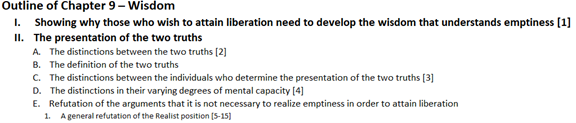
Just as when we engage in painting a room, we first have to engage in certain preparations such as covering the floor, taping the doorways, and getting enough paint; in the same way, to fully appreciate Shantideva’s presentation of emptiness we first have to prepare our mind to be able to receive his teachings. All of the explanations of the previous eight chapters are the primary or distant preparations. But what follows over the next several posts are the close preparations. First, I will spend several weeks discussing the bodhisattva the downfalls associated with the perfection of wisdom. Second, we will start with the end in mind, namely what is the final view of emptiness that we are after. Third, we will examine in detail different explanations identifying the object of negation of emptiness. Fourth, I’ll explain some key analogies that we use for realizing emptiness. Sixth, I will say a few words about how to relate to the philosophical debates about emptiness in Shantideva’s presentation. And seventh, gaining a big picture overview of the chapter by looking at its outline.  I believe these seven close preparations will all help lay the groundwork for enabling us to more easily understand and appreciate Shantideva’s explanations and not get lost in the very detailed debates and outline of his argument. By taking the time to prepare properly, we will be able to understand much more easily all that follows.

Happy Tara Day: May there be the auspiciousness of her presence

This is the final installment of the 12-part series sharing my understanding of the practice Liberation from Sorrow.

Dedication

By this virtue may I quickly
Become Arya Tara,
And then lead every living being
Without exception to that ground.

The dedication of any sadhana indicates the practice’s main function.  By engaging in the practice, we create the karmic causes for the ends we dedicate towards in the dedication.  Then, when doing the dedication, we “seal” the karma we have created through doing the practice so that it continues to work without interruption until the dedication is realized.  For me, the best analogy is dedication is like putting our savings into a retirement account, where it will continue to accumulate interest until eventually we have reached our retirement goals.  Geshe Chekhawa says there are two activities:  one at the beginning and one at the end.  In the beginning, we establish our motivation for engaging in the practice; and in the end, we dedicate our merit towards the accomplishment of our desired spiritual goals.  As Mahayanists, our motivation and our dedication are the same – we wish to become a Buddha for the sake of all living beings and then we dedicate at the end towards the same end.  Thus it is important that we recall our bodhichitta motivation for having engaged in the practice, and now we solidify it by dedicating our merits towards the same goal.

Sometimes it is easy to get lazy and distracted with our dedications, but this is a big mistake.  By the end of our practice, we are tired and we are also anticipating everything that we will have to do once our practice is over.  Our mind is already positioning itself for what comes after.  Shantideva explains that anger can quickly destroy all undedicated merit, but dedication functions to protect our merit from subsequent anger.  Given how easily we get angry, it is safe to say that any merit we have not dedicated has already been destroyed by our past anger.  In other words, the only merit we have left on our mind is that which we have dedicated.  Whenever good karma ripens, we should recall that the only reason why we are able to enjoy our present good circumstance is due to our past practice of dedication.

Here, we dedicate to become Arya Tara and to lead all living beings to the same ground.  We are Kadampas, so it is only natural for us to wish to become a Lamrim Buddha just like Tara.  Her special power is to bestow Lamrim realizations and her uncommon mission is to care for all Atisha’s future disciples.  We wish to do the same. 

Through the virtues I have collected
By worshipping the Blessed Mother,
May every living being without exception
Be born in the Pure Land of Bliss.

Here, we specifically recall that she is our blessed spiritual mother, who cares for and nurtures our spiritual life to maturity.  When we recite this dedication, we should mentally generate the wish that she be our spiritual mother in all of our future lives until we attain enlightenment.  Geshe-la once said that the mind of Lamrim is Akanishta Pure Land.  In other words, if we transform our mind into Lamrim, the world which will naturally appear is Akanishta Pure Land.  When we help others develop Lamrim minds, we are in fact bringing them into our Pure Land.  We do not have to wait until others die for them to be reborn in the Pure Land of Bliss, they can do so now through generating Lamrim minds.

Auspicious verse

You, who having abandoned all bodily faults, possess the signs and indications,
Who having abandoned all verbal faults, possess a heavenly voice,
Who having abandoned all mental faults, realize all objects of knowledge;
O Lady of blessed, glorious renown, may there be the auspiciousness of your presence.

This verse reveals how we should rely upon Tara in the meditation break.  We generate faith by considering the good qualities of a Buddha, but sometimes we forget to connect that to our own life.  In this verse, we bridge the gap by praying that we always be in the living presence of Tara and experience firsthand her good qualities.  A Buddha’s body is not just their form, such as a Green Deity with an outstretched leg; rather, their body pervades the entire universe and we can correctly view all things as her emanations.  With the first line, we pray that we “see” her in every form we encounter, and that we understand what we see as the signs and indications of her presence in our life.  To strengthen this experience, during the meditation break, we should take the time to view everything that appears to us as her bodily emanations in our life.  In particular, we can view the food we eat, the home we live in, the clothes we wear, etc., all as provided by our spiritual mother caring for us.

With the second line, we pray that every sound we hear – even the rustling of the leaves in the wind – is recognized by us as her heavenly voice teaching us the Kadam Lamrim.  During the meditation break, we hear countless sounds, but whether those sounds teach us Lamrim depends upon our familiarity with the Lamrim teachings and the blessings we receive from the Buddhas.  By practicing pure view recognizing every sound as Tara’s heavenly voice, she will enter into every sound and our mind will be blessed to hear everything as Lamrim teachings.  Then, day and night, it will be as if we are in her holy temple at her lotus feet.

With the third line, we pray that every thought that arise in our mind arise from her omniscient wisdom.  Thoughts arise in our mind like bubbles from the bottom of the sea, but the majority of them are contaminated, deluded views.  If we can unite our mind with Tara’s, then every thought we have will be a manifestation of her omniscient wisdom arising in our mind.  Venerable Tharchin says a blessing is like a subtle infusion of a Buddha’s mind into our own.  When we feel the presence of Arya Tara’s mind within our own, then we will receive a steady stream of her blessings.  Throughout the meditation break, we should recall Tara has mixed inseparably with our root mind at our heart, and view every thought that arises as her quick wisdom.  By maintaining this view, she will enter every thought we have and bless us to have a Lamrim perspective with respect to every appearance.  In this way, everything that arises, both externally and internally, are all viewed as Tara.  In short, our practice during the meditation break is to always remember we are in her presence in these three ways.

Dedication:  I dedicate all of the merit I have accumulated through sharing my understanding of Tara practice so that in all our future lives she remains our spiritual mother, who gives birth to us as Kadampas and nurtures us to spiritual maturity on the Kadampa path.  Through her blessings, may our every experience give rise to Lamrim minds, and may we always feel ourselves to be in her holy presence.  May every person who reads this series of posts make the firm determination to engage in the Liberation from Sorrow practice the 8th of every month for the rest of their lives, and may Tara appear to them at the time of their death and lead them to her Pure Land. 

Dream where Geshe-la blessed me and made two predictions

I occasionally have Dharma dreams, but very rarely ones with Geshe-la. I had one last night. I’m writing it down so I do not forget it and sharing it in case others might benefit from it.

It started and I was at a festival with some people from other countries I had just met. Somehow we were told or decided through some strange circumstances to go for a drive. So we went driving, I was in the back seat, and we were just talking about nonsense in a worldly way. We then come out on this country road with nobody around and Geshe-la was standing in the middle of the road like he was waiting for us. I had the feeling in the dream that we had been set up to go for the drive so that we could meet Geshe-la, even though there was no way we could have known he would be on the road.

We stopped the car and he came to the back window where I was sitting. He started greeting us and I noticed he was wearing a very warm ski mask that covered his whole face, except his nose and mouth, and I recalled how he often liked to stay warm, but went into cold climates for us. I then noticed that despite his eyes being covered by the sky mask, he was nonetheless able to see and talk with us perfectly, as if he could see everything. (I didn’t understand this at the time, but I understand this to mean despite from an ordinary perspective we mostly related to his speech, in reality he was omniscient able to see everything).

He then stuck his head in the car through the window where I was sitting to greet each person in the car individually. Each person gave him their name and he nodded as if meeting us for the first time. When it came to be my turn, I told him I was Ryan and thought he should know me, but he didn’t seem to know me which reminded me of the first time I had a close encounter with him at the Creperie at Manjushri, so I then started to describe myself in detail, but realized that was being needy of wanting his recognition, so I just said I used to be a Resident Teacher. He then just took that in stride without any additional recognition of me, and I accepted it didn’t matter if he recognized me.

And then the person sitting next to me started going off about how many people I help. This got Geshe-la’s laser like focus on me, and then he put his left hand squarely on my heart and his right hand on my shoulder and started to pray and bestow blessings into my heart while holding me. I felt like I was receiving a huge empowerment for the future to be able to help more people, and I remember remarking how incredibly physically strong he was despite the fact that I knew him to be seemingly very old and frail, knowing he was going to die soon.

He then somehow appeared to be in the front passenger’s seat in the car, directly in front of me since I was in the backseat (American style car with left-side drive). He then started talking and he gave me two predictions about the near future. First, he said I will soon be tested to see how I respond to some situation about the killing of something like animals, but he couldn’t come up with the word to describe it, and so I suggested the word “hunting?”, and he indicated kindof yes, that could work, but it wasn’t quite the right word. I mentally thought it interesting that his world is so pure he doesn’t even have the word for such things. He then said I will be tested to see if I allow the G20 (something that will preoccupy a good deal of my time at work over the next year) will become a weak excuse for why I am neglecting my spiritual life. I then thought that I needed to mention this to one of my work colleagues at USAID who I work closely with on G20 issues who I also understood in the dream to be a former Resident Teacher now working (she is not, but in the dream she was).

I then woke up and debated with myself whether to get up to write down the dream. I thought if I did so, I would wake up for the day and then be really tired (I have been very and easily fatigued ever since I got COVID about a month ago). So I said I would just try remember the dream and went back to sleep. I then had a second dream where I ran into my work colleague at USAID and I was all excited thinking, “oh, I’ve got to tell you about the dream I just had!” I started recounting the story, and I began by saying Geshe-la had told me to go to sleep, and then in the dream I found myself in the car and we ran into Geshe-la on the road – it was a dream in the dream like I had recently had and wrote a blog post about. I then realized that was not true, my original dream was not a dream within a dream and so I had just lied to make the story sound more impressive than it really was, but then I thought “oh well, I shouldn’t lie, but it doesn’t really matter in this context, so just be more careful in the future to not do that.”

I then started telling my colleague about the dream and mentioning to her the part where Geshe-la was mumbling trying to find the right word for the killing of animals, and she misunderstood the meaning of this and revealed she had a somewhat critical attitude towards Geshe-la because of the way he spoke unclearly and this was one of the reasons why she eventually stopped being a Resident Teacher. I then remember thinking I need to be careful, considerate, and compassionate about how I talk to people who are no longer actively engaged with the tradition, to not assume they have no problem with things, but understand they may have some mental obstacles which prevent them from having a happy mind towards the tradition which need to be skillfully worked through and addressed. I then woke up.

After I woke up, I then started wondering what he meant by the killing of animals, and it came to me that it would be more about what I think about what will happen with the war in Ukraine.

In writing all of this, several themes stand out for me. First, how I still have residuals of excessive concern for recognition by Geshe-la and my spiritual teachers, but I have made a lot of progress since the Creperie about 20 years ago. Second, I struggle to tell stories or talk about myself without my self-importance creeping in, like I am habitually bragging, but don’t want to. Third, Geshe-la doesn’t care about our position, but what gets his attention is our helping people. Fourth, we shouldn’t grasp at how he conventionally appeared, but realize how strong and all-seeing he was. Fifth, I still have tendencies for minor negativities, which is not good, but not something I should overly dramatize or beat myself up over – just acknowledge, course correct, and move on. Sixth, I have been a supporter of Western support for Ukraine for geopolitical and protection of others reasons, but fundamentally it is still like animals killing each other, and perhaps the test will be what I think about some sort of peace proposal that will come in the future – do I support that proposal or support the continuation of the killing. Seventh, I need to be clear where my priorities lie between work and my spiritual life, and not allow the former to become a weak excuse to neglect the latter. Eighth, I will not look at my work colleague the same, perhaps she was formerly some sort of spiritual person who somehow lost her way, and perhaps I need to be skillful in helping gradually guide her back. Ninth, there are all sorts of people who used to have a positive mind towards the tradition, but then had some negative experience or misunderstanding which caused them to leave. Instead of judging these people, we need to be considerate and compassionate with their mental obstacles, accepting them where they are at.

Modern Bodhisattva’s Way of Life: Why do we obsess over our body?

(8.178) My body is a frightening, impure form
That cannot move without depending upon mind
And that eventually will completely disintegrate;
So why do I grasp at it as “I”?

(8.179) Whether it lives or dies,
What use is it to me to grasp at this machine?
It is no different from grasping at a clod of earth;
So why do I not give up the pride of grasping “my body”?

Our body is no more than a guest house.  Eventually it will be no different from the earth itself.  Why should we identify with something we know we will be separated from?  Surely our true self would be something that goes on, no?  How is our body any different than our clothes?  We don’t identify with them, do we?

(8.180) As a result of attending to the body’s desires,
I have experienced much suffering without real meaning.
What is the point of generating anger or attachment
For the sake of something that is like a piece of wood?

(8.181) Whether I care for it in the way that I do,
Or allow it to be harmed by others,
The body itself develops neither attachment nor anger;
So why do I feel so attached to it?

(8.182) Since the body itself does not know
Anger when it is insulted
Or attachment when it is praised,
Why do I go to so much trouble for its sake?

How much of our attachment and our anger arise from thinking “I” with respect to this body, and showing so much concern for it? how much attachment how much anger and how much suffering as a result of our attachment and anger, just for the sake of this body?

(8.183) “But I want to cherish this body
Because it is very beneficial to me.”
Then why not cherish all living beings,
For they are very beneficial to us?

(8.184) Therefore, without any attachment,
I will give up my body for the benefit of all;
But, although it might have many faults,
I will look after it while I am working for others.

We need to give our body then into the service of other living beings.  We need to use it for their sake, not for our own enjoyment.  At present we’re very much anchored in this body, so we must stop now identifying with this body.  We must stop considering it to be mine.  We must consider it to be others’, we must consider it to belong to others, and in this way bring our self-centeredness to an end.

(8.185) I will put a stop to all childish behaviour
And follow in the steps of the wise Bodhisattvas.
Recalling the instructions on conscientiousness,
I will turn away from sleep, mental dullness, and the like.

(8.186) Just like the compassionate Sons and Daughters of the Conqueror Buddha,
I will patiently apply myself to whatever needs to be done.
If I do not apply constant effort throughout the day and the night,
When will my misery ever come to an end?

Here Shantideva’s saying it is time to grow up, isn’t he?  We need to put a stop to all childish behavior.  We have discussed before we’ve got to grow up, we’ve got to move on. We must be conscientious now, apply great effort, and become like the actual Bodhisattvas others need us to be, become the actual Bodhisattvas our spiritual guide is trying to create.

Finally:

(8.187) Therefore, to dispel both obstructions,
I will withdraw my mind from all distracting conceptions
And place it in constant meditative equipoise
On the perfect object of meditation, the correct view of emptiness.

The main point of this chapter is we need to withdraw into our mind, but not be self-centered.  To be able to mix our mind with emptiness, we need to be withdrawn and centered within our mind. It is our attachment and delusions, such as self-cherishing, which draw us out.  We need to be centered, but not self-centered.  Letting go of attachment to wanting things for the self of our self-cherishing is how we do this.  We can do this on the side of letting go of the object of our self-cherishing or at least moving onto the side of letting go of the self-cherishing.

The only way to identify with other’s body as our own is if we understand it is a projection of our mind, we are looking at the fabric of our mind.  It is us.  So the more we go inward, the more we discover others are ourselves.  Then we can be centered, but not self-centered.  It seems like a contradiction to withdraw into our mind, yet at the same time go out to others to cherish them.  But this is only because we grasp at others being outside, when in reality they are part of our inside.  They are most of our inside, actually.  Our ordinary self is only a small part.  Our self-cherishing mind just spends all of its time obsessing about this one small part.

We also need to practice the moral discipline of restraint.  Things will try to pull us out of being centered within our mind in our heart.  We need to realize there is nothing worth going out to because actually there is nothing out there at all.  This is difficult to do unless we become disciplined with our bodily, verbal, and mentally activity.  When we are withdrawn in our mind, we are happy.  When we get drawn out, we become unhappy.  We can experience this directly, and then we know.  When we can withdraw ourselves into our mind and never be drawn out by things, then we will experience our lives as if we are on retreat right now.  Our whole life will become a big retreat.  I once heard a story about a senior teacher having a meeting with Geshe-la.  He hadn’t seen him for several days.  He remarked on how well Geshe-la looked, and he looked at the teacher and said “that’s because I’m always inside.”

This concludes the eighth chapter of Guide to the Bodhisattva’s Way of Life, entitled “Relying upon Mental Stabilization”.

Happy Protector Day: All the Attainments I Desire Arise From Merely Remembering You

The 29th of every month is Protector Day.  This is part 11 of a 12-part series aimed at helping us remember our Dharma Protector Dorje Shugden and increase our faith in him on these special days.

In the last post I explained most of the things we request Dorje Shugden to do.  In this post I will explain the summary requests from the sadhana.

Please remain in this place always, surrounded by most excellent enjoyments.
As my guest, partake continuously of tormas and offerings;
And since you are entrusted with the protection of human wealth and enjoyments,
Never waver as my guardian throughout the day and the night.

All the attainments I desire
Arise from merely remembering you.
O Wishfulfilling Jewel, Protector of the Dharma,
Please accomplish all my wishes.   (3x)

This verse is the synthesis of the entire Dorje Shugden practice.  Everything is contained within this verse.  We can understand this verse as follows:  The first line refers to our pure wishes, not our mundane wishes.  The second line refers to wherever we imagine a Buddha, a Buddha actually goes, and where ever they go, they accomplish their function.  If we remember Dorje Shugden, he will infuse himself into the situation and transform it into something we see as perfect for our practice.  The third and fourth lines explain how Dorje Shugden can become a wishfulfilling jewel.  Since he accomplishes all our spiritual wishes, if we make all of our wishes spiritual ones, he will accomplish all our wishes.

Whenever we are in a difficult situation, we can recite this verse like a mantra requesting him to provide us immediate protection.  Then we should strongly believe that he has infused himself into the situation and everything is now perfect.  We may wonder why is it that all the attainments we desire arise from merely remembering Dorje Shugden.  The reason for this is Dorje Shugden is a wisdom Buddha, which means he primarily helps us by blessing our mind to be able to see how the conditions we have are perfect for our practice.  When we remember him, we recall that everything is emanated by him and thus perfect.  Just believing this to be the case with faith opens our mind to receiving his powerful blessings.  Sometimes we understand immediately how the situation is perfect for our spiritual training, other times it is not so clear.  But even when it is not clear why the conditions are perfect, our remembering him gives us the faith that things are perfect, so we can more easily accept them.  Understanding exactly why things are perfect for our practice is obviously best, but sometimes simply understanding that things are perfect is good enough to set our mind at peace.

If we do not have time to engage in the whole Dorje Shugden sadhana, we can just recite this verse three times and this will maintain our commitments.  One verse said out of deep faith and a pure motivation is far more powerful than hundreds of hours of sadhana practice with a distracted, unfaithful mind.  If we offer our life completely into his care, it does not matter how much recitation we do.  But with that being said, reciting the full sadhana is obviously more effective than just reciting this last verse assuming our faith and motivation are equal in both situations.

After reciting the “all the attainments I desire…” verse, it is customary to pause and make personal requests for ourself and the people we care about.  The following are some example requests we can make.  General requests can include, “May I gain all the realizations necessary to lead all those I love to enlightenment.” This is the essence of our bodhchitta wish.  We can also make the request, “Please arrange all the outer, inner and secret conditions so that all those I love may enter, progress along and complete the path to enlightenment in this lifetime.”  This request fulfills our superior intention to lead all beings along the path to enlightenment.

Some specific requests we can make are:  When we do not know what is best, we can request “Please arrange whatever is best with respect to _____.”  When we think something is best, but we have some attachment to getting it our way, we can make the request, “With respect to ____, if it is best, please arrange it; otherwise, please sabotage it.”  When we have some situation that needs transforming, we can request, “May my/his experience of _____ become a powerful cause of my/his enlightenment.”  Finally, we can request anything that has a pure motivation, but we shouldn’t become attached to getting things the way we think is best.  We do not know what is best, which is why we need an omniscient Dharma protector managing these things for us.

After we have made our requests, we can maintain three special recognitions.  We can hold these recognitions in the meditation session and the meditation break, and indeed for the rest of our life.  First, we can think, from now until we attain enlightenment, and especially in this lifetime, everything that appears to us physically is emanated by Dorje Shugden for our practice.  Certain appearances will be for us to overcome certain delusions.  Certain appearances will be for us to generate virtuous minds.  But we can be certain that from this point forward, there is not a single physical appearance that has not been emanated by him for us, so we can correctly see everything as an emanation of him for our practice.

Second, from now until we attain enlightenment, and especially in this lifetime, everything that we hear is emanated by Dorje Shugden to teach us the Dharma.  Obviously, this includes all the Dharma teachings we receive.  But it also includes conversations we overhear, songs we hear, even the wind blowing through the leaves.  But we can be certain that from this point forward, there is not a single sound that has not been emanated by him to teach us the Dharma.  We can correctly imagine that all sounds are mounted upon his mantra, and that when we hear the sounds they teach us the Dharma.

Third, from now until we attain enlightenment, and especially in this lifetime, everything that arises within our mind will be emanated by Dorje Shugden to provide us an opportunity to train our mind.  Obviously, this includes every time we generate virtuous minds with our Dharma practice.  He will also help us generate the virtuous minds of the stages of the path.  This additionally includes all the delusions that arise within our mind.  For example, if strong anger arises, we can believe it is emanated by him so that we can practice patience.  If strong jealousy arises, we can think it is emanated by him so we can practice rejoicing, etc.  This also applies to what others think, for example what they think about us, etc.  We can view everything that others are appearing to think to be emanated by Dorje Shugden for our practice.  We can be certain that from this point forward, there is not a single thought that will arise within our mind or the mind of others that has not been emanated by him to provide us an opportunity to train our mind, so we can fully accept everything that happens as perfect for our practice. 

In the next post I will explain how we can increase the power of our practice of Dorje Shugden.

Modern Bodhisattva’s Way of Life: Don’t try go at it alone

We also should not try go it alone.  We need to enlist the help of the Buddha and Sangha jewels to help us put the Dharma jewel of cherishing others into practice.  We need blessings and support.  We cannot do it alone.  We need to choose to come under their influence instead of trying to have our Samsara and Dharma too.  Sometimes our self-cherishing is so strong that we do not even want to turn to Buddha and Sangha because we know they would encourage us to not do what our self-cherishing wants.  I always keep a picture of Geshe-la and Dorje Shugden on my desk.  When I feel tempted to do something wrong, I try look at them and ask, “would I do this in front of them?”  In fact, that is what I am doing.  But sometimes, my delusions are so strong, I intentionally do not look at them because I know if I did, I wouldn’t be able to do what my self-cherishing wants to do.  Ridiculous!  I start to view them as the problem because if they were not around, I could pursue my delusions with abandon.  When we have such thoughts, we need to ask ourselves the question, “if I follow this thought, where will it lead me?”  Sometimes we need to stare into the abyss before we decide to step back.

(8.171) If, out of non-conscientiousness,
I were not to give you to others,
You would certainly deliver me
To the guardians of hell!

(8.172) You have done this to me often enough in the past
And, as a result, I have suffered for a very long time;
But now that I have brought to mind all my grudges towards you,
I am determined to destroy you, selfish mind.

(8.173) Thus, if I want happiness,
I should not be happy with the self-cherishing mind;
And if I want protection,
I should always protect others.

We need to realize a very clear relationship:  the more we try to make this self happy, the more unhappy we become as our wishes go unfulfilled.  If our only wish is to work for the happiness of others, then we can be happy all the time regardless of what happens because we can always do what we want.  Karmically, the more we work for and protect ourself, the more we actually make our situation difficult because we are depriving our future selves of help and protection.  If we want freedom, happiness and protection, then we need to give these things to others.  It is that simple.  Our attachment to harvesting results instead of planting seeds is what prevents us from doing this.

(8.174) To whatever extent I seek
To fulfil the desires of the body,
To that extent I shall experience
A state of dissatisfaction.

(8.175) The desires of the self-cherishing mind
Cannot be satisfied
Even by all the wealth in the world –
So how can we hope to fulfil all its wishes?

(8.176) When our desires are not fulfilled,
We develop delusions and a dissatisfied mind;
But whoever becomes free from such distracting concerns
Will never know dissatisfaction.

(8.177) Therefore, I will never allow
The desires of the body to increase.
A person who has no attachment to attractive objects
Will find contentment – the best of all possessions.

One of our greatest problems, one of the greatest obstacles to removing self-cherishing is our attachment to our body and to our bodily feelings.  As much as we say we do not like our body, we do.  The fact is that we do have attachment to it.  One of my former students once told me, “most people live their life by the pleasure principle, seeking to do what brings them the most pleasure.  Not me man, I head towards what hurts because that is how we grow.” Our body is one of our biggest objects of pleasure.  Think about how much people do in this world to bring about pleasurable feelings within this body – attractive forms, sounds, smells, tastes and so forth.

But Shantideva is indicating that there is no satisfaction to be had in the body, ever.  We are not quite convinced of that one, are we?  We seek satisfaction, don’t we?  The fact that we seek satisfaction indicates that we are desirous, doesn’t it?  The fact that we are seeking means that we are desirous, which itself is a suffering and indicates that we have not yet found satisfaction.  Even when we do fulfil certain desires, others manifest themselves because the desirous mind remains – it just reasserts itself towards another object, so we remain forever dissatisfied.

If we reduce our desires, we will reduce our dissatisfaction because there will be less desires unfulfilled.  When we have eliminated all our external desires, we will experience pure contentment.  Someone who is content is truly wealthy because they lack nothing.  We will become the richest person on earth as far as our experience is concerned.  A person who has no attachment to attractive objects will find contentment, the best of all possessions.

Happy Tsog Day: How to Practise Completion Stage

In order to remember and mark our tsog days, holy days on the Kadampa calendar, I am sharing my understanding of the practice of Offering to the Spiritual Guide with tsog.  This is part 42 of a 44-part series.

I seek your blessings, O Protector, that you may place your feet
On the centre of the eight-petalled lotus at my heart,
So that I may manifest within this life
The paths of illusory body, clear light, and union.

Completion stage is the method for directly purifying samsara and becoming a Buddha. Everything else is fundamentally a preparation for completion stage. Samsara is most commonly understood as uncontrolled rebirth. Without freedom or control we die and are then thrown into another realm of samsara. The totality of the Buddhist path is learning how to gain control of the death process, so that we are able to control our next rebirth and take a rebirth outside of samsara either in a pure land, as a liberated being, or as a fully enlightened being. In generation stage, we purify the death process through the practice called the three bringings. We bring death into the path of the Truth Body, the intermediate state into the path of the Enjoyment Body, and rebirth into the path of the Emanation Body. In completion stage, we purify the death process through the nine mixings. There are the three mixings while waking, the three mixings while sleeping, and the three mixings at the time of death. The three mixings are mixing with the Truth Body, mixing with the Enjoyment Body, and mixing with the Emanation Body. By training in the three mixings while waking, we are then able to train in the three mixings while sleeping, which prepares us to be able to engage in the three mixings at the time of death. By engaging in the three bringings and the nine mixings we can gradually purify the process of uncontrolled death and become an immortal deathless being. We quite literally purify the appearance of death and rebirth so that they never arise again. From our perspective, we become a deathless being, a deity who abides eternally in the pure land. More explanation on the three bringings can be found in Essence of Vajrayana and Guide to Dakini Land, and more explanation on the nine mixings can be found in Clear Light of Bliss and Tantric Grounds and Paths.

The final object of meditation of all our completion stage practices is clear light emptiness. This is a very subtle mind of great bliss that realizes directly the emptiness of all phenomena. All our completion stage meditations, such as learning how to control our inner winds and drops, are all methods for generating the subjective mind of great bliss. We then carry this bliss with us into the clear light and we use it to meditate on emptiness. Emptiness is a very subtle object, therefore it requires a very subtle mind to realize it directly. Our very subtle mind of great bliss is our most subtle mind. It is also the most stable mind we can generate and so therefore is the most powerful possible mind with which we can meditate on emptiness. When we meditate on the emptiness of all phenomena, in particular the emptiness of our very subtle mind, with the mind of great bliss we quickly purify all the contaminated karmic imprints that are stored on our very subtle mind. When all these contaminated karmic imprints are purified, we attain enlightenment.

The practice of Offering to the Spiritual Guide itself is a preliminary practice for our main practice which is Vajrayana Mahamudra. Vajrayana Mahamudra is in essence completion stage practice. All our other practices – the Lamrim, Lojong, generation stage, and everything else – are all preparatory practices for our meditation of the union of great bliss and emptiness. To find the correct object of bliss and emptiness requires all this preparation. The more qualified we can generate these preparations and the more accurate our understanding of emptiness, the more powerful our practice of purifying our contaminated karma will be.

For many years I was reluctant to begin the practice of completion stage. I simply did not feel that I was ready, and I needed to do more preparations through Lamrim, Lojong, and generation stage practice. There is of course nothing wrong with this because these are essential preparations, but we must not mistake them for our main practice. Our main practice must be understood, even from the beginning, to be training in Vajrayana Mahamudra, in particular the meditation on the union of great bliss and emptiness. If we correctly understand this meditation on the union of bliss and emptiness to be our final spiritual destination, then all the practices that we do before them will correctly function as preparations for when we are able to start engaging in completion stage practice.

In truth, completion stage practice is not complicated. Anybody can visualize channels, drops, winds, and so forth. The visualizations are not complicated. What makes them powerful, though, is not the visualizations but the purity of our bodhichitta motivation, the degree of our faith in our spiritual guide, and the accuracy of our understanding of emptiness. It is these three – our motivation, faith, and correct view of emptiness – that give our completion stage practices their power. Once we have these three foundations in place, engaging in completion stage meditation is not difficult. We just need to have patience to gradually gain familiarity to begin to perceive and experience our central channel, indestructible drop, and so forth.

Geshe-la explains in Oral Instructions of Mahamudra that once we attain the fourth mental abiding on the indestructible wind and mind at our heart, we can cause all our inner winds to enter, abide, and dissolve into our central channel and be able to directly perceive the eight dissolutions culminating in the clear light. It is also not that difficult to attain the fourth mental abiding. Once we realize how doable these things our effort becomes, in Venerable Tharchin’s words, effortless. We know how it works, we see how it works, and we see how it is doable, so effort comes naturally. We are also filled with a great deal of confidence that we can indeed attain the path if we put these methods into practice.

It is said that it is possible to attain enlightenment in three years through instructions of the Ganden Oral Lineage. Many of us have been practicing for several decades and still do not feel as if we have begun our practice. Geshe-la once told Venerable Tharchin that if he had complete faith he could attain enlightenment very quickly. What we principally lack is faith. If we had faith, were able to set aside all our doubts, and really go for it, there is no doubt that we would make rapid progress along the path. Whether we attain enlightenment in three years or not is of secondary importance. What matters is that we give it the best shot we can. At some point it will be true that our enlightenment is only three years away. We do not know when that point will be reached, but it is good to live our life believing that if we really go for it, it is possible.