Happy Tsog Day: How to Generate Aspiring Bodhichitta

In order to remember and mark our tsog days, holy days on the Kadampa calendar, I am sharing my understanding of the practice of Offering to the Spiritual Guide with tsog.  This is part 3 of a 44-part series.

For the sake of all mother sentient beings,
I shall become the Guru-Deity,
And then lead every sentient being
To the Guru-Deity’s supreme state.  (3x)

Aspiring bodhichitta is the wish to become a Buddha for the sake of all living beings. It differs from engaging bodhichitta, which embarks upon the path. Aspiring bodhichitta is like wishing to go to some destination, and engaging bodhichitta is making the trip. Bodhichitta is generated by first generating compassion for all living beings who are also trapped in a circle of fire, wishing to protect them from such suffering, and then considering how we currently lack the ability to do so. We then consider if we become a Buddha, then we will be able to help each and every living being every day until eventually every last one of them is led to the final goal of full enlightenment.

It is important at this stage to remove any doubts we have about our ability to become a Buddha ourselves. Gen Tharchin explains if we understand how the path will take us to the final goal of enlightenment, then effort becomes effortless. But if we do not think attaining enlightenment is possible, then our bodhichitta will be intellectual and lack any power to move our mind. We see this in our daily life all the time. We think, “yeah, that would be great, but there is no way I will ever be able to do that.” We discourage ourself into paralysis, and think it would be better if we adopted a more reasonable, achievable goal. But when we think it is possible to accomplish our goals and we know exactly what we need to do to attain them, then we become filled with burning energy to take the necessary steps to accomplish our goal.

How can we generate a strong conviction that we can attain enlightenment? The key for me is recognizing that we all have a Buddha nature. This means our actual nature is enlightenment, but it is covered or obstructed by our delusions and their karmic imprints. If we can purify completely our mind of these two obstructions, then our enlightened state will naturally arise. Our problem is we identify with our contaminated karma (and its effects) and not our pure potential. We are, quite simply, confused about who we are. When we identify clearly who and what we are, then we start to see our contaminated karma and its effects as crusty mud on the clear light diamond that is our true self. On the basis of this understanding, we then quite naturally generate the wish to clean ourselves. How? According to Sutra, this can take aeons, and for most of us that seems to be too long, and so we give up trying. But Tantra provides a special technology for almost instantly cleaning our Buddha nature of its two obstructions. The key is understanding that all our contaminated karma is stored on our very subtle mind. If we realize the emptiness of our very subtle mind directly, then we can directly and simultaneously purify all our contaminated karma we have accumulated since beginningless time. For me, it helps to imagine that my very subtle mind is like a sphere and all my contaminated karma is stored on the surface of that sphere. If I can get into the center of the sphere (realize the emptiness of my very subtle mind), the fire of this wisdom will burn away the roots of all my contaminated karma stored on the sphere directly and simultaneously. It is said that if we can attain a direct realization of the emptiness of our very subtle mind, also known as meaning clear light, we can attain enlightenment in a matter of just a few months!

Thus, to access this special spiritual technological method, we first need to make manifest our very subtle mind and then meditate on its emptiness. How do we make our very subtle mind of great bliss manifest? First, we need to generate a pure bodhichitta motivation. Then, through the power of completion stage meditations, we cause our inner energy winds to enter, abide, and dissolve into our central channel at our heart. When we do, we will naturally experience the eight signs of dissolution, the last of which is the clear light of our very subtle mind. Once we have made manifest this clear light mind, we then meditate on its emptiness using the exact same emptiness meditations we use in Sutra – namely, we identify our mind as it normally appears, differentiate its constituent parts, and then recognize that our very subtle mind is neither one of the individual parts, the collection of the parts, or separate from the parts. Seeing this, we then “see” the emptiness of our very subtle mind. We continue to meditate on this emptiness until eventually it becomes a direct vision. When we have this, we have attained meaning clear light, and enlightenment is very close.

The challenge, then, is simply causing our inner energy winds to gather and dissolve into our central channel motivated by bodhichitta. This is not hard, actually. Wherever we direct our mind, our winds naturally gather. Through training in the various completion stage meditations, we direct our mind inside our central channel at various points. With enough familiarity, our mind gets inside our central channel and our winds naturally gather. Through single-pointed concentration over an extended period of time, our winds begin to enter, abide, and dissolve into our central channel, we will perceive the eight signs, and our very subtle mind of the Clear Light of Bliss will become manifest. Geshe-la explains it is not hard to engage in completion stage meditations – visualizing our channels, drops, and winds and imagining our mind enters into them is certainly much easier than the elaborate generation stage meditations we engage in. Many ordinary people have familiarity with penetrating the central channel, such as those who do hatha yoga and kundalini practices. But their meditations do not lead to enlightenment because their motivation for engaging in them is often worldly. It is only when we engage in completion stage meditations with a motivation of bodhichitta and faith that our indestructible wind at our heart is one with our Guru that we can generate enough power to generate the clear light mind. Thus, we can see the union of Sutra and Tantra. The precious minds of faith and bodhichitta are the quintessential butter that come from mixing the instructions of Sutra; and entering, abiding, and dissolving our winds into our central channel is the quintessential essence of Highest Yoga Tantra practice. The two together quickly lead us to enlightenment.

With this explanation, we can understand precisely what we need to do to attain enlightenment and see that it is something entirely doable. Maybe we doubt that we can complete our training in this life, but there is no doubt it will not take that long compared to beginningless time. We are, if truth be told, just a whisker away from enlightenment. We have never been closer to attaining enlightenment than we are right now. If we commit ourselves to this path, there is no doubt we will progress swiftly to the final goal, if not in this life, within a few short lives. If we engage in this practice sincerely, we will definitely be able to take rebirth in the pure land at the end of this life, where we will be able to complete our training without ever having to fear taking an uncontrolled samsaric rebirth again. Our good fortune is beyond imagination – almost incomprehensible. Understanding all this, we will know attaining enlightenment is possible, and feel a powerful motivation in our heart to engage in the necessary trainings to reach our spiritual goal. This is the mind of aspiring bodhichitta.


Happy Tara Day: How to increase our faith in Tara

This is the third installment of the 12-part series sharing my understanding of the practice Liberation from Sorrow.

Homage to the Twenty-one Taras

OM Homage to Venerable Arya Tara

The main purpose of reciting the twenty-one homages is to generate faith in Arya Tara.  Faith is what gives Buddhas power to help us.  It is not they hold back their help waiting for our faith and respect, rather when we generate faith we open the blinds of our mind to allow the sunlight of their blessings to pour in.  There are three types of faith:  believing faith, admiring faith, and wishing faith.  Believing faith believes in the qualities and abilities of holy beings.  Admiring faith generates a feeling of wonder, amazed at their incredible good qualities.  Wishing faith wishes to be the beneficiary of such power, and superior wishing faith wishes to gain these good qualities ourselves so we can do for others what the holy beings can do for us.  The more faith we have, the more powerfully we will receive the blessings of the given Buddha.  To paraphrase Lord Acton, faith empowers and absolute faith empowers absolutely. 

When we recite the twenty-one homages, we can train in increasing our faith.  Typically, we recite the twenty-one homages three times.  With the first recitation, we can primarily train in believing faith; with the second recitation, we can focus on admiring faith; and with the final recitation, we can emphasize wishing faith.  In this way, we will build up powerful potential energy in our mind for the remainder of the practice.

Praising Tara by her life story

Homage to Tara, the Swift One, the Heroine,
Whose eyes are like a flash of lightning,
Who arose from the opening of a lotus,
Born from the tears of the Protector of the Three Worlds.

Each time we receive a Tara empowerment, we hear Tara’s life story.  She has both a common and an uncommon life story.  Her common life story is as a bodhisattva, some sexist monk said if she continues in this way, she can pray to be reborn as a man so she can become a Buddha.  Upon hearing this, she vowed to always take rebirth in a female form and ultimately attain enlightenment in a female form.  She was the first feminist.  Her uncommon life story is Avalokiteshvara, the Buddha of Compassion, wept as he looked at how many beings remained to be liberated.  His tears fell into the clear light emptiness, and Arya Tara arose telling him to not worry, she would help him free all living beings.  When we recite this verse, it is important to make this personal – she became Tara for us, and so we should generate a feeling of closeness and gratitude.

Praising Tara by the brightness and radiance of her face

Homage to you with a face like a hundred full moons in autumn
Gathered together into one;
Blazing with brilliant light
Like a thousand constellations.

Sometimes people wonder how it is Buddhas can help all living beings directly and simultaneously.  There are so many living beings, how exactly can we understand their emanations pervading all worlds?  For me, there are two analogies that help, both of which are illustrated by this verse.  First, while there is only one moon in the sky, it nonetheless spontaneously reflects on the surface of every body of water in the world without its light being diminished in the process.  In the same way, the wisdom moon of Mother Tara shines in the sky of our mind, and spontaneously appears on the surface of every mind of faith in the world.  Second, imagine a wheel with countless straw-like spokes.  If you shined a light inside any one spoke, it would illuminate just that spoke, but if you moved the light into the hub of the wheel, it would illuminate all of the spokes directly and simultaneously.  In the same way, Tara’s brilliant light shines into the spokes of our minds like a thousand constellations.

Praising Tara by her colour, what she holds and her causes

Homage to you who are bluish gold,
Your hand perfectly adorned with a lotus flower;
Who arose from practising giving, moral discipline,
Patience, effort, concentration and wisdom.

Blue generally represents Buddha Akshobya, the completely purified aggregate of consciousness of all the Buddhas; and gold (yellow) represents Buddha Ratnasambhava, the completely purified aggregate of feeling of all the Buddhas.  A purified aggregate of consciousness is one that is free from the two obstructions, and a purified aggregate of feeling experiences all phenomena equally as manifestions of bliss and emptiness.  By praising Tara as being bluish gold, we recall her purified consciousness and feeling and generate faith.  A lotus flower generally symbolizes how an object of complete beauty and purity (a lotus flower) emerges from a contaminated source (the mud in the pond).  In the same way, our eventual enlightenment will emerge despite our origin being contaminated.  Tara holding a lotus flower symbolizes her power to lead contaminated beings such as ourselves to enlightenment.  All Buddhas attain enlightenment in exactly the same way – through training in the six perfections of giving, moral discipline, patience, effort, concentration and wisdom.  We sometimes think Buddhas were always enlightened and they are somehow different than the rest of us, but they were suffering sentient beings once as well just like us, and through their practice of the six perfections they attained enlightenment.  If we do the same, we too will attain the same results.  Recalling Tara’s causes reminds us of that and shows her power to help us train in the six perfections ourselves. 

Praising Tara by her being honoured by the Conquerors and the Bodhisattvas

Homage to you who surmount the Tathagatas’ ushnishas,
Whose victorious actions are limitless;
Who are greatly honoured by the Sons of the Conquerors,
Who have attained every perfection.

The primary purpose of this verse is to increase our faith in Tara as an enlightened being.  Normally, we view our spiritual guide on our crown.  Tara being on the crown of all the Tathagatas indicates that she is the spiritual guide of all the Tathagatas.  Victorious actions refer to her victory over the four maras, delusions, and all other objects of abandonment along the path.  She is honoured by all the Bodhisattvas (Sons of the Conquerors) because she is their mother, and she has attained every perfection.  Considering these qualities, we generate deep faith in her.

Praising Tara by her subduing unfavourable conditions

Homage to you who with the letters TUTTARA and HUM
Fill the realms of desire, direction and space.
With the seven classes of evil spirits beneath your feet,
You are able to draw all beings to bliss.

Here, we imagine that from the mantra rosary at her heart, countless light rays radiate out in all directions, filling the entire universe and dispelling all unfavorable conditions and obstructions to our practice of Dharma.  We imagine she is doing this for the benefit of ourself and all living beings.  There are countless evil spirits (all empty) who wish to obstruct our Dharma practice, but she is able to overcome them all single-handedly.  Through her powerful actions, we then imagine she draws all living beings into the bliss of her Dharmakaya where they are perfectly freed from all unfavorable conditions.

Praising Tara by her being worshipped by the great worldly gods

Homage to you who are worshipped by Indra, Agni,
Brahma, Vayu, and the other mighty gods;
And before whom the host of evil spirits,
Zombies, smell-eaters and givers of harm respectfully offer praise.

Normally living beings look up to the worldly gods, but worldly gods worship Tara.  If we bow to them and they bow to her, then we certainly should also bow to her.  Normally we fear evil spirits, but they too offer praise and respect to Tara.  We would think evil spirits would also fear Tara since she is the opposite of evil and has the power to overcome them, but she is so loving and skillful, even her would-be enemies respectfully offer her praise.  By relying upon her, we too can gain the ability to earn the respect of those who oppose our virtuous wishes.

Modern Bodhisattva’s Way of Life: It’s Prasangikas vs. Proponents of Things

(9.3) Of those who assert the two truths, two types of person can be distinguished:
Madhyamika-Prasangika Yogis and proponents of things.
The views held by the proponents of things, who assert that things are truly existent,
Are refuted by the logical reasonings of the Prasangika Yogis.

There are many different philosophical schools of emptiness.   The highest view of emptiness is the Madhyamika-Prasangika view.  As a shorthand, usually we just refer to this as the Prasangika view.  Shantideva is a Prasangika.  From a Prasangika point of view, there are two types of being:  proponents of things and Prasangikas. A proponent of things believes that objects do truly exist. There is something that is a car, a computer, and so forth that exists independent of the mind within the object.

A Prasangika, or a proponent of no thing, says that nothing truly exists. There is no object that exists from the side of the object. If we look, we cannot find something that is the computer, something that is the car, and so forth. A proponent of things believes that we can find something that is the object.  A Prasangika says when we look with wisdom, we cannot find anything. Amongst the proponents of things, there are many different philosophical schools about where exactly we can find the object that truly exists. Some say the object exists in the material substance, some say it exists as the collection, some say it exists inside the mind, but that the mind itself truly exists, and so forth. All proponents of things believe that the object itself can be found upon investigation. The Prasangikas refute all of these views. 

The table for example is a thing.  According to Madhyamika-Prasangikas, there is no-thing that is the table.  There is nothing that is the table. Madhyamika-Prasangikas are proponents of no thing.  Unlike us, proponents of things believe that there exists something that is a table. There can be found something that is table.  Different schools believe it is a different thing that is the table.  The Prasangikas refute all of these views. 

(9.4) Moreover, among the Prasangika Yogis, there are different levels of insight –
Those with greater understanding surpassing those with lesser understanding.
All establish their view through valid analytical reasons.
Giving and so forth are practised without investigation for the sake of achieving resultant Buddhahood.

The first line that there are different levels of insight amongst the Prasangikas does not mean that they are realizing a different emptiness. For a Prasangika, all emptinesses are the lack of inherent existence. The different levels of insight correspond with the different degrees to which the Prasangika realizes directly not all phenomena lack inherent existence.

Another way of understanding the different levels amongst Prasangikas is the motivation with which we realize emptiness. In general, we can say there are two levels of philosophical tenants:  Hinayana and Mahayana. Normally when we talked about Hinayana and Mahayana we are talking about the motivation of the practitioner. A Hinayana practitioner seeks individual liberation, and a Mahayana practitioner seeks full enlightenment. The Hinayana schools of emptiness are the Vaibhashikas and the Sautrantikas.  And the Mahayana schools of emptiness are the Chittamatrins and the Madhyamikas.  We will get to know the tenets of these four schools of emptiness as we progress through Shantideva’s explanation. At this point, we can note that it is possible to hold Hinayana philosophical tenants yet possess a Mahayana spiritual motivation. Likewise, it is possible to be a holder of Mahayana philosophical tenets yet possess a Hinayana spiritual motivation.

We also need to be very clear on our motivation for meditating on emptiness.  It is not enough to just gain an intellectual understanding of emptiness within our mind, we need to firmly establish that things are actually this way.  When this is established within our mind, the more things appear different than the way we know they are the more it will confirm for us that things are empty.  It is like when Neo went back into the Matrix after he found out what it really was – the Matrix still appeared vividly, but he knew it was just a simulation.

To emphasize this point I will read what Geshe-la says in Eight Steps to Happiness in the chapter on ultimate Bodhichitta.  We can remind ourselves of this as we study Shantideva’s verses.  Right at the very end of the chapter he says:

“When we study emptiness it is important we do so with the right motivation. There is little benefit in studying emptiness if we just approach it as an intellectual exercise. Emptiness is difficult enough to understand, but if we approach it with an incorrect motivation this will obscure the meaning even further. However, if we study with a good motivation, faith in Buddha’s teachings, and the understanding that a knowledge of emptiness can solve all our problems and enable us to help everyone else solve theirs, we shall receive Buddha’s wisdom blessings and understand emptiness with greater ease. Even if we cannot understand all the technical reasoning, we shall get a feeling for emptiness, and we shall be able to subdue our delusions and solve our daily problems through contemplation and meditation on emptiness. Gradually our wisdom will increase until it transforms into the wisdom of superior seeing and finally into a direct realization of emptiness.”

The last line of this verse refers to the apparent contradiction between realizing that everything is empty and engaging in virtuous actions towards other living beings. If the beings we normally see do not exist, then why bother engaging in virtuous actions towards them. Shantideva says we can overcome this objection by simply engaging in virtuous actions without investigating more closely the exact nature of the existence of living beings. The main point here is we do not practicing giving, moral discipline, etc., because there are really other beings there, but because by doing so it functions to create the result of enlightenment within our mind.  For example, when we do taking and giving practice, we strongly believe that we have actually liberated all living beings from their suffering.  We do this not because we actually have liberated all beings, but by believing we have we complete the karmic action we are after which will ripen later in the appearance of our dream filled with beings free from all suffering.

Happy Protector Day: Removing the Faults We Perceive in Others

The 29th of every month is Protector Day.  This is part 2 of a 12-part series aimed at helping us remember our Dharma Protector Dorje Shugden and increase our faith in him on these special days.

We can learn to be happy all the time, regardless of our external circumstances.  Normally, we are happy when things go well, but unhappy when things go badly.  When we are a spiritual being, all situations, good or bad, equally provide us with an opportunity to train our mind and create good causes for the future, so we are equally happy with whatever happens.  In this way, we can develop a real equanimity with respect to whatever happens in our life.

We have the power to free all the beings we know and love from this world of suffering.  We have the opportunity to become a fully enlightened Buddha who has the power to lead each and every living being to full enlightenment.  So eventually we can save everyone we know and love.  We can understand this at a deeper level by understanding that we are dreaming a world of suffering.  By purifying our own mind, we dream a different dream, a pure dream, and thereby free all these beings.

With this background in mind, in this series of posts I will explain a special practice we can do to make the most out of our precious human life, namely surrendering our life completely to the protection and guidance of the Dharma Protector Dorje Shugden. 

Normally we explain what to do in the meditation session first, but I wanted to explain how we rely upon Dorje Shugden in the meditation break first because this is where we first gain experience of him and see how useful he is.  Then, we naturally want to deepen our practice of him in the meditation session.

I would like to explain two key practices for the meditation break:  taking personal responsibility to remove the faults we perceive in others and viewing our life as a training ground for becoming the Buddha we need to become.  I will explain these over the next two posts.

Taking personal responsibility for removing the faults you perceive in others

Normally, we think it is the responsibility of others to remove the faults we perceive in them, but if we think about this carefully, we will realize that actually we are uniquely responsible for all the faults we perceive in others.  At a simple level, we can say that the world we experience is the world we pay attention to.  If we pay 90% of our attention on the 10% of faults in the other person, then it will seem to us that the person is 90% faulty.  This is how we will experience the other person.  This is how we make ‘enemies,’ ‘friends,’ ‘sangha,’ and even ‘Buddhas.’  In the same way, we ‘make’ faulty people. 

We can also understand this by considering emptiness.  If we consider emptiness according to Sutra, we understand that everything is just a dream-like projection of our mind. Where does this faulty person come from?  Our own projections of mind.  There is no other person other than emptiness. Are we responsible for the appearance of faults in the people of our dreams?  If yes, then we are likewise responsible for the faults in the people of the dream of our gross mind.  If we consider karma and emptiness together, we realize that others are mere appearances arising from our own karma. We engaged in actions in the past which are now creating the appearance of a ‘faulty’ person.  So it is our own past faulty actions which created this appearance of a faulty person. 

If we consider emptiness according to Tantra, we understand that these faulty people are actually different aspects, or parts, of our own mind.  We consider our right and left hands to be aspects or parts of our body.  In the same way, when we understand emptiness according to Tantra, we realize that others are merely aspects or parts of our mind.  Just as I am an appearance in my mind, so too is the ‘faulty’ person.  Both are equally appearances to my mind inside my mind.  They are different aspects of my mind.  So this is the ‘me’ part of me and that is the ‘faulty’ part of me.  When we meditate deeply on these things, we will come to the clear realization that there is no ‘other person’ other than the one created by my mind, so we are uniquely responsible for all the faults we perceive in others.

Given this, how do we actually remove the faults we perceive in others?  There are several things we can do.  First, we should make a distinction between the person and their delusion.  Just as a cancer patient is not their cancer, so too somebody sick with delusions is not their delusions. By making a separation between the person and their delusions, we no longer see faulty people, rather we see pure people sick with delusions.  We see faulty delusions, but pure beings.

Second, we need to develop a mind of patient acceptance that can transform everything.  The mind of patient acceptance is a special wisdom that has the power to transform anything into the spiritual path.  This wisdom enables practitioners to ‘accept’ everything without resistance because the bodhisattva can ‘use’ everything.  When we have this mind, what would otherwise be a fault is considered to us to be perfect because it gives us a great opportunity to further train our mind.  If we can learn to use whatever others do for our spiritual development, then their otherwise ‘faulty’ actions for us will be perfect.

Third, it is also very helpful to create a space of 100% freedom and non-judgment of others, and in that space, set a good example.  A bodhisattva does not try or need to change others.  When people feel controlled or judged, they become defensive.  If they are defensive, then it blocks them from changing because they are engaging in a process of self-justification.  For change to take place, it has to take place from the side of the person.  Internal change can only come from the inside.  Therefore, in the space of not controlling or judging others, we set a good example.  This will naturally inspire people to change from their own side.

Fourth, Venerable Tharchin once explained to me that we need to “own other’s faults as our own.”  Since the faults of others are projections of our own mind, the only reason why others appear to have any faults is because we possess those faults ourself.  Our job then is to find these faults in ourselves and purge them like bad blood.  We take the time to find where we have these same faults, and then we use the Dharma to eliminate them from ourself with a bodhichitta intention to be able to help the other person, and anyone else, who appears to have this fault.  If we practice like this, there are many different benefits.  We will gain the realizations we need to be able to help the other person overcome their problem because we have personal experience of having done that ourselves.  We will show the perfect example for the other person of somebody striving to overcome and eventually becoming free from what troubles them the most.  Our example often helps much more than our words.  More profoundly, the problem will actually disappear in the other person because it is coming from our own mind anyways.  And at the very least, we ourselves will have one less fault.  

Finally, we can adopt a pure view of others as emanations of Dorje Shugden.  I will explain this is greater detail in the next post.

Modern Bodhisattva’s Way of Life: What are the Two Truths?

(9.2ab) The two truths are explained as conventional truths and ultimate truths.
Ultimate truth, emptiness, is a non-affirming negative phenomenon

Shantideva says emptiness is a non-affirming negative phenomena.  This explains the nature of the realization of emptiness itself. Here we need to use some technical terms, but I will try explain them in a simple and easy to understand way. The technical term is emptiness is a non-affirming negative phenomena. What does that mean? A negative phenomena is a phenomena that is realized by negating something else. For example, if I see the lack of money in my wallet, I realize that I am poor. The object of negation is money, I see it’s lack, and I realize that I am poor.  The lack of money is a negative phenomena.

A non-affirming negative phenomena is best understood by understanding what is an affirming phenomena. For example, if we say the fat man does not eat at night, then he must eat during the day. If someone grasps at gender binaries, and I say this person is not female, then we understand that the person is male. If I say in a coin toss it is not heads, then it implies that it is tails. These sorts of binaries are all examples of affirming negative phenomena. By negating one possibility, it necessarily implies the other possibility.

Emptiness, however, is a non-affirming negative. By negating its object, it does not affirm any other positive phenomena. It is simply the mere lack of something. The example that is traditionally given is space. Space is the lack of obstructive contact. The lack of obstructive contact does not imply or affirm any other phenomena. It is simply a mere lack of obstructive contact. This mere lack can have great meaning. For example, if I remember parking my car in space 24, and I then go to that space and see the mere lack of my car, this mere absence has great meaning. But it does not affirm any other positive phenomena. In the same way, emptiness is the mere lack of inherent existence, mere lack of existence from its own side, mere lack of independent existence, and so forth, but realizing this mere lack does not affirm any other phenomena. Nonetheless, it has great meaning. The meaning of emptiness is there is nothing to worry about, there is no one criticizing us, there is no death, no birth, and so forth. All of these things do not actually exist.

(9.2cd) That cannot be realized directly by a mind that has dualistic appearance,
For such minds are conventional, and thus mistaken awareness.

Once again Shantideva gives us some technical terms that we need to understand in order to grasp the meaning of emptiness that is presented. The first term is dualistic appearance. Dualistic appearance is when an object appears to be one with its inherent existence. Inherent existence is when we fail to see the difference between the basis of imputation and the imputation itself. We see the object itself as its basis. Dualistic appearance is when we see an object, we simultaneously see it as inherently existing or existing from its own side. Two things are appearing to our mind – the object itself and its inherent existence. This is dualistic appearance. The opposite of dualistic appearance is the union of appearance and emptiness. Here instead of the object appearing to be one with its inherent existence it appears to be one with its underlying emptiness. What we see is emptiness, but it appears as a form.

The second key term Shantideva refers to here is conventional appearance. A conventional appearance is something that we normally see, for example a car, a computer, or our best friend.  They are called conventional appearances because we all agree on the name to call these different objects. For example, when we see something with four wheels, a chassis, a motor, and seats, we call it a car. When we see a screen, a keyboard, and microchips, we call it a computer. The names car, computer, and so forth are the names we all agree by convention to call these specific objects with these particular functions. 

But fundamentally, conventional appearances are mistaken appearances. The things that we normally see appear to exist from their own side, independent of mind.  So while they appear, they do not in fact exist. Hence, they are mistaken. This can give rise to the question of whether Buddhas see conventional appearances. Does a Buddha see a car or a computer? If they don’t, how can we say they are omniscient? The answer is no, a Buddha does not see conventional appearances because conventional appearances are mistaken appearances and Buddhas only know truth.  Only emptiness is the truth. How can a Buddha see something that is not true?  So does that mean a Buddha only sees the clear light emptiness like a vast empty space? No, a Buddha does not just see the clear light emptiness. They do just see emptiness, but emptiness can appear in myriad different ways. Sometimes emptiness appears as a computer, sometimes it appears as a car, sometimes it appears as the clear light. Buddha sees only the infinite space of emptiness, but that emptiness appears in countless different ways. Therefore, Buddhas do see computers, cars, and so forth, they just don’t see the conventional appearances of computers, cars, and so forth that we normally see.  The things we normally see do not exist at all.

This can also give rise to the question of whether Buddhas see us seeing conventional appearances. The short answer is no, they do not. They see us as Buddhas seeing everything purely. They do not see us in this way because we objectively are Buddhas seeing things purely.  In fact, we are not objectively anything. Buddha’s see us seeing everything purely because this view functions to ripen us so that we are ourselves able to view things in this way. For ordinary beings they see suffering, and then engage in virtuous actions. For a Buddha, their pure view of us is their compassionate action. The duality between view an action has dissolved.

To keep it simple:  Ultimate truth is emptiness – that there is no thing that exists from its own side.  Conventional truth is things are nothing more than dream-like projections of mind.  If you look for something more than just a projection of mind, you find nothing.  Truth is relative.  Relative to conventional reality, a schizophrenic’s world is a mistaken appearance.  Relative to ultimate reality, conventional reality is a mistaken appearance.  Only emptiness is truth, but it can appear in countless ways.

Happy Tsog Day: How to Go for refuge

In order to remember and mark our tsog days, holy days on the Kadampa calendar, I am sharing my understanding of the practice of Offering to the Spiritual Guide with tsog.  This is part 2 of a 44-part series.

Before we engage in any Dharma practice, we must first prepare our mind. We first prepare a shrine and our meditation seat, and then sit in the traditional posture. The most important thing is to maintain a straight back. We then turn our mind inwards. Since normally our mind is completely absorbed in the things we normally see and perceive, we need to first dispel all distractions. First, we can engage in some gentle breathing meditation, imagining that all our distractions and delusions are expelled from our mind in the form of black smoke, and we breathe in the blessings of our spiritual guide in the form of five-coloured wisdom lights representing the five omniscient wisdoms.

Once we have done this for a few breaths, we can then engage in a brief Mahamudra meditation on the nature of our mind. Geshe-la explains that our mind is by nature clarity and cognizing. Clarity means that our mind itself is formless. Because it is formless, it can cognize – or know – any form. If our mind had a form, then all objects known to our mind would also possess that form. Practically speaking, when we meditate on the conventional nature of our mind, we feel as if all our normal, ordinary thoughts dissolve away, like clouds back into the sky, and we are left with an infinite expanse of clear light that is a universal field of knowing. Nothing appears but the clear light, but we see this clear light as an all-pervasive field of knowing. It is like a three-dimensional blank canvas upon which any thought can be generated and known. We should feel as if our gross conceptual thoughts have completely ceased and our mind becomes completely still. We then rest in this inner stillness where everything is completely calm.

We can then generate the causes of going for refuge – namely fear and faith. Geshe-la explains in Oral Instructions of Mahamudra that we should generate a fear of samsaric rebirth like we would if we were trapped in a circle of fire. Normally we do not like generating fear and we jump straight to faith, but this is a mistake. It is primarily because we do not have a genuine, heart-felt fear that our refuge – even after so many years of dedicated practice – remains superficial and intellectual. Only when we are truly gripped by genuine fear will our refuge be qualified. Geshe-la explains that the root cause of samsara is we identify with our ordinary body and mind as if it were ourselves. In short, we remain in samsara because we identify with it as ourselves. We are like a fly on flypaper – stuck to samsara. I imagine that I am standing on top of small island surrounded by a vast molten ocean of lava and fires, in which countless hell beings are drowning. I am quite literally trapped in a circle of fire. On this island are those close to me – such as my family and work colleagues – and all living beings in this world in the aspect of human beings. The island is made of crumbling sand that is rapidly sinking into the molten ocean of samsara, gradually taking everyone I know and love into the fires of hell. Inside the ocean of fire, we can occasionally see sea monsters of the Lord of Death rising up, capturing those who have fallen off of the island, dragging them down into the depths of hell below. Myself, my family, my work colleagues, and everyone else is similarly stuck onto samsara, like flies on flypaper, and we are all sinking. It is important to remember that this is not a metaphor, this is our actual situation. We are stuck on to the island of our human bodies, sinking rapidly into the circle of fire surrounding us, swallowed up by the sea monsters of the Lord of Death, dragged down into the abyss where we may not re-emerge for countless aeons. We should let this fear touch our heart.

Then, to generate faith, we can imagine our root Guru in the aspect of Lama Losang Tubwang Dorjechang appears in the space in front of us, surrounded by all the Buddhas and bodhisattvas of the three times. They have come, like helicopters, to rescue us before we sink into the fires of hell. All we need to do is let go of our grasping at samsara and grab onto the hook of our Guru’s compassion, and he will bring us to the pure land. How do we let go of samsara? Through the practice of the three higher trainings – moral discipline, concentration, and wisdom. With moral discipline, we let go of all behaviour inconsistent with the Dharma. With concentration, we let go of distractions thinking about samsara. And with wisdom, we let go of grasping at identifying with samsara. Why do we let go of samsara? Because we do not want to sink ourselves and because we want to become a helicopter-like Buddha ourselves so we can extend the hook of our compassion to those we love just as our spiritual guide has done for us. With this mind of fear and faith, we then go for refuge according to the Sadhana.

With a perfectly pure mind of great virtue,
I and all mother sentient beings as extensive as space,
From now until we reach the essence of enlightenment,
Go for refuge to the Guru and Three Precious Jewels.

Namo Gurubhä
Namo Buddhaya
Namo Dharmaya
Namo Sanghaya  (3x)

A perfectly pure mind of great virtue refers to our minds of fear and faith as described above. With the second line, we recall ourselves and all living beings trapped in the circle of fire, sinking into samsara. With the third line we recall the final destination of our spiritual training is to bring ourself and all living beings into the clear light Dharmakaya, or Truth Body, of all the Buddhas. To go for refuge – the fourth line – we promise to make effort to receive Buddha’s blessings, turn to Sangha for help, and practice Dharma. For our refuge practice to be qualified, we need to have a very clear understanding of what, exactly, is our problem. Normally, we blame our external circumstances for our problems, but when we go for refuge, we recall the difference between our outer problem and our inner problem. Our outer problem, such as having to pay taxes, is solved through outer means; but our inner problem, our actual problem, is our deluded reaction to our external circumstance. The Three Jewels cannot help us pay our taxes, but they can help us mentally relate to doing so as an act of giving to all living beings, for example. The Three Jewels can help us change our mind towards our outer circumstance, so that everything becomes a cause of our enlightenment instead of a cause of suffering.

Unlike other practices, in Offering to the Spiritual Guide our refuge practice has two uncommon characteristics. First, we explicitly go for refuge to the Guru, recognizing him as the synthesis and source of all the other Three Jewels. Second, we recite the refuge prayer in Sanskrit to recall the original language Buddha taught in. This makes us feel more closely connected to the origin of these instructions.

Modern Bodhisattva’s Way of Life: Method Practices are Preparations for Realizing Emptiness

(9.1) Buddha taught all the method practices explained above
To enable us to complete the training in wisdom realizing emptiness.
Therefore, those who wish to liberate themselves and others from suffering
Should strive to develop this wisdom.

This is an important point:  the purpose of all the method practices is to help us gain the realization of emptiness, because only that can end samsara.  If we think samsara is created by something other than our mind, we can never become free of it.  When we realize everything is empty, we realize all that needs to change is our own mind.  Liberation is possible because it is entirely within our control.

Love and compassion alone are not enough, because they still grasp at beings existing outside of us.  It will take us a long way, but it will leave the roots in tact.  Only by realizing emptiness can we bring an end to all the suffering of all living beings because we stop projecting it.

At the end of the day, samsara is a dream created by delusions.  As long as its creator exists, samsara will continually be re-created.  If we can replace its creator – delusions – with its opposite – wisdom – then samsara will quite simply cease to be created.  If we stop creating new contaminated karmic seeds, the ones already on our mind will gradually exhaust themselves, either through purification or ripening.  Deluded minds activate contaminated karma.  If we eliminate all of our delusions from our mind, we will stop activating contaminated karma, and samsara will cease to appear. 

A Buddha is a being that has removed the two obstructions – the delusion obstructions and the obstructions to omniscience.  Just as all waves are the nature of water, so too all delusions are the nature of the ignorance of self-grasping.  If we remove the water, waves cannot arise – ever.  The wisdom realizing emptiness opposes self-grasping directly, and in so doing, opposes all other delusions indirectly, thereby removing the delusion obstructions.  Once we have removed the delusion obstructions, we attain individual liberation. This is also sometimes known as Nirvana. It is a permanent state in the sense that if we never generate delusion it is impossible for us to activate any contaminated karma potentialities that remain in our mind, so we never fall back into samsara, even though the karmic potentials to do so remain on our mind.

The obstructions to omniscience are the contaminated karmic potentialities on our mind from our past actions motivated by delusion.  Each one of these seeds, if ripened, would create a samsaric experience.  In order to purify the obstructions to omniscience we need to purify our very subtle mind of all of these contaminated karmic potentialities. The method for doing so is realizing the emptiness of our very subtle mind. When we connect with the emptiness of our very subtle mind it functions to uproot all of our contaminated karmic potentialities directly and simultaneously. In this way we gradually purify our very subtle mind of the obstructions to omniscience and attain enlightenment. From this perspective it is easy to see how the wisdom realizing emptiness overcomes both the delusion obstructions and the obstructions to omniscience.  Therefore, if we want to attain liberation or enlightenment we must gain the wisdom realizing emptiness.

It is useful to re-examine each of our method practices from the perspective of how it helps us to realize emptiness.  The method practices help us create the mental environment for realizing emptiness.  By seeing the connection between wisdom and our method practices, we will understand the deep meaning of the method practices.  All of our method practices are made more powerful when they are conjoined with an understanding of emptiness.   For example, dedication.  If things existed outside of the mind, our dedication is useless.  But because things are coming from our mind, our dedications can and have worked miracles. 

Back in 2013, I did an extensive series of posts where I looked at all of the stages of the path of lamrim, lojong, and Mahamudra from the perspective of emptiness.  We can do the same, meditating on the union of emptiness and each of the 21 lamrim meditations, the six perfections, and the two tantric stages.  When we build these connections within our mind, we realize that everything we have been taught has a deeper meaning – one informed by ultimate truth emptiness.

A Pure Life: How to Skillfully Train in the Eight Mahayana Precepts

This is part two of a 12-part series on how to skillfully train in the Eight Mahayana Precepts.  The 15th of every month is Precepts Day, when Kadampa practitioners around the world typically take and observe the Precepts.

Most of us know the teachings Geshe-la has given on the correct attitude to have towards our vows and commitments, but sadly we sometimes don’t really believe him when he explains it.  We still tend to think of them in absolutist, black and white terms, when in reality each vow has many, many different levels at which we can keep it.  We think in terms of our ability to “keep” our vows instead of viewing them as trainings we engage in. 

When we go to the gym, there are all sorts of different exercise machines.  Each one works out a different muscle, and each person who uses the machine uses it at a different level (different amounts of weight, different number of repetitions, etc.).  But everyone in the gym uses the same equipment.  It is exactly the same with our vows.  Each vow is something we train in, not something we are already expected to be able to do perfectly at the maximum.  Each vow focus on strengthening different mental muscles, but doing all of them strengthens the whole of our mind.  We each train in the vow at different levels according to our capacity, but we know the more we train, the more our capacity will grow.  Everyone in the spiritual gym trains with the same vows regardless of our level.  In almost every way, the correct attitude towards a physical exercise regimen is exactly the same attitude we should cultivate towards our spiritual exercise regimen of the Eight Mahayana Precepts, and indeed all of our vows.  I often find it helpful to read the sports training literature, especially that of long-distance tri-athletes.  Our journey is very long and will require almost unthinkable stamina, but we must recall every Iron Man Champion was once a baby who couldn’t even lift their head. 

Geshe-la explains there are four main causes of the degeneration of our vows and commitments.  These are known as the ‘four doors of receiving downfalls’.  He says to close these doors we should practice as follows:

  1. Closing the door of not knowing what the downfalls are.  We should learn what the downfalls are by committing them to memory.  We should learn how they are incurred.  We should make plans to avoid such situations.  In this series of posts, I will try explain all of these things for each of the Eight Mahayana Precepts.
  1. Closing the door of lack of respect for Buddha’s instructions.  We can protect ourselves from this primarily by training in the refuge vows.  Refuge is not a difficult concept.  When we have a toothache, what do we do?  We turn to the dentist.  When we have a legal problem, what do we do?  We turn to a lawyer.  When we have an internal problem with our mind, what do we do?  We turn to Buddha, Dharma and Sangha.  Dentists can fix our teeth and lawyers can solve our legal problems, but only the three jewels can help us with our inner mental problems.  In particular, we need to contemplate the benefits of each of the Eight Mahayana Precepts.  We need to think about how much better our life would be and all the karmic fruit that flows from training in them.  When we see the value of keeping the Precepts, we will naturally have respect for them.  Geshe-la said we should contemplate as follows:

“Since Buddha is omniscient, knowing all past, present, and future phenomena simultaneously and directly, and since he has great compassion for all living beings without exception, there is no valid reason for developing disrespect towards his teachings.  It is only due to ignorance that I sometimes disbelieve them.”

  1. Closing the third door of strong delusions. The reason why we engage in non-virtuous actions is we are currently slaves to our delusions.  They take control of our mind and then compel us to engage in harmful actions.  We may voluntarily participate in the process, but that is only because our delusions have so deceived us, we actually believe their lies.  Largely, the Eight Mahayana Precepts oppose our delusion of attachment.  Our attachment does not want to keep the precepts, and frankly views them as standing in the way of our fun.  We cannot keep our vows through will power alone.  Perhaps we can for Precepts Day itself, but if in our heart we still want to engage in these behaviors, what we will really do is simply do slightly more negativity before and after Precepts Day, so for the month as a whole, it is exactly the same amount of negativity.  That’s obviously not the point!  Our goal should be to train in the Precepts and gradually expand the scope of keeping their meaning throughout the month and indeed throughout our whole life.  To do this, we need to want to keep them more than we want the objects of attachment they oppose.  We are desire realm beings, which means we have no choice but to do whatever we desire.  The only way to sustainably train in moral discipline is to change our desires away from delusions and towards virtue.  This is primarily accomplished through a sincre and consistent practice of Lamrim.  Lamrim is a systematic method for changing our desires from worldly ones to spiritual ones. 
  1. Closing the fourth door of non-conscientiousness.  We should repeatedly bring to mind the disadvantages of incurring downfalls, and the advantages of pure moral discipline.  These have been explained in the previous post, and the specific karmic benefits of each Precept will be explained in the explanation of each Precept.

In brief, Geshe-la explains, we prevent our vows from degenerating by practicing the Dharma of renunciation, bodhichitta, correct view, generation stage, and completion stage. 

It is important to be skillful in our approach to all of our vows, including the Eight Mahayana Precepts.  We should not have unrealistic expectations or make promises we cannot keep.  It will happen to all of us in the early stages of our Dharma practice that when we are at some festival and feeling very inspired, we make these outlandish vows that we (at the time) intend to keep our whole life.  Then we get home, try at first, but eventually are forced to abandon the vow.  Venerable Tharchin says when making promises, we should ask ourselves, “what can I do on my absolute worst day?”  We promise only to do that.  On any given day we will most likely do better than our promise, but then we will not actually break it.  It is a bad habit to make spiritual promises which we later break.  We will all make all sorts of what I call “beginner’s errors” with this one.  It does not matter.  When you break the promise, realize your mistake, recalibrate your promise and try again.  Eventually you will get the right balance. 

We should adopt our vows gradually, as each can be kept on many levels.  In this way, we can gradually deepen the level we are able to keep the vows.  If we are a teacher, we should explain the vows well and not encourage our students to promise to keep them all perfectly from the beginning.  Getting the correct attitude towards our vows is well over half the battle.  But keeping the vows gradually does not mean that we can temporarily put to one side the vows that we do not like.  We have to work with all the vows, gradually improving the way we observe them.

Finally, Geshe-la says we should begin to practice all the vows as soon as we have taken them.  Then we practice them to the best of our ability.  Geshe-la says we should never lose the determination to keep our vows perfectly in the future.  He says by keeping the intention to keep them purely in the future we keep our commitments, even if along the way we repeatedly fall short.  I can’t remember who, but some wise person once said, “the day you can keep all of your vows and commitments perfectly is the day you will no longer need them.  It is because we can’t keep our vows and commitments perfectly that we do need them.”  This is useful to always keep in mind.

All of that being said, the Eight Mahayana Precepts are unique in our training in moral discipline because on Precepts Days we do strive to keep them perfectly. On Precepts Days we make a point of emphasizing the practice of moral discipline and we strive our best to observe the the vows as purely as we can. The literal meaning of many of the precepts is quite black and white, we either keep the vow or we do not. In this sense, we can say it is an exception to the otherwise gradual approach we take to our practice of moral discipline. But if we look beyond the literal meaning of the precept, we realize that they all also have many different levels at which they can be kept. Further, we can gradually expand the scope with which we engage in our precepts practice by observing their essential meaning throughout the month, not just on Precepts Days. In any case, we should not worry but always simply try our best. If we break our precepts, we can learn our lesson, retake them, and try again.

Modern Bodhisattva’s Way of Life: Overview of Chapter 9 as a Whole

Preparation 6:  Big picture overview of the whole chapter

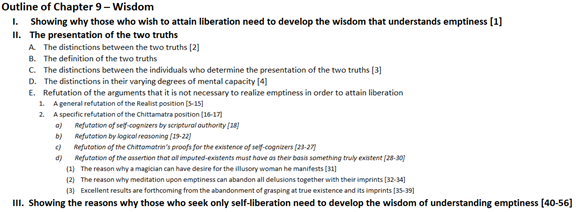
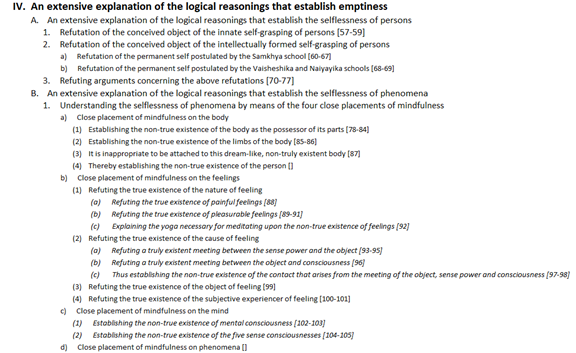
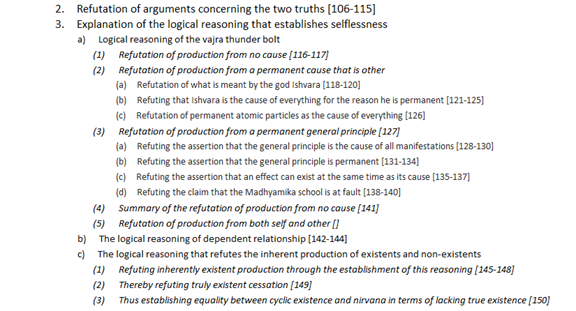
As we go through the verses, I will add in where we are within the overall outline of Shantideva’s chapter.  Without this, it is easy to get lost as to what is the main point of each verse.  Each verse is building towards a main argument or point, which is indicated by the outline heading.  It is helpful to look at the outline as a whole.  This is like first looking at a map of the whole city before we look at the specific streets in any given neighborhood.  Having an overall understanding of how the city is laid out gives us an appreciation of how each neighborhood fits within a larger mosaic.

Shantideva’s presentation of the perfection of wisdom has five main parts. The first, the third, and the fifth are all exhortations encouraging people to develop this wisdom. And the second and the fourth part of his presentation actually explain the teachings on emptiness. It is not enough for us to know what emptiness is, we have to be actually motivated to try realize it ourselves. It is our motivation which determines the karmic effect of our wisdom, not the wisdom itself. For our meditation on emptiness to lead to liberation and enlightenment, our practice needs to be motivated by renunciation and bodhichitta.

In the second part on the presentation of the two truths, there are essentially two main parts. The first simply introduces what are the two truths. And the second refutes the arguments made by those who say we do not actually need to realize emptiness. This is important because we might begin to become discouraged during our study of emptiness and ask ourselves whether it is worth it. But if we recognize that we will never end our suffering until we realize emptiness, then we will be extremely motivated to gain this realization understanding it is not only the panacea for all our problems it is the only solution to all our problems.

The fourth part of Shantideva’s explanation is also primarily divided into two parts:  the explanation of the emptiness or selflessness of persons and an explanation of the emptiness or selflessness of phenomena. Because all things can be divided into persons or phenomena, if we realized the emptiness of both of these, then we realize the emptiness of everything. In particular, Shantideva goes into an extensive explanation of the emptiness of phenomena. He does so first through looking at the four close placements of mindfulness, namely close placement of mindfulness of the body, of feelings, of the mind, and of phenomena. Second, he looks at the relationship between the production of phenomena and their emptiness. Normally we think if things are empty they cannot produce anything, but actually if anything is produced it reveals that it is empty.  

Happy Tsog Day: Motivation for doing series

In Guide to Dakini Land, Geshe-la explains Heruka said, “Practitioners who sincerely practise the tsog offering without missing the two ‘tenth’ days of each month will definitely be reborn in Dakini Land.” A tsog offering is, in effect, an enlightened party. When ordinary beings throw a party, they gather their friends and enjoy objects of delight. In a tsog offering, we generate ourself and others as the Guru-deity, gather together, and collectively accumulate vast merit that is in turn dedicated to gaining Dharma realizations and accomplishing spiritual goals for the sake of all living beings.

Once we take rebirth in the pure land, we will be able to receive teachings and empowerments directly from Heruka and Vajrayogini and be able to swiftly complete our spiritual training. A pure land is like a bodhisattva’s training camp, and once reborn there we will never again take an uncontrolled samsaric rebirth. If we wish to help those we love, we can send emanations – almost like drones or avatars in a video game – into the realms of samsara, but from our perspective, we remain safe in the pure land. Once we reach the pure land, our eventual enlightenment is guaranteed. Geshe-la explains many different ways to guarantee that we attain the pure land, such as reaching tranquil abiding on the generation stage object, reaching the fourth mental abiding on the Mahamudra, or dying with a pure mind of compassion. But the easiest and most certain way of reaching the pure land is to maintain our commitment to practice the tsog offering without missing the two tenth days of each month. Heruka himself explained this. Thus, practicing the tsog offering is like an insurance policy for attaining the pure land. What could possibly be more important than this?

The “tenth” days here refers to the 10th and 25th of every month when Kadampa practitioners traditionally engage in a “tsog” offering in the context of the practice Offering to the Spiritual Guide. If we miss a tsog day, we can just make it up on the weekend. If we cannot do it at the center, we can just do it at home on our own. If we cannot do it with physical offerings, we can just do it with imagined ones. If we do not have time to do it and our other daily commitments, we can just imagine our tsog puja indirectly fulfils our other commitments. If we do not have time to do it, we can just do it more quickly. If we cannot do any of that, Venerable Geshe-la says we can just double our normal daily mantra commitment. The point is, we should try find a way to remember tsog days.

To help mark the tsog days myself, and hopefully help others do the same, I am writing this 44-part series of blog posts which I will post on every tenth day over the next two years. During January, which is Heruka and Vajrayogini month, I will post separately on the 10th and 25th since they are Vajrayogini and Heruka day respectively, hence 44 parts instead of 48 parts.  This series will share my personal thoughts and reflections on engaging in the Offering to the Spiritual Guide sadhana with tsog. Geshe-la encourages us to “make our own commentary” to our practices to try deepen our understanding of them. When Shantideva wrote Guide to the Bodhisattva’s Way of Life, he said his purpose in doing so was to consolidate his own thinking about the bodhisattva’s path, and if others received benefit from his explanations, then all the better. In the same way, I do not pretend that this explanation is in any way definitive – for that, we have the book Great Treasury of Merit – rather, I will share what my current understanding is of the practice. I write it to help consolidate my own experience and understanding of the practice, and if others also find benefit, then all the better.

In my mind, writing and posting this series of posts is my tsog offering to my spiritual guide. By writing it, I offer my practice, my faith, and my effort to try help the Kadam flourish in this world. I pray that those who read this will be inspired to always engage in tsog offerings every tenth day for the rest of their life, and thereby guarantee that they take rebirth in Keajra Pure Land. Once there, may they quickly complete their spiritual training and begin liberating all living beings from the vast, terrible ocean of samsara’s sufferings.