Modern Bodhisattva’s Way of Life: Emptiness of our Five Senses

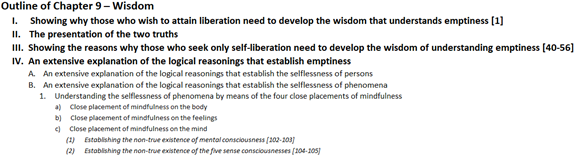
Now Shantideva looks at the emptiness of the sense consciousnesses:

(9.104) If a sense awareness exists prior to its object,
What is it aware of?
If it arises simultaneously with its object,
In dependence upon what object does it arise?

(9.105) And if a sense awareness is truly existent,
How can it arise subsequently in dependence upon an object condition?
In this way, we can understand
That all six consciousnesses lack true existence.

This is a very powerful logic. It looks at the sequential relationship between an object of our sense powers and the sense consciousness aware of the sensory experience.  Either the truly existent sense power exists before it comes into contact with its object, at the same time as its object, or after its object. There is no fourth possibility. Clearly a sense consciousness cannot arise before it encounters its object because that would imply is it possible to have an awareness of something without an object that it is aware of.  Likewise, the sense awareness does not arise after encountering the object because that would imply that the object of an eye awareness can exist without being known. How can there be an object of awareness without there being an awareness aware of that object?

Understanding why a truly existent sense consciousness cannot arise simultaneously with the object is a bit more subtle. It is true that the eye awareness and the visual form arise simultaneously. The two arise in mutual dependence upon one another. You cannot have one without the other as the above logic demonstrates. But you cannot have a truly existent sense consciousness arise simultaneously with the object of consciousness because a truly existent sense consciousness is one that exists independently of all other phenomena. If the sense consciousness arises simultaneously independence upon the object of consciousness then it clearly shows there is a dependent relationship between the consciousness and the object. The sense consciousness cannot be simultaneously independent and have a dependent relationships with other things. So while a non-truly existent sense consciousness can arise simultaneously with a non-truly existent object of consciousness, a truly existent consciousness cannot arise simultaneously with a truly existent object because both the sense consciousness and the object exist independently of one another. If they exist independently of one another they cannot enter into contact with one another or into enter into any sort of relationship with one another. 
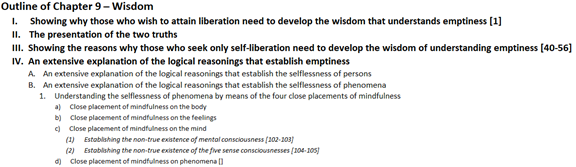
In Shantideva’s commentary there are not any verses that correspond with the close placement of mindfulness of phenomena. However, the traditional explanation of the four close placements includes the close placement of mindfulness on phenomena. Since Shantideva explains the close placements of mindfulness on the body, on the feelings, and on the mind, we can be certain he also wishes to explain the close placement of mindfulness of phenomena. He does not actually add a verse here because one is not necessary. The explanation of the emptiness of phenomena has already been explained in detail above in the presentation of the two truths.

However, Shantideva’s explanation of the close placement of mindfulness of the five sense consciousness indirectly reveals the close placement of mindfulness on phenomena. The Prasangikas do not negate that phenomena exist, they negate that truly existent phenomena exist. Truly existent phenomena are phenomena that exist independent of the mind. But as the explanation above on the close placement of mindfulness on the mental consciousness and the close placement of mindfulness on the sense consciousness reveal, it is impossible for a truly existent phenomena to come into contact with a truly existent consciousness because both consciousness and the object exists independently. Two independent things cannot have a dependent relationship with one another because if they have a dependent relationship they necessarily are not independent.

Indeed, if an independent object truly existed it could not ever be known. Because to be known would imply that it enters into a relationship with a consciousness. For it to be an independent object it must exist entirely independently of consciousness. But if it exists entirely independently of consciousness, how could it possibly be known? Since objects are known, it follows that they cannot possibly exist independently. Thus, all phenomena lack true independent existence.
Modern Bodhisattva’s Way of Life: Your Mind is Empty Too

Now Shantideva explains how mental consciousness is empty.

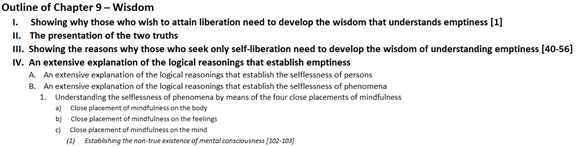
(9.102) Mental consciousness cannot be found in the six powers,
In the six objects of consciousnesses, such as forms, or in the collection of the two.
It cannot be found either inside or outside of the body,
Nor can it be found anywhere else.

This meditation is exactly like the meditation on the emptiness of our I or our body. It starts with the premise that if our mental consciousness exists it should be findable. All consciousness arises from the meeting of a power with an object. For example, when our eye sense power meets a visual form we generate an eye consciousness and when our mental powers meets a phenomena source, which is an object that appears to mind, we generate a mental consciousness.  If the mental consciousness is to be found we should be able to find it either in the power, in the objects of consciousness, in the collection of the two, or separate from the two.

The mental consciousness is not the mental power because the mental power is the ability to know, not an awareness itself. Without an object to be aware of the mental power cannot know anything, and therefore there is no mental consciousness. Likewise, the mental consciousness is not in the phenomena source because that is the object known by the consciousness, and the object known and the mind that knows it are two different things. It is not the collection of the two because neither the mental power nor the phenomena source are the consciousness, so how can a collection of two things that are not a consciousness magically transform into a consciousness. There is nothing there that is the possessor of the power and the object known. It likewise cannot be found separate from the mental power or the phenomena source because without either how can we speak of a consciousness when there’s nothing to know and nothing that has the power to know?

Understanding this, we can see clearly that the mental consciousness does not exist independently. It is a mere name we impute upon the collection of a mental power and an object of consciousness.

(9.103) Mental consciousness is neither the body nor inherently other than the body.
It is not mixed with the body, nor is it entirely separate from it.
It is not the slightest bit truly existent.
This lack of true existence, the emptiness of the mind, is called the “natural state of nirvana”.

Why do you think Shantideva refers to the body when trying to find the mind?  Because we think that our mind comes from our body.  This is our current scientific view.  Modern thought believes that the brain is the mind. It is true there is a relationship between our mind and our brain. We can think of our brain as like a radio receiver, and our mind as like the radio waves pervading everything. There are currently radio waves all around us playing music, but it is only when we connect a radio receiver that we can transform the waves into sounds that we can hear. In the same way, the brain is like the radio receiver and the mind is like the radio waves pervading everything. Just as there are powerful radios and weak radios, so too there are powerful brains and weak brains. But the radio waves themselves are different from the radio receiver itself.  The mind is different from the brain, yet there is a functional relationship between the two.

Modern science does not have an explanation for how a physical blob of the brain is able to a formless continuum that knows. Without a theory of the relationship between the form that is the brain and the formless phenomena that is the mind, we cannot say the brain is the mind. How do the Prasangikas escape this dilemma? For the Prasangikas, the mind is formless. But all of the things we normally see are by nature objects of mind. They too are the nature of mind. Mind can easily know a projection of mind.

Modern Bodhisattva’s Way of Life: Using Emptiness to Heal our Past Traumas

Previously the Prasangikas refuted truly existent feelings by showing that there is no such thing as a truly existent feeling because our feelings change, and therefore enter into some sort of dependent relationship with other things. If our feelings change, then how can we say they exist independently?  

The other schools answer this objection by saying we continue to have a memory of our past feelings, so the feelings are still there, just not manifest. Once again, this corresponds with how we normally think. Psychotherapy is almost entirely about removing the effects of negative past experience on our present experience of life. Perhaps we experienced some trauma as a child, and this trauma is continuing to serve as a drag on our present experience. In psychotherapy, we try identify these past wounds and the negative feelings associated with them, and then relate to our past experience and these feelings in a different way so as to heal our mind of them. In this way we come to view our greatest wounds as our greatest blessings because they shaped us into the person we are today. Therefore, we say the feelings still exist even though we are no longer experiencing them directly – they truly exist. 

In the same way, our normal view is we project some future and then worry about that future.  Even though we are not yet experiencing the future, we can nonetheless “feel” it now by thinking about it.  We feel the future now, therefore, it is truly existent, just experienced at different levels of intensity. 

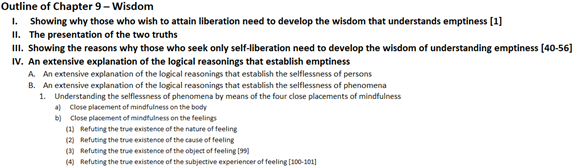
(9.100) Moreover, even if you assert that it can remember feelings that have passed, it cannot experience them;
And it cannot experience feelings that have yet to arise because they do not exist.
So, feelings cannot experience themselves,
And no truly existent other consciousness can experience them either.

The Prasangikas refute the view of the other schools by saying we are not actually experiencing the feelings of our past, we are experiencing our present memory of our feelings of our past.  Our feelings in the present are arising from our present memory of our past.  Thus, the feeling of the past completely ceased when our past moments experiencing those feelings ceased. 

(9.101) Thus, since the person who experiences feelings does not truly exist
And feelings themselves do not truly exist,
How can this selfless collection of aggregates
Be harmed or benefited by painful or pleasant feelings?

We are not prepared, are we, to experience suffering.  We do not tolerate it.  We find it unacceptable.   And we like, prefer, actually we crave, to a great extent, comfort, pleasure.  When we frame the choice as endure suffering or go for pleasant feelings, what will we choose?  We will lose this every time.  So we need to reframe the choice as move deeper into samsara or move out of samsara with our actions.  Then, when we really understand the nature of samsara, we will make the right choices.

We have a choice to make of what we think matters:  our feelings or our intention.  Our answer to this choice will determine everything.  Our focus on our feelings is the root of our worldly concerns, being focused on present feelings as opposed to creating causes for the future.  Because we are not creating any good causes for our future, it will be hard and miserable. 

We base our whole life on our feelings. The things that matter to us the most are what we are feeling, whether good or bad. Shantideva is pointing out that in fact the feelings that we normally grasp at do not exist at all.  If we go looking for them, we cannot find them. What is the point of dedicating our life to something that does not exist at all? We can understand since there are no truly existent feelings, why bother avoiding unpleasant feelings?  Why bother pursuing pleasant feelings?  You cannot be harmed by the one, benefited by the other.  Whether we are harmed or benefited from a feeling depends entirely upon how we relate to it.  What we actually feel depends entirely upon how we discriminate the object.  Nothing is actually pleasant, they become pleasant when we relate to them with a pleasant mind.  Nothing is actually unpleasant, they become unpleasant when we relate to them with an unpleasant mind.

Likewise, our self that experiences these feelings does not exist. So who are we trying to serve? Does it make sense to dedicate our whole life to serving the interests and needs of an illusion or a hallucination? It is not enough to just intellectually understand, “oh yeah our feelings are self that we normally see do not exist.” We need to deeply internalize what this means. It means that everything we have considered to be important in fact is meaningless. Everything we have worked for does not exist at all. Our priorities are completely mistaken. When we realize this, we naturally then reorient our priorities in a spiritual way. We dedicate our life to waking up from samsara, not trying to find the most comfortable place within it. We start to cultivate our true self, not an illusion.

When we meditate on the emptiness of our feelings, they disappear.  Imagine you are feeling pain somewhere in your body.  You can try find it and when you do not, the pain will go away.  It is the ultimate pain killer, and the more you take it the more effective it becomes. 

But we do not want our feelings of pleasure to go away, so we are reluctant to meditate on their emptiness.  But when we have renunciation, we do not want to have contaminated happiness because we know that just strengthens the chains to samsara.  By letting go of contaminated happiness we can come to enjoy a pure bliss which is infinitely better.  But to get that bliss we have to let go of our attachment to worldly pleasure.  The interesting thing about meditating on the emptiness of contaminated pleasant feelings is when you do so, the pleasure does not go away, rather it becomes released.  You realize that it is coming from your mind, so it becomes uncontaminated pleasure. We actually experience the pleasure more deeply, more thoroughly.  The gap between ourselves and the pleasure dissolves away, we quite literally become the pleasure itself.

Modern Bodhisattva’s Way of Life: Stop Blaming External Things for Internal Feelings

All the schools agree all feelings must have an object related to them. This is because the aggregate of consciousness compiles both the aggregate of feeling and the aggregate of discrimination. The aggregate of discrimination perceives an object, and the aggregate of feeling experiences that object as a feeling. And the aggregate of consciousness knows these two simultaneously in a single mind.  

For the lower schools however, they believe there are truly existent objects giving rise to truly existent feelings. Again, this corresponds with our normal view. It seems as if we encounter objects and then experience them in different ways, therefore we conclude the objects give rise to the feelings. We have no sense whatsoever that the way our mind discriminates these objects determines how our aggregate of feeling experiences them. We feel as if we are a passive experiencer of objects. We encounter the object, it gives rise to a feeling. The object is what the object is, the feeling that arises is the feeling that arises, and our mind has no role in this process.

(9.99) All objects of consciousness that give rise to feelings – from visual forms to tactile objects –
Are like dreams and illusions, utterly devoid of true existence.
If the mind experiencing feelings is truly existent,
It cannot experience any feelings that arise simultaneously with it.

The Prasangikas point out that our normal way of looking at things is actually impossible. If the object is truly existent, then how do we come into contact with it since it exists independently of the person experiencing it?  If it exists independently, how can it enter into a relationship with anything else? If it can enter into a relationship with something, then it does not exist independently since being in a relationship with something else implies some degree of dependence. Likewise, if the mind experiencing feelings is truly existent, it also exists independently. If it exists independently, how can it come into relationship with an object?  If it can come into relationship with an object, then there is some dependence between the two, at which point it is no longer independent. If the aggregate of feeling existed independently, then how could it experience different feelings at different times? There would have to be some sort of dependent relationship between the objects and the feelings that arise in the aggregate of feeling to bring about the change. But if there is a dependent relationship between the objects and the feelings, then how can we say the aggregate of feeling exists independently? It is impossible for an independent thing to exist and change in dependence upon other things.  Therefore, a truly existent aggregate of feeling would not be able to feel anything at all. Or it would experience the same feeling at all times without ever changing.

Modern Bodhisattva’s Way of Life: Can We Even Perceive Inherently Existent Objects?

The other schools also assert that there is a truly existent meeting between the object of consciousness and the consciousness itself. Just as the partless particle comes into contact with the sun’s power and generates feelings in our senses, here the other schools assert that objects come into contact with consciousness, and generate different minds within our mind.

Again, this view conforms with our normal way of thinking. We encounter objects all of the time, and then generate thoughts or understandings about those objects.  To us, this makes perfect sense.

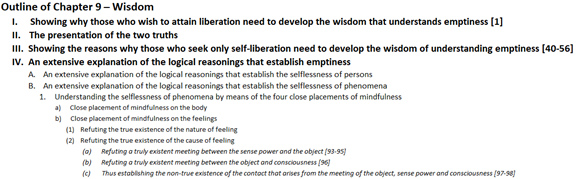
(9.96) There can be no truly existent meeting between consciousness and form
Because consciousness has no material qualities.
Moreover, as we explained previously, there is no truly existent collection;
So there is no truly existent collection of material particles with which to meet.

The prasangika’s offer two refutations of the views of the other schools.  First, just as there can be no meeting between the partless particles of the external cause and the partless particles of the sense power , so two there can be no inherently existent meeting between objects of form and consciousness.  The reason for this is not the existence or nonexistence of space between the partless particles, rather a question of objects of form and objects of consciousness having fundamentally different natures. Objects of form are by nature form, whereas objects of consciousness are by nature formless. To argue that an inherently existent form meeting an inherently existent consciousness generates an inherently existent awareness in mind would require some theory about how such a form can come into contact with something that is formless. If the object is inherently form and the mind is inherently formless, then how can the two ever come into contact with each other? If they did come into contact, there would have to be some part of the form which is formless and some part of the mind which is form for the two to ever meet. But if that is the case then the object cannot be inherently form and the mind cannot be inherently formless. Therefore such a meeting is impossible.

How then do the Prasangikas explain various minds arising in response to various objects of mind? For the Prasangikas, the objects of mind are equally aspects of mind in the same way the Chittamatrins say objects are by nature mind. Mind can come into contact with mind with no difficulty. The problem of meeting only arises if the object being met and the mind meeting the object are each inherently existent.

(9.97) Thus, if contact is not truly existent,
The feeling that arises from it must also lack true existence.
So why exhaust yourself pursuing pleasant feelings?
And, if there are no truly existent painful feelings, who can be harmed by what?

If the other schools cannot establish there is contact, then it is impossible for feelings to arise from inherently existent contact. If that is the case, then truly existing contact does not exist at all. If such contact does not exist, then surely the feelings that arise from such contact also does not exist.  Just as we can never meet the child of a childless woman, so too we can never experience truly existent feelings arising from truly existent contact.

Once again, this is not merely a philosophical exercise. If this reasoning is correct, and indeed it is irrefutable, then it has profound implications for how we live our life. At present, we exert tremendous energy and expend considerable resources chasing after pleasant feelings coming from external objects. The Prasangika’s logic shows that all of this activity of chasing is completely futile. It will never produce results. Therefore, there is no need for us to continue to waste our life exhausting ourselves pursuing pleasant feelings from external phenomena.

And if there is no such thing as truly existent painful feelings, then nothing has the power to harm us. The only reason why things at present appear to have the ability to harm us is because we grasp at them as having this power. But when we realize our feelings are in fact empty, created by our own mind, we can create different causes and conditions within our mind giving rise to different feelings. Indeed, with our tantric practice we learn how to experience all phenomena as great bliss. How do we do this? There is a close relationship between the objects discriminated by our mind and how our aggregate of feeling experiences those objects. Bliss is quite simply what emptiness feels like. When our aggregate of discrimination realizes emptiness, our aggregate of feeling experiences great bliss. Our consciousness then experiences the union of great bliss and emptiness as a single mind.

(9.98) If there are no truly existent feelings,
There is no truly existent person to experience them.
Seeing this to be the case,
Why do we not abandon our craving?

This logic is quite subtle, but quite powerful. Normally we grasp at a truly existent person experiencing truly existent feelings. But if truly existent feelings do not exist at all, which the above reasoning establishes, then it is impossible for there to be a person who experiences truly existent feelings because there is no such feelings at all, therefore there is no one who can experience them. Thus, by realizing the emptiness of truly existent feelings directly, we can realize the emptiness of the person experiencing those feelings indirectly. Geshe-la explains this reasoning in more detail in Mirror of Dharma.

Modern Bodhisattva’s Way of Life: Emptiness and Quantum Physics

Some of the other schools assert the existence of a partless particle and they claim this particle is the building block of everything. They claim that these partless particles truly exist, independent of the mind. Most of experimental physics is aimed at trying to find partless particles. I used to live in the Geneva area where they had a giant supercollider called CERN. This supercollider would accelerate atomic particles almost at the speed of light and have them smash into each other, breaking the atomic particles apart into smaller and smaller bits. Even though they were able to break atomic particles into even smaller parts, most of the engineers assumed there must be something that survives all of these collisions that is a partless particle. But even when they would smash these smaller bits, they would find yet smaller bits.

Understanding this, modern physics has moved into quantum physics. Quantum physics says objects come into existence when they are observed by an observer. This is quite similar to emptiness, but quantum physics has not yet gotten to the point in which it concludes there is nothing there behind the observation of the mind. They still think there must be something there that is being observed, but it comes into existence upon observation. The other schools are like the quantum physicists who grasp at some sort of partless particle. They simply think these objects come into existence through observation. The Prasangikas agree objects come into existence through observation, but they are never and will never be anything more than mere appearance to mind. In other words, there is no partless particle behind the observation.

Why does any of this matter? Our normal way of thinking, as expressed by the other schools, is that there must be something there that is the cause of our pleasant or unpleasant feelings. When we eat ice cream or get hit by a baseball bat, we experience pleasure and pain. We think the ice cream causes pleasure and the baseball bat causes pain. We therefore assume there must be something in the ice cream or the baseball bat that causes these feelings. According to the other schools, and according to our “common sense,” pleasure and pain arise from the meeting of this external cause and our sense powers. The Prasangikas now go on to refute this “common sense” view.

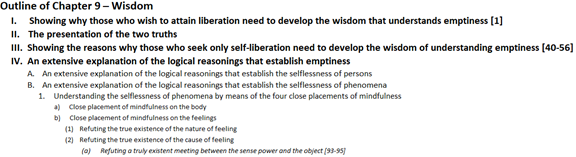
(9.93) If there is space between the partless particles of a sense power and those of its object,
How can you maintain that they have met?
But if there is no space between them, they must mix and become completely one;
In which case, what is it that meets with what?

The Prasangikas say there are two possibilities, either there is space between the partless particles and the sense power or there is not. If there is space, then they never actually meet and therefore we cannot say feelings arise from the meeting of the partless particles with the sense powers. If there is no space between the partless particles and our sense powers, then the partless particles and our sense powers are one in the same.  If that is the case, what is the point of differentiating the partless particles from the sense power? Further, if they can be nominally differentiated between the partless particle itself and the sense power itself, even though the two are one in the same, then we can no longer say the particle is partless since it has a part that is the particle itself and a part that is the sense power. This logic is irrefutable. It completely destroys the possibility of our normal way of thinking.

We should not take this merely as an intellectual exercise, but realize that the way we have been thinking about the world makes absolutely no sense. Nothing external ever causes any feeling.  This is an incredibly liberating thought. If external things are not the cause of our feelings, then we no longer need to be preoccupied with what happens externally since it has no fundamental bearing upon what we feel. Further, if our feelings come from within, then the way in which we change our feelings is by changing what is within, namely our mind. This realization that external objects have no means of causing feelings helps us stop looking for happiness where it cannot be found, and start looking where it can be found.

The other schools respond to this objection by saying the partless particles of the external cause of feeling and the partless particles of our sense powers penetrate one another and therefore generate feelings.

(9.94) But one partless particle could never penetrate another
Because they would both be equal in size without any empty space inside.
Without penetrating, they could not mix;
And without mixing, they could not meet.

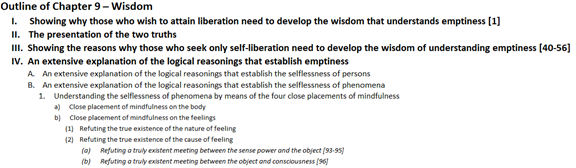
The Prasangikas say this is a logical contradiction. If one partless particle penetrated another they would have to do so completely without any gaps, otherwise there would be part of the partless particle that is penetrated by the other partless particle and part of the partless particle that is not penetrated by the other partless particle. If that was the case, then how can we say it is a partless particle since it now has two parts, one part penetrated and one part not?  But if they do not actually penetrate one another, they do not ever mix, and therefore they do not meet. If they do not meet, then we cannot say feelings arise from the meeting of the partless particles and the sense power.

(9.95) To say that two partless things can meet
Is completely illogical.
If it were possible, you would be able to detect it;
So please show me an example!

Since the other schools are asserting this is how feelings arise , then the burden of proof is on them to provide an example demonstrating the truth of their view. If they cannot even provide one example, then how can they say their view is valid?

Modern Bodhisattva’s Way of Life: Assume Responsibility for your Own Experience of Life

(9.91) (Other schools) “So what you are saying is that painful feelings do not occur at that time
Because the delicious taste is a cause of their opposite – pleasant feelings.”

Here the other schools are trying to trap the Prasangikas into saying the delicious taste of the cake is a cause of the pleasant feelings, therefore pleasant feelings have external causes.

Whether it is a cause of pleasant or painful feelings depends merely upon conceptual imputation;
Thus, feelings are established as having no inherent existence.

The Prasangikas reply that no, they are not grasping at an external cause of pleasant or unpleasant feelings, they were simply showing that the analogy the other schools were using does not work even for them. Whether any external phenomena is experienced as pleasant or unpleasant depends entirely upon the mind experiencing that object. We see this all the time. One person experiences some food as delicious and someone else experiences that same food as disgusting. Which is it?  It is neither delicious nor disgusting. How it is experienced depends upon the mind experiencing it.

For example, we can consider broccoli.  Before, I did not like it at all because I was making decisions based solely on what is good for my mouth.  But then I started thinking about what is good for my body, and I ate broccoli even though my mouth didn’t like it.  Then over time, due to my change of attention – focusing more on the health benefits and less on the taste, I actually came to like the taste of broccoli.  What has changed?  Not the broccoli, just my mind.  By considering this example, we can change our experience of anything, even at the level of feelings.  We can even come to experience painful feelings as enjoyable. 

The key point is we need to assume personal responsibility for our own experience of things.  Our experiencing something as pleasant or unpleasant has nothing to do with the object and has everything to do with our mind and our view.  We can think about different types of music that some like and some detest.  It is primarily a question of attention.  The world we experience is the world we pay attention to.  We need to choose to pay attention to the good qualities of an object, and by doing so, we can enjoy everything.

We can literally come to experience everything as great bliss.  This is what a Buddha does.  A Buddha pays attention to the ultimate nature of the object, its being the nature of bliss and emptiness, as the dominant characteristic of the object, and as a result, they experience all objects as bliss and emptiness.  We need to stop attributing our experience of an object to the object itself, and realize instead it comes from our mind.  This will solve so many of our problems because then we will just work on changing our mind.  If we change objects, we constantly have to change objects (this is what most people do their whole life – in search of new objects that will do something to them).  If we change our mind, the job is done forever.  It is much more efficient.

(9.92) The antidote that abandons grasping at truly existent feelings
Is meditation on and analysis of lack of true existence.
The superior seeing that arises from analysis of this emptiness, conjoined with tranquil abiding,
Is the food that nourishes the Yogi’s realizations.

Our concern for our own, present feelings distracts us from our spiritual training that brings enjoyment.   We choose to pursue a samsaric pleasure, which will bring us nothing but suffering, and it takes us away from authentic spiritual practice.  Why do we allow ourselves to be distracted?  Why do we allow doubts to arise? I think mainly it is because we’re not enjoying ourselves with our Dharma practice.  We look to other places than our spiritual practice for our enjoyment, don’t we?  We do this because we make a false distinction between our spiritual practice and our enjoyments.  The truth is we can enjoy everything more if we relate to it in a spiritual way.  Then, there is no problem, everything becomes part of our spiritual training.  If we are not enjoying our spiritual practice, we will look to other things for enjoyment.  Since we know everything else is in the end harmful, we should really put effort into learning how to enjoy our spiritual practice.  It is worthwhile to revisit the chapter on effort, recalling that effort in a Dharma context means enjoying our spiritual practice.  If there is no enjoyment in our spiritual practice, there is no effort, and without effort, there will be no spiritual attainments, no matter how long we “practice.”  The easiest way out of this problem is to let go of our concern and attachment to feelings.  If we are no longer driven by feelings, but instead by wisdom, we will breeze through any problem.

It is helpful to recall that the dharmakaya of a Buddha is called the truth body. The clear light emptiness is a body whose nature is bliss and emptiness. When we have a direct realization of emptiness and our mind is absorbed single-pointedly in tranquil abiding on this realization, we are nourishing our truth body. We are bringing it to life and feeding it a steady diet of our attention. If our mind is able to be 100% focused on the union of bliss and emptiness and our mind never leaves this union then we will have attained enlightenment. Unpleasant feelings will never arise again.

Modern Bodhisattva’s Way of Life: The Emptiness of Eating Cake at our Loved Ones’ Funeral

(9.88cd) And if pleasant feelings are truly existent,
Why do delicious tastes not bring joy to one who is grieving?

The Prasangika objection here is easy to understand. When we are in a bad mood or when we are experiencing a good deal of suffering, things that would normally make us happy do not anymore. In fact, when we experience them, we want to push them away and find them to be intrusive. Our mind is simply incapable of appreciating anything good because it is entirely preoccupied with the bad.

(9.89) (Other schools) “Such a person does develop pleasant feelings, but he or she does not experience them
Because they are suppressed by the strength of the painful feelings.”

This objection from the other schools makes sense to us. If we just lost a loved one and we were at the reception after the funeral, we would be very sad. However, if we eat some cake at the reception, there would be part of us that enjoys the cake even though generally speaking we are sad. We might not enjoy it as much as we normally would on our birthday, but there is still a degree of enjoyment in our mind from eating the cake. It has simply been reduced or suppressed due to the strength of the painful feelings we have.

(9.89cd) How can there possibly be a feeling
That is not experienced?

The Prasangika answer here is the other schools are grasping at there being two different minds experiencing two different feelings that somehow cancel each other out in some way. But the reality is at any one time we only have one consciousness which experiences one feeling. The mixed feeling of sadness at the death of our loved one and enjoyment of the cake creates a single combined feeling that we experience. There are not two consciousnesses experiencing two feelings that are neutralizing each other. There is only one consciousness and one feeling of a grieving person eating cake. To say otherwise is to say there is a feeling of greater suffering from the death of the loved one that is not being experienced but nonetheless exists and likewise there is a greater feeling of pleasure from the cake that is not being experienced but nonetheless exists. How can something that is not being experienced be considered a feeling that exists since it is not actually being experienced?

(9.90) (Other schools) When a strong pleasant feeling occurs, there is still a subtle painful feeling.
The gross feeling of pain is dispelled, and the subtle pain that remains
Becomes the nature of a subtle pleasant feeling.”

Here the other schools are saying that the full experience of sadness at the death of our loved one still exists , with part of it being manifest and part of it being in a subtle form that is suppressed from the pleasure we gain from eating the cake.  Again, this makes sense to us. We are still equally sad about the death of our loved one, and that sadness has not gone away, we just aren’t experiencing it as intensely because of pleasure associated with the cake.

Well then, that subtle feeling is a pleasant feeling, not a painful one!

The Prasangika reply if that is the case, then how can you call the painful part that is not manifest a painful feeling when it is currently being experienced as a pleasant feeling? Even conventionally, to say that the painful feeling takes the form of a pleasant feeling makes no sense because a painful feeling is not a pleasant feeling. What is actually experienced is a reduced painful feeling. The normal painful feeling we would otherwise be experiencing if we did not eat the cake is replaced with a reduced painful feeling of that experienced by a grieving person eating cake. The former feeling no longer exists and only the latter feeling exists. What need is there to say there exists a painful feeling of sadness that is not being experienced, a pleasant feeling of the cake we would be experiencing if we were not grieving that is also not being experienced, and a combined feeling of both pleasant and unpleasant feelings. Only the latter is actually experienced, therefore only that exists. The other two types of feeling are purely conceptual and never actually experienced by anybody. This shows two things. First, that the feelings change, and therefore do not exist inherently. And second, that the non-experienced feelings do not exist at all.

Modern Bodhisattva’s Way of Life: Letting Go of Painful Feelings

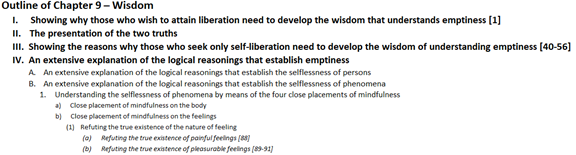
(9.88ab) If painful feelings are truly existent, they can never be changed,
And it follows that living beings never experience pleasant feelings.

Another aggregate we grasp at strongly, keeping us firmly within our samsara, is the mental factor feeling.   We think it matters how we feel at any time.  We feel it is so important that we feel good and that we do not feel bad.  We grasp at and are very attached to pleasant feelings and we grasp at and are averse to unpleasant feelings.  If we look at how society is organized and people act, it seems this is the most important consideration in our society.  And what is the result?   We are preoccupied then with the favorable and the unfavorable.  We focus all our energy on changing our external conditions so that we have pleasant feelings and we don’t have unpleasant feelings.  Like everyone else, we set our sights on the immediate and not on the future, such as our future lives.  We want one type of feeling and we do not want the other.  This preference is itself keeping us in samsara.  This preference is samsara.

There is enormous freedom to be had from a true equanimity with respect to our feelings – both are equally good, just in different ways.  They are not equally good to our worldly concerns, but they are equally good to our spiritual concerns.  Whether we have equanimity with respect to our feelings or not depends primarily on our concerns.  How do we change our concerns to be spiritual concerns?  Again, the lamrim.  Lamrim is the real panacea that solves all our problems because nothing is a problem for a lamrim mind.  If we learn to enjoy equally all feelings, pleasant or unpleasant, would we suffer anymore?  Would we not be liberated?

We generally determine whether something is a cause of happiness or suffering on the basis of how it makes us feel, but this is completely deceptive.  Drugs feel good, but they bring only suffering.  Working hard at overcoming our delusions does not feel good, but it brings only happiness.  Gen-la Khyenrab said that an ordinary being primarily follows the aggregate of feeling, whereas a spiritual practitioner primarily follows the aggregate of discrimination.  Feelings are not a reliable guide, wisdom is.

Shantideva here explains to us how our feelings are not truly existent.  Because we feel they are.  We feel that no matter how we discriminate things, it will not change how we feel or experience them.  But this is clearly wrong.  For example, if we drank something very sweet, and then later learned that it is poison.  This will radically change our experience of the drink.  We feel like we are ‘in’ pain, when it is more correct to say, ‘there is the appearance of pain in my mind.’  This makes all the difference in terms of whether we experience pain or not.  We need to get a feeling for the emptiness of our feelings, it is the feeling of lightness and freedom, having completely let go.  Like clouds passing through the sky.

We also need to make a distinction between experiencing painful feelings and experiencing suffering.  It is perfectly possible to experience painful feelings, but not suffer from them.  For example, when people lift weights or engage in strenuous exercise, they experience considerable pain, but they are happy to do so because they know they are growing stronger.  As they say, “no pain, no gain.”  The pain we feel of being stuck with a needle is not suffering if we know it is giving us a life-saving vaccine.  Painful feelings plus non-acceptance of the painful feelings equals suffering.  Painful feelings plus a Dharma mind towards the painful feelings equals blessings. 

Sometimes we can become impatient with our suffering if it continues for a long time. We feel as if we have been experiencing painful feelings for so long we simply can’t take it anymore, and so are suffering compounds over time. We then strongly wish that our painful feelings would go away. This suffering comes from a non-acceptance of our painful feelings. Just because we have suffered in the past does not mean we somehow have an exemption to the laws of samsara where all experiences are the nature of suffering. Indeed, we can use the fact that suffering is relentless within samsara to increase our renunciation, or the determination to once and for all escape from samsara.

Temporarily though, if we want our suffering to decrease, we need to accept the painful feelings that we are experiencing. There are all sorts of different methods we can use to do so explained in the lojong teachings. I have a friend who has fibromyalgia. She wrote Geshe-la asking for advice of what to do, and he told her to study and meditate on the chapter on ultimate bodhicitta in Eight Steps to Happiness. The essential point is painful feelings do not exist from their own side. They arise in dependence upon internal causes and conditions, namely grasping at both our body, our self, and the painful feelings. If we can realize that our self, our body, and the painful feelings are all equally empty then the pain quite literally goes away.  The meditation on emptiness is the ultimate pain reliever.  Just as we go looking for our body or our I in an emptiness meditation, so too we can also go looking for the pain we experience in our body. Where exactly is the pain? We can perform the exact same meditation of looking in the parts, in the collection of the parts, or separate from the parts to identify the emptiness of our painful feelings. When we do so, the pain disappears. In the dharmakaya, or truth body of Buddha, there is no pain. The only reason why we experience pain is because we are still grasping at our i’s being one with a samsaric body.

So you understand why painful feelings, if they are truly existent, can never be changed. 

Modern Bodhisattva’s Way of Life: Understanding LGBT Experience

(9.87) Therefore, what intelligent person
Would develop attachment for this dream-like form?
And since there is no truly existent body,
Who is truly existent male and who is truly existent female?

I am sure most of you know what Tara had to say, in this world there is no man, there is no woman.  But we grasp at us being inherently male or inherently female.  Many people become Heruka or Vajrayogini for this reason, but this is completely mistaken.  We need to identify within ourselves how we grasp at our gender.  Many problems come from this, such as sexism, homophobia, etc.  Male and female, we are just making it up, but we grasp at it as if it were intrinsically so.  We are making up everything, we are making the distinctions.  But then we think the distinctions exist from the side of the object and now how we are discriminating it.

I wanted to take advantage of this verse to discuss a Buddhist perspective on LGBT experience.  A heteronormative view grasps at inherently existent males and inherently existent females – where one’s gender identity and one’s biological gender are the same. A heterosexist views grasps at males necessarily being sexually attracted to females, and females being sexually attracted to males. Anything that deviates from this “normal” is viewed as an aberration. How do Buddhists who understand both emptiness and karma explain the wide variety of gender and sexual orientations?  

According to the laws of karma, each time we engage in an action we create four different karmic causes. The ripened effect results in a future rebirth somewhere within samsara. The tendency similar to the cause is a future tenancy to engage in similar actions, both bodily and mental. The effect similar to the cause results in us experiencing effects which are similar to the causes that we created in the past, for example if we hit somebody we are likely to get hit back. And the environmental effect is that which surrounds us in our different rebirths.

Somebody who is a cisgender straight male is someone who has the ripened effect to be born male, and the tendency is similar to the cause to be attracted to females. Somebody who is a cisgender straight female is someone who has the ripened effect to be born female, and the tendency similar to the cause to be attracted to males. A gay man is someone who has the ripened effect to be born male and the tendency similar to the cause to be attracted to males. A bisexual person is someone who has the ripened effect to be born either male or female, but the tendencies similar to the cause to be sexually attracted to both males and females. A lesbian is someone who has the ripened effect to be born female and the tendencies similar to their cause to be attracted to females. A transgender female is someone who has the ripened effect of a male body, but the tendencies similar to the cause to think and feel in ways that are conventionally considered female. A transgender male someone who has the ripened effect of a female body, but the tendencies similar to the cause to think and feel in ways that are conventionally considered male. A trans person can be sexually attracted to either males or females, independence upon the tendencies similar to the cause they have of being attracted to different genders. Since there is an infinite variety of karma that beings can create, it follows that there is an infinite variety of combinations in which this karma can ripen.

To simplify matters, we can think of things as existing along three axes. The first is the ripened effect of being born into a body that is biologically male or female. This has a spectrum of things, from those who are extremely masculine males to effeminate males to masculine females to extremely feminine females. The second axis is what tendencies similar to the cause of how one thinks and feels are ripening. This determines how one individually identifies oneself as being male or female, which can be quite distinct from one’s biological basis. Once again, this exists upon a spectrum, from very strong male tendencies to very strong female tendencies. It is worth noting that what is male or female in this context is purely conventionally constructed based upon cultural norms. There are certain things which we identify with being conventionally male and conventionally female, although they are not inherently so. A two-spirit person is someone who has multiple nodes of tendencies similar to the cause of how one thinks and feels, both male and female. The third axis is the tendencies similar to the cause of what we are sexually attracted to, from being strongly attracted to males to being strongly attracted to females. Again this exists upon a spectrum. Someone who is asexual word for example be at zero along this axis.  A person’s gender and sexual identity can fall anywhere within this 3-dimensional space. From the perspective of karma and from the perspective of emptiness there is no basis for saying any one combination of these is better or worse than any other.  They are all simply different karmic possibilities.

How does the environmental effect factor into this? Some people live in very heterosexist societies where any deviation from the hetero patriarchal norm is considered wrong or bad in some way, and the societal structures create penalties for those who deviate from these norms. Other people live in an environment in which there is no judgment or no penalty, and everyone’s individuality is celebrated. How does the effect similar to the cause factor into this?  Some people experience persecution based upon their sexual identity whereas others do not. It is possible for someone to live in a heterosexist society, but themselves not experience any particular discrimination or oppression. Someone else might live in a very open society but nonetheless experience discrimination and oppression. Just as it is possible for someone to be born with any combination of the three axes of gender and sexual identity described above, so too it is possible for someone to be born into a wide variety of combinations of environments that are either oppressive or accepting and to experience oppression or acceptance. While difficult to visualize, from a karmic perspective, we can imagine a five-dimensional space with five axes, and living beings being born into any number of possibilities.

In this way, we can understand that all of the different experiences and all of the different possibilities that arise with respect to LGBT experience can be understood from the perspective of the karma we have created. It is not my place to dictate what are the Buddhist conclusions one can draw from such an analysis. But if we contemplate these different karmic effects deeply we can hopefully come to a greater understanding of the wide variety of human proclivities and human experiences as they relate to LGBT experience. The hope as if we understand how karma and emptiness work, we can all relate to each other with greater wisdom and compassion.