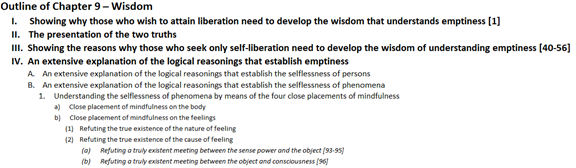
The other schools also assert that there is a truly existent meeting between the object of consciousness and the consciousness itself. Just as the partless particle comes into contact with the sun’s power and generates feelings in our senses, here the other schools assert that objects come into contact with consciousness, and generate different minds within our mind.
Again, this view conforms with our normal way of thinking. We encounter objects all of the time, and then generate thoughts or understandings about those objects. To us, this makes perfect sense.
(9.96) There can be no truly existent meeting between consciousness and form
Because consciousness has no material qualities.
Moreover, as we explained previously, there is no truly existent collection;
So there is no truly existent collection of material particles with which to meet.
The prasangika’s offer two refutations of the views of the other schools. First, just as there can be no meeting between the partless particles of the external cause and the partless particles of the sense power , so two there can be no inherently existent meeting between objects of form and consciousness. The reason for this is not the existence or nonexistence of space between the partless particles, rather a question of objects of form and objects of consciousness having fundamentally different natures. Objects of form are by nature form, whereas objects of consciousness are by nature formless. To argue that an inherently existent form meeting an inherently existent consciousness generates an inherently existent awareness in mind would require some theory about how such a form can come into contact with something that is formless. If the object is inherently form and the mind is inherently formless, then how can the two ever come into contact with each other? If they did come into contact, there would have to be some part of the form which is formless and some part of the mind which is form for the two to ever meet. But if that is the case then the object cannot be inherently form and the mind cannot be inherently formless. Therefore such a meeting is impossible.
How then do the Prasangikas explain various minds arising in response to various objects of mind? For the Prasangikas, the objects of mind are equally aspects of mind in the same way the Chittamatrins say objects are by nature mind. Mind can come into contact with mind with no difficulty. The problem of meeting only arises if the object being met and the mind meeting the object are each inherently existent.
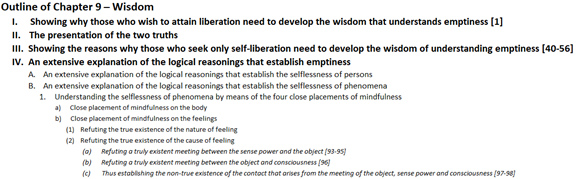
(9.97) Thus, if contact is not truly existent,
The feeling that arises from it must also lack true existence.
So why exhaust yourself pursuing pleasant feelings?
And, if there are no truly existent painful feelings, who can be harmed by what?
If the other schools cannot establish there is contact, then it is impossible for feelings to arise from inherently existent contact. If that is the case, then truly existing contact does not exist at all. If such contact does not exist, then surely the feelings that arise from such contact also does not exist. Just as we can never meet the child of a childless woman, so too we can never experience truly existent feelings arising from truly existent contact.
Once again, this is not merely a philosophical exercise. If this reasoning is correct, and indeed it is irrefutable, then it has profound implications for how we live our life. At present, we exert tremendous energy and expend considerable resources chasing after pleasant feelings coming from external objects. The Prasangika’s logic shows that all of this activity of chasing is completely futile. It will never produce results. Therefore, there is no need for us to continue to waste our life exhausting ourselves pursuing pleasant feelings from external phenomena.
And if there is no such thing as truly existent painful feelings, then nothing has the power to harm us. The only reason why things at present appear to have the ability to harm us is because we grasp at them as having this power. But when we realize our feelings are in fact empty, created by our own mind, we can create different causes and conditions within our mind giving rise to different feelings. Indeed, with our tantric practice we learn how to experience all phenomena as great bliss. How do we do this? There is a close relationship between the objects discriminated by our mind and how our aggregate of feeling experiences those objects. Bliss is quite simply what emptiness feels like. When our aggregate of discrimination realizes emptiness, our aggregate of feeling experiences great bliss. Our consciousness then experiences the union of great bliss and emptiness as a single mind.
(9.98) If there are no truly existent feelings,
There is no truly existent person to experience them.
Seeing this to be the case,
Why do we not abandon our craving?
This logic is quite subtle, but quite powerful. Normally we grasp at a truly existent person experiencing truly existent feelings. But if truly existent feelings do not exist at all, which the above reasoning establishes, then it is impossible for there to be a person who experiences truly existent feelings because there is no such feelings at all, therefore there is no one who can experience them. Thus, by realizing the emptiness of truly existent feelings directly, we can realize the emptiness of the person experiencing those feelings indirectly. Geshe-la explains this reasoning in more detail in Mirror of Dharma.

