Modern Bodhisattva’s Way of Life: The Parts Are Empty Too

(9.85) Just as the body lacks true existence, so do its parts such as the hands;
For they too are merely imputed upon the collection of their parts, the fingers and so forth.
The fingers, in turn, are merely imputed upon the collection of their parts, such as the joints;
And, when the joints are separated into their parts, they too are found to lack true existence.

(9.86) The parts of the joints are merely imputed upon a collection of atoms,
And they, in turn, are merely imputed upon their directional parts.
Since the directional parts, too, can be further divided,
Atoms lack true existence and are empty, like space.

And when we look for the parts, we just find the parts of the parts, nothing more.  We keep looking, and no matter where we look, we find nothing.  We think we are surrounded by reality, but in truth it is all an illusion.  There is nothing here at all, it just appears that there is.  It’s a very nice meditation to do sometime, just go to the parts of the parts, and just end up finally meditating on space-like emptiness, realizing that even the atoms lack true existence.

Again, this does not require any faith to realize.  This is something we can prove to ourselves with investigation.  Emptiness is the definitive valid reason that establishes the rest of the path.  If we can establish emptiness, we can prove every other stage of the path – death, lower realms, karma, renunciation, cherishing others, taking and giving, bodhichitta, tantra, everything. 

When we think about it, it is truly amazing. Everything appears so vivid and appears so real, but when we actually look for it, we find nothing. It is all one giant illusion. It appears real, it has shape it has form it functions we can touch it, yet when we look for what is behind these appearances we find nothing. Our mind simply connects the dots and projects everything in between them. In fact when we look, we don’t even find the dots. Each dot itself is simply yet another hallucination, another illusion, another hologram.

Very often we can develop doubt, am I wasting my life practicing the spiritual path? I see everybody else off doing different things, enjoying life. But here I am, dedicating all of my time to trying to attain some state beyond this life. I am trying to construct a pure land and identify with myself as a deity. What if this is all a bunch of nonsense? What if none of it is true. What if it is all just a waste of time and I’m just engaging in make believe?

We can have these doubts. If we do not have an answer to these doubts, they can become crippling, and we lose all the motivation to engage in our spiritual path. We start to think that our spiritual guide and our sangha are perhaps deceiving us or themselves have been fooled into wasting their life chasing these fantasies.

How do we overcome this doubt? Through this meditation on emptiness. We identify the emptiness of our body, then we look at the emptiness of each of the parts of our body, then we look at the emptiness of the parts of the parts of our body, and so forth all the way down to atoms. We then look at the emptiness of atoms – made up of electrons, neutrons, and protons. Each of these things can be broken down further and further yet no matter how much we break it down, we continue to find absolutely nothing. There is nothing actually there. Our mind is simply projecting that there is something there, connecting dots that are not there, creating a mental illusion that our ignorance grasps at as real.

This is something we can prove to ourselves through investigation. There’s no doubt when we investigate, we find nothing. The self we normally see, the body we normally see, the world we normally see does not exist. It just appears to exist, like an illusion. It is all created by mind. We’re like those people who believe in conspiracy theories who see random data points and then fill in elaborate stories connecting those dots, grasping at their stories as somehow being true. We are exactly the same. Somebody trapped in samsara is in fact simply somebody who’s grasping at its conspiracy. But when we check, when we investigate, we realize it is all a big lie. Samsara is fake news. It is all created by mind.

If it is created by mind, then mind can create new worlds, different worlds. Here again we have direct experience. Before we viewed something as a hardship, later we came to view it as a blessing. What was it? Was it a blessing or was it a hardship? In reality it was nothing. From its own side it is absolutely nothing. But our mind can relate to it in different ways, and then we experience it in different ways. This shows that we can create with our mind the world that we inhabit and the world that we experience. Seeing this, we realize we can create any world, including the pure land. It just takes enough mental action to create enough karma to cause our abiding within the pure land to become a self-sustaining experience. Karma is proven by emptiness. Tantra is proven. Future lives are proven. Everything is established through emptiness. We could have 100% confidence in our spiritual path because of emptiness, which itself can be proven.

Happy Protector Day: Helping the Pure Kadam Dharma Flourish

The 29th of every month is Protector Day.  This is part 9 of a 12-part series aimed at helping us remember our Dharma Protector Dorje Shugden and increase our faith in him on these special days.

All my harmful thoughts and actions
That have offended your mind, O Great Protector,
I confess from the depths of my heart.
Please purify them swiftly, and care for me with love, like a mother for her child.

With this verse, we can purify all the negative karma that obstructs our ability to receive the care and protection of Dorje Shugden.  Such negative karma is like interference preventing a reception of our mobile phones or junk clogging up the arteries of a person.  We can generate a regret for whatever we have done in the past which has created negative karma preventing us from receiving the care and protection of Dorje Shugden.  Then we strongly imagine from Dorje Shugden purifying light rays and nectars flow down and touch all the beings inside the protection circle, ourself included, purifying all of the negative karma obstructing us from receiving Dorje Shugden’s care and protection.  We then strongly believe that all of these being are now without obstruction.

I beseech you from the depths of my heart, O Supreme Deity,
Please cause the tradition of Je Tsongkhapa to flourish,
Extend the life and activities of the glorious Gurus,
And increase the study and practice of Dharma within the Dharma communities.

We can understand this as follows:  The key point here is we realize how the Dharma of Je Tsongkhapa is the solution to all the problems of all beings.  The reason why beings suffer is because they too are trapped in a dream-like world of suffering created by their own self-centered minds.  They need to wake up from this dream into the pure world of the Buddhas.  The Dharma of Je Tsongkhapa provides a solution for destroying this self-centered mind, thereby enabling all beings to wake up from their worlds of suffering.  This is the solution to all of their problems.

Please be with me always like the shadow of my body,
And grant me your unwavering care and protection.
Destroy all obstacles and adverse conditions,
Bestow favourable conditions, and fulfil all my wishes.

Here we request Dorje Shugden to accomplish his main function, namely to arrange perfect conditions and to eliminate obstacles to our practice.  There are two types of condition:   When we are confronted with a situation which we think could be better, we request Dorje Shugden to arrange whatever is best and imagine that a protection circle radiates out accomplishing this function.  If the external situation changes, then we know the situation was beyond our capacity and we can use that to develop bodhichitta, wishing later to have a capacity that can transform anything and everything.  If the external situation remains the same (or gets worse) then we can know that we need to work on the delusions that this situation generates for us.  We can equally do this with internal conditions.  An important thing worth noting at this point is Dorje Shugden will arrange what is best for our practice, not what is necessarily best for our worldly concerns.  We might even say Mick Jagger is actually part of Dorje Shugden’s mandala when he sung ‘you don’t always get what you want, but you get what you need.’

Now is the time to show clearly your versatile strength
Through your four actions, which are swift, incisive, and unobstructed,
To fulfil quickly my special heartfelt desires
In accordance with my wishes;

Here we request Dorje Shugden to arrange whatever is best in general, in his own mysterious ways and imagine that a protection circle radiates out accomplishing this function. Ask people their Dorje Shugden stories when you are at festivals, and you will be amazed.  If our motivation is pure, he can arrange anything.

Now is the time to distinguish the truth and falsity of actions and effects;

Here we request him to make clear the relationship between cause and effect for all the beings within the protection circle.  At present, we think negativity is entertainment and exciting and we think virtue is boring.  In reality, negativity creates the cause for enormous suffering and virtue is the cause of all happiness.  Here we request that Dorje Shugden to bestow special wisdom blessings on all beings within the protection circle so they naturally, from their own side, make good choices.

Now is the time to dispel false accusations against the innocent;

Here we request Dorje Shugden to enable all beings within the protection circle to stop making mistaken and false imputations on others, but to correctly impute onto everybody ‘emanation of my spiritual guide’ and imagine that a protection circle radiates out accomplishing this function.  At present, we impute onto others ‘object of attachment’ ‘object of aversion’ or ‘irrelevant.’  These are false accusations we impute on others, and we relate to them as if they were really these things from their own side.  This creates all our problems.  The only valid imputation of anybody is ‘emanation of my spiritual guide.’  The ultimate nature of all things is the Dharmakaya, so it is correct to say that everybody is an emanation of my spiritual guide.

Now is the time to protect the pitiful and protectorless;

The reason why people are pitiful and protectorless is because we have been neglecting them.  Their experience is what we have karmically created for them in our empty dream.  So here we request that he provide protection for all the beings we have been neglecting and imagine that a protection circle radiates out accomplishing this function.

Now is the time to protect Dharma practitioners as your children.

It is particularly important to provide care and protection for Dharma practitioners because by helping them directly, indirectly it helps all living beings since they have vowed to attain enlightenment for the benefit of all.  It is like opening up a second cash register at the supermarket.  Everybody gets through the line twice as fast.

In short, from now until I attain the essence of enlightenment,
I shall honour you as the embodiment of my Guru, Deity, and Protector.
Therefore please watch over me during the three periods of the day and the night
And never waver in your actions as my Protector.

The biggest fear of a Dharma practitioner is the fear of losing the path.  If we do not lose the path, we have nothing to fear; but if we do lose the path, we have all of samsara to fear.  When we recite this verse, we are creating the causes to be able to meet Dorje Shugden and rely upon him again in all our future lives.  In this way, we maintain the continuum of our practice and go from joy to joy until we attain enlightenment.

Happy Tsog Day: Generating Admiring Faith in our Spiritual Guide

In order to remember and mark our tsog days, holy days on the Kadampa calendar, I am sharing my understanding of the practice of Offering to the Spiritual Guide with tsog.  This is part 16 of a 44-part series.

Requesting by remembering his good qualities as explained in the Vinaya scriptures

Great ocean of moral discipline, source of all good qualities,
Replete with a collection of jewels of extensive learning,
Second Buddha, venerable saffron-robed monk,
O Elder and Holder of the Vinaya, to you I make requests.

The practice of moral discipline is the primary cause of upper rebirth. Engaging in moral discipline with a spiritual motivation enables us to take another precious human rebirth, liberation, or enlightenment. Normally, we divide our practice of moral discipline into the different levels of our vows: refuge, pratimoksha, bodhisattva, and tantric vows. The essence of our refuge vows is to make effort to receive Buddha’s blessings, receive help from Sangha, and to put the Dharma into practice. The essence of our pratimoksha vows is to not harm living beings, either ourself or others. The essence of our bodhisattva vows is to put others first, and the essence of our tantric vows is to maintain pure view out of compassion. At the beginning of the sadhana, we emphasized our practice of refuge. Here, we emphasize our pratimoksha vows by recalling our spiritual guide maintains perfect outer moral discipline. This is symbolized by his outer aspect as a fully ordained monk. During the prayer of the stages of the path later in the sadhana, we generate both aspiring and engaging bodhichitta for our bodhisattva vows, and we maintain pure view throughout the practice and especially after we dissolve the Guru at the end of the practice. In this way, the practice of Offering to the Spiritual Guide is a supreme practice of all types of moral discipline.

In order to understand all the different vows and how we practice them in the context of our Kadampa life, I did a series of posts on each of the 200+ vows and commitments of Kadampa Buddhism. You can find the explanation here. The posts are listed in reverse chronological order, but you can scroll down to the bottom and work your way up if you want to read them in order.

Requesting by remembering his good qualities as a Mahayana spiritual guide

You who possess the ten qualities
Of an authentic Teacher of the path of the Sugatas,
Lord of the Dharma, representative of all the Conquerors,
O Mahayana spiritual guide, to you I make requests.

In Hundreds of Deities of the Joyful Land we recite, “I rejoice in the great wave of your deeds.” What does this mean? Je Tsongkhapa’s special strategy for ripening and liberating all living beings is for himself to become a spiritual guide, then train others to become fully qualified spiritual guides, who then in turn form yet more spiritual guides, and so forth. In this way, gradually all living beings are guided to enter, progress along, and eventually complete the path to enlightenment. This is the great wave of Je Tsongkhapa’s deeds, and his actions as a Mahayana spiritual guide. This is symbolized by Buddha Shakyamuni appearing at the heart of Lama Losang Tubwang Dorjechang.

Requesting by remembering his good qualities as a Vajrayana spiritual guide

Your three doors are perfectly controlled, you have great wisdom and patience,
You are without pretension or deceit, you are well-versed in mantras and Tantra,
You possess the two sets of ten qualities, and you are skilled in drawing and explaining,
O Principal Holder of the Vajra, to you I make requests.

In the sutra teachings, we generate the wish to become a Buddha. But it does not explain exactly how we do so. The actual method for attaining enlightenment is only explained in buddha’s tantric teachings. When Buddha taught tantra, he appeared as Buddha Vajradhara. The tantric teachings explain how to change the basis of imputation of our “I” from the contaminated aggregates of an ordinary samsaric being to the completely purified aggregates of a deity. We can say but there are five principal aspects of the path: renunciation, bodhichitta, the correct view of emptiness, generation stage, and completion stage of Highest Yoga Tantra. These can be understood as follows. There is only one action on the path – changing the basis of imputation of our “I” from an ordinary samsaric being to an enlightened being. There are two reasons why we do this, for the sake of ourselves or renunciation, and for the sake of others or bodhicitta. Realizing the ultimate nature of phenomena or emptiness enables us to change the basis of implication of our “I”. This is the essence of the tantric teachings that Buddha Vajradhara taught. This is symbolized by Buddha Vajradhara appearing at the heart of Buddha Shakyamuni who himself is at the heart of Je Tsongkhapa.

Requesting by remembering that he is kinder than all the Buddhas

To the coarse beings of these impure times who, being so hard to tame,
Were not subdued by the countless Buddhas of old,
You correctly reveal the excellent path of the Sugatas;
O Compassionate Refuge and Protector, to you I make requests.

We can say that the spiritual guide is kinder than all the Buddhas because all the Buddhas are in fact emanations of our spiritual guide. There are two helpful ways to understand this. First, our spiritual guide is like a magic portal through which we can gain access to and communicate directly with all the Buddhas. By making offerings and requests to our spiritual guide directly, we are making offerings and requests to all the Buddhas indirectly. Second, our spiritual guide is like a diamond, and all the Buddhas are like different facets of this diamond. When we look at one facet, we might see Tara or Avalokiteshvara or Manjushri, but by nature they are all the diamond of our spiritual guide. Understanding this we can see that our spiritual guide is kinder than all the Buddhas.

Requesting by remembering that he is kinder even than Buddha Shakyamuni

Now, when the sun of Buddha has set,
For the countless migrators without protection or refuge
You perform exactly the same deeds as the Conqueror;
O Compassionate Refuge and Protector, to you I make requests.

Buddha is incredibly kind because he shows us how to wake up from the nightmare of samsara. Ultimately, samsara is like a Rubik’s Cube in which there is no solution. Yet we fundamentally believe that there must be a solution, and we spend all our time trying to arrange samsara in a way in which we do not suffer. Despite committing ourselves fully to this task since time without beginning we still continue to suffer. The reason for this is samsara is the nature of suffering, and that will never change. Buddha helps us recognize this, enabling us to let go of trying to fix the unfixable. Instead, we can focus on waking up from the contaminated dream of samsara. Only Buddha provides us this solution which is why Buddha is so kind. But our spiritual guide is kinder still. The reason is he is the Buddha who appears to us now and is helping us along the spiritual path. Buddha Shakyamuni while still living, does not appear directly to us because our minds are too impure. But he can emanate himself in the aspect of our spiritual guide who then introduce us to the path. In this way, we can say that our spiritual guide is even kinder – to us at least – than Buddha Shakyamuni. Ultimately, this is not correct because our spiritual guide himself is an emanation of Buddha Shakyamuni. But conventionally, we can say our spiritual guide is even kinder.  

Modern Bodhisattva’s Way of Life: Our Body We Normally See Does Not Exist

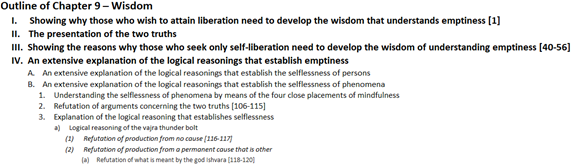
Shantideva now goes on to give reasons establishing the selflessness of phenomena. This is the largest section of Chapter 9. He essentially provides two main arguments establishing the selflessness of phenomena. The first is the four close placements of mindfulness. These look at the emptiness of the aggregates that form the basis of imputation for our I. The second method is to examine the relationship between emptiness and cause and effect. According to the Three Principal Aspects of the Path, Je Tsongkhapa says that when emptiness reaffirms karma and karma reaffirms emptiness, then our understanding of both emptiness and karma is correct. The outlines of Shantideva’s argument are quite detailed and it is easy to get lost in the details and forget what the main point is that he’s trying to establish. The goal is to establish the emptiness of phenomena. There are two ways that he does so: establishing the emptiness of our aggregates and establishing the emptiness of cause and effect. Everything else flows from this.

What follows is a classic meditation on the emptiness of our body. We are all familiar with this meditation since it shows up in all of our Dharma books. The fundamental point is we first need to identify the object of negation: the body that we normally see. The body that we normally see appears to exist from its own side, independent of our mind. It appears to be a singular entity we call my body. If such a body exists, it should be findable. There are three possibilities it is one of its parts, it is the collection of its parts, or it is somehow separate from its parts. There is no other possibility. If it cannot be found in one of these possibilities, then the body that we normally see does not exist. First, Shantideva looks to see if the body is one of its parts.

(9.78) Neither the feet nor the calves are the body,
Nor are the thighs or the loins.
Neither the front nor the back of the abdomen is the body,
Nor are the chest or the shoulders.

(9.79) Neither the sides nor the hands are the body,
Nor are the arms or the armpits.
None of the inner organs is the body,
Nor is the head or the neck.
So where is the body to be found?

None of the individual parts are the body itself, they are parts of the body.  We make a distinction between the parts and the part possessor.  The body itself is the part possessor, which is necessarily distinct from that which it possesses. 

(9.80) If you say that the body is distributed
Among all its different parts,
Although we can say that the parts exist in the parts,
Where does a separate possessor of these parts abide?

When we look, we find only parts.  There is no actual part possessor.  None of the individual parts of the body is the body, and there is no thing separate or within the body that is the possessor of these parts.  We simply have parts. 

(9.81) And if you say that the entire body exists
Within each part, such as the hand,
It follows that there are as many bodies
As there are different parts!

I don’t know anybody who actually thinks that the entire body exists within one of its individual parts.  Obviously that is absurd.  But, when we do a conventional search, that is exactly what we do.  Someone says, “point to your body,” and we then point to some part of our body and say, “it is here.”  We don’t mean that it is within an individual part, we are referring to the whole thing, but in fact we are just pointing to a part of our body.

(9.82) If a truly existent body cannot be found either inside or outside the body,
How can there be a truly existent body among the parts such as the hands?
And since there is no body separate from its parts,
How can there be a truly existent body at all?

Recall above we established that there is no fourth possibility.  Either the body is one of its parts, the collection of the parts, or separate from the parts.  But when we look in each of these three places, we cannot find something that is “my body.”  We only find parts, perhaps collected together, but there is no part possessor anywhere that is “my body.”  Yet, that is precisely the sort of body we normally see, grasp at, and refer to when we speak of my body.  When we look for such a body, we don’t find it anywhere.  If we can’t find it, then it does not exist. 

The danger is we have engaged in these sorts of contemplations perhaps hundreds of times, and they no longer move our mind.  We just intellectually go through them, “yeah, yeah, not one of its parts, not the collection, not separate, check.”  We need to instead, each time we meditate, go looking for the object just as we would go looking for our keys.  We know they have to be somewhere.  We have to be convinced we will find it so that when we don’t, we get the point – the body we normally grasp at and are convinced exists in fact does not exist at all.  There are just parts here, nothing more. 

(9.83) Therefore, there is no truly existent body,
But, because of ignorance, we perceive a body within the hands and so forth,
Just like a mind mistakenly apprehending a person
When observing the shape of a pile of stones at dusk.

(9.84) For as long as the causes of mistaking the stones for a person are present,
There will be a mistaken apprehension of the body of a person.
Likewise, for as long as the hands and so forth are grasped as truly existent,
There will be an apprehension of a truly existent body.

Normally we see a body within its parts.  But when we check, we do not find one.  The key question in identifying emptiness – what is the part possessor?  We think there is one, but when we check, there is none.  The analogy of a pile of stones at night is very good.  From a distance, we see a body, one that appears vividly to our mind.  But when we investigate closer, the appearance disappears and we see just a pile of stones.  In the same way, we see a body, one appears vividly, but when we check, we find only parts.  The appearance of a body is a mistaken apprehension.

Happy Buddha’s Return from Heaven Day: Returning to Help Those Less Fortunate

September 22 is Buddha’s Return from Heaven Day, one of the special holy days on the Kadampa calendar in which all of our virtuous actions are multiplied by ten million.  After Buddha Shakyamuni attained enlightenment, he went to the Land of 33 Heavens where his mother had taken rebirth, gave teachings to the beings of that realm, and then returned to this world to turn the wheel of Dharma here.  On this day, we can generate compassion for beings in the upper realms and generate the wish to return to this world as Buddha did so that the Dharma may flourish forevermore.

Understanding How Holy Days Work

There are certain days of the year which are karmically more powerful than others, and the karmic effect of our actions on these days is multiplied by a factor of ten million!  These are called “ten million multiplying days.”  In practice, what this means is every action we engage in on these special days is karmically equivalent to us engaging in that same action ten million times.  This is true for both our virtuous and non-virtuous actions, so not only is it a particularly incredible opportunity for creating vast merit, but it is also an extremely dangerous time for engaging in negative actions.  There are four of these days every year:  Buddha’s Englightenment Day (April 15), Turning the Wheel of Dharma Day (June 4), Buddha’s Return from Heaven Day (September 22), and Je Tsongkhapa Day (October 25).  Heruka and Vajrayogini Month (January 3-31), NKT Day (1st Saturday of April), and International Temple’s Day (first Saturday of November) are the other major Days that complete the Kadampa calendar. 

A question may arise, why are the karmic effect of our actions greater on certain days than others?  We can think of these days as a spiritual pulsar that at periodic intervals sends out an incredibly powerful burst of spiritual energy or wind.  On such days, if we lift the sails of our practice, these gushes of spiritual winds push us a great spiritual distance.  Why are these specific days so powerful?  Because in the past on these days particularly spiritually significant events occurred which altered the fundamental trajectory of the karma of the people of this world.  Just as calling out in a valley reverberates back to us, so too these days are like the karmic echoes of those past events.  Another way of understanding this is by considering the different types of ocean tides.  Normally, high and low tide on any given day occurs due to the gravity of the moon pulling water towards it as the earth rotates.  But a “Spring tide” occurs when the earth, moon, and Sun are all in alignment, pulling the water not just towards the moon as normal, but also towards the much more massive sun.  Our holy days are like spiritual Spring tides.

Generating Compassion for Beings in the Upper Realms

The vast majority of beings in samsara are in the lower realms.  In this world, we talk often about the 1% and the other 99% of the wealth distribution.  Samsara’s demographics are quite similar.  The Wheel of Life image sometimes gives a distorted perception that the six realms of samsara (gods, demigods, humans, animals, hungry ghosts, and hell beings) are roughly equally distributed, but in reality, roughly 99% of the beings in samsara are in the lower realms, whereas only about 1% are in the upper realms.  We know this to be true because roughly 99% of the actions of living beings in samsara are negative, and only about 1% are virtuous – meaning a cause for upper rebirth.  We might object that our actions are at least 50% positive – we are a good person after all – but the actions of beings in the lower realms are almost universally negative, so they remain trapped. 

When we talk about the 1%, we usually do so from a position of jealousy, resentment, and condemnation.  We are jealous of their wealth and power, resent the control they have over our lives, and condemn the many selfish and negative actions they engage in that harm the rest of us.  Wars, climate change, nuclear weapons, pollution, structural inequality, etc., are all caused by the decisions of the 1%, but the rest of us have to suffer the consequences.  Our natural instinct is to dislike or even hate the 1%.  Considering all the harm they do, generating compassion for them seems misplaced at best and twisted at worst. 

One of Buddha’s first acts was to go to the Land of 33 Heavens to give teachings, not just to his mother, but to all of the beings who had taken rebirth there.  In other words, he showed the example that we should also have compassion for the 1% – both in this world and in samsara. 

The method for generating compassion is the same for all beings – first, we generate a mind of love, considering their happiness to be important; and then we consider how they suffer.  The beings of the upper realms are also our mothers and so they are equally objects of our love.  Why should we resent them for whatever happiness and pleasant conditions they enjoy?  They created the karmic causes for such experiences, did they not?  They are also “living beings” and so are worthy of our love.  If Buddha loves them, why can’t we also?

How can we understand the sufferings of beings in the upper realms?  First, it is important to recall that we ourselves are among that elite group since we are human, and the human realm is considered an upper realm.  We are part of the 1%.  Human sufferings are quite manifest – we all get sick, if we are lucky we get old, and we all will die.  All of us already took rebirth.  All of these sufferings are inescapable and traumatic.  We also frequently encounter things we do not like, are separated from things we do like, and experience pervasive uncertainty about what happens next.  We all know these teachings, but we need to personalize them.  My mother in law had a terrible stroke that nobody wanted to encounter, much less her.  I have been separated from my family due to working in another country.  The whole world experienced pervasive uncertainty due to the Coronavirus.  All humans are experiencing these sufferings, regardless of how rich or powerful they might be.

Geshe-la explains in Modern Buddhism that demigods experience more mental pain than humans do.  We can see and understand how by considering the 1% of this world.  The 1% are extremely jealous of the 0.01%, and no matter how much they have, it is never enough.  My kids have had the good fortune to attend these amazing international schools around the world, but the vast majority of the families who put their kids in these schools are miserable.  They are constantly competing against one another, obnoxiously bragging about their kids in an effort to feel better than others, and worrying about their husbands running off with somebody younger and more attractive.  They work insanely long hours, experience tremendous stress at work, face constant criticism from others when the majority of them don’t do anything wrong, and they live in constant fear of losing it all.  I know hundreds of these people from all over the world, and I quite literally can’t think of one who is genuinely happy, and certainly nowhere near as happy as Aunt Paulette who doesn’t have a penny to her name, lives alone after her husband of 40 years died in a small apartment with little heat and faulty plumbing, in a tiny village in France. When you travel the world and see people of different levels of wealth, you can’t help but notice there seems to be an inverse relationship between having and being happy. 

The gods are no better off.  Venerable Tharchin explains that Greek Mythology is not myth, but rather a fairly accurate description of god realm society.  They are in constant conflict with each other, and their actions have terrible repercussions on millions in the other realms – creating horrific karma in the process.  There is a saying when an American sneezes, somebody in the developing world gets a cold.  Americans have tremendous power in this world and everything they do has spillover effects on the rest of the world.  The instability we create with our economic policy, wars, and negligence in controlling pandemics have echo effects around the world.  We are like the Hunger Games, living blithely in the capital while much of the world struggles to get by supplying our excesses. 

From a karmic perspective, those in the upper realms are quite unfortunate.  Sure, the karma that is ripening might be nice, but they are burning it all up and later will have nothing.  We get complacent when things are good and it is only when we suffer do we feel any motivation to practice Dharma, now try to imagine being a demigod or a god.  Bonfire of the vanities.  And even those who do take rebirth in the upper realms still have on their mental continuum all of the negative karma from when they were in the lower realms, and if they die with a negative mind, it will activate this negative karma and they will fall.  We respond to even mild adversities in life with negative minds, so it goes without saying that many people in the upper realms will likewise generate negative minds when they face the greatest adversity of all – their own death.  It is said gods can see their next rebirth.  Imagine the horror of reaching your death and knowing how far you will fall.

We may have studied these sorts of teachings many times in the past, but have we let them touch our heart?  We still, deep within our desires, wish for even a similitude of what the demigods and gods have.  We chase after these dreams, wasting our precious time, only to arrive at death and realize it was all for nothing.  We feel resentment or jealousy towards those whose good karma is burning up faster than ours.  How ridiculous.  What we need is compassion – just like Buddha had when he went to the 33 Heavens in the first place.

Returning to this World to Spread the Dharma

Buddha did not just go to the upper realms, he returned to help us.  Think about that.  How many of those who are in positions of great wealth, pleasure, or power return to help those less fortunate than they are?  The vast majority just wall themselves off from the unclean masses and try to turn a blind eye to the suffering around them, often while looking down on all those who are not as lucky as they are.  But Buddha returned.  Many people escape from poverty and enter into the middle or even upper classes; many people get out of their small towns and move to the big city where they enjoy great success; many people are the first in their communities to get a good education and go on to enjoy a life beyond the wildest dreams of those they grew up with; many people leave their country and move to rich countries; but very few of these return for the sake of those who were left behind.  The entire nationalist populist movement in the world today is a backlash against those who have enjoyed the fruits of globalization by those who were left behind.  Of all people, it was Trump who bothered to look back and even see these people.  Of course, he did so just to con them, but still – at least he looked back.  The rest of us…  But Buddha, he returned.

One of the best aspects of Jesus’ example is he made a point of seeking out those society had left behind, judged, and condemned.  He renounced the hypocrisy of those with wealth and power and lifted up the spirits of the downtrodden.  Despite being the Son of God, he returned and dedicated his life and his teachings to those less fortunate, those on the receiving end of oppression.  He returned. 

And so should we.  For us as Kadampas, it is an increasing time.  We are better off now than we were before.  There are many who we grew up with who have been left behind.  Maybe not in material terms, but certainly in spiritual terms.  When we are at our Dharma centers or festivals, we happily rejoin our friends, but think little of those who might feel alone or lost in the crowd.  When we start to gain some mental peace and stability, we start to become frustrated with “deluded people,” even using the Dharma to judge them in a sub-conscious effort to feel superior.  We start cocooning ourselves into smaller and smaller circles of like-minded people and view it as a chore to have to return to our families on the holidays.  The root of all negativity is self-cherishing, which is not just a mind that puts ourselves first but also neglects to bother caring for others.  We sometimes forget that latter part and content ourselves with not directly harming others.  Our failure to help when we otherwise could do so is a subtle form of harming others.  For somebody who travels Mahayana paths, they equally fear samsara and solitary peace, the latter being content to be absorbed in our own liberation while neglecting everybody else.  Buddha returned. 

If we are honest, it is terribly easy to call ourselves Mahayanists, but actually just be interested in our own freedom and happiness.  We generate ourselves as the deity in the pure land, but do we remember our compassionate reasons why we are bothering to emanate pure forms?  We may even be able to bring our winds into our central channel, but is our motivation bodhichitta or a wish for the bliss of mental suppleness?  Buddha returned.

On Buddha’s Return from Heaven Day, we should honestly examine our own behavior and see all of the different ways we neglect others.  We may not harm anybody, but we neglect almost everyone just in different ways.  We should ask ourselves, how can we return?  Who should we be returning to?  How can we emulate Buddha’s example?  We might think we will return when we become a Buddha, but if we never develop the habit of returning as a budding Bodhisattva, how will we want to return when we attain liberation? 

Returning doesn’t have to imply any physical action even, it is a mental attitude.  Do we give back?  Do we engage in our practices genuinely for the sake of others?  Do we say prayers?  Do we do powa for others?  Do we put others first in our daily actions?  All of these are returning.  Buddha returned, and so should we.

Returning to Spread the Dharma

The most important way in which we return is by dedicating ourselves to ensuring the Dharma flourishes forevermore.  Buddha did not just return to help people in worldly samsaric ways, he returned to help people escape from samsara as well.  Most people who escape from prison will not return to the prison to help everybody else escape as well.  Buddha does not seek for us merely that we enjoy a more privileged position in samsara, but he returned to tell us there is no happiness to be found anywhere within it.  He trains us to become qualified spiritual guides so we can help others likewise escape.  While we may leave samsara behind, like a good soldier, we leave nobody behind. 

Venerable Tharchin says we should each assume our place in the lineage.  The responsibility is on us to internalize the Dharma, then “return” to pass it on to the next generation.  We may not all do that as Dharma teachers, but we can do so as center administrators or even the person who secretly cleans all the toilets without anybody knowing.  Even if we do nothing physically to help others, through the power of our inner spiritual actions, we can bless the minds of everyone and pray for their well-being.  Some people think such actions are meaningless compared to “practical” (meaning physical) help, but Geshe-la explains that our mental actions are thousands of times more beneficial to others than anything we can do with our body or speech. 

At the end of every spiritual practice we do, we recite the prayers for the virtuous tradition.  Aligning our life with the meaning of this prayer is the actual meaning of Buddha’s Return from Heaven Day.  As Geshe-la explains, Je Tsongkhapa represented Buddha’s teachings, and his Dharma is Buddha’s Dharma.  Geshe-la has done the same for the modern world.  He returned.  This is the deeper, spiritual meaning of returning. 

So that the tradition of Je Tsongkhapa, the King of the Dharma may flourish, may all obstacles be pacified and may all favorable conditions abound.  Through the two collections of myself and others, gathered throughout the three times, may the doctrine of Losang Dragpa flourish forever more. 

Do Not Despair, No Matter How Hard it Gets

The bottom line is this: each person is experiencing their own little world of hallucinations. We are all schizophrenic from one perspective. A world appears vividly to our mind, and we respond to that world as if it were actually real, when in reality it is nothing more than our karmic hallucinations. This is equally true for everyone. The only difference is some people’s hallucinations are more calm or “normal” than others. But they are all equally hallucinations.

The challenge is we each have a different set of hallucinations, and they don’t necessarily correspond to what others are hallucinating. So we may be acting in a PERFECTLY RATIONAL WAY relative to how the world is appearing to us, our family is likewise acting in a perfectly rational way relative to how the world is appearing to them, and the same is true for everyone else. For us, it might make no sense how our family or society are acting. For our family, it might make no sense how we are acting. Many can’t understand how society is acting, but it makes sense to them relative to their world. Everyone then accuses each other of being crazy and they are the only normal one. Nope, sorry, we are all crazy – just a different kind of crazy.

So what can we do to address this? There are two things I am aware of:

First, instead of fighting with people about why they act the way they do, we need to improve our communication with them so we at least mutually understand one another. Ask them questions about how they perceive things and why they act the way they do, not out of defensiveness, but in trying to understand the world as it appears to them. Likewise, we can share our perspective with them so they understand how the world appears to us and why we act the way we do. They will continue to think they are in reality and we are in crazy land, but that’s OK. We understand we are all crazy, just in different ways. But virtually all conflict comes from misunderstanding each other’s appearing worlds. If we take the time to understand the world appearing to their mind better, there will be less scope for misunderstanding and conflict. Things will externally pacify somewhat at best or we will understand better at worst.

Second, regardless of what appears, respond with Lamrim minds. It doesn’t matter even if everything appearing to our mind is schizophrenic hallucinations (I know it isn’t, but it also is like it is for everybody else). The point is this is HOW the world is currently appearing to us, whether it has any grounding in reality or not. How the world appears to us is NOTHING MORE than a mere karmic appearance to mind. But it is OUR karma. It is OUR karmic dream, every last bit of it. The only way to change the karmic dream is to change our karma. There is no other way. The way to change our karma is to change our actions.

It is possible for us to change our karma for the worse or for the better. The choice is ours. The way we change it for the better is by trying, to the best of our ability, to put the Lamrim into practice. Try to recognize we have a precious human life with which we can accomplish spiritual goals. Admit that we may die at any point and could fall into the lower realms. Generate qualified refuge in your mind. Follow assiduously the laws of karma. Generate the wish to wake up from all our contaminated karmic hallucinations. Generate the wish to help others do the same – they think they are in reality when they are just trapped in a different kind of crazy. Dissolve the guru into your heart, and ask him to work through you, to bless your mind, to guide you out. Above all, rely on Dorje Shugden, requesting him to arrange all the outer, inner, and secret conditions you need to advance along the path to enlightenment.

If we do these things in our daily life, responding to whatever arises with some Lamrim mind, Venerable Geshe-la 100% guarantees us that things will get better. Not right away. They could get worse in the short term, who knows what karma we have created or has ripened, but if we play the LONG GAME, it is 100% guaranteed if we change our actions, we will change our karma, and that will change what appears to us. There is no doubt about this. Tantric practice is just a super-charged method of doing this.

Both of these solutions will require a great deal of patience. Things will take time. But they will help. And they will work in the long run. It doesn’t matter how lost we are or where we find ourselves, it is never too late to start heading in the right direction. If we never give up, we will eventually get to where we want to go.

We Can Purify Others, If They Created the Causes

Can we actually purify other or not? Can Buddhas do so? On the surface, it seems like we have contradictory teachings on the matter.

Sometimes we develop doubts coming from seeming contradictions in the teachings. Personally, I always find it helpful to lean into these apparent contradictions because resolving them usually leads to big breakthroughs in our understandings.

On the one hand, we have teachings that explain it is possible to purify others negative karma, such as when we are doing powa practice; we can actually take on others suffering, Jesus potentially being one of the world’s best examples of this; we can purify migrators, transforming them all into Dakas and Dakinis; we can do powa for others, transferring their consciousness to pure lands, etc. All of this is possible because others, including their minds, are empty.

But on the other hand we have teachings that say others have to solve their own problems and follow the path themselves, we can’t do it for them. Sure, we can set a good example, offer good advise, make prayers, but fundamentally they have to liberate themselves. If Buddhas could liberate us, they would have done so by now. Buddhas can’t take the delusions out of our minds like we can pull a thorn out of our foot.

So which is it? Can we purify others or not? How can both sets of instructions be true simultaneously? I’m aware of two answers.

First, we can purify others if they have created the karmic causes for us to do so. For example, we can create the karmic causes for somebody to perform life-saving surgery on us, we don’t have to perform surgery on ourselves. In the same way, we can create the karma for others to pray for us and for Buddhas to perform mental surgery on us. If we don’t create the karma for them to do so, they can’t; but if we do create the karma for them to do so, they can.

This has important practical implications. It means if we want others to pray for us, we need to pray for them; if we want others to perform powa for us, we need to do powa for them; if we want others to take on our suffering, we need to take on other’s suffering; and if we want Buddhas to transform us into a Hero or Heroine, we need to do the same towards others. All of these karmic actions create the causes for the three jewels to do the same towards us. The more we do these things for others, the more we create the karma for others to do these things for us.

The second answer I’m aware of is pure view is compassionate action. Normally we think of view as observing things objectively – things are a particular way and we see them. On the basis of that view, we then act. But for a Buddha, their pure view IS their compassionate action. By seeing us as completely purified, fully enlightened Buddhas, it functions to ripen us into one. We see this with our children, students, friends, and co-workers. When we see the good in them, see their potential, we help draw it out. It becomes more manifest. This works because it is correct imagination and others are empty. We can quite literally karmically reconstruct them into enlightened beings.

But how do we reconcile this with if this were possible, Buddhas would have already liberated us by now? The answer is shocking: from their perspective, they already have. Indeed, they see us, themselves, and all living beings as having always been Buddhas in all three times – as if samsara never was. We know this because this is exactly what we imagine in our tantric practices. We train in bringing the future result into the path. We see this now and believe it to be true. This is CORRECT imagination, meaning it is an imagination that also happens to be true. The more we meditate on correct imaginations, the more they start to appear directly to our mind and even to our sense consciousnesses to be that way – until eventually it is our direct perception.

Why do they view us this way if we are not actually enlightened? Don’t they know we are still drowning in samsara? Geshe-la taught at many festivals that for Buddhas, suffering sentient beings do not exist. But if they don’t exist, then who are they leading to enlightenment after they attain enlightenment themselves? These doubts arise from thinking we ARE or we AREN’T enlightened as some objective fact. The truth is it is a question of point of view. From our perspective as a practitioner, we are not but Buddhas are helping us get there. From the perspective of a Buddha, they have already led us all to the fully enlightened state – not because we are actually there, but because this view ripens us most quickly.

So yes, we can purify others. We should not doubt this at all. Indeed, our doubting this holds us back from even trying. Quite the opposite, we should make the yoga of purifying migrators our main practice as a tantric bodhisattva. In Mirror of Dharma, our oral instructions of Lamrim, VGL explains in his commentary to Avalokiteshvara practice that our main practice is purifying the six realms of samsara. We are meant to incorporate this instruction into our HYT practice. It’s great to transform ourselves into a Buddha, but imagine the wonder at transforming all living beings!

And indeed, it is by our taking the yoga of purifying migrators as our main practice that we create the karmic causes for others and the Buddhas to do the same for us. Not only can we purify others, we should orient all of our practices around this understanding, feeling that we are directly purifying and transforming all beings, their activities, their enjoyments, and their environments into complete purity, strongly believing that not only it is true, but that they experience it as such.

Tantric practice is incredibly radical, but when we see the connection between our training in the yoga of purifying migrators and the karma such a practice creates for us, we can easily understand how it is the quick path and it is possible to attain enlightenment, even in this very lifetime.

Modern Bodhisattva’s Way of Life: It’s Our Responsibility to Bring Emptiness to the World

(9.76) (Other schools) If living beings do not truly exist, who will gain the results of meditating on compassion?”
It is true that the cause, meditation on compassion, and the result, Buddhahood, do not truly exist; but they do exist nominally.
Thus, so that the suffering of all living beings may be completely pacified,
We should not reject the nominally existent compassion which leads to that result.

For us when we hear that they are dreamlike beings or that they are nominally existent and so forth it robs some of the thunder. We think therefore it does not matter. The extent to which we think this comes from are having fallen into the extreme of nothingness thinking that if things do not exist inherently then that means they do not exist at all.

All of the problems that arise with these sorts of doubts come from grasping at believing there is some part of reality that exists and some part of reality that does not exist. We hear the Prasangikas say that things do not exist inherently and even if we accept that, we then say OK all of those things do not exist, but there is something that does exist that is reality that I should worry about. But if everything is equally empty then this problem goes away. Our dreamlike self engages in dreamlike actions which create a dreamlike enlightenment to help dreamlike sentient beings. Everything is the same nature of a dream. It all functions, it all makes sense, it all has a point in the context of emptiness.

And finally:

(9.77) It is suffering and its causes that need to be abandoned,
And it is the ignorance of self-grasping that causes delusions and suffering to increase.
(Other schools) “But there is no way to abandon self-grasping so that it will never recur.”
On the contrary, meditation on selflessness, or emptiness, is the supreme method for accomplishing this.

In this world, more and more people are desperate to find solutions to their problems.  There are many samsaric methods for finding release from suffering, but they are all temporary and the problems come back, so they are not real solutions.  All the sufferings come back because we do not address the root cause of our suffering, our identifying with contaminated aggregates.  Only when people realize that none of these things are truly existent does sickness or any kind of suffering come to an end. Why?  Because we cease identifying with that which has problems.  In fact, we cease to appear such things in the first place.

It is our responsibility as Kadampas to provide the real solution, actual methods. It is our responsibility now to teach emptiness, the actual method to remove suffering from this world.  We need to gain knowledge of emptiness and experience of emptiness.  It is particularly important that we know how to teach emptiness, isn’t it?   We can start by helping people realize that their opinion of things, and therefore their experience of things, depends on their mind.  They have a choice what opinions they have of things.   Help people view their situations differently, as opportunities to improve themselves as people.  Even ordinary people can understand that your world is what you make of it.  Help them realize this and that they have choice.  Choice is the very essence of emptiness.

One thing that we are all learning is that we have to stop protecting ourself by self-cherishing means, because it doesn’t work. On the surface, self-cherishing seems to protect us, but through examination we know it just brings us more suffering.  Yet we keep being duped, don’t we?  We must rely upon wisdom in order to protect ourselves from suffering and to bring us happiness.  But this means choosing to listen to and follow our wisdom, which is not always easy because of strong habits and we think it is no big deal.  Geshe-la says we actually need to just forget about the object of our self-cherishing, more simply, forget about ourself.  Just work for others, which will include taking care of this instrument that we normally refer to as our self so we can help them more.

We also need to let go of the person we think we are.  So often we grasp at who we are, and then think we cannot change.   We need to give the spiritual guide a chance to change us, and he can only do this if we let go of our grasping at who we ‘are.’  We need to actively try to change ourselves – who wants to remain who we are, we need to aspire to be better people.  We need to want to leave our ordinary self completely behind.  This is easier for people who get ordained, but internally we need to do the same thing.  When you let go of self, and you just cherish others, wonderful changes will naturally take place.  A bodhisattva becomes whatever she is needed to be.  Such flexibility.

But to let go of our ordinary self and allow change to take place, we need to realize that our self-cherishing is not protecting us, but keeping us imprisoned.  Then, we will be able to break free.

We Need Never Worry

When we dissolve everything into the clear light, we don’t just dissolve our own body and mind into emptiness – transporting ourselves to the inner pure land – we also can dissolve the bodies and minds of everyone we love into emptiness – transporting them also to the inner pure land.

Just like us, their samsara is a mere karmic appearance to their minds, a hallucination they believe is real and suffer from. But their samsara is not just empty with respect to THEIR minds, it is also empty with respect to our mind. They suffer because they believe their samsara and they believe the lies of their delusions.

When we dissolve them into the clear light, we should imagine we are freeing them from the clouds of hallucinations that have been tormenting them and they are freed and delivered into the inner pure land where they enjoy infinite peace and omniscient wisdom.

Dissolving them into emptiness doesn’t make them cease, it just makes their samsara they normally see cease. Their minds remain, abiding in the bliss of the emptiness of all things.

We should feel that our meditations on emptiness are supreme acts of compassion and that those we dissolve into the clear light are directly blessed by the definitive guru because we dissolve the mental obstructions between them and his loving care.

When we think about it, if we allow their samsara to again reappear to our mind, it is like we are re-imprisoning them in a samsara of our creation. We can’t do that! So out of compassion, we again dissolve them back into the clear light, imagining we are re-delivering them to everlasting joy. This is Vajrayana Mahamudra.

All of this works because it is correct imagination and they are empty. There will of course be a lag between when we see them this way and they come to see themselves in this way, but if we keep at it for as long as it takes, eventually they will. This is why we need never worry.

Just as nobody can stop us from leaving the prison of samsara if we choose to do so, so too nobody can stop us from also freeing everybody else from samsara.

According to common appearance, it will appear as if they are freeing themselves (they will be blessed to start to do the right things, if not in this life in some future life), but from the uncommon perspective of our own enlightenment, we will directly perceive us having liberated all beings and they all abide with us in the pure land, not just at some point in the future, but always in all three times.

It will be as if samsara never was, not just for us, but for everyone. As Nagarjuna said, with emptiness, everything is possible.

A Pure Life: Abandoning Intoxicants (In particular alcohol and marijuana)

This is part nine of a 12-part series on how to skillfully train in the Eight Mahayana Precepts.  The 15th of every month is Precepts Day, when Kadampa practitioners around the world typically take and observe the Precepts.

One of our Mahayana precepts is to abandon intoxicants.  This includes drinking alcohol, smoking cigarettes, or taking drugs.  This is often one of the toughest ones for us to follow.  The object of this vow is obviously any intoxicant, whether it is legal or not.  Some people ask the question whether caffeine counts, after all it is highly addictive and many people relate to it no differently than other drugs.  And if coffee is an intoxicant, then aren’t all of the centers and festivals and World Peace Cafes constantly encouraging others to break their Pratimoksha vows?

Some people don’t like the answer I am about to give, but I will give it anyways.  Yes, I think caffeine can be considered an intoxicant.  I think nothing is really an intoxicant from its own side and everything can be an intoxicant for us depending on how we relate to it.  Sugar is not an intoxicant from its own side, but if we adopt an addictive attitude towards it, then for us I would way it is and likewise should be brought under control.  Likewise, many people get addicted to porn.  This is a very common addiction in the modern world, especially with the ease of access on-line.  This too can be a form of intoxicant for us depending on how we relate to it. Whether caffeine, sugar, and porn would be considered intoxicants as far as the Pratimoksha vows are concerned is debatable, but strictly speaking probably not. Should we nonetheless consider abandoning addiction to things a worthwhile goal on precepts day about abandoning intoxicants? Sure, why not.

Some objects, like cigarettes, alcohol and drugs are in a somewhat different category because their express purpose is to alter our mind.  This is the main point.  If we understand that our problem is our mind and alcohol and drugs help us change our mind, then can’t we argue that with them we are at least solving the right problem?  From one perspective, I guess we can say that.  But it is still a completely wrong thought.  Yes, we need to change our mind, but we need to change our mind with our mind.  We can think of our mind as like a muscle.  The more we exercise it, the stronger it gets.  The more we become dependent upon other things to change our mind, the weaker that muscle becomes.  Ultimately, we need a very strong mind.  Further, alcohol and drugs function to render our mind uncontrolled.  Our goal is to make our mind controlled.  So these things may change our mind, but they do so in a way that makes our mind more uncontrolled, and thus they take us in the opposite direction of where we want to go.

Let’s talk about alcohol

Alcohol in particular generally just makes us stupid.  The reason why alcohol is so dangerous is it primarily functions to undermine our inhibitions.  Our inhibitions are often what hold us back from engaging in negativity.  If we harbor in our heart a good deal of negative impulses, then when we consume alcohol, it erodes those inhibitions and our negativity is given free rein.  We all know stories.  Now, some people say that there is nothing wrong with being an occasional social drinker, especially if is done in moderation.  It is true that it is less bad, but that does not necessarily make it good.  It is true that it is good to be social, but how will you grow more as a person, by using the crutch of alcohol or doing the deep inner work of overcoming those delusions which prevent you from being a socially engaged person?  I am now a diplomat and I attend quite a number of social gatherings where virtually everyone is drinking.  I walk around with a glass of water or even orange juice in my hand.  At first, I hated these gatherings because I have never liked parties.  But I forced myself to learn how to become socially engaged, to let go, relax, and have a good time.  I learned how to be able to have a good conversation easily with anybody.  The secret to this is not complicated:  take a genuine interest in what others have to say.  Everyone has a lifetime’s worth of experiences waiting to be tapped, and all you need to do is be interested in finding out what they have to say.  Usually people only want to talk about themselves anyway, so it is not difficult to get the conversations started, and what you will find is because you have all of your mental faculties about you, you are better able to cherish the other person and occasionally pepper the conversation with some wisdom. 

Other people object saying having a glass of red wine every day has been medically proven to be good for your health.  I am not a doctor, so I cannot say whether this is true or not, but let’s just assume it is.  My question is simple:  isn’t moral discipline also good for your health?  Let us take a wild exaggeration of the benefits of drinking a glass of wine every day and say it adds 10 years onto your human life.  Surely that is extraordinary, is it not?  Surely that is enough justification to do it.  But every time we engage in the practice of moral discipline we create the substantial karmic cause for a rebirth in the upper realms, for example as a human.  If we assume an average lifespan of 80 years, what extends our experience of human life more, the 10 years or the 80?  And, just to take this a little further, if you practice this moral discipline every day from age 21 to 80, then that is 21,535 instances of moral discipline, each one of which creates the cause for at least another human rebirth of say 80 years, then keeping this vow will extend our experience of human life by 1,722,800 years!  Do the math.  Logic doesn’t lie. 

Let’s talk about marijuana

Some people agree that drinking alcohol just makes us stupid and taking hard drugs is just too dangerous, but they then ask what about marijuana?  People who have smoked almost all agree that it makes them more mellow and often gives them insights which are very similar and profound like what we realize with the Dharma.  There are also a great number of medical studies about the health benefits of this drug.  Let us face it, a very high percentage of Dharma practitioners have smoked pot in the past. 

Here the case is much harder, but still it is not worth it.  Why?  First, just as alcohol functions to undermine our inhibitions, marijuana functions to undermine our desire to do anything other than more marijuana.  This is true and anybody who has smoked knows what I am talking about.  Conventionally, people usually all agree that people who regularly smoke have less ambition and drive than they used to.  Whenever free time arises, their first impulse is to light up.  As we know from the lamrim teachings, desire is everything.  All of the lamrim meditations are ultimately about building up within us an unquenchable desire for liberation and enlightenment.  Marijuana deflates our desires, and the more we smoke the less we desire anything else. 

Second, if we are even slightly prone to psychiatric disorders, marijuana is downright dangerous.  When I was in Geneva, there were three different practitioners who were mentally completely normal prior to smoking marijuana, but they had latent potentials for psychiatric disorders, and after smoking regularly for a period of time, they all three developed very serious psychiatric issues, so much so that all three of them have spent a fair amount of time in mental hospitals.  We do not know what latent potentialities we have lurking under the surface, and smoking could activate them.  Perhaps we have smoked a few times without a problem and therefore think we are immune to this problem.  But we never know if we are just one joint away from tripping over some invisible karmic wire we did not know was there.

Third, marijuana is a gateway drug.  It is like crossing the Rubicon, and once we have done so, the other drugs that before we said we would never even consider trying suddenly no longer seem that different.  Marijuana seems to be OK, perhaps Ecstasy, opium, or a little blow might be OK too.  Geshe-la explains in the teachings on delusions that the easiest way to stop delusions is to do so early before they have gathered up steam.  Once we allow them to run a little bit in our mind, they can seemingly take on a force of their own and become unstoppable in our mind.  It is the same with drugs.  Just as they say it is easier to attain enlightenment once we have become a human than it is to become a human if we have fallen into the lower realms, so too it is easier to avoid marijuana now than it is to avoid using other drugs once we have started using marijuana. 

Finally, sometimes people object saying that when they smoke marijuana it gives them deep insights into the Dharma, so how can that be bad.  Perhaps it is true that when we smoke up, suddenly emptiness makes sense.  We see all the connections between the different Dharma teachings.  Such experiences can quickly and easily be used to justify doing it some more “for valid Dharma reasons.”  So again, just like with the health benefits of drinking a glass of wine every day, let us assume for the sake of argument that there are deeper insights to be had by smoking marijuana.  Once again, my question is simple:  isn’t having a precious human life also good for gaining spiritual insights?  Every time we practice moral discipline for spiritual reasons, we create the karmic causes for an entire precious human life.  So what gives us greater opportunities to gain spiritual insights, 80 years worth of a precious human life or a few hours each week for 80 years?  And this is setting aside the fact that there are diminishing returns.  Perhaps the first time we get high we feel the subtle vibrations of the cosmos, but do we get that same feeling the 20th time we get high?  Eventually, it starts to do very little for us.  So again, let us assume you smoke once a week for your whole life.  By taking this vow, you will train in this moral discipline 3,120 times (assuming you are 20 and live until you are 80).  3,120 actions of moral discipline translates into 3,120 precious human lives or another 249,600 years’ worth of precious human existence.  What will give you the opportunity to gain greater spiritual insight, 250,000 years’ worth of precious human life or a few random insights from being high?  Again, math does not lie.

The final thing I want to address is the situation of what happens if despite all of the above, we are ready to take the Pratimoksha vows for everything except this one related to intoxicants.  We just can’t bring ourselves to do it.  Should we hold off on taking the vows?  Normally, Geshe-la teaches that we generate the intention to one day keep all our vows purely and that is good enough. So by that logic, the answer would be we should take the vows and then gradually work with all of them until we can keep them better. But for technical reasons I don’t fully understand, apparently we can’t follow this logic with our pratimoksha vows.

So should we not take the Pratimoksha vows at all then if we find ourself in this situation? I would say there is nothing stopping us from formally taking all the other Pratimoksha vows as clear, absolute moral disciplines, and then we take the one at the level of intention of working gradually with the vow until one day we can keep it perfectly too. Have we taken Pratimoksha vows in this way? Technically no, but we’ve taken something very close to them. So there is no reason to not do this. It makes absolutely no sense to refrain from all moral discipline just because you cannot do one act of moral discipline perfectly.  How is that any better? 

Now it is true that we cannot take all of the Pratimoksha vows except the one regarding intoxicants, we need to work with all of the vows, but we can work with each one at different levels according to our capacity.  Just as Buddha skillfully encouraged the butcher to no longer kill animals at night, so too we can skillfully promise to refrain from taking intoxicants in some circumstances, such as never do so while alone.  Or not on Tuesdays, whatever.  Start somewhere, and then gradually expand the scope.  What matters is that mentally you understand the value of moral discipline and you maintain the intention to one day keep even this vow purely.  It is better to get incomplete benefits from imperfect Pratimoksha vows than it is to get no benefit from no Pratimoksha vows.  So don’t let this wrong understanding prevent you from getting started on the path of improving your moral discipline.