Modern Bodhisattva’s Way of Life: It’s Prasangikas vs. Proponents of Things

(9.3) Of those who assert the two truths, two types of person can be distinguished:
Madhyamika-Prasangika Yogis and proponents of things.
The views held by the proponents of things, who assert that things are truly existent,
Are refuted by the logical reasonings of the Prasangika Yogis.

There are many different philosophical schools of emptiness.   The highest view of emptiness is the Madhyamika-Prasangika view.  As a shorthand, usually we just refer to this as the Prasangika view.  Shantideva is a Prasangika.  From a Prasangika point of view, there are two types of being:  proponents of things and Prasangikas. A proponent of things believes that objects do truly exist. There is something that is a car, a computer, and so forth that exists independent of the mind within the object.

A Prasangika, or a proponent of no thing, says that nothing truly exists. There is no object that exists from the side of the object. If we look, we cannot find something that is the computer, something that is the car, and so forth. A proponent of things believes that we can find something that is the object.  A Prasangika says when we look with wisdom, we cannot find anything. Amongst the proponents of things, there are many different philosophical schools about where exactly we can find the object that truly exists. Some say the object exists in the material substance, some say it exists as the collection, some say it exists inside the mind, but that the mind itself truly exists, and so forth. All proponents of things believe that the object itself can be found upon investigation. The Prasangikas refute all of these views. 

The table for example is a thing.  According to Madhyamika-Prasangikas, there is no-thing that is the table.  There is nothing that is the table. Madhyamika-Prasangikas are proponents of no thing.  Unlike us, proponents of things believe that there exists something that is a table. There can be found something that is table.  Different schools believe it is a different thing that is the table.  The Prasangikas refute all of these views. 

(9.4) Moreover, among the Prasangika Yogis, there are different levels of insight –
Those with greater understanding surpassing those with lesser understanding.
All establish their view through valid analytical reasons.
Giving and so forth are practised without investigation for the sake of achieving resultant Buddhahood.

The first line that there are different levels of insight amongst the Prasangikas does not mean that they are realizing a different emptiness. For a Prasangika, all emptinesses are the lack of inherent existence. The different levels of insight correspond with the different degrees to which the Prasangika realizes directly not all phenomena lack inherent existence.

Another way of understanding the different levels amongst Prasangikas is the motivation with which we realize emptiness. In general, we can say there are two levels of philosophical tenants:  Hinayana and Mahayana. Normally when we talked about Hinayana and Mahayana we are talking about the motivation of the practitioner. A Hinayana practitioner seeks individual liberation, and a Mahayana practitioner seeks full enlightenment. The Hinayana schools of emptiness are the Vaibhashikas and the Sautrantikas.  And the Mahayana schools of emptiness are the Chittamatrins and the Madhyamikas.  We will get to know the tenets of these four schools of emptiness as we progress through Shantideva’s explanation. At this point, we can note that it is possible to hold Hinayana philosophical tenants yet possess a Mahayana spiritual motivation. Likewise, it is possible to be a holder of Mahayana philosophical tenets yet possess a Hinayana spiritual motivation.

We also need to be very clear on our motivation for meditating on emptiness.  It is not enough to just gain an intellectual understanding of emptiness within our mind, we need to firmly establish that things are actually this way.  When this is established within our mind, the more things appear different than the way we know they are the more it will confirm for us that things are empty.  It is like when Neo went back into the Matrix after he found out what it really was – the Matrix still appeared vividly, but he knew it was just a simulation.

To emphasize this point I will read what Geshe-la says in Eight Steps to Happiness in the chapter on ultimate Bodhichitta.  We can remind ourselves of this as we study Shantideva’s verses.  Right at the very end of the chapter he says:

“When we study emptiness it is important we do so with the right motivation. There is little benefit in studying emptiness if we just approach it as an intellectual exercise. Emptiness is difficult enough to understand, but if we approach it with an incorrect motivation this will obscure the meaning even further. However, if we study with a good motivation, faith in Buddha’s teachings, and the understanding that a knowledge of emptiness can solve all our problems and enable us to help everyone else solve theirs, we shall receive Buddha’s wisdom blessings and understand emptiness with greater ease. Even if we cannot understand all the technical reasoning, we shall get a feeling for emptiness, and we shall be able to subdue our delusions and solve our daily problems through contemplation and meditation on emptiness. Gradually our wisdom will increase until it transforms into the wisdom of superior seeing and finally into a direct realization of emptiness.”

The last line of this verse refers to the apparent contradiction between realizing that everything is empty and engaging in virtuous actions towards other living beings. If the beings we normally see do not exist, then why bother engaging in virtuous actions towards them. Shantideva says we can overcome this objection by simply engaging in virtuous actions without investigating more closely the exact nature of the existence of living beings. The main point here is we do not practicing giving, moral discipline, etc., because there are really other beings there, but because by doing so it functions to create the result of enlightenment within our mind.  For example, when we do taking and giving practice, we strongly believe that we have actually liberated all living beings from their suffering.  We do this not because we actually have liberated all beings, but by believing we have we complete the karmic action we are after which will ripen later in the appearance of our dream filled with beings free from all suffering.


Modern Bodhisattva’s Way of Life: What are the Two Truths?

(9.2ab) The two truths are explained as conventional truths and ultimate truths.
Ultimate truth, emptiness, is a non-affirming negative phenomenon

Shantideva says emptiness is a non-affirming negative phenomena.  This explains the nature of the realization of emptiness itself. Here we need to use some technical terms, but I will try explain them in a simple and easy to understand way. The technical term is emptiness is a non-affirming negative phenomena. What does that mean? A negative phenomena is a phenomena that is realized by negating something else. For example, if I see the lack of money in my wallet, I realize that I am poor. The object of negation is money, I see it’s lack, and I realize that I am poor.  The lack of money is a negative phenomena.

A non-affirming negative phenomena is best understood by understanding what is an affirming phenomena. For example, if we say the fat man does not eat at night, then he must eat during the day. If someone grasps at gender binaries, and I say this person is not female, then we understand that the person is male. If I say in a coin toss it is not heads, then it implies that it is tails. These sorts of binaries are all examples of affirming negative phenomena. By negating one possibility, it necessarily implies the other possibility.

Emptiness, however, is a non-affirming negative. By negating its object, it does not affirm any other positive phenomena. It is simply the mere lack of something. The example that is traditionally given is space. Space is the lack of obstructive contact. The lack of obstructive contact does not imply or affirm any other phenomena. It is simply a mere lack of obstructive contact. This mere lack can have great meaning. For example, if I remember parking my car in space 24, and I then go to that space and see the mere lack of my car, this mere absence has great meaning. But it does not affirm any other positive phenomena. In the same way, emptiness is the mere lack of inherent existence, mere lack of existence from its own side, mere lack of independent existence, and so forth, but realizing this mere lack does not affirm any other phenomena. Nonetheless, it has great meaning. The meaning of emptiness is there is nothing to worry about, there is no one criticizing us, there is no death, no birth, and so forth. All of these things do not actually exist.

(9.2cd) That cannot be realized directly by a mind that has dualistic appearance,
For such minds are conventional, and thus mistaken awareness.

Once again Shantideva gives us some technical terms that we need to understand in order to grasp the meaning of emptiness that is presented. The first term is dualistic appearance. Dualistic appearance is when an object appears to be one with its inherent existence. Inherent existence is when we fail to see the difference between the basis of imputation and the imputation itself. We see the object itself as its basis. Dualistic appearance is when we see an object, we simultaneously see it as inherently existing or existing from its own side. Two things are appearing to our mind – the object itself and its inherent existence. This is dualistic appearance. The opposite of dualistic appearance is the union of appearance and emptiness. Here instead of the object appearing to be one with its inherent existence it appears to be one with its underlying emptiness. What we see is emptiness, but it appears as a form.

The second key term Shantideva refers to here is conventional appearance. A conventional appearance is something that we normally see, for example a car, a computer, or our best friend.  They are called conventional appearances because we all agree on the name to call these different objects. For example, when we see something with four wheels, a chassis, a motor, and seats, we call it a car. When we see a screen, a keyboard, and microchips, we call it a computer. The names car, computer, and so forth are the names we all agree by convention to call these specific objects with these particular functions. 

But fundamentally, conventional appearances are mistaken appearances. The things that we normally see appear to exist from their own side, independent of mind.  So while they appear, they do not in fact exist. Hence, they are mistaken. This can give rise to the question of whether Buddhas see conventional appearances. Does a Buddha see a car or a computer? If they don’t, how can we say they are omniscient? The answer is no, a Buddha does not see conventional appearances because conventional appearances are mistaken appearances and Buddhas only know truth.  Only emptiness is the truth. How can a Buddha see something that is not true?  So does that mean a Buddha only sees the clear light emptiness like a vast empty space? No, a Buddha does not just see the clear light emptiness. They do just see emptiness, but emptiness can appear in myriad different ways. Sometimes emptiness appears as a computer, sometimes it appears as a car, sometimes it appears as the clear light. Buddha sees only the infinite space of emptiness, but that emptiness appears in countless different ways. Therefore, Buddhas do see computers, cars, and so forth, they just don’t see the conventional appearances of computers, cars, and so forth that we normally see.  The things we normally see do not exist at all.

This can also give rise to the question of whether Buddhas see us seeing conventional appearances. The short answer is no, they do not. They see us as Buddhas seeing everything purely. They do not see us in this way because we objectively are Buddhas seeing things purely.  In fact, we are not objectively anything. Buddha’s see us seeing everything purely because this view functions to ripen us so that we are ourselves able to view things in this way. For ordinary beings they see suffering, and then engage in virtuous actions. For a Buddha, their pure view of us is their compassionate action. The duality between view an action has dissolved.

To keep it simple:  Ultimate truth is emptiness – that there is no thing that exists from its own side.  Conventional truth is things are nothing more than dream-like projections of mind.  If you look for something more than just a projection of mind, you find nothing.  Truth is relative.  Relative to conventional reality, a schizophrenic’s world is a mistaken appearance.  Relative to ultimate reality, conventional reality is a mistaken appearance.  Only emptiness is truth, but it can appear in countless ways.

Modern Bodhisattva’s Way of Life: Method Practices are Preparations for Realizing Emptiness

(9.1) Buddha taught all the method practices explained above
To enable us to complete the training in wisdom realizing emptiness.
Therefore, those who wish to liberate themselves and others from suffering
Should strive to develop this wisdom.

This is an important point:  the purpose of all the method practices is to help us gain the realization of emptiness, because only that can end samsara.  If we think samsara is created by something other than our mind, we can never become free of it.  When we realize everything is empty, we realize all that needs to change is our own mind.  Liberation is possible because it is entirely within our control.

Love and compassion alone are not enough, because they still grasp at beings existing outside of us.  It will take us a long way, but it will leave the roots in tact.  Only by realizing emptiness can we bring an end to all the suffering of all living beings because we stop projecting it.

At the end of the day, samsara is a dream created by delusions.  As long as its creator exists, samsara will continually be re-created.  If we can replace its creator – delusions – with its opposite – wisdom – then samsara will quite simply cease to be created.  If we stop creating new contaminated karmic seeds, the ones already on our mind will gradually exhaust themselves, either through purification or ripening.  Deluded minds activate contaminated karma.  If we eliminate all of our delusions from our mind, we will stop activating contaminated karma, and samsara will cease to appear. 

A Buddha is a being that has removed the two obstructions – the delusion obstructions and the obstructions to omniscience.  Just as all waves are the nature of water, so too all delusions are the nature of the ignorance of self-grasping.  If we remove the water, waves cannot arise – ever.  The wisdom realizing emptiness opposes self-grasping directly, and in so doing, opposes all other delusions indirectly, thereby removing the delusion obstructions.  Once we have removed the delusion obstructions, we attain individual liberation. This is also sometimes known as Nirvana. It is a permanent state in the sense that if we never generate delusion it is impossible for us to activate any contaminated karma potentialities that remain in our mind, so we never fall back into samsara, even though the karmic potentials to do so remain on our mind.

The obstructions to omniscience are the contaminated karmic potentialities on our mind from our past actions motivated by delusion.  Each one of these seeds, if ripened, would create a samsaric experience.  In order to purify the obstructions to omniscience we need to purify our very subtle mind of all of these contaminated karmic potentialities. The method for doing so is realizing the emptiness of our very subtle mind. When we connect with the emptiness of our very subtle mind it functions to uproot all of our contaminated karmic potentialities directly and simultaneously. In this way we gradually purify our very subtle mind of the obstructions to omniscience and attain enlightenment. From this perspective it is easy to see how the wisdom realizing emptiness overcomes both the delusion obstructions and the obstructions to omniscience.  Therefore, if we want to attain liberation or enlightenment we must gain the wisdom realizing emptiness.

It is useful to re-examine each of our method practices from the perspective of how it helps us to realize emptiness.  The method practices help us create the mental environment for realizing emptiness.  By seeing the connection between wisdom and our method practices, we will understand the deep meaning of the method practices.  All of our method practices are made more powerful when they are conjoined with an understanding of emptiness.   For example, dedication.  If things existed outside of the mind, our dedication is useless.  But because things are coming from our mind, our dedications can and have worked miracles. 

Back in 2013, I did an extensive series of posts where I looked at all of the stages of the path of lamrim, lojong, and Mahamudra from the perspective of emptiness.  We can do the same, meditating on the union of emptiness and each of the 21 lamrim meditations, the six perfections, and the two tantric stages.  When we build these connections within our mind, we realize that everything we have been taught has a deeper meaning – one informed by ultimate truth emptiness.

Modern Bodhisattva’s Way of Life: Overview of Chapter 9 as a Whole

Preparation 6:  Big picture overview of the whole chapter

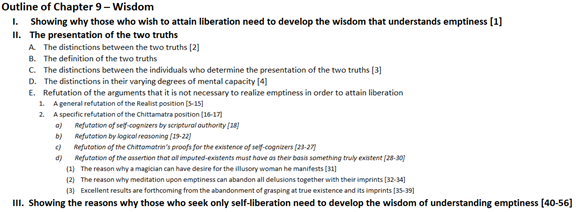
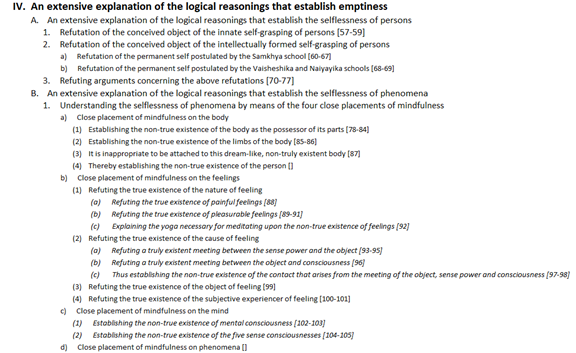
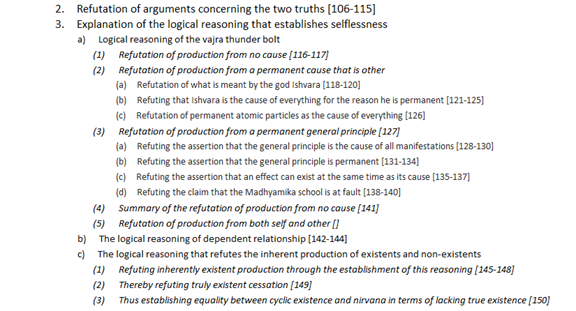
As we go through the verses, I will add in where we are within the overall outline of Shantideva’s chapter.  Without this, it is easy to get lost as to what is the main point of each verse.  Each verse is building towards a main argument or point, which is indicated by the outline heading.  It is helpful to look at the outline as a whole.  This is like first looking at a map of the whole city before we look at the specific streets in any given neighborhood.  Having an overall understanding of how the city is laid out gives us an appreciation of how each neighborhood fits within a larger mosaic.

Shantideva’s presentation of the perfection of wisdom has five main parts. The first, the third, and the fifth are all exhortations encouraging people to develop this wisdom. And the second and the fourth part of his presentation actually explain the teachings on emptiness. It is not enough for us to know what emptiness is, we have to be actually motivated to try realize it ourselves. It is our motivation which determines the karmic effect of our wisdom, not the wisdom itself. For our meditation on emptiness to lead to liberation and enlightenment, our practice needs to be motivated by renunciation and bodhichitta.

In the second part on the presentation of the two truths, there are essentially two main parts. The first simply introduces what are the two truths. And the second refutes the arguments made by those who say we do not actually need to realize emptiness. This is important because we might begin to become discouraged during our study of emptiness and ask ourselves whether it is worth it. But if we recognize that we will never end our suffering until we realize emptiness, then we will be extremely motivated to gain this realization understanding it is not only the panacea for all our problems it is the only solution to all our problems.

The fourth part of Shantideva’s explanation is also primarily divided into two parts:  the explanation of the emptiness or selflessness of persons and an explanation of the emptiness or selflessness of phenomena. Because all things can be divided into persons or phenomena, if we realized the emptiness of both of these, then we realize the emptiness of everything. In particular, Shantideva goes into an extensive explanation of the emptiness of phenomena. He does so first through looking at the four close placements of mindfulness, namely close placement of mindfulness of the body, of feelings, of the mind, and of phenomena. Second, he looks at the relationship between the production of phenomena and their emptiness. Normally we think if things are empty they cannot produce anything, but actually if anything is produced it reveals that it is empty.  

Modern Bodhisattva’s Way of Life: What’s with All the Debates in Emptiness Teachings?

Preparation 5:  Understanding how to relate to philosophical debates about emptiness

Throughout Shantideva’s explanation of emptiness he refers to many different philosophical schools of thought.  the names of these schools, such as the samkhyas the chittamatrins, and the prasangikas are all very unfamiliar to us. The debates between the different schools can seem academic and since we have never actually met someone from these philosophical schools it can seem to have little meaning. So how can we understand these discussions?

Fundamentally, the presentation of the views of the other schools are designed to help us to better identify the object of negation.  As Gen Tharchin explains, 80% of realizing emptiness is correctly identifying the object of negation.  The debates between the Prasangikas and the other schools helps us identify different common forms of grasping we might still be holding onto.  By presenting them as different philosophical schools, we can see within our own mind how we have similar grasping.  When we see clearly how we have such views, the debates with the Prasangikas will function to dismantle the wrong views within our own mind.

Concretely, how can we understand these debates?

First, they are like a ladder that gradually brings us to the final view of the prasangika. By refuting each of the lower schools, we are able to leave behind an aspect of our ignorance. And each time we do, we move up the ladder closer to the final view. 

Second, we need to identify these different schools of thought in our own world. The views represented by these different philosophical school schools do in fact correspond with philosophical views many people or different religions hold. Therefore, it is helpful to connect the views of the different philosophical schools with common philosophical views we find in our modern world.

But third and most importantly, we must identify within our own mind how we are still grasping onto the views of these lower schools in our own thinking. If we do not recognize how we are in fact holding onto the views of these lower schools but just do not realize it, then the prasangika refutations of the lower schools will lack power. But if we see clearly how in fact we are holding such views, then the prasangika refutation will directly dismantle our ignorance. In this way, contemplating these different debates is itself a practical method for bringing our mind to a correct view of emptiness.

Since we know that the final view Geshe-la wants us to have is that of the prasangika, we can often think that the views of the lower schools are irrelevant and wrong and we can just look at the highest view. This is a mistake. Instead, when we read the objections of the lower schools, we should identify how we ourselves have the doubt that is being expressed by the lower school. We need to look into our mind and see how we do hold onto the views that they espouse. We might not ever call ourselves a samkhya, but we all definitely have samkhya tendencies. We need to find these tendencies within ourselves, and then the prasangika refutation will be extremely powerful in our mind. As we go through the debates in Shantideva’s presentation, I will introduce the basic tenants of each of the lower schools when we first encounter them so we know where they are coming from. For a complete explanation of tenets, please see the appendix in Ocean of Nectar. This is not an intellectual philosophical game, it is a practical method for bringing our mind to the correct view of emptiness.

Modern Bodhisattva’s Way of Life: Understanding Emptiness Through Analogies

Preparation 4:  Understanding key analogies for realizing emptiness.

By way of further introduction, I think it might be helpful to discuss some of the main analogies Geshe-la uses to illustrate the meaning of emptiness. The most frequently used analogies are dreams, illusions, holograms, waves on the ocean, and the blue of the sky. I will now discuss each in turn.

Phenomena are like dreams:  One of the most effective analogies for illustrating the meaning of emptiness is all phenomena are like dreams. It is easy to understand how dreams are merely projections of our mind. If we dream of an elephant, we do not then go looking in our room for the elephant after we wake up. The appearances of our dream simply disappear when we wake up, and we understand that they never truly existed. They were simply projections of our mind. The only difference between last night’s dream and today’s waking world is the mind perceiving the appearances. Our dream mind is a subtle mind and our waking mind is a gross mind but the appearances in dreams, and the appearances in our waking state, are both equally mere projections of our mind.  The appearances themselves are exactly equal in nature. They have no existence other than projection of mind. If we go looking for something that is more than just mere projection of mind we find nothing. Even modern quantum physics confirms the truth of Buddha’s teachings 2,500 years ago. Quantum physics says objects come into existence when they are observed. The object itself is a projection of our mind, just like a dream.

Illusions:  Phenomena are also likened to illusions. An illusion is something that appears in one way but actually exists in another. The classic example is an illusory tiger manifested by an ancient magician. To the people in the audience, they see a living tiger; but for the magician, he understands it is an illusion. In the same way, all phenomena appear in one way but actually exist in another. They appear to be truly existent or existent from the side of the object, when in fact neither of these things is true. Perhaps a more modern example is taking psychedelic drugs. When people take LSD for example, all sorts of hallucinations appear vividly to their mind, but none of these things actually exist. Or another modern example would be someone with schizophrenia. People, places, and things appear clearly to their mind but they do not in fact exist.

Holograms:  Holograms are things that can appear in different ways depending upon how you look at them. For example, at Disneyland on the ride Pirates of the Caribbean, there is a room you pass through which has a bunch of faces. At the first angle they appear to be friendly, normal people; but when you move a little bit farther along, they then appear to be Pirates. So what is actually there? A kind person or a pirate? The truth is neither is actually there – from one perspective it is a kind person and from another perspective it is a pirate. The same is true for all phenomena. Different people looking at the same person, for example, can see a friend, an enemy, or a stranger. Their mother would look at the same person and see their child. A boss might see an employee, a child might see a parent, a con man might see a potential victim, and so forth. So who is actually there? Nobody. The person is neither child nor parent nor friend nor enemy nor any of these things.  Who and what they are depends upon the perspective with which we look at them. If the person was truly existent, then they would appear the same to everybody. The fact that they do not, shows that they do not truly exist.

Waves on the ocean:  One of my favorite analogies for emptiness is waves on the ocean. Each phenomenon is like a wave on the ocean of our mind. We can nominally differentiate one wave from another, but all of the waves are equally the ocean. You cannot ever separate the wave from the ocean, nor one wave from another – they rise and fall in dependence upon one another.  In the same way, all phenomena are like waves on the ocean of emptiness. We can nominally differentiate one phenomenon from another, but all phenomena are equally empty. They are all equally emptiness appearing in different forms. Or more specifically, when we look at phenomena, what we are seeing is emptiness appearing in different ways. Just as when we look at waves, we are seeing the ocean appearing in different aspects.  The prasangika view of emptiness says all things are manifestations of their emptiness, like waves are manifestations of the ocean. The tantra prasangika view goes one step further and says that all phenomena are by nature our mind of great bliss and our mind of great bliss is the nature of emptiness.

Blue of the sky:  In Mirror of Dharma, Geshe-la spends a great deal of time explaining the union of appearance and emptiness. The union of appearance and emptiness is Buddha’s final view. The analogy he gives for illustrating the relationship between appearance and emptiness is the blue of the sky. when we look at the sky, it appears blue. What we are looking at and seeing is the sky, and it appears blue. We certainly cannot separate the blue from the sky, but we also do not say we are looking at blue, we say we are looking at the sky. In exactly the same way, a Buddha looks at and sees emptiness everywhere appearing in myriad different ways. Their mind is never separated from the wisdom realizing the emptiness of all phenomena, but they nonetheless are able to see this emptiness appearing in all of its different manifestations. When I look at my shrine, for example, I see emptiness appearing as my shrine. As Geshe-la says in Mirror of Dharma, when we see our body, in truth we see only the emptiness of our body because the real nature of our body is its emptiness. He goes on to say, we realize the non-dual appearance and empty as an endless space of emptiness. In Essence of Vajrayana, Geshe-la explains that Heruka has serene eyes symbolizing that his mind never leaves emptiness, yet he remains omniscient knowing directly and simultaneously all phenomena.

Modern Bodhisattva’s Way of Life: 80% of Realizing Emptiness is Identifying the Object of Negation

Preparation 3:  Understanding clearly the object of negation

Before we dive into the actual verses of Shantideva’s explanation of emptiness, I first want to say a few words about the object of negation of emptiness. Gen Tharchin explains that 80% of realizing emptiness is correctly identifying the object of negation. If we know what exactly we are negating, then emptiness is simply the mere absence of that. The non-existence of that. If we do not correctly understand the object of negation, then our understanding of emptiness is merely fabricated and almost certainly wrong. Sometimes we are in a rush to get to the final object of emptiness, but this is a mistake. Instead, we should spend the majority of our time correctly identifying what exactly it is we are negating before we engage in the actual contemplations which dismantle our grasping at the existence of the things we normally see.

Geshe-la explains several different ways of understanding the object of negation. Each one is of course synonymous – there is only one emptiness. But each formulation of the object of negation reveals a different aspect of it that then enables us to better understand what exactly it is we are negating. Therefore, I thought it would be helpful to first explain each of these different ways of understanding the object of negation so that when we enter into Shantideva’s explanation, we know what exactly he is talking about. Geshe-la alternatively refers to inherent existence, true existence, existence from its own side, independently existent, and the things we normally see. I will now explain each one in turn.

Inherent existence:  The most common explanation of emptiness in the majority of Geshe-la’s books is the absence of inherent existence. Emptiness is the mere lack of inherent existence.  What exactly is inherent existence?  Inherent existence means that the existence of the object inheres in the object itself. In other words, there is no difference between the object and its basis of imputation. We think the object itself is its basis. The car is the car, the tree is the tree, its existence is inside itself – its existence is itself. When we engage in the traditional meditation as explained in the Meditation Handbook on looking for the body that we normally see, the I that we normally see and so forth, we are looking for where is the object. We say it can be found either as one of its parts, as the collection of its parts, or as separate from its parts. Inherent existence means we can find the object itself inside the object. The key point of the Prasangika view of emptiness is recognizing the distinction between the basis of imputation and the object itself. When we see the imputation as distinct from its basis, we see the lack of inherent existence. When we see the basis of imputation and the object itself as one in the same, then we are grasping at inherent existence.

True existence:  True existence is if the object exists in the way in which it appears. Objects appear to exist from their own side, independent of the mind. It seems as if objects exist “out there” waiting to be observed, and our mind has no role whatsoever in bringing these objects into existence. True existence, therefore, is assenting to this appearance. We conceptually believe that objects do indeed exist in the way that they appear. We do not think that the appearance of objects existing from their own side is incorrect, rather we think it is exactly correct – that is how objects exist. 

Existence from its own side:  existence from its own side means that the object exists on the side of the object itself and not on the side of the mind. Normally we say there are two things: subject and object.  The subject is the person who or mind that knows and the object is what is known. We say I know John. In this example “I” is the subject “John” is the object. How does John exist? When we believe in existence from its own side, we think that John exists on the side of John. We believe that our mind has no role whatsoever in bringing John into existence. Existing on the side of the object and objectively existing are synonymous. In our normal way of talking about things we refer to a subjective perception of something and an objective perception of something. The subjective perception of something is seen to be false and dependent upon the person who is looking at it, whereas an objective perception of things is supposedly neutral and accurate and true for how the object actually exists from its own side. For example, we could say that is objectively good. To say something is objectively anything is to say that its existence is established on the side of the object itself. In truth, nothing is objectively existent, everything is subjectively existent. Believing that there is such a thing as objective existence of anything is ignorance, and the object of negation of emptiness. All of modern science is based on the assumption that we can objectively describe things. Every other discipline nowadays is trying to be more and more like science. Economics, sociology, political science, etc., all of these things are trying to be more science-like and describe things objectively. We often say someone who is objective has a better view than someone who is merely offering their subjective opinion. We even place a value judgment saying objective is better when in fact objective does not even exist.

Independently existent:  Another way of understanding the object of negation is independently existent. Objects exist independent of other things. This is how things appear to us. We think that we exist independently of others. We think others exist independently of us. We think our computer exists independently from our table. The list goes on and on.  To exist independently means to not depend upon other things for being able to come into existence. Everyone knows that a rainbow is a dependent-arising. When water and sunlight come together at a particular angle it creates the appearance of a rainbow. Without the water and without the sunlight, there is no rainbow. We know that the rainbow exists in dependence upon these causes and conditions. Independent existence is thinking that things exist and arise independently of other things. Of course, even superficially thinking about things we recognize that nothing exists independently of anything else, but our ignorance nonetheless innately grasps at things as existing independently of everything else. For example, because we think our self exists independently of others, it makes sense to us to cherish only ourselves and not others. When things happen to other people, we think it does not matter because we believe it is not happening to us. We think this because we think we are independent of others and others are independent of us. In many ways understanding the dependent nature of all phenomena is the easiest way of understanding emptiness. That is why Shantideva spends so much time discussing how objects come into existence.

The things we normally see:  In recent years, Geshe-la has primarily focused on explaining the object of negation of emptiness as “the things we normally see.” In Mirror of Dharma, Geshe-la says everyone knows that emptiness is the lack of inherent existence, but despite having this intellectual understanding our delusions are not changed. We remain just as deluded as before. The object of negation simply is an intellectual abstraction, and not our actual innate ignorance. The phraseology of the things we normally see counters this. What is my self that I normally see? It’s Ryan. The Ryan that I normally see. What is the body that I normally see? It’s my body that I look at and see in the mirror. There is no need to make it more complicated than that. It is simply the body that I normally see. The same is true for cars, our friends, the world, and all other phenomena. Everything that we normally see is the object of negation. None of these things actually exist. Our intellectual mind likes to focus on the words “normally see,” to then re-impute our intellectual understanding of inherent existence. How do things normally appear?  They appear to exist from their own site, they appear to exist inherently, etc. But by doing this, we miss the point of this phraseology and it just winds up being a recreation of our intellectual understanding of emptiness. We need to take these words exactly as they are without extra commentary. What is the object of negation? All the things that we normally see – our computer, our home, our boss, our children, etc., etc., etc. The phraseology of the things I normally see do not exist is also particularly powerful in meditation itself. Even in our mind the world continues to appear. That world that appears inside our mind is the things that we normally see. None of that exists – it is all mere projections, illusions, hallucinations, holograms, and so forth of the mind. When we say the things we normally see do not exist in meditation, then all of these appearances inside of our mind dissolve into the clear light emptiness. We then look out into the clear light and see the mirror lack or the non-existence of all of the things that we normally see. 

Modern Bodhisattva’s Way of Life: Making our Dharma Study Qualified

Bodhisattva downfall:  Making no effort to study Dharma. 

If, without a good reason, we make no effort to listen to Dharma teachings or read Dharma books, we incur a secondary downfall.

Venerable Tharchin explains that if we take full advantage of the spiritual opportunities we have been given it creates the causes for us to have even better opportunities in the future.  But if we waste the opportunities we have, we burn up the karma which created them and will find it increasingly difficult to find such opportunities again in the future.  When we understand we have stumbled upon the one door through which we can escape from suffering forever we will realize there is nothing more important we can do with our life or our time than train our mind in the Dharma.  This is doubly so when we realize we can die at any point in time and lose this opportunity forever. 

But at the same time, again, we need to approach our practice with a balanced attitude. It is better to do a little every day for the rest of our life than a ton of spiritual activity for a short period of time and then nothing after that.  We are running a spiritual marathon and we need to pace ourselves for the long haul.  We should not project onto ourself an arbitrary standard that 24/7 we need to directly be doing Dharma, and if we are not we are somehow committing some downfall.  Instead, we should practice comfortably and skillfully, improving a little bit each day, each month, each year.  Slowly but surely, drop by drop, the bucket of our enlightenment will be filled.

Bodhisattva downfall:  Preferring to rely on books rather than on our Spiritual Guide. 

If we neglect the practice of sincere reliance on our Spiritual Guide and prefer to acquire our understanding from books we incur a secondary downfall.

There are many people, especially in the West, who really struggle with the idea of reliance upon a “guru.”  The very sound of it just sounds cult like, and alarm bells go off every time we hear people speaking in this way.  It may be that we usually only talk with other Dharma practitioners who speak in a similar way, and so we inadvertently sound like we have joined some crazed cult when we speak with others and talk about our “guru.”

Geshe-la says externally we should treat our Spiritual Guides “exactly as normal.”  Outwardly, there should be no visible indications of us treating our teachers, including our root guru, differently than we would any other respected person in this world.  Geshe-la explains in Great Treasury of Merit that the Spiritual Guide’s true miracle powers are his ability to outwardly appear completely as normal, even though internally they have perfected every good quality.  At a Summer Festival once he explained that it is by relating to our spiritual teachers exactly as normal that we gain the realizations we are supposed to get.  If we act all weird with our teachers, we do not gain the needed realizations, others think we are crazy and so we bring the Dharma into disrepute, we set ourselves up for a fall when our teacher appears to make mistakes, and we are actually putting our teachers into a real personal bind.  In the early days of the tradition, everyone spoke of their teachers as if they were Buddhas without fault.  This then lead to the teaches pretending to be better than they are thinking it was helpful to the student’s faith.  The teachers would then repress their delusions, develop all sorts of strange forms of pride and then either implode from repression or explode by doing something stupid thinking it was divine to do so.  This is why Gen-la Khyenrab is such a good example.  There is not an ounce of pretention in him and he constantly encourages us to keep it real.  Such behavior is perfect.

Modern Bodhisattva’s Way of Life: Stop Criticizing Other Religions!!!

Bodhisattva downfall:  Criticizing other Mahayana traditions. 

If some of the different traditions of the Mahayana appear to be contrary to our own tradition we should not discriminate against them or criticism them without a good reason.  If we do so with a deluded motivation we incur a secondary downfall.

Generally speaking, we leave people to make their own spiritual choices.  It is not our place to judge the spiritual path of others, just as we do not wish others to judge us.  Just because another path is not what is best for us does not mean it is not best for those who follow that path.  So there is no contradiction in saying the other path is not for us, but still respect that it is the right path for somebody else.  If we all respect each other, then there are no problems.

Many people criticize Kadampas because generally speaking the “follow one tradition purely without mixing.”  Because we do not mix Kadampa teachings with non-Kadampa teachings, those who do such mixing can feel that we are being sectarian for not doing so.  The fact that we don’t do so can be taken by some as a judgment by us about other’s spiritual choices.  It is also not uncommon for Kadampas to unskillfully criticize others who do mix, thinking that people who do so are somehow inferior practitioners or doing something wrong.

The reality is this:  most people will mix.  We ourselves can decide against doing so for the reasons given, but we should never judge those who do differently than we do.  We should not feel like we need to embark upon a personal crusade to stop people from mixing.  If they ask us why we don’t do so, we can explain our reasons, but we should make it very clear that it is our own personal decision to not do so and in no way are we saying others should do as we do.  It is up to each person to decide how to approach their spiritual life.  It is true that not mixing is not being sectarian, but if we judge others who do mix then we are being sectarian and incurring this downfall of criticizing other Mahayana traditions.  We are also providing those critical of Kadampas with fodder for their wrong views about us.  It is because there are so many misunderstandings about our way of practice that we need to be unambiguous in our respect for those who practice differently than we do.  This especially includes people who come to our local centers and who participate in the on-line discussion forums. 

One area where we are justified in making a distinction when it comes to not mixing is in the selection of the teachers of Kadampa centers.  It is entirely reasonable to say that those who teach in Kadampa centers should themselves be Kadampas.  If there is only Kadampa coming into a practitioners mind, there will only be Kadampa coming out in their teachings.  If there is a mix of things going in, there will be a mix of things coming out in their teachings.  Since our centers are Kadampa centers, it is entirely reasonable that the teachings given are Kadampa teachings.  But besides this one exception, we leave people be.

Bodhisattva downfall:  Praising ourself and scorning others. 

This is similar to the first root downfall except that here we are motivated by slight pride but have no intention to deceive others.

This downfall was already explained in detail in the context of the root downfall.  The reality is this:  everytime we say anything even slightly negative or judgmental about somebody else, we are implicitly saying we are somehow better.  If we check carefully and honestly, we will see that virtually everything we say is directly or indirectly saying we are somehow better than others who make the mistakes we cite.  This is why as a general rule it is best to adopt a very simple policy of never saying anything bad about anyone ever.  No exceptions.  A corollary of this is to never say anything good about ourselves ever.  No exceptions.  If we follow these two basic rules, there is little risk of us committing this downfall.

Modern Bodhisattva’s Way of Life: Don’t Be Distracted by Worldly Subjects

Bodhisattva downfall:  Studying non-Dharma subjects without a good reason. 

If we study non-Dharma subjects without the motivation to increase our capacity to help other beings we incur a secondary downfall.

In the early days of the tradition, there was a current of thought that pursuing our traditional schooling or jobs was somehow a mistake or waste of time.  Jobs, families and worldly knowledge were viewed as obstacles to our spiritual training, and those who pursued such things were viewed as somehow not being dedicated practitioners.  Such wrong views lead to a great deal of inner turmoil and tension for practitioners as they struggled between these two apparent needs.  About the time that Geshe-la first published Transform your Life he addressed this point.  He said, “up until now we as a tradition have fallen a bit into the extreme of Dharma.  That has been OK because of the unique times we are in, but now is the time to seek the middle way between Dharma and modern life.”  At first, people misunderstood this to mean we need to do 50% dharma life, 50% modern life.  But this wasn’t Geshe-la’s meaning at all.  Rather, the middle way between the two is we view the Kadam Dharma as the means by which we live our modern life and we view our modern life as the context of our practice of the Kadam Dharma.  In this way, there is no contradiction whatsoever between 100% living a Dharma life and 100% living a modern life.  The two are one in the same. 

In recent years, since the publication of Modern Buddhism Geshe-la has become even more clear saying that the main purpose of the tradition right now is to attain the union of Kadampa Buddhism and Modern Life.  This is the meaning of “Modern Buddhism.”  It is by NOT abandoning our modern lives, but instead navigating through them with the Kadam Dharma, that we will gain the realizations the people of this world need.  Ultimately, all situations are equally empty, thus all situations are equally perfect for our spiritual training.  While there are still those who grasp at “normal life” as somehow being an obstacle to Kadampa practice, their doing so doesn’t make such a view true.  In fact, such a view is an aspect of an ignorance that grasps at the Dharma somehow not being practicable in the context of certain karmic appearances.  Such a view is completely wrong.  This does not mean people should no longer get ordained, move into centers, etc.  Each person must follow the karmic path that works best for them individually.  What it does mean is there is no hierarchy of spiritual lives where one is better than another in some universal sense.  All life contexts have equal potential to be quick paths to enlightenment or a completely wasted opportunity. 

So there is no contradiction between people pursuing their normal studies, engaging in lifelong learning and career professionalization, and their bodhichitta goals.  Indeed, we actively seek to maximize our potential in this world because doing so will push us to the limits of our capacity.  Dorje Shugden will arrange things so that the challenges we face along the way are the ones we need to overcome.  Our purpose in studying non-Dharma things is to pursue the opportunities available to us knowing that it is by operating within the context of those opportunities that we will gain the realizations we need to gain.  Besides, all things reveal the truth of the Dharma.  When we approach our study of any subject as an opportunity to see how the truth of Dharma is revealed through that subject, then there is no danger of us committing this downfall.

What we don’t do, though, is view our non-Dharma studies as ends in themselves.  They are rather means to our Dharma ends.  Our final purpose is always to improve ourself to better serve others.  Learning non-Dharma wisdom helps us move in that direction.

Bodhisattva downfall:  Becoming engrossed in non-Dharma subjects for their own sake. 

If we study non-Dharma subjects simply for pleasure (losing our original good intention) we incur a secondary downfall.

This downfall should be pretty self-explanatory if we understood the previous downfall.  But we need to be careful to not go to extremes here.  It is unrealistic to assume we will maintain a perfect spiritual motivation for every non-Dharma thing we do.  We of course try to transform everything we do, but if we fall short of this we should not feel like we are doing something wrong.  Just because we can do better doesn’t mean what we are doing is wrong.  There is good and even better.  We simply do our best and maintain a balanced and comfortable approach to our practice.  There is a danger that we push too hard and adopt an unsustainable approach to our practice.  This never lasts and creates lots of problems.  We strive to be a slow, but steadily flowing river.

At the least, we can say that our engaging in non-Dharma activities, such as watching a favorite TV show, is a form of rest that enables us to come back to our practice refreshed.  Avoid extremes.