Modern Bodhisattva’s Way of Life: The Parts Are Empty Too

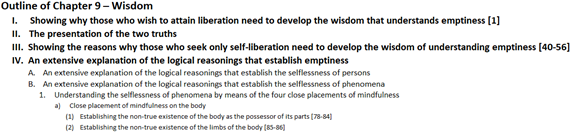
(9.85) Just as the body lacks true existence, so do its parts such as the hands;
For they too are merely imputed upon the collection of their parts, the fingers and so forth.
The fingers, in turn, are merely imputed upon the collection of their parts, such as the joints;
And, when the joints are separated into their parts, they too are found to lack true existence.

(9.86) The parts of the joints are merely imputed upon a collection of atoms,
And they, in turn, are merely imputed upon their directional parts.
Since the directional parts, too, can be further divided,
Atoms lack true existence and are empty, like space.

And when we look for the parts, we just find the parts of the parts, nothing more.  We keep looking, and no matter where we look, we find nothing.  We think we are surrounded by reality, but in truth it is all an illusion.  There is nothing here at all, it just appears that there is.  It’s a very nice meditation to do sometime, just go to the parts of the parts, and just end up finally meditating on space-like emptiness, realizing that even the atoms lack true existence.

Again, this does not require any faith to realize.  This is something we can prove to ourselves with investigation.  Emptiness is the definitive valid reason that establishes the rest of the path.  If we can establish emptiness, we can prove every other stage of the path – death, lower realms, karma, renunciation, cherishing others, taking and giving, bodhichitta, tantra, everything. 

When we think about it, it is truly amazing. Everything appears so vivid and appears so real, but when we actually look for it, we find nothing. It is all one giant illusion. It appears real, it has shape it has form it functions we can touch it, yet when we look for what is behind these appearances we find nothing. Our mind simply connects the dots and projects everything in between them. In fact when we look, we don’t even find the dots. Each dot itself is simply yet another hallucination, another illusion, another hologram.

Very often we can develop doubt, am I wasting my life practicing the spiritual path? I see everybody else off doing different things, enjoying life. But here I am, dedicating all of my time to trying to attain some state beyond this life. I am trying to construct a pure land and identify with myself as a deity. What if this is all a bunch of nonsense? What if none of it is true. What if it is all just a waste of time and I’m just engaging in make believe?

We can have these doubts. If we do not have an answer to these doubts, they can become crippling, and we lose all the motivation to engage in our spiritual path. We start to think that our spiritual guide and our sangha are perhaps deceiving us or themselves have been fooled into wasting their life chasing these fantasies.

How do we overcome this doubt? Through this meditation on emptiness. We identify the emptiness of our body, then we look at the emptiness of each of the parts of our body, then we look at the emptiness of the parts of the parts of our body, and so forth all the way down to atoms. We then look at the emptiness of atoms – made up of electrons, neutrons, and protons. Each of these things can be broken down further and further yet no matter how much we break it down, we continue to find absolutely nothing. There is nothing actually there. Our mind is simply projecting that there is something there, connecting dots that are not there, creating a mental illusion that our ignorance grasps at as real.

This is something we can prove to ourselves through investigation. There’s no doubt when we investigate, we find nothing. The self we normally see, the body we normally see, the world we normally see does not exist. It just appears to exist, like an illusion. It is all created by mind. We’re like those people who believe in conspiracy theories who see random data points and then fill in elaborate stories connecting those dots, grasping at their stories as somehow being true. We are exactly the same. Somebody trapped in samsara is in fact simply somebody who’s grasping at its conspiracy. But when we check, when we investigate, we realize it is all a big lie. Samsara is fake news. It is all created by mind.

If it is created by mind, then mind can create new worlds, different worlds. Here again we have direct experience. Before we viewed something as a hardship, later we came to view it as a blessing. What was it? Was it a blessing or was it a hardship? In reality it was nothing. From its own side it is absolutely nothing. But our mind can relate to it in different ways, and then we experience it in different ways. This shows that we can create with our mind the world that we inhabit and the world that we experience. Seeing this, we realize we can create any world, including the pure land. It just takes enough mental action to create enough karma to cause our abiding within the pure land to become a self-sustaining experience. Karma is proven by emptiness. Tantra is proven. Future lives are proven. Everything is established through emptiness. We could have 100% confidence in our spiritual path because of emptiness, which itself can be proven.

Modern Bodhisattva’s Way of Life: Our Body We Normally See Does Not Exist

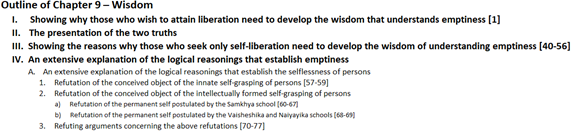
Shantideva now goes on to give reasons establishing the selflessness of phenomena. This is the largest section of Chapter 9. He essentially provides two main arguments establishing the selflessness of phenomena. The first is the four close placements of mindfulness. These look at the emptiness of the aggregates that form the basis of imputation for our I. The second method is to examine the relationship between emptiness and cause and effect. According to the Three Principal Aspects of the Path, Je Tsongkhapa says that when emptiness reaffirms karma and karma reaffirms emptiness, then our understanding of both emptiness and karma is correct. The outlines of Shantideva’s argument are quite detailed and it is easy to get lost in the details and forget what the main point is that he’s trying to establish. The goal is to establish the emptiness of phenomena. There are two ways that he does so: establishing the emptiness of our aggregates and establishing the emptiness of cause and effect. Everything else flows from this.

What follows is a classic meditation on the emptiness of our body. We are all familiar with this meditation since it shows up in all of our Dharma books. The fundamental point is we first need to identify the object of negation: the body that we normally see. The body that we normally see appears to exist from its own side, independent of our mind. It appears to be a singular entity we call my body. If such a body exists, it should be findable. There are three possibilities it is one of its parts, it is the collection of its parts, or it is somehow separate from its parts. There is no other possibility. If it cannot be found in one of these possibilities, then the body that we normally see does not exist. First, Shantideva looks to see if the body is one of its parts.

(9.78) Neither the feet nor the calves are the body,
Nor are the thighs or the loins.
Neither the front nor the back of the abdomen is the body,
Nor are the chest or the shoulders.

(9.79) Neither the sides nor the hands are the body,
Nor are the arms or the armpits.
None of the inner organs is the body,
Nor is the head or the neck.
So where is the body to be found?

None of the individual parts are the body itself, they are parts of the body.  We make a distinction between the parts and the part possessor.  The body itself is the part possessor, which is necessarily distinct from that which it possesses. 

(9.80) If you say that the body is distributed
Among all its different parts,
Although we can say that the parts exist in the parts,
Where does a separate possessor of these parts abide?

When we look, we find only parts.  There is no actual part possessor.  None of the individual parts of the body is the body, and there is no thing separate or within the body that is the possessor of these parts.  We simply have parts. 

(9.81) And if you say that the entire body exists
Within each part, such as the hand,
It follows that there are as many bodies
As there are different parts!

I don’t know anybody who actually thinks that the entire body exists within one of its individual parts.  Obviously that is absurd.  But, when we do a conventional search, that is exactly what we do.  Someone says, “point to your body,” and we then point to some part of our body and say, “it is here.”  We don’t mean that it is within an individual part, we are referring to the whole thing, but in fact we are just pointing to a part of our body.

(9.82) If a truly existent body cannot be found either inside or outside the body,
How can there be a truly existent body among the parts such as the hands?
And since there is no body separate from its parts,
How can there be a truly existent body at all?

Recall above we established that there is no fourth possibility.  Either the body is one of its parts, the collection of the parts, or separate from the parts.  But when we look in each of these three places, we cannot find something that is “my body.”  We only find parts, perhaps collected together, but there is no part possessor anywhere that is “my body.”  Yet, that is precisely the sort of body we normally see, grasp at, and refer to when we speak of my body.  When we look for such a body, we don’t find it anywhere.  If we can’t find it, then it does not exist. 

The danger is we have engaged in these sorts of contemplations perhaps hundreds of times, and they no longer move our mind.  We just intellectually go through them, “yeah, yeah, not one of its parts, not the collection, not separate, check.”  We need to instead, each time we meditate, go looking for the object just as we would go looking for our keys.  We know they have to be somewhere.  We have to be convinced we will find it so that when we don’t, we get the point – the body we normally grasp at and are convinced exists in fact does not exist at all.  There are just parts here, nothing more. 

(9.83) Therefore, there is no truly existent body,
But, because of ignorance, we perceive a body within the hands and so forth,
Just like a mind mistakenly apprehending a person
When observing the shape of a pile of stones at dusk.

(9.84) For as long as the causes of mistaking the stones for a person are present,
There will be a mistaken apprehension of the body of a person.
Likewise, for as long as the hands and so forth are grasped as truly existent,
There will be an apprehension of a truly existent body.

Normally we see a body within its parts.  But when we check, we do not find one.  The key question in identifying emptiness – what is the part possessor?  We think there is one, but when we check, there is none.  The analogy of a pile of stones at night is very good.  From a distance, we see a body, one that appears vividly to our mind.  But when we investigate closer, the appearance disappears and we see just a pile of stones.  In the same way, we see a body, one appears vividly, but when we check, we find only parts.  The appearance of a body is a mistaken apprehension.

Modern Bodhisattva’s Way of Life: It’s Our Responsibility to Bring Emptiness to the World

(9.76) (Other schools) If living beings do not truly exist, who will gain the results of meditating on compassion?”
It is true that the cause, meditation on compassion, and the result, Buddhahood, do not truly exist; but they do exist nominally.
Thus, so that the suffering of all living beings may be completely pacified,
We should not reject the nominally existent compassion which leads to that result.

For us when we hear that they are dreamlike beings or that they are nominally existent and so forth it robs some of the thunder. We think therefore it does not matter. The extent to which we think this comes from are having fallen into the extreme of nothingness thinking that if things do not exist inherently then that means they do not exist at all.

All of the problems that arise with these sorts of doubts come from grasping at believing there is some part of reality that exists and some part of reality that does not exist. We hear the Prasangikas say that things do not exist inherently and even if we accept that, we then say OK all of those things do not exist, but there is something that does exist that is reality that I should worry about. But if everything is equally empty then this problem goes away. Our dreamlike self engages in dreamlike actions which create a dreamlike enlightenment to help dreamlike sentient beings. Everything is the same nature of a dream. It all functions, it all makes sense, it all has a point in the context of emptiness.

And finally:

(9.77) It is suffering and its causes that need to be abandoned,
And it is the ignorance of self-grasping that causes delusions and suffering to increase.
(Other schools) “But there is no way to abandon self-grasping so that it will never recur.”
On the contrary, meditation on selflessness, or emptiness, is the supreme method for accomplishing this.

In this world, more and more people are desperate to find solutions to their problems.  There are many samsaric methods for finding release from suffering, but they are all temporary and the problems come back, so they are not real solutions.  All the sufferings come back because we do not address the root cause of our suffering, our identifying with contaminated aggregates.  Only when people realize that none of these things are truly existent does sickness or any kind of suffering come to an end. Why?  Because we cease identifying with that which has problems.  In fact, we cease to appear such things in the first place.

It is our responsibility as Kadampas to provide the real solution, actual methods. It is our responsibility now to teach emptiness, the actual method to remove suffering from this world.  We need to gain knowledge of emptiness and experience of emptiness.  It is particularly important that we know how to teach emptiness, isn’t it?   We can start by helping people realize that their opinion of things, and therefore their experience of things, depends on their mind.  They have a choice what opinions they have of things.   Help people view their situations differently, as opportunities to improve themselves as people.  Even ordinary people can understand that your world is what you make of it.  Help them realize this and that they have choice.  Choice is the very essence of emptiness.

One thing that we are all learning is that we have to stop protecting ourself by self-cherishing means, because it doesn’t work. On the surface, self-cherishing seems to protect us, but through examination we know it just brings us more suffering.  Yet we keep being duped, don’t we?  We must rely upon wisdom in order to protect ourselves from suffering and to bring us happiness.  But this means choosing to listen to and follow our wisdom, which is not always easy because of strong habits and we think it is no big deal.  Geshe-la says we actually need to just forget about the object of our self-cherishing, more simply, forget about ourself.  Just work for others, which will include taking care of this instrument that we normally refer to as our self so we can help them more.

We also need to let go of the person we think we are.  So often we grasp at who we are, and then think we cannot change.   We need to give the spiritual guide a chance to change us, and he can only do this if we let go of our grasping at who we ‘are.’  We need to actively try to change ourselves – who wants to remain who we are, we need to aspire to be better people.  We need to want to leave our ordinary self completely behind.  This is easier for people who get ordained, but internally we need to do the same thing.  When you let go of self, and you just cherish others, wonderful changes will naturally take place.  A bodhisattva becomes whatever she is needed to be.  Such flexibility.

But to let go of our ordinary self and allow change to take place, we need to realize that our self-cherishing is not protecting us, but keeping us imprisoned.  Then, we will be able to break free.

Modern Bodhisattva’s Way of Life: If Others are Empty, Why Generate Compassion?

(9.73) Neither the mind of the past nor the mind of the future is the self,
Because the former has ceased and the latter has yet to be produced.
(Other schools) “But surely the mind arising in the present moment is the self.”
If it were, then the self would not exist in the next moment!

(9.74) If you peel away the layers of the trunk of a plantain tree,
You will never discover anything substantial.
In the same way, if you conduct a detailed analysis,
You will never be able to find a self, or I.

The self or I can be found nowhere. According to the Madhyamika-Prasangikas, it can be found nowhere.  What we believe to be true is just an illusion. If we look for our I or self anywhere, we will find nothing. There is nothing that is the I or self. Nothing.  If you look for an inherently existent I you will find nothing, because it doesn’t exist, but if you look for the conventionally existent I, the mere name projected by mind, you can find it.

(9.75ab) (Other schools) “If living beings have no true existence,
For whom can we develop compassion?”

This is a very common objection that arises when we start to consider emptiness. We think if living beings do not truly exist then there’s nobody there who’s actually suffering, so what is the point of generating compassion? Further we think if there’s no one actually there then it doesn’t matter if we harm others because no one is actually being harmed. When the Matrix movies came out Dharma practitioners saw very close parallels between the teachings on emptiness and the movie, how everyone was trapped in a simulation that they thought was real. But in the movies, they made it seem as if there was no harm in killing and shooting everybody since they weren’t really real anyways. If no one actually exists then what is the point of anything?

(9.75cd) We promise to achieve the goal of Buddhahood
For the sake of those whom ignorance imputes as truly existent.

Shantideva’s answer to this objection is living beings do not have to truly exist for us to generate compassion for them or to attain enlightenment for them. For example, if in a dream we see somebody who is hurting, we naturally go to their aid. This is the right thing to do in the context of dream. We have a dreamlike self helping dreamlike others in dreamlike ways. All of it is appropriate within the context of the dream. If we were not dreaming, then of course there would be no need to go help dreamlike beings because none would be appearing.

People who are schizophrenic see all sorts of hallucinations that they believe to be real and as a result they often suffer from these appearances. Their doctors try help them understand that these appearances are not real but are just projections of mind, so there is nothing that they need to worry about. It is because the doctor knows that the hallucinations are not real but that the person believes that they are that they then help the patient understand reality. In exactly the same way, we are all trapped in a schizophrenic dream that we believe is real. Because we believe it is real, we suffer from it. It does not have to be real for us to experience pain and suffering. The Buddhas, who are outside of this contaminated dream, naturally want to help wake us up from these hallucinations. They don’t do so because they believe the hallucinations are real, they do so because they know we believe they are real and we are suffering as a result.

The fundamental flaw in this doubt is it assumes pain has to have a real cause for it to be painful. This is not true. In fact, most of the things that we suffer from never actually occur. For example, we worry endlessly about what could possibly happen in the future, and very little of what we worry about ever comes to pass. The mental future that we project does not actually exist, is just a mere projection of our mind, but we nonetheless suffer from it because we fear it could come to pass and we believe it is real. Likewise, all of our delusions are amplified by the degree to which we have inappropriate attention. Inappropriate attention exaggerates either the good or bad qualities of something beyond what is actually there. As a result, we generate attachment or aversion towards these things. This attachment aversion then causes us to mentally suffer and destroys our inner peace. But none of those things that we are imagining are actually true, they are all exaggerated interpretations of what is going on created by our mind. All of these examples which we see in our daily life show clearly that even though things are not real we can still suffer from them, in fact most of what we suffer from doesn’t actually exist.

Modern Bodhisattva’s Way of Life: Overcoming Doubts About Emptiness

(9.70) (Non-Buddhists) If the self were not permanent but perished in the next moment,
There would be no relationship between actions and their effects
Because, if the self perished the moment it committed an action,
Who would there be to experience its fruits?”

Now Shantideva answers some common objections that may arise in response to the explanations given. Again, we need to identify within ourselves the same doubts that the other schools are raising so that we can appreciate the refutation that Shantideva gives.

Here the non-Buddhists are refuting impermanence. To be permanent means to not change. To be impermanent means to be undergoing continuous change, things do not remain even for a moment. Impermanence says that the entire universe is simultaneously utterly destroyed and completely recreated in every moment. Everything changes, there is nothing that remains the same. There is a complete cessation of the previous moment to create the space for the next moment. Indeed, we can say that the process of destruction of one moment and the process of creation of the next moment are simply two sides of the same process viewed from different angles.

The non-Buddhists say if things are impermanent and everything ceases completely every moment, then we cannot establish any connection between cause and effect. Karma is negated. How can we say that we experience the effects of our previous actions if our present self has no relationship with our previous self? The old self has completely ceased and our new self is something that is completely different so therefore there is no continuity between the actions that we created in the past and the effects that we experience now.

(9.71) There is no point in our arguing about this,
Because we both assert that the continuum of a person who commits an action
Is not different from the continuum of the person who experiences its effect;
But at the time of experiencing the effect, the person who committed the causal action no longer exists;

(9.72) And at the time of committing the causal action,
It is impossible to see the person experiencing the effects.
Both the committer of the action and the experiencer of its effects
Are merely imputed upon a single continuum of a collection of aggregates.

The main point here is the impermanence of persons.  The teachings on impermanence explain that things do not remain even for a moment, and that includes people.  In every moment, a person changes completely.  The old self goes completely out of existence, without even the slightest trace remaining.  And an entirely new self is created – a completely new person.  Our view is that minor things on the surface change, but there is an underlying core which remains unchanging.  We feel it is the same person, but even conventionally, it is not. 

But there is nonetheless a continuum, like beads on a mala.  All Buddhists believe in impermanence. But impermanence simply means that there is not a self that remains unchanging eternally. However, there is a continuum to the self. It constantly changes, but we can trace the continuum path or trajectory of those changes. It is upon this continuum that we can say that the person who experiences the effects is the same continuum as the one who created the causes or created the karma.

Why does this matter?  What would happen if I stopped grasping at a permanent self?  One of the main reasons we become discouraged is grasping at a permanent I, is it not?  If we were not to grasp at a permanent I, would we become so discouraged? We would not become discouraged at all.  Geshe-la himself said there’s no valid reason for us to become discouraged. We can become who we want, change is taking place naturally.  Because we are empty, our aggregates are empty, change is taking place moment by moment by moment.  All we have to do is direct that change, that is all.  We can become what we want merely by creating causes for what effect we would like to take place in the future. We create causes whose effects take place in our continuum.  We can become a Bodhisattva or a Buddha in dependence upon creating the right causes.  We can change into whoever we want because we are empty.  It does not seem like we can because we grasp at ourselves as being permanent.  As a result, we don’t even try.  But when we let go of that, everything becomes flexible and we become changeable. 

If we really believe that the person who criticized us, for example, ended the moment the criticism ended, then why would we bother getting angry and retaliate? We would be angry with someone who has not criticized us. They have finished criticizing us, and it’s too late!  What would happen, again from a practical point of view, and this is most important, if we stopped grasping at others’ permanence?  What would happen to the attachment that we have towards people and the anger that we have towards people, and the sufferings that arise from them?  It would cease, wouldn’t it?   It seems as long as we are grasping at permanence we’re not giving ourself a chance and we’re not giving others a chance to change, are we?

Modern Bodhisattva’s Way of Life: Why the Materialists Are Wrong

If the Samkhyas are the Christians who are the Vaisheshikas and Naiyayikas?  Essentially, they are the materialists or the scientists or the atheist. They are the people who say there is just the material world. Everything can be explained in terms of physical phenomena. Much of modern psychology has attempted to try explain everything that happens within the mind as the product of physical evolution or biological processes occurring inside of the brain.  As we go through the refutations of this school, we should have that sort of thinking in mind. There is part of us that still thinks everything is just material and that the mind is the brain.  

(9.68) The material I asserted by materialists also cannot be the I,
Because it is devoid of mind, just like a jug.
(Vaisheshika and Naiyayika) “But it has a relationship with mind and so it can know objects.”
When the self, or I, comes to know something, the former self that did not know ceases;

(9.69) But if, as you say, the self is permanent and unchanging,
How can it form a relationship with mind and become a knower?
Saying that the self is devoid of mind and unable to function
Is like saying that space is the self or I!

Materialist psychologists do not have an answer for how the physical organ of the brain can know a non-physical object. They simply observe that we do know things and they observe that we have a brain, therefore they conclude that somehow the brain can know mental objects. What’s interesting is the materialists consider those who believe in spiritual matters are naive and that they are the scientists. But in truth they are the ones that make the leap of faith that is somehow a material substance can know.

Modern Bodhisattva’s Way of Life: Realizing the Emptiness of God

(9.66) (Samkhya) “The different aspects are not true, only their nature is.”
If the aspects are not true, why say their nature is true?
(Samkhya) “Their nature is true and the same in that they are both merely conscious apprehenders.”
Well then, all living beings must be one and the same because they are all conscious apprehenders.

(9.67) Moreover, it follows that animate and inanimate phenomena must be one and the same,
As creations of the general principle, the independent creator of all.
If all the particular aspects are false,
How can their basis, their nature, be true?

This debate is actually very important because most of us are actually Samkhyas!  The Christian view is there is an independent creator of all, and that all of his creation is the same nature as the creator.  This is also what the Samkhyas are more or less saying.

We need to ask one simple question:  are we independent from God or not?  If we are independent from him, how can he create us because that would imply there is some point of connection between the two.  If we are not independent from him, how can he exist inherently?  We would have to be the same nature as him, which means he would have to be the same nature as us.  Since we ourselves are empty, so is he.   Realizing emptiness enables you to eliminate the final gap between you and the creator by realizing you are the creator – your mind is the creator of all. 

So we can agree that God is the creator of all, and that the whole universe is his creation – it is one with him.  But so are we.  The only way that can be is if we are him.  It does not feel that way because our ignorance is grasping at a self that is independent of the creator – an inherently existent I.  This is what needs to be abandoned.  We need to let go of that to fully unite with the creator, both his conventional and ultimate nature.  The only way you can establish a permanent, unchanging God is if you understand his emptiness.  All functioning things are by nature impermanent, but the ultimate nature of God, his emptiness, is unchanging – he never becomes more or less empty.  Because the creator is empty, then its creation can completely change in every moment.  We grasp at there being an underlying unchanging nature to our conventional self, but this is impossible because if it were, it could not function.  When we feel the correct view, we feel very fluid and supple.

Once we see that our own mind is the creator, the question then becomes:  are we a good creator or a bad one?  If we check, we have created a world of suffering – our self-centered mind has created a world of suffering.  So a bodhisattva resolves to become a good creator and with wisdom and compassion create a pure world filled with pure beings.

One of the best ways to increase your understanding of emptiness is find a few key phrases from the explanations of emptiness that really speak to us, and contemplate them informally throughout the day, such as on the bus, while exercising, etc.  We ask ourselves what does this mean? How can I understand this? What is its practical value?

We request blessings to have answers to these questions.  We need to continue to contemplate these things until they make sense to us – yeah, I get it.  That makes sense.  The key is we should enjoy it, like trying to solve a puzzle that has great meaning.  We think about the arguments and try to understand them like a game.  Then it is fun.  If we do this continually, our understanding will gradually deepen.

Modern Bodhisattva’s Way of Life: Can an Independent Creator Create Anything?

(9.62) (Samkhya) “When no sound is present, the consciousness enjoys other objects such as visual forms.”
But if it is permanent, why does it not continue to apprehend sound?
(Samkhya) “Because there is no sound in the vicinity at that time.”
Well, if there is no object, sound, then there is no subjective apprehender of sound!

Shantideva’s point here is that if there is no subjective apprehender of sound then it shows that the consciousness has changed from there being a subjective apprehender of sound to there not being a subjective apprehender of sound, therefore the consciousness that the Samkhya’s is the I is not permanent.

(9.63) Moreover, how can an awareness whose nature it is to apprehend sound
Also be an awareness whose nature it is to apprehend visual forms?
(Samkhya) “It is like one person who can be considered to be both a father and a son.”
But this is mere imputation; he is not by nature both.

The Prasangikas do not disagree that consciousness can be aware of both sound and visual forms, they simply disagree that such a consciousness can be permanent. How is it possible then for us to refer to a continuously residing consciousness that the Prasangikas believe in? How exactly is that different from what the Samkhyas are asserting? The Prasangikas agree that the continuously residing consciousness is like one person who is considered to be both a father and a son, but that this difference is one of simply mere imputation by mind. The consciousness apprehending sound and the consciousness apprehending visual forms are two different consciousnesses because they are perceiving two different objects, but conventionally we can refer to them as our continuously residing consciousness by mere name or mere imputation. It is not inherently or permanently one or the other.

(9.64) The analogy of father and son does not work for you Samkhyas.
According to you, the independent creator of all manifests all forms.
Thus, father and son must be one nature, as must an apprehender of sound and an apprehender of visual forms –
But such things are not seen by a valid mind.

Once again, like the Christians, the Samkhyas believe in an independent creator of all phenomena.  Like many Christian Mystic traditions, the Samkhyas believe there is no distinction between the creator and its creation. Thus, father and son, the apprehender of sound of the apprehender of visual forms, must all equally be the same nature as this independent creator.

But how can there be an independent creator? If it is independent, then how could it come into a relationship with its creation? If it is permanent, then how can it create different things because does not it then change? Interestingly, it is only by embracing the Prasangika view that we can resolve these contradictions and view all things as the nature of our mind which is the creator of all, and that our mind is empty which enables it to change and create and come into contact with and know different things. We are able to make a nominal distinction between the mind that knows things and the objects that are known while still seeing them as being of one nature. All things are the nature of mind, and the ultimate nature of mind is emptiness.

(9.65) (Samkhya) “It is like an actor changing roles and being seen in different aspects.”
Well, if the I changes in this way, it cannot be permanent!
(Samkhya) “Although the aspects change, its nature remains one and the same.”
But you cannot establish an unchangeable nature of the I, because you deny the ultimate nature of I, the lack of a truly existent I.

Remember, the goal of the Prasangika refutations of the other schools is to gradually guide people to the Prasangika view. We do not disagree that it is like an actor changing roles but being seen in different aspects, we just disagree that such an I is permanent. We also do not disagree that although the aspects changed the nature remains one in the same, we simply say that the nature of that I cannot be truly existent. The only way in which the aspects can change and the nature remains one in the same is if everything is empty.  We can see the Prasangikas agree with much of what the Samkhyas say about the I, they just simply disagree with it being permanent and it being truly existent.

Modern Bodhisattva’s Way of Life: Emptiness of Our Soul

We now enter into a section in which Shantideva refutes the views of the lower schools.  The first view he looks at is the Samkhya schools. The Samkhyas are very similar to how most Christians think about their soul. When you speak with a Christian and ask them about their soul, they will describe it as this permanent thing that goes with them from life to life, and the purpose of the Christian path is to save their soul. Once again, when we go through these debates we should not feel as if they are somehow divorced from our normal reality because none of us have ever heard of the Samkhyas before. We don’t know what their view is and we don’t seem to hold it, so it seems irrelevant to us. But if we can connect the views of the lower schools with views that we see in modern society, then we can appreciate the reputation that shantideva engages in. So when you see the sampek’s, as a shorthand it’s enough to think about a popular understanding of Christianity. And even that is not enough because we might not consider ourselves Christian and so we might think that this is refuting the views of others. In truth we need to find within our self where we still grasp onto notions of relating to our I or our self as something that is permanent and eternal.

(9.60) If, as the Samkhya school asserts, a permanent consciousness is the I,
Then the consciousness that enjoys sound is also permanent;
But how can it continue to enjoy sound
When the object, sound, is no longer present?

(9.61) If it can be a subjective consciousness even though its object does not exist,
Then it follows that even a piece of wood can be a subjective consciousness.
Nothing can be established as a consciousness
If there is no object of which to be conscious.

As we go through Shantideva’s actual refutations it is important to keep in mind what exactly Shantideva is rejecting and what he is not rejecting. Sometimes we can look at these debates and over apply the refutations to see a complete and total rejection of all the views of the lower schools. This is incorrect.  The way to think about the different schools is like a ladder of thought where we gradually abandoned different aspects of things that we mistakenly think are ourselves but in fact are not. But we do not reject everything that was in the lower view because there are elements of the lower schools that we retain within the Prasangika view. In this way, our study of the lower schools enables us to gradually build up the overall framework for understanding the Prasangika.

The Samkhya view is that our self is a permanent consciousness. They say not only is the I inside the permanent consciousness, the I is this permanent consciousness. They think this is our true self that goes with us from life to life. Again, it is very similar to the Christian view.

In Buddhism, when we call something permanent it means that it is unchanging. It never changes.  We need to make a distinction between permanent and eternal. Eternal means lasts forever, permanent means unchanging. It is perfectly possible for something to be eternal but not permanent. For example, the water on this earth is eternal , but it is constantly changing forms and so therefore it is not permanent. It is also possible for something to be permanent but not eternal. For example, the emptiness of my car is permanent in the sense that it never becomes any more or less empty, but it is not eternal because when the car no longer exists, the emptiness of the car no longer exists.

The Samkhyas believe in an I that is both permanent and eternal. The Prasangikas disagree with the permanent part but agree that our actual self is indeed eternal. According to the tantric teachings we understand that at our heart we have our continuously residing mind and continuously residing wind, which is our continuously residing body and mind. These never separate and are eternal. They last forever. But they are not permanent because they are undergoing constant change.

The Prasangikas also retain the idea of consciousness being part of our I.  The difference is the Samkhyas say that our consciousness is our I, whereas the Prasangikas say that consciousness is part of the basis of imputation of are I.  Specifically, we impute our I onto our continuously residing body and our continuously residing mind.  Our consciousness is part of our I but not our I itself.  

So what then do the Prasangikas actually refute of the Samkhya view? First, they refute that the I is permanent. If the consciousness is the I, and the I is permanent, then it follows that once the consciousness perceives something it must perceive that thing forever without change. If the consciousness goes from a state of observing a sound to then not observing the sound, then it implies that the consciousness itself has changed, and therefore is not permanent.

Implicit within the Samkhya view is that this is not a problem because the consciousness just continues to see things and know things as those things move around it. It is like a light that simply shines and illuminates whatever comes in front of it. Shantideva refutes this view by pointing out it is impossible to have a consciousness without an object of consciousness because otherwise what is the consciousness conscious of? Therefore, you cannot have a consciousness that does not change as it becomes aware of different objects.

Modern Bodhisattva’s Way of Life: Is our Mucus our Authentic Self?

(9.57) The teeth, hair, or nails are not the I,
Nor are the bones or blood.
The mucus and phlegm are not the I,
Nor are the lymph or pus.

(9.58) The body’s fat or sweat are not the I,
Nor are the lungs or liver.
None of the other inner organs is the I,
Nor are the excrement or urine.

(9.59) The flesh or skin are not the I,
Nor are the body’s warmth or winds.
The space element of the body is not the I,
Nor are any of the six consciousnesses.

The basic point is rather simple:  Ignorance is when we hold the following view:  The I is one with its basis, yet it is also independent.  When somebody points at our body, we feel they are pointing at us.  Yet, we say, ‘my body’ as if the I was somehow an independent possessor of the body.

Emptiness is when we realize the I is not one with its basis, but it is not entirely separate from it.  We cannot find the I anywhere within its basis, but without the basis there is no I at all.  Emptiness is when the I is a mere name imputed upon the body and mind.  We are able to identify the distinction between the basis of imputation and the imputation itself.

This is not just an academic discussion, but has very practical implications:  If we think our self is one with its basis, we identify with our delusions, thinking they are an intrinsic part of ourselves. For as long as we are doing this, when we apply opponents, we will not actually eliminate our delusions because we are grasping at them.  We can remain like this for decades in the Dharma and wonder why we are not changing.  To actually get rid of our delusions, we have to stop identifying with them as ‘us.’ 

We have all had examples of situations where we thought we had gotten rid of a delusion, but then it came back.  We then think we haven’t really changed.  We think there is this permanent nature to ourselves that doesn’t change.  Our belief in this makes any progress on the path impossible.  We need to stop grasping at the permanence of our self, and realize that we are always changing – in what way depends upon our actions.  This gives us enormous flexibility to change ourselves.  Normally we are afraid to do so.

In popular psychology, people talk about being true to our “authentic self.”  We then even make a moral issue out of ‘being true to ourselves’, ‘this is me.’  So anything that isn’t consistent with ‘who we are’ we think is wrong.  We then think not indulging our delusions is somehow not being true to our authentic self.  We intentionally grasp at some view that prevents us from ever changing for the better.  This is completely wrong.  We are what we identify with, and we have choice about what we identify with.  If we say the angry, jealous, deluded person is “not me,” but rather the patient, loving, and wise person “is me,” then we can change the basis of imputation of our I from a deluded person to a wise one.  In truth, this is more being “true to our authentic self,” because we are not our delusions, we are our Buddha nature.  The self that we normally see is a hallucination, so how can we be true to that?