Happy Tara Day: How to increase our faith in Tara

This is the third installment of the 12-part series sharing my understanding of the practice Liberation from Sorrow.

Homage to the Twenty-one Taras

OM Homage to Venerable Arya Tara

The main purpose of reciting the twenty-one homages is to generate faith in Arya Tara.  Faith is what gives Buddhas power to help us.  It is not they hold back their help waiting for our faith and respect, rather when we generate faith we open the blinds of our mind to allow the sunlight of their blessings to pour in.  There are three types of faith:  believing faith, admiring faith, and wishing faith.  Believing faith believes in the qualities and abilities of holy beings.  Admiring faith generates a feeling of wonder, amazed at their incredible good qualities.  Wishing faith wishes to be the beneficiary of such power, and superior wishing faith wishes to gain these good qualities ourselves so we can do for others what the holy beings can do for us.  The more faith we have, the more powerfully we will receive the blessings of the given Buddha.  To paraphrase Lord Acton, faith empowers and absolute faith empowers absolutely. 

When we recite the twenty-one homages, we can train in increasing our faith.  Typically, we recite the twenty-one homages three times.  With the first recitation, we can primarily train in believing faith; with the second recitation, we can focus on admiring faith; and with the final recitation, we can emphasize wishing faith.  In this way, we will build up powerful potential energy in our mind for the remainder of the practice.

Praising Tara by her life story

Homage to Tara, the Swift One, the Heroine,
Whose eyes are like a flash of lightning,
Who arose from the opening of a lotus,
Born from the tears of the Protector of the Three Worlds.

Each time we receive a Tara empowerment, we hear Tara’s life story.  She has both a common and an uncommon life story.  Her common life story is as a bodhisattva, some sexist monk said if she continues in this way, she can pray to be reborn as a man so she can become a Buddha.  Upon hearing this, she vowed to always take rebirth in a female form and ultimately attain enlightenment in a female form.  She was the first feminist.  Her uncommon life story is Avalokiteshvara, the Buddha of Compassion, wept as he looked at how many beings remained to be liberated.  His tears fell into the clear light emptiness, and Arya Tara arose telling him to not worry, she would help him free all living beings.  When we recite this verse, it is important to make this personal – she became Tara for us, and so we should generate a feeling of closeness and gratitude.

Praising Tara by the brightness and radiance of her face

Homage to you with a face like a hundred full moons in autumn
Gathered together into one;
Blazing with brilliant light
Like a thousand constellations.

Sometimes people wonder how it is Buddhas can help all living beings directly and simultaneously.  There are so many living beings, how exactly can we understand their emanations pervading all worlds?  For me, there are two analogies that help, both of which are illustrated by this verse.  First, while there is only one moon in the sky, it nonetheless spontaneously reflects on the surface of every body of water in the world without its light being diminished in the process.  In the same way, the wisdom moon of Mother Tara shines in the sky of our mind, and spontaneously appears on the surface of every mind of faith in the world.  Second, imagine a wheel with countless straw-like spokes.  If you shined a light inside any one spoke, it would illuminate just that spoke, but if you moved the light into the hub of the wheel, it would illuminate all of the spokes directly and simultaneously.  In the same way, Tara’s brilliant light shines into the spokes of our minds like a thousand constellations.

Praising Tara by her colour, what she holds and her causes

Homage to you who are bluish gold,
Your hand perfectly adorned with a lotus flower;
Who arose from practising giving, moral discipline,
Patience, effort, concentration and wisdom.

Blue generally represents Buddha Akshobya, the completely purified aggregate of consciousness of all the Buddhas; and gold (yellow) represents Buddha Ratnasambhava, the completely purified aggregate of feeling of all the Buddhas.  A purified aggregate of consciousness is one that is free from the two obstructions, and a purified aggregate of feeling experiences all phenomena equally as manifestions of bliss and emptiness.  By praising Tara as being bluish gold, we recall her purified consciousness and feeling and generate faith.  A lotus flower generally symbolizes how an object of complete beauty and purity (a lotus flower) emerges from a contaminated source (the mud in the pond).  In the same way, our eventual enlightenment will emerge despite our origin being contaminated.  Tara holding a lotus flower symbolizes her power to lead contaminated beings such as ourselves to enlightenment.  All Buddhas attain enlightenment in exactly the same way – through training in the six perfections of giving, moral discipline, patience, effort, concentration and wisdom.  We sometimes think Buddhas were always enlightened and they are somehow different than the rest of us, but they were suffering sentient beings once as well just like us, and through their practice of the six perfections they attained enlightenment.  If we do the same, we too will attain the same results.  Recalling Tara’s causes reminds us of that and shows her power to help us train in the six perfections ourselves. 

Praising Tara by her being honoured by the Conquerors and the Bodhisattvas

Homage to you who surmount the Tathagatas’ ushnishas,
Whose victorious actions are limitless;
Who are greatly honoured by the Sons of the Conquerors,
Who have attained every perfection.

The primary purpose of this verse is to increase our faith in Tara as an enlightened being.  Normally, we view our spiritual guide on our crown.  Tara being on the crown of all the Tathagatas indicates that she is the spiritual guide of all the Tathagatas.  Victorious actions refer to her victory over the four maras, delusions, and all other objects of abandonment along the path.  She is honoured by all the Bodhisattvas (Sons of the Conquerors) because she is their mother, and she has attained every perfection.  Considering these qualities, we generate deep faith in her.

Praising Tara by her subduing unfavourable conditions

Homage to you who with the letters TUTTARA and HUM
Fill the realms of desire, direction and space.
With the seven classes of evil spirits beneath your feet,
You are able to draw all beings to bliss.

Here, we imagine that from the mantra rosary at her heart, countless light rays radiate out in all directions, filling the entire universe and dispelling all unfavorable conditions and obstructions to our practice of Dharma.  We imagine she is doing this for the benefit of ourself and all living beings.  There are countless evil spirits (all empty) who wish to obstruct our Dharma practice, but she is able to overcome them all single-handedly.  Through her powerful actions, we then imagine she draws all living beings into the bliss of her Dharmakaya where they are perfectly freed from all unfavorable conditions.

Praising Tara by her being worshipped by the great worldly gods

Homage to you who are worshipped by Indra, Agni,
Brahma, Vayu, and the other mighty gods;
And before whom the host of evil spirits,
Zombies, smell-eaters and givers of harm respectfully offer praise.

Normally living beings look up to the worldly gods, but worldly gods worship Tara.  If we bow to them and they bow to her, then we certainly should also bow to her.  Normally we fear evil spirits, but they too offer praise and respect to Tara.  We would think evil spirits would also fear Tara since she is the opposite of evil and has the power to overcome them, but she is so loving and skillful, even her would-be enemies respectfully offer her praise.  By relying upon her, we too can gain the ability to earn the respect of those who oppose our virtuous wishes.

Modern Bodhisattva’s Way of Life: Venerating our enemies

(6.109) “But your enemy has no intention to help you practice patience,
So why should you venerate him?”
Then why venerate the holy Dharma
As a way of practising virtue?

(6.110) “Surely you should not venerate an enemy
Who harbours the intention to cause you harm.”
But if everyone was like a doctor striving to help me,
When would I ever practise patience?

(6.111) Thus, because the practice of patience occurs
In dependence upon those with hateful minds,
Such people should be venerated just like the holy Dharma
Because they are causes of the practice of patience.

Outrageous! Shantideva is so outrageous.  If we appreciate or value the Buddhadharma, then we should appreciate or value those who bring us problems and suffering because in dependence upon them, Dharma realizations develop in our mind.  We should appreciate and value those with hateful minds towards us. We should venerate them in the same way that we venerate the holy Dharma.  It does not matter that they have no intention to help. After all, neither does the Dharma. That doesn’t matter. Because we still benefit.  What matters, actually, is that they have the intention to harm. That’s important! Because it is then that I must really train in patience.  Those people I must venerate, just like I venerate the holy Dharma, because the practice of patience occurs in dependence upon those with hateful minds.

Now some verses encouraging us to venerate living beings just as we venerate holy beings:

(6.112) Buddha says that the field of living beings
Is like the field of enlightened beings,
For there are many practitioners who, through pleasing living beings,
Have attained the state of perfection, Buddhahood.

(6.113) Since living beings and enlightened beings are alike
In that the qualities of a Buddha arise in dependence upon them,
Why do we not show the same respect to living beings
As we do to the enlightened beings?

How can we understand this?  Enlightened beings give us the opportunity to engage in spiritual practice, spiritual practice leading to liberation, to enlightenment. How kind. Enlightened beings such as our spiritual guide are kind in giving us such an opportunity to follow the spiritual path leading to freedom, to happiness.  How are living beings any different in this sense? They also give us the opportunity, in just the same way they give us the opportunity to follow the path, spiritual path, to liberation and enlightenment. They give us freedom and happiness.  Therefore, it is entirely appropriate to respect them exactly as we would the enlightened beings.

Additionally, even from a worldly point of view, it makes sense to respond to harm with respect.  If we retaliate against others, then the cycle of retaliation will continue without end and the other person will continue to bother us in the future.  Even if we don’t externally retaliate and neither do they, we will wind up having ill feelings in our heart every time we think of or see the other person.  We are just torturing ourself.  Even from a worldly perspective of wanting pleasant relationships, it is better to heal our negative, dysfunctional relationships.  Treating the other person with respect, and trying to understand things from their perspective is the best way of doing so.

Ghandi showed how it is possible to use peaceful non-violent, non-cooperation and a willingness to accept suffering to not only gain independence, but earn the respect of the colonizer in the process.  If such methods can be used to defeat the most powerful empire in history, then surely it will be enough to heal our relationship with our loved ones or difficult work colleagues.

Happy Protector Day: Removing the Faults We Perceive in Others

The 29th of every month is Protector Day.  This is part 2 of a 12-part series aimed at helping us remember our Dharma Protector Dorje Shugden and increase our faith in him on these special days.

We can learn to be happy all the time, regardless of our external circumstances.  Normally, we are happy when things go well, but unhappy when things go badly.  When we are a spiritual being, all situations, good or bad, equally provide us with an opportunity to train our mind and create good causes for the future, so we are equally happy with whatever happens.  In this way, we can develop a real equanimity with respect to whatever happens in our life.

We have the power to free all the beings we know and love from this world of suffering.  We have the opportunity to become a fully enlightened Buddha who has the power to lead each and every living being to full enlightenment.  So eventually we can save everyone we know and love.  We can understand this at a deeper level by understanding that we are dreaming a world of suffering.  By purifying our own mind, we dream a different dream, a pure dream, and thereby free all these beings.

With this background in mind, in this series of posts I will explain a special practice we can do to make the most out of our precious human life, namely surrendering our life completely to the protection and guidance of the Dharma Protector Dorje Shugden. 

Normally we explain what to do in the meditation session first, but I wanted to explain how we rely upon Dorje Shugden in the meditation break first because this is where we first gain experience of him and see how useful he is.  Then, we naturally want to deepen our practice of him in the meditation session.

I would like to explain two key practices for the meditation break:  taking personal responsibility to remove the faults we perceive in others and viewing our life as a training ground for becoming the Buddha we need to become.  I will explain these over the next two posts.

Taking personal responsibility for removing the faults you perceive in others

Normally, we think it is the responsibility of others to remove the faults we perceive in them, but if we think about this carefully, we will realize that actually we are uniquely responsible for all the faults we perceive in others.  At a simple level, we can say that the world we experience is the world we pay attention to.  If we pay 90% of our attention on the 10% of faults in the other person, then it will seem to us that the person is 90% faulty.  This is how we will experience the other person.  This is how we make ‘enemies,’ ‘friends,’ ‘sangha,’ and even ‘Buddhas.’  In the same way, we ‘make’ faulty people. 

We can also understand this by considering emptiness.  If we consider emptiness according to Sutra, we understand that everything is just a dream-like projection of our mind. Where does this faulty person come from?  Our own projections of mind.  There is no other person other than emptiness. Are we responsible for the appearance of faults in the people of our dreams?  If yes, then we are likewise responsible for the faults in the people of the dream of our gross mind.  If we consider karma and emptiness together, we realize that others are mere appearances arising from our own karma. We engaged in actions in the past which are now creating the appearance of a ‘faulty’ person.  So it is our own past faulty actions which created this appearance of a faulty person. 

If we consider emptiness according to Tantra, we understand that these faulty people are actually different aspects, or parts, of our own mind.  We consider our right and left hands to be aspects or parts of our body.  In the same way, when we understand emptiness according to Tantra, we realize that others are merely aspects or parts of our mind.  Just as I am an appearance in my mind, so too is the ‘faulty’ person.  Both are equally appearances to my mind inside my mind.  They are different aspects of my mind.  So this is the ‘me’ part of me and that is the ‘faulty’ part of me.  When we meditate deeply on these things, we will come to the clear realization that there is no ‘other person’ other than the one created by my mind, so we are uniquely responsible for all the faults we perceive in others.

Given this, how do we actually remove the faults we perceive in others?  There are several things we can do.  First, we should make a distinction between the person and their delusion.  Just as a cancer patient is not their cancer, so too somebody sick with delusions is not their delusions. By making a separation between the person and their delusions, we no longer see faulty people, rather we see pure people sick with delusions.  We see faulty delusions, but pure beings.

Second, we need to develop a mind of patient acceptance that can transform everything.  The mind of patient acceptance is a special wisdom that has the power to transform anything into the spiritual path.  This wisdom enables practitioners to ‘accept’ everything without resistance because the bodhisattva can ‘use’ everything.  When we have this mind, what would otherwise be a fault is considered to us to be perfect because it gives us a great opportunity to further train our mind.  If we can learn to use whatever others do for our spiritual development, then their otherwise ‘faulty’ actions for us will be perfect.

Third, it is also very helpful to create a space of 100% freedom and non-judgment of others, and in that space, set a good example.  A bodhisattva does not try or need to change others.  When people feel controlled or judged, they become defensive.  If they are defensive, then it blocks them from changing because they are engaging in a process of self-justification.  For change to take place, it has to take place from the side of the person.  Internal change can only come from the inside.  Therefore, in the space of not controlling or judging others, we set a good example.  This will naturally inspire people to change from their own side.

Fourth, Venerable Tharchin once explained to me that we need to “own other’s faults as our own.”  Since the faults of others are projections of our own mind, the only reason why others appear to have any faults is because we possess those faults ourself.  Our job then is to find these faults in ourselves and purge them like bad blood.  We take the time to find where we have these same faults, and then we use the Dharma to eliminate them from ourself with a bodhichitta intention to be able to help the other person, and anyone else, who appears to have this fault.  If we practice like this, there are many different benefits.  We will gain the realizations we need to be able to help the other person overcome their problem because we have personal experience of having done that ourselves.  We will show the perfect example for the other person of somebody striving to overcome and eventually becoming free from what troubles them the most.  Our example often helps much more than our words.  More profoundly, the problem will actually disappear in the other person because it is coming from our own mind anyways.  And at the very least, we ourselves will have one less fault.  

Finally, we can adopt a pure view of others as emanations of Dorje Shugden.  I will explain this is greater detail in the next post.

Modern Bodhisattva’s Way of Life: Loving those who harm us

(6.107) Just as if some treasure were suddenly to appear in my house
Without my making any effort to obtain it,
I should be delighted to have found an enemy
Who can help me practise the conduct that leads to enlightenment.

(6.108) Along with myself, my enemy is the cause of my practising patience.
Therefore, I should first dedicate
Whatever fruits arise from this practice
To the person who was a cause of it.

As Geshe-la says in Eight Steps to Happiness, others can be a treasure or a mara.  Either. It depends upon us.  He says if we practice Dharma in a skillful way, they can be priceless jewels.  Geshe-la says, “for a sincere Mahayana practitioner, just seeing other living beings, speaking with them, or even thinking about them is like finding buried treasure.” If someone criticizes us, then they can be a treasure, a precious treasure, increasing our inner wealth of patience, in this way helping us to make progress along a spiritual path.  So, when such a person turns up, we should be happy, not unhappy. I should be delighted to have found an enemy who can help me practice the conduct that leads to enlightenment.

But if our practice is mixed with the eight worldly concerns, they can become like maras. If someone praises us, they can be a mara, act and function like a mara because we allow them, the fault is within our own mind, we allow them to stimulate attachment or pride. We have created a mara for ourselves, obstructing spiritual development.

Shantideva really pushes us by saying we should in particular dedicate our merit from our practice of patience to the one who provokes our anger.  This is the opposite of how we normally think.  Normally, we want to retaliate and harm the other person back to teach them a lesson to not mess with us again.  Perhaps at best we don’t wish to harm them, but to actually be happy to reward them for harming us with our dedications seems quite radical.

Paulo Friere says “the oppressor is unfree when he oppresses.”  This is the mind of a bodhisattva.  From the point of view of the karma ripening, it is the oppressed who is being harmed.  But from the point of view of the karma being created, the oppressed is purifying their karma and the oppressor is creating the causes of future suffering.  Who is truly harmed and who is benefiting?  The mind of universal love wishes for all beings to enjoy happiness, including those who inflict the most harm.  In many ways, Hitler, Stalin and so forth are worse off than their victims because they now must spend aeons in hell working through their negative karma.  Who is in greater need of dedications if we truly love all beings equally?  Surely it is the person who does the most harm.  This is especially true when we consider the only reason why the person created the negative karma of harming us is because we still have not purified the negative karma on our mind which triggers others to harm us! 

Shantideva is encouraging us to not only practice patience, but as an act of love give away our merit we accumulated from practicing patience to the one who harmed us.  Not only is the person who harmed us more in need of our dedications, but our responding to harm with love is how we purify our toxic relationship with the other person.  Geshe-la famously said, “love is the real nuclear bomb that destroys all enemies.”  Not only conventionally does a loving response change the dynamic in our relationship with the person who is harming us, it also fundamentally purifies the karma between us and the other person.  Gen Tharchin says we should view each person as our future disciple who it is our responsibility to lead to enlightenment.  We have a close karmic connection to the person who is harming us and it is our responsibility to eventually lead them to enlightenment.  Why make that task  harder by poisoning our relationship with them by retaliating when instead we can begin a relationship of love with them?

An objection may arise that if we reward the person who harms us with love, then aren’t we encouraging – indeed enabling – them to harm us again in the future?  This is why we need to love with wisdom.  We don’t give the person who harmed us what they wanted to obtain by harming us, because yes, that would encourage them to harm us again (unless of course we were unjustly depriving them of whatever they wanted, at which point giving it to them would be entirely appropriate).  There is nothing about loving others that means we need to become objects of abuse.  Quite the opposite, actually.  If we do love them, we will cease cooperating with their abuse because we want to protect them from creating negative karma.  So externally, making them stop if we can or separating ourself from them if we can’t is an act of love.  But internally, we need not hold back at all.  We can wholeheartedly give all our merit and all our prayers to the person.

Happy Tsog Day: How to Go for refuge

In order to remember and mark our tsog days, holy days on the Kadampa calendar, I am sharing my understanding of the practice of Offering to the Spiritual Guide with tsog.  This is part 2 of a 44-part series.

Before we engage in any Dharma practice, we must first prepare our mind. We first prepare a shrine and our meditation seat, and then sit in the traditional posture. The most important thing is to maintain a straight back. We then turn our mind inwards. Since normally our mind is completely absorbed in the things we normally see and perceive, we need to first dispel all distractions. First, we can engage in some gentle breathing meditation, imagining that all our distractions and delusions are expelled from our mind in the form of black smoke, and we breathe in the blessings of our spiritual guide in the form of five-coloured wisdom lights representing the five omniscient wisdoms.

Once we have done this for a few breaths, we can then engage in a brief Mahamudra meditation on the nature of our mind. Geshe-la explains that our mind is by nature clarity and cognizing. Clarity means that our mind itself is formless. Because it is formless, it can cognize – or know – any form. If our mind had a form, then all objects known to our mind would also possess that form. Practically speaking, when we meditate on the conventional nature of our mind, we feel as if all our normal, ordinary thoughts dissolve away, like clouds back into the sky, and we are left with an infinite expanse of clear light that is a universal field of knowing. Nothing appears but the clear light, but we see this clear light as an all-pervasive field of knowing. It is like a three-dimensional blank canvas upon which any thought can be generated and known. We should feel as if our gross conceptual thoughts have completely ceased and our mind becomes completely still. We then rest in this inner stillness where everything is completely calm.

We can then generate the causes of going for refuge – namely fear and faith. Geshe-la explains in Oral Instructions of Mahamudra that we should generate a fear of samsaric rebirth like we would if we were trapped in a circle of fire. Normally we do not like generating fear and we jump straight to faith, but this is a mistake. It is primarily because we do not have a genuine, heart-felt fear that our refuge – even after so many years of dedicated practice – remains superficial and intellectual. Only when we are truly gripped by genuine fear will our refuge be qualified. Geshe-la explains that the root cause of samsara is we identify with our ordinary body and mind as if it were ourselves. In short, we remain in samsara because we identify with it as ourselves. We are like a fly on flypaper – stuck to samsara. I imagine that I am standing on top of small island surrounded by a vast molten ocean of lava and fires, in which countless hell beings are drowning. I am quite literally trapped in a circle of fire. On this island are those close to me – such as my family and work colleagues – and all living beings in this world in the aspect of human beings. The island is made of crumbling sand that is rapidly sinking into the molten ocean of samsara, gradually taking everyone I know and love into the fires of hell. Inside the ocean of fire, we can occasionally see sea monsters of the Lord of Death rising up, capturing those who have fallen off of the island, dragging them down into the depths of hell below. Myself, my family, my work colleagues, and everyone else is similarly stuck onto samsara, like flies on flypaper, and we are all sinking. It is important to remember that this is not a metaphor, this is our actual situation. We are stuck on to the island of our human bodies, sinking rapidly into the circle of fire surrounding us, swallowed up by the sea monsters of the Lord of Death, dragged down into the abyss where we may not re-emerge for countless aeons. We should let this fear touch our heart.

Then, to generate faith, we can imagine our root Guru in the aspect of Lama Losang Tubwang Dorjechang appears in the space in front of us, surrounded by all the Buddhas and bodhisattvas of the three times. They have come, like helicopters, to rescue us before we sink into the fires of hell. All we need to do is let go of our grasping at samsara and grab onto the hook of our Guru’s compassion, and he will bring us to the pure land. How do we let go of samsara? Through the practice of the three higher trainings – moral discipline, concentration, and wisdom. With moral discipline, we let go of all behaviour “I”nconsistent with the Dharma. With concentration, we let go of distractions thinking about samsara. And with wisdom, we let go of grasping at identifying with samsara. Why do we let go of samsara? Because we do not want to sink ourselves and because we want to become a helicopter-like Buddha ourselves so we can extend the hook of our compassion to those we love just as our spiritual guide has done for us. With this mind of fear and faith, we then go for refuge according to the Sadhana.

With a perfectly pure mind of great virtue,
I and all mother sentient beings as extensive as space,
From now until we reach the essence of enlightenment,
Go for refuge to the Guru and Three Precious Jewels.

Namo Gurubhä
Namo Buddhaya
Namo Dharmaya
Namo Sanghaya  (3x)

A perfectly pure mind of great virtue refers to our minds of fear and faith as described above. With the second line, we recall ourselves and all living beings trapped in the circle of fire, sinking into samsara. With the third line we recall the final destination of our spiritual training is to bring ourself and all living beings into the clear light Dharmakaya, or Truth Body, of all the Buddhas. To go for refuge – the fourth line – we promise to make effort to receive Buddha’s blessings, turn to Sangha for help, and practice Dharma. For our refuge practice to be qualified, we need to have a very clear understanding of what, exactly, is our problem. Normally, we blame our external circumstances for our problems, but when we go for refuge, we recall the difference between our outer problem and our inner problem. Our outer problem, such as having to pay taxes, is solved through outer means; but our inner problem, our actual problem, is our deluded reaction to our external circumstance. The Three Jewels cannot help us pay our taxes, but they can help us mentally relate to doing so as an act of giving to all living beings, for example. The Three Jewels can help us change our mind towards our outer circumstance, so that everything becomes a cause of our enlightenment instead of a cause of suffering.

Unlike other practices, in Offering to the Spiritual Guide our refuge practice has two uncommon characteristics. First, we explicitly go for refuge to the Guru, recognizing him as the synthesis and source of all the other Three Jewels. Second, we recite the refuge prayer in Sanskrit to recall the original language Buddha taught in. This makes us feel more closely connected to the origin of these instructions.

Thoughts on a Vivid Dream: Compassion for the Giant Spider

I just had a very vivid dream, and I wanted to write down what happened before I forget. Just prior to the ripening of major negative karma in my life, I typically have very vivid dreams, almost like premonitions of what is to come. This has happened to me before on at least two occasions in my life, one of which was the landslide at my house more than 12 years ago which changed everything.

Yesterday night I had a dream where the people who I was caring for, including some young children under my care, had no choice but to get COVID, but we decided to do so in a controlled, isolated way that could be cared for, and I was to be one of the adult carers of the house. We were getting everybody ready, and I put this very cute, sweet little soon-to-be-sick girl into bed, tucked in with her favorite blanket. I had great love and compassion for her. I had a feeling that I too might get COVID if I did this, and I had a moment of hesitation and doubt about what I was doing feeling like a fever was about to come on, but I kind of shook it off, and left the room and then found myself outside the house.

There were then all these people arriving, like refugees, and I was thinking how are we going to deal with all of them? I wanted to help, but they seemed too many, and I was part concerned for their welfare and part bothered by now having this responsibility to care for these people, but still willing to help. Then this group of about 3-5 punk ass teenagers come walking by as a group who were headed for the COVID care house. Imagine obnoxious, toxic, and potentially destructive all wrapped into one group of teenagers who had banded together united in thinking everyone else was stupid and being disdainful towards the world. They too were among the refugees, but I knew they were headed for the house and they would ruin everything for those already in the house, including the little girl who I had just put to bed. I thought, “oh no, I don’t want them there, they are going to ruin everything,” and I went to go try intervene to stop them from heading towards the COVID house, and then I woke up.

When I awoke from that dream, I had a feeling that it was a premonition dream of major negative karma, potentially related to my health, that was about to ripen in my life. I had this sinking feeling in my gut that “oh no, something might be coming, I’m not safe for as long as I have not purified my negative karma – which I haven’t done.”

I then went about my day. Major karma ripened yesterday which might mean I need to leave my current assignment and go to Beijing. It would represent a major change in my life, but I would be happy about if it happened because then I could be reunited with my family who I am currently separated from. If I’m honest, I’m happy about the prospects of seeing them, but also part reluctant to leave my current retreat-like life situation. I know it would be a lot more work having to be around their suffering, so there is a partial reluctance, but overall I would be happy if this happened, even though it would mean the loss of my current situation which is perfect from a being-able-to-practice-Dharma perspective. I then went to bed as normal.

I just woke from a second premonition-like dream. I was in a house which I understood to be my own, and there was this absolutely terrifying giant spider which was trapped in our living room. Normally, we take spiders and bugs out so as to not kill them, but this one was absolutely enormous and terrifying, and there was no way removing it would be possible. I watched it scramble around the room, trying to get out. It would fly into the corner, scramble up the wall, then break apart into lots of different snake-like pieces, fall to the ground, then re-assemble into a giant spider, then scurry quickly back into the corner looking for some escape to get out of the room. I watched this cycle unfold a few times, with no idea what to do or how to deal with it. I had to get it out, I didn’t want to kill it, but since it was in our living room and my kids used this space, and there was no way they could with this giant spider on the loose.

It then started to pound its legs like it was trying to bust its way through the wall. Unsuccessful, it then went back up to the ceiling, broke into pieces like the snake again, fell to the floor, reassembled, and then started over. It then started doing the same thing, but now next to an electrical socket. The electrical socket was simultaneously normal size and enormous, depending on the perspective, like the yak horn in the story where a yogi went into it without getting any smaller or the horn getting any bigger. I then thought, “oh, that’s good, if it pounds its legs into the electrical socket, it will get electrocuted, that’s how I can deal with it.”

I watched it pound its legs against the wall, but it missed the socket, scurried up to the roof as before, ran around the room, disassembled, fell to the floor, and then ran back to the socket, and started pounding its legs again. The socket was now enormous, the spider started pounding its legs, but this time it’s legs got stuck in the socket, but not quite far enough to get electrocuted. I was hopeful that it would be, not in a malicious sort of way, but in an anxious I have no idea what else to do way.

There was then this small young yet old at the same time woman who I knew from before who appeared inside the room near me. This woman was kinda creepy and weird, and she was shunned by all who thought she was strange and everyone didn’t want to have anything to do with her. As a result, she had been socially isolated her whole life, and became even more strange and socially awkward as a result. In the past, I had always tried to be nice to this girl since everyone else had shunned her, but while I had been slightly kinder than being polite with her, I never really showed enough kindness and acceptance to make a difference in her life because I too thought she was odd and didn’t really want to have anything to do with her. Because I was nice to her, she was clingy towards me, which I didn’t really want, but I couldn’t totally push her away like everybody else did because I felt bad for her. I also never really let her get too close to me because I didn’t really want her around since she was kind of annoying and weird.

We both watched the spider get itself stuck in the socket. The spider then started squirming in the socket, its legs moving deeper and deeper in where it would soon be electrocuted. Seeing this, the awkward girl then spontaneously jumped to save it, approaching without fear because she had such love and compassion for the spider, she was even willing to grab it to pull it out. I cried out, “no,” as if to stop her because I reluctantly knew this was the only way to deal with the spider. But she successfully pulled the spider out, saving it.

It then latched onto her as if in love with her, and I thought, “oh, that might be good, the spider can be the companion of this girl so she has a friend.” My motivation for this thought was part compassion for the girl, but also part relief that now if she has a partner it would get her off my back since she was clingy to me. But she then jumped onto me, with the spider now attached to her, and I just wanted both of them off of me because now the spider was on me and was going to get to me. I started running down the hall, trying to squirm away, but the spider crawled up and was about to get me, and I woke up.

Over the years, I have come to understand dreams that have this sort of feel are signs, and whatever we “understand them to mean” is their message. What actually appears is secondary. When I awoke, I recalled the earlier dream I had last night about the COVID house, and realized the two were connected. I thought about how my virtues had been present, but they were weak and when tested with difficult circumstances, I was willing to set them aside. I felt upon awaking that the way I can purify the potentially serious negative karma coming my way represented by the spider was to have compassion for those who would harm me (the spider), who would harm those I love (the teenagers), and greater acceptance of those who everyone shuns (again like the girl). If I do so, and I had a feeling that I will be tested soon, then I might be able to purify this karma and avoid its ripening – though I felt it might already be too late and the karma may have already begun to ripen, but just has not yet appeared in a manifest way in my life.

I’m not exactly sure how or when I will be tested in this way, but I need to be fearless and without self-concern like the girl was trying to pull the spider out of the socket. It may have something to do with compassion for my enemies or those who I normally view as people I would rather push away who everyone else shuns, or frankly both. In both dreams, my virtues were present and my default reaction (care for the sweet little girl, not want to kill the spider, be kind to the girl who everyone else shunned), but they were weak and when tested with a larger sacrifice, I was willing to engage in negativity and indeed stop others from engaging in virtue for my own selfish purposes of not wanting or not knowing how to deal with it (trying to block the teenager refugees from entering the COVID house, wanting the spider to get electrocuted, trying to stop the girl from saving the spider, being happy that the spider would be the companion of the awkward girl which would mean it would get her off my back, then trying to run away when they all jumped on me).

For me, the messages of these dreams are first, I must purify my negative karma and I can’t remain complacent as long as negative karma remains on my mind, and something major may be coming soon, but I can (perhaps) avoid it if I purify soon, though it might already be too late. Second, I need to also push further to be virtuous and caring not just when it is easy, but when it is harder and involves some sacrifice on my part. My best friend from college recently posted a picture of this enormous spider in his mailbox, who he was content to leave there viewing it as his home. Everyone else was posting comments saying they would get a new mailbox or kill it. My internal reaction was also time to get a new mailbox and perhaps take that one somewhere else. My friend’s response to those comments was rather compassion for the spider worried that he might not have enough to eat in the mailbox. This is likely my example I need to emulate. Third, compassion for those who would harm (the teenagers, the spider) is the likely method I need to use to purify this potentially soon ripening negative karma. I think it might have something to do with my work, but am not sure. Fourth, I need to not push away those who everyone else shuns (the teenagers, the awkward girl), but instead wholeheartedly also accept them into the circle of my compassion and caring. I think this will primarily manifest in my personal life. All of this is likely related in some way to the situation of me possibly changing assignments.

I’m writing all of this down so I don’t forget and in the hope that these dreams might also have some lessons for anybody who might read this. I suspect whatever these dreams “mean to you” is your lesson from them.

All my appearances in dreams teach me
That all my appearances when awake do not exist;
Thus for me all my dream appearances
Are the supreme instructions of my Guru.

Modern Bodhisattva’s Way of Life: The mind of patience is the pure land

A pure land and its residents are created by mind. It’s subjective. That creation of a pure land and pure beings must be taking place in our lives.  Where else?  We spend most of our time in our daily life, where else are we going to be creating a pure land with pure residents?  That creation must be taking place with a patient mind. Otherwise we will never be able to create it, it will never be a pure land for us.

There is no objectively existent pure land, with pure beings inhabiting it.  We push away a deluded being, they remain a deluded being.  If we push away deluded beings, which is what we do if anger comes up, they remain for us a deluded being. They remain a deluded being. Where is the Bodhichitta in that?  We will never transform that person into an enlightened being, never. A pure being can never appear in their place. So where is the Bodhichitta?  There can be no Bodhichitta without patient acceptance, pushing no one away, welcoming wholeheartedly everyone without exception. Everyone.

What is a pure land like? In a pure land, everything appears as a Dharma lesson, every moment is an opportunity to practice Dharma, and we have no problems. What is the mind of patient acceptance like? Because we are able to accept everything, everything teaches us some lesson of Dharma. Indeed, it is our ability to transform everything into a lesson of Dharma that enables us to accept everything. Further, with a mind of patience acceptance, no matter what happens, no matter how difficult the circumstance, everything is viewed as an opportunity to train our mind. We don’t need to push away anything or anyone because they are all viewed by the mind of patience as an opportunity to practice Dharma. With a mind of patient acceptance, we may still experience all sorts of unpleasant and indeed painful situations, but for us, none of it will be a problem because we can wholeheartedly welcome everything as an opportunity to train or purify our mind. So from a practical, experiential point of view, there is essentially no difference between being in a pure land and the mind of patience. With both, everything is a Dharma lesson, every moment is an opportunity to practice Dharma, and nothing is a problem.

In Transform your Life, Geshe-la says, “We underestimate the value of patience. It is possible that people might sometimes interrupt our meditation sessions or Dharma study, but they can never take away our opportunity to train in inner virtues such as patience. It is this mental training rather than outer virtuous activities that is the essence of Dharma practice. If we truly understand the value of patience, we shall never resent an opportunity to practise it. Even if we never found the opportunity to sit down to study and meditate throughout our entire life, but we truly learnt to practise patient acceptance every moment of the day, we would make vast progress on the path to enlightenment. On the other hand, if we spent our whole life studying and meditating, but we never practised patience, our spiritual practice would remain superficial and inauthentic.”

Speechless. There is no virtue greater than patience. So if we really want to make progress ourselves and help others, we must take every opportunity to practice patience. Who gives us those opportunities? We need to start seeing the difficult people in our life as the most precious.

Kadampa Prophecy 2.0: How Samsara Ends

OK, sorry I’m geeking out on this! 🙂 Shantideva says we should enjoy Dharma like an elephant jumping into a refreshing pool on a hot day, and that is how I feel playing with this model.

In my previous post, I tried to use Kadampa teachings to create a model showing how samsara ends. Several people offered some helpful suggestions on how to improve the model. Specifically:

  1. Report everything in percentages of the population of samsara
  2. Assume all beings start according to their actual distribution within the six realms of samsara (in other words, roughly 99% in the lower realms)
  3. Assume Buddhas blessings are concentrated primarily in the human realm, but they bleed over into the other realms.

I re-ran the model correcting for these assumptions. Super interesting results and I think much more accurate.

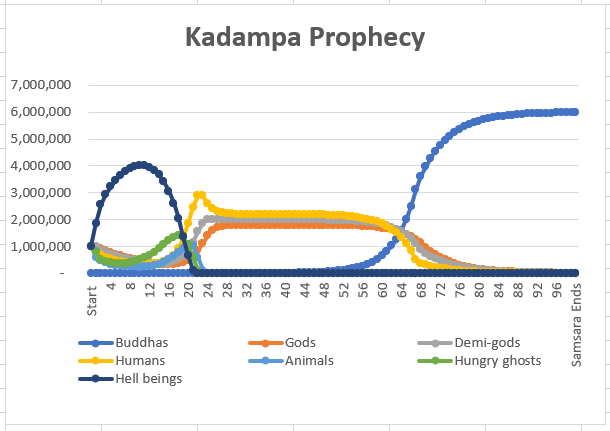
In the beginning, the demographics remain similar to the starting point. Over time, as the number of Buddhas increase, the human realm becomes increasingly purified. As it does, more and more beings get drawn into it through the blessings of the Buddhas. Once they get to the human realm, more and more of them attain enlightenment.

At around half way through between now and the end of samsara, the human realm actually transforms into a pure land, where everybody who takes rebirth in it attains enlightenment. After that happens, there is a rapid acceleration in the number of people who attain enlightenment, drawing more and more beings from the surrounding realms into the human realm/pure land.

The number of hell beings then quickly plummets, causing the share of the hungry ghost realms and animal realms to grow as more beings are pulled towards the human realm. At around 88% towards the end of samsara, the hell realm is emptied, at 92% the hungry ghost realm is emptied, and at 96% the animal realm is emptied.

In the last 4% of samsara, we have to wait until those beings in the god and demigod realms fall into the human realm (but this is occurring faster because they are receiving blessings causing them to take rebirth in the human realm), and then at the end, everyone attains enlightenment.

This seems MUCH more accurate than my previous model. Thanks to everyone for the suggestions.

A Kadampa Prophecy Until the End of Samsara

I did the math between now and the end of samsara according to the Kadampa teachings. It yielded some interesting results.

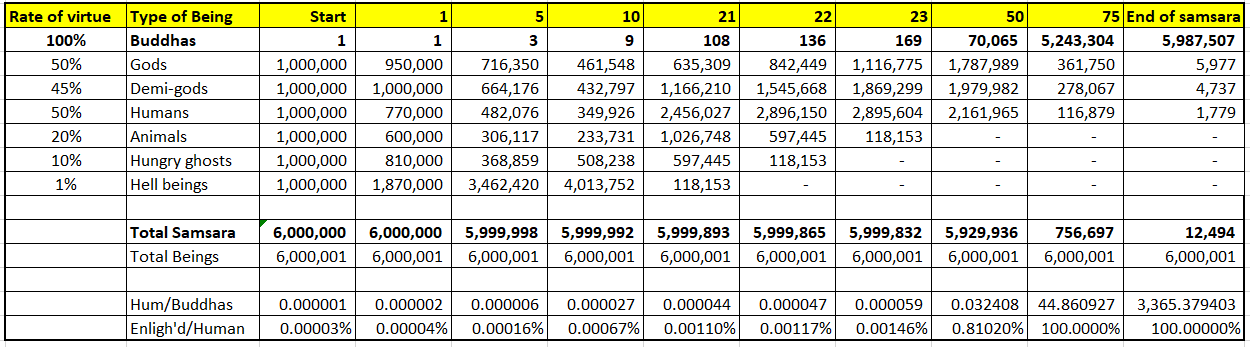
First, I assumed a starting point where beings are equally distributed in the six realms plus one Buddha for all of samsara (not accurate, but some people struggle to accept that 99% of all beings are already in hell, so to humor them, I did an even distribution). I then assumed a starting rate of virtue for each type of being depending on the realm they occupy. At the end of each period beings go up or they go down a realm based on the percentage of virtue of that realm.

I then assumed a certain percentage of humans attain enlightenment in each period. To calculate the attain enlightenment/human ratio I took the total number of humans on earth divided by the number who I’m estimating attain enlightenment (7.6 billion people, 30,000 Kadampas, 2,500 of whom attain enlightenment = 0.00003% enlightenment rate). With each increase in the number of Buddhas, I assume the amount they bless the minds of living beings goes up 1%, thus increasing the rate of virtue for the human, animal, hungry ghost, and hell realms. I did not assume the virtue rate goes up for beings in the demi-god and god realms because then they get stuck in those realms and never attain a human rebirth. Presumably, Buddhas would bless their minds to take human rebirths.

In the beginning, as would be expected, almost everyone falls into the lower realms, in particular the hell realm because once you take rebirth in the lower realms, it is almost impossible to get out. But gradually over time, the number of Buddhas increases, who are then able to bless the minds of the beings in the lower realms more and more effectively. After about 23% of time between now and the end of samsara, due to all the blessings of the now more numerous Buddhas, the lower realms are emptied and almost everyone is in the upper realms. At that time, there is a big spike in the number of humans who start attaining enlightenment at faster rates, again thanks to increased blessings from the Buddhas.

The demographics of samsara over time

We then start a very long period where we wait for Gods and demi-gods to burn up their merit to fall down into the human realm, where then a growing percentage of them attain enlightenment. At around the 75% of time mark, there is an exponential growth in the number of Buddhas who then so outnumber humans, they reach an efficiency where anybody who reaches the human realm attains enlightenment in that life.

Once that stage is reached, there are still about 700,000 remaining beings who just refuse to let go of their pleasures in the demi-god and god realms, ignoring their spiritual guides who go and visit them there. But eventually, enough of them fall back into the human realm, drip by drip, where they then attain enlightenment.

After about 100 periods, essentially all of samsara is emptied except about 12,500 of the last stragglers.

Let me know if you have suggestions on how to change the assumptions of the model. Obviously, this is all an estimate, but it does paint a pretty accurate picture of how things are likely to unfold between now and the end of samsara based upon my understanding of the Kadampa teachings.

Modern Bodhisattva’s Way of Life: Nobody is an obstacle to our spiritual practice

Shantideva asked in the previous verse, what if the person is obstructing our spiritual practice?  Then surely we don’t want to wholeheartedly welcome that?  There are many people who seem to create obstacles to our practice, such as perhaps our partner or family who think we have joined some crazed cult and we will burn in hell, or whatever.  There are those who make noise when we are trying to meditate, there are bills to pay making us have to work, etc.  We might have people we need to tend to so never find time to practice.  All of these things can be viewed as an obstacle to our practice.  But are they really?  I think they are only an obstacle to our attachment to engaging in certain forms of practice.  We may long to engage in solitary retreat in the woods with only the birds as our company, or we may wish to attend every class and puja at the center, but we can’t due to our life circumstance.  Then we start getting frustrated with all of these people and things in our life that prevent us from practicing in the way we want. 

What does it mean to practice Dharma?  The ancient Kadampas said the essence of Dharma practice was to help others as much as possible and to harm our delusions as much as possible.  If we check, almost all of the things we normally consider “obstacles” to our Dharma practice, and therefore feel justified at getting angry at or frustrated with, are actually all opportunities to help others and harm the delusions arising in our mind.  What is bad for our self-cherishing is actually good for us.  These situations which trigger our delusions are exactly what we need to force us to train in their opponents.  Just as a beggar isn’t an obstacle to the practice of giving, so too the arising of delusions in our mind isn’t an obstacle to our practice of training our mind.  Quite the opposite, both are essential conditions.  With the wisdom mind of patient acceptance, nothing is an obstacle to our practice of Dharma. 

(6.103) If, because of my own shortcomings,
I do not practise patience with my enemy,
It is not he, but I, who prevent me from practicing patience,
The cause of accumulating merit.

(6.104) My enemy is the cause of my accumulating the merit of patience
Because without him there is no patience to practise,
Whereas with him there is.
So how does he obstruct my virtuous practice?

(6.105) A beggar is not an obstacle
To people practising giving
Any more than an Abbot is an obstacle
To those wishing to ordain.

(6.106) Indeed, there are many beggars in this world,
But people who harm me are extremely rare.
In fact, if I had not inflicted harm on others in the past,
There would be no one to inflict harm on me now!

If patience is not just an important part of our spiritual training but an essential one, then clearly we need opportunities to practice patience.  But perhaps we still feel that other parts of our spiritual training are more important. We think there are other virtues greater than patience, and we feel other people can get in the way of our other trainings?  We think of some of the other aspects of our spiritual training, people get in the way. People do get in the way, obstructing our spiritual training, obstructing our virtuous practices.  For example we may feel that our family or the people close to us are obstructions to our spiritual training.  The fact that we need to care for them is an obstruction. 

But what is the real obstruction? Surely one of our greatest obstructions is anger – impatience, anger, hatred in our mind.  If we are to remove obstructions to our enlightenment then we must practice patience. Patience is the opponent. We need to use it.  And who provides us with the opportunity to practice patience, to apply this opponent, directly and indirectly?  The difficult people in our life.  If the people in our life were always well-behaved then then we’d be stuck, wouldn’t we, we’d be left with no objects of patience.

What we would like is for everything and everybody to be perfect.  Others will never be perfect if you look at them with an imperfect mind.  Everybody can be perfect just the way they are if you look at them with a perfect mind of patience.  It is perfect for me that you are as screwed up as you are!  Ha ha Because we are looking at people in a perfect way, they forge us into perfect Spiritual Guides.  How wonderful!  It is only difficult people that can forge us into such teachers, not well-behaved people.