Happy Tsog Day: How to Make the Most Sublime Offerings

In order to remember and mark our tsog days, holy days on the Kadampa calendar, I am sharing my understanding of the practice of Offering to the Spiritual Guide with tsog.  This is part 10 of a 44-part series.

Offering the mandala

O Treasure of Compassion, my Refuge and Protector, supremely perfect Field of Merit,
With a mind of devotion I offer to you
A thousand million of the Great Mountain, the four continents,
The seven major and minor royal possessions, and so forth,
A collection of perfect worlds and beings that give rise to all joys,
A great treasury of the desired enjoyments of gods and men.

Geshe-la explains that mandala offerings are the best method for creating the karma to take rebirth in the pure land. Why is this so? It seems that our practice of self-generation as the deity in the pure land would be the best method since that is what we are directly doing (presumably with a bodhichitta motivation). There are three reason why mandala offerings are superior: it is the highest possible offering we can make, we are making it with the greatest possible motivation of bodhichitta, and we are offering it to the supreme object of offering – our spiritual guide, the synthesis of all the Buddhas.

A mandala offering is the highest possible offering we can make. For me, the key to mandala offerings is understanding what, exactly, I am offering. I am not simply offering a completely purified universe; I am offering a promise of practice that I will not stop until I have transformed the universe into the pure land I am offering. The mandala offering is an offering of promise to fulfil our bodhichitta wish. An offering of our practice in general is the highest possible offering we can make because it is what delights the spiritual guide most. An offering of a promise to not stop until we fulfil our bodhichitta wish to transform the universe into a pure land is the highest possible offering of practice possible. Therefore, there is no offering greater than a mandala offering.

Geshe-la explains in the teachings on bodhichitta that engaging in virtuous actions motivated by bodhichitta is a merit-multiplier – we multiply the merit of our virtuous action by the number of beings for whose behalf we engage in the virtuous action. Since bodhichitta seeks to liberate countless living beings, any action engaged in with a bodhichitta motivation is karmically equivalent to engaging in that same virtuous action countless times. Making a mandala offering with a bodhichitta motivation is karmically equivalent to making a regular mandala offering countless times.

Finally, the Guru is the supreme recipient of our offering. In the same way that bodhichitta acts as a merit multiplier, Geshe-la explains that an offering to the Guru is karmically equivalent to making that same offering to each of the countless Buddhas individually. Why? Because the Guru is like a portal to all the other Buddhas – an offering directly to the spiritual guide is indirectly an offering to all the countless Buddhas.

Taken together, we can see that when we make mandala offerings to our Guru with a bodhichitta motivation, we quite literally “max out” the virtuous potential of the action. The offering itself is the highest possible offering of our practice (the promise to fulfil our bodhichitta wish), multiplied by countless living beings due to our bodhichitta motivation, all offered to each of the countless Buddhas through our spiritual guide. Each mandala offering we make with these three recognitions creates countless karmic potentialities to attain the pure land. It only takes one of these to ripen at the time of our death for us to take rebirth there. From this, we can conclude that making mandala offerings is indeed the best method for attaining rebirth in the pure land, for how could it even be possible to offer anything greater than this? It is for this reason that Je Tsongkhapa emphasized mandala offerings and Geshe-la encourages us to engage in mandala offering retreats every year and to complete 100,000 mandala offerings as part of our great preliminary guides for Mahamudra practice.

Offering our spiritual practice

O Venerable Guru, I offer these pleasure gardens,
Both arranged and emanated by mind, on the shores of a wish-granting sea,
In which, from the pure white virtues of samsara and nirvana,
There arise offering substances of broad, thousand- petalled lotuses that delight the minds of all;

Where my own and others’ mundane and supramundane virtues of the three doors
Are flowers that bring colour to every part
And emit a multitude of scents like Samantabhadra’s offerings;
And where the three trainings, the five paths, and the two stages are the fruit.

Geshe-la explains that offerings of our spiritual practice are the highest possible offering. Why? The definition of an offering is that which delights the Guru. Nothing delights our spiritual guide more than our practice of his instructions. He does not want us to practice to flatter his ego that we spend time doing what he says, but because his only wish for us is that we escape permanently from samsara and that we seek to help others do the same. He knows that the only way we can do that is by training in the stages of the path of Sutra and Tantra. When we do so, he is delighted because he knows we are moving closer to the fulfilment of his ultimate wish for us.

Any offering of our practice delights our Guru, from simply smiling to a stranger out of kindness to engaging in advanced completion stage meditations. We can offer our spiritual practice throughout the day and the night as we engage in our different practices. Simply engaging in our practices itself if not the offering of our spiritual practice, we also have to have the recognition that our practice itself is an offering to our spiritual guide.

With the explanation above about how mandala offerings are an offering of a promise of our spiritual practice to fulfil our bodhichitta wish to build our pure land for the sake of others, we can appreciate the description of the offering of our spiritual practice in the sadhana. In effect, we are simply describing in more detail the experience of living in the pure land we have created for others with the mandala offering.

Inner offering

I offer this ocean of nectar with the five hooks, the five lamps, and so forth,
Purified, transformed, and increased,
Together with a drink of excellent tea
Endowed with a hundred flavours, the radiance of saffron, and a delicate aroma.

There are four types of offering – outer, inner, secret, and thatness offering. Each of these types of offering correspond with the four different Highest Yoga Tantra empowerments we receive – vase, secret, wisdom-mudra, and precious word empowerment. The outer offerings create special karmic seeds on our mind which are then activated during the vase empowerment. This merit then powers our meditation on the profound generation stage of the body mandala and leads to us eventually attaining the resultant Emanation Body of a Buddha. Inner offerings create the special karmic seeds that are activated during the secret empowerment, which powers our meditation on the completion stage of illusory body and leads to us eventually attaining the resultant Enjoyment Body. The karma of secret offerings is activated during the wisdom-mudra empowerment and power our meditation on the completion stage of the clear light of Mahamudra and enable us to attain the resultant Truth Body. And thatness (or suchness) offerings are ripened by the word empowerment, empowering us to mediate on the completion stage of inconceivability and attain the resultant union of Vajradhara. When we clearly understand the relationship between the different types of offering, the different empowerments, the different tantric stages, and their corresponding bodies of a Buddha, the practice of each of these becomes much more powerful.

What are inner offerings? This refers to the transformation of the five meats and the five nectars into completely purified nectar, which we then offer. The five meats and the five nectars refer to disgusting substances and liquids in our body. When we bless the inner offering, we recognize the emptiness of these substances and liquids, then generate them as completely pure nectars that we offer. Samsara is identifying with the contaminated aggregates of our ordinary body and mind. Because our aggregates are contaminated, when we identify with them, we are a contaminated, samsaric being. But if we completely purify them, then there is no longer a contaminated basis to identify with, de facto removing us from samsara. The inner offerings primarily refer to our body, and the end result of the secret empowerment is the attainment of the illusory body of completion stage and the resultant Enjoyment Body of a Buddha. These are our vajra bodies, our deathless spiritual bodies.

If we wish to make a tsog offering to emphasize the accumulation of great merit, such as in a long life puja, we should do so at this point.

According to the sadhana, we can engage in the tsog offering at different points of the practice to emphasize different attainments. For auspiciousness, I will explain the tsog offering in the context of emphasizing gaining the realizations of the stages of the path. But there are times when we feel we are particularly lacking in merit, and doing our tsog offering here enables us to emphasize its accumulation. How do we know if we are lacking merit? A typical sign is no matter how hard we try to accomplish our pure wishes, we never manage to do so and we always come up short. It should be noted there is nothing stopping us from doing the tsog offering multiple times in a single session at different points of the sadhana if we want to emphasize more than one aspect of the practice.

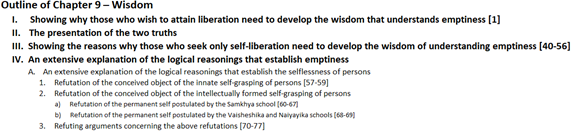
Modern Bodhisattva’s Way of Life: There is no Enlightenment Without Realizing Emptiness

(9.47) The principal holders of Buddhadharma were said to be those who have attained nirvana, the Arhats;
But the Arhats that you proponents of things assert
Cannot be real Arhats because, according to your view,
Their minds still grasp at truly existent things.

It is important that we do not misinterpret these verses as a criticism of other traditions.  Anything that takes people in the direction of enlightenment is wonderful as far as we are concerned.  For us, since we understand that the ignorance of self-grasping is the root of samsara, it is only natural that the wisdom that realizes its emptiness is necessary for complete liberation.  We can encourage people in their own paths, in particular Christian ones, and perhaps later we can explain how to fully unite with God by realizing his emptiness.  But at the same time, we can have confidence that with the wisdom realizing emptiness, we can bring all of our suffering to an end. 

While understanding we do not criticize or undermine the faith in other people’s traditions, it is nonetheless helpful for ourselves to realize that even though this proponents of the lower schools or other religions are kindhearted and well intentioned, there is no actual liberation from samsara without realizing emptiness. This does not mean these other traditions cannot have their holy beings, it means that either their holy beings have not attained actual liberation from samsara despite thinking that they have, or that the followers of those holy beings do not understand the view that was taught by their holy beings.

In this context, the Hinayana scriptures were written by the Arhats, or those who have attained liberation. The Prasangikas agree that these Arhats did indeed attain liberation, therefore they must have realized the emptiness that is the lack of true existence of all phenomena. It is simply their followers who do not understand the final view realized by their own spiritual Masters.  

(9.48a) (Proponent of things) “They attained nirvana, or liberation, and became Arhats because they abandoned their delusions.”

The proponents of things say that the Arhats did attain liberation because they abandoned their delusions.  To attain liberation, we simply need to abandon our delusions. Therefore, they say we do not need to realize the emptiness the Prasangikas teach.

(9.48bcd) You seem to think that, simply by abandoning manifest delusions, one immediately becomes an Arhat;
But it is clear that even though a person might have temporarily abandoned manifest delusions,
Nevertheless, he or she still bears the karmic potentials to be reborn in samsara.

Shantideva agrees that it is possible to reduce all of our delusions other than the ignorance of self-grasping through the teachings of the lower schools. The people who follow these teachings will abandon their attachment, anger, jealousy, and so forth. And so externally it will appear as if they have no delusions. Shantideva is saying that is not enough. The reason why is such beings will still have on their mind the contaminated karmic tendencies to grasp at inherent existence and to generate all of the other types of delusions. And so while temporarily such beings may appear to not have any delusions, they still have on their mind the karmic seeds for generating future delusions, therefore they have not actually escaped from samsara.

According to the Prasangikas, our mind possesses two obstructions. The first is the delusion obstructions, the second is the obstructions to omniscience. Once we have removed the delusion obstructions from our mind, we attain individual liberation. Once we have removed both the delusion obstructions and the obstructions to omniscience, then we attain full enlightenment. The delusion obstructions are not simply manifest delusions arising in our mind. The delusion obstructions are the contaminated karmic tendencies on our mind to generate delusions. The result of following the teachings of the lower schools may lead to the temporary cessation of manifest delusions arising in our mind, but it is not sufficient to actually uproot and purify our mind of the delusion obstructions themselves. We can only do this by realizing the emptiness of our mind itself. Therefore, if we want to never generate delusions again and truly attain liberation from samsara, we must realize the emptiness that is the lack of true existence.

Father’s Day for a Kadampa

As Kadampas, we often talk about the kindness of our mothers; but I think on Father’s Day it is equally important that we reflect on fathers.  Just as all living beings have been our mother, so too all living beings have been our father.  It is equally valid to view all living beings as our kind fathers.  Fathers, especially modern ones, often help us in many of the same ways as described in the meditations on the kindness of our mothers.  They could have insisted our mother had an abortion, but instead they chose to keep us.  They provided us with a roof over our head, food on our plate and clothes on our body.  They changed our diapers, taught us to walk, run and so forth.  As we grow older, fathers give us our sense of values, teach us about a solid work ethic, encourage us to push ourselves and reach for the stars.  By expecting so much of us, we rise to the occasion.  We each have different relationships with our fathers, so we should take the time to reflect on all of the different ways our father has helped us and generate a genuine feeling of gratitude.

Most of the time we take what our parents, especially our father, does for granted.  In fact, usually we feel no matter how much our father does for us, it is never enough.  We always expect more and then become upset that they didn’t provide it.  We feel it is our parent’s job to do everything for us, and when they don’t we become angry with them.  Actually, our parent’s job is to teach us how to do things for ourselves – and that necessarily means many instances of “helping us most by not helping us.”  Not helping us is sometimes the best way our parents can help us because it forces us to develop our own abilities and experience with life.  So instead of being angry at our fathers for what they didn’t do for us, we should be grateful for what they did do.  We should especially be grateful for what they didn’t do, because this is what helped us become independent, functioning adults.  We should look deep into our mind, identify the delusions and resentments we have towards our father, and make a concerted effort to remove them.  There is no greater Father’s Day gift we can provide than healing our mind of all delusions towards him.

There is no denying it, our fathers appear to have a great number of delusions.  Whether they actually have these delusions or are just Buddhas putting on a good show for us, there is no way to tell.  But the point is the same:  they conventionally appear to have delusions, and they tend to pass those delusions on to us.  Part of our job as a child is to identify the delusions of our father, then find those same delusions within ourselves, and then root them out fully and completely.  That way we don’t pass on these delusions down to future generations.  We should also encourage our own kids to identify our delusions and to remove them from their own mind.  We have trouble seeing our own delusions, but fortunately our kids can see them quite clearly!  In Confucian societies, they place a lot of emphasis on their relationship with their ancestors.  We need to recall the good qualities and values of our ancestors and pass those along; but we also need to identify their delusions and put an end to their lineage.  Doing this is actually an act of kindness towards our father because we limit the negative karma they accumulate (remember, the power of karma increases over time, largely due to these karmic aftershocks) by preventing the ripple effects of their negativity from going any further.

But I believe for a Kadampa, Father’s Day is about so much more than just remembering the kindness of our physical father.  I believe it is even more important to recall the kindness of our spiritual father, our Spiritual Guide.  My regular father gave birth to me as a person, but it is my spiritual father who gave birth to the person I want to become.  All the meaning I have in my life comes through the kindness of my spiritual father.  He has provided me with perfectly reliable teachings, empowerments into Highest Yoga Tantra practices, constant blessings, a worldwide spiritual family, and Dharma centers where I can learn and accumulate vast merit.  He believes in me and helps me believe in my own spiritual potential.  He has given me the wisdom to navigate through some of the hardest moments of my life, and he has promised to be with me, helping me, until the end of time.  There is no one kinder than my spiritual father.  I owe him everything.  Like my regular father, I have taken his kindness for granted.  I fail to appreciate what he has provided, and I was negligent when it came to praying for his long life – something I deeply regret, but not in a heavy guilt way.

My spiritual father also emanates himself in the form of Guru Sumati Buddha Heruka. He appears as Lama Tsongkhapa, who reveals the paths of Lamrim, Lojong and Vajrayana Mahamudra.  Lama Tsongkhapa resides at my heart and guides me through every day.  If only I can learn to surrender myself completely to him, he promises to work through me to ripen and liberate all those I love.  My spiritual father also emanates himself in the form of my Dharma protector, Dorje Shugden.  Dorje Shugden is my best friend.  Ever since the first day I started relying upon him, the conditions for my practice – both outer and inner – have gotten better and better.  This does not mean he has made my life comfortable, far from it!  He has pushed me to my limits, and sometimes beyond, but always in such a way that I am spiritually better off for having gone through the challenge.  Dorje Shugden’s wisdom blessings help me overcome my attachment, my anger and my ignorance.  I quite literally resolve 95% of my delusions simply by requesting Dorje Shugden arrange whatever is best for my spiritual development, and then trusting that he is doing so.  Geshe-la is my father.  Je Tsongkhapa is my father.  Dorje Shugden is my father.  My spiritual father also provides for me my Yidam.  A Yidam is the deity we try become ourselves, in my case Guru Father Heruka.  He provides me the ideal I strive to become like.

Father’s Day for me is also more than remembering the kindness of my spiritual father, but it is also appreciating the opportunity I have to be a father myself.  I have always been way too intellectual and have found it difficult to have heart-felt feelings.  Before I got married, I went to the Protector Gompa at Manjushri and asked for a sign whether I should get married or not.  I then had a very clear vision of a Buddha approach me and hand me a baby saying, “this is where you will find your heart.”  Being a father has taught me what it means to love another person, to be willing to do anything to help another person.  I use the love I feel for my children as my example of how I should feel towards everyone else.  Father’s Day is a celebration of that and an appreciation of the opportunity to be a father.  More often than not, fathers mistakenly believe Father’s Day is about their children showing (for once!) some appreciation for all that a father does, then when the gratitude doesn’t come they feel let down.  I think a Kadampa father should have exactly the opposite outlook.  Father’s Day is not about receiving gratitude, it is the day where we should try live up fully to be the father we want to become.  It is about us giving love, not receiving gratitude.

Many people are not yet fathers, or maybe they never will be in this life.  But just as everyone has been our father, so too we have been a father to everyone.  We can correctly view each and every living being as our child, and we should love them as a good father would.  The beating heart of bodhichitta is the mind of superior intention, which takes personal responsibility for the welfare of others.  That is what being a father is all about.  We need to adopt the mind that views all beings as our children, and assume personal responsibility for their welfare, both in this life and in all their future lives.  The father we seek to become like is our spiritual father.  What is a Buddha if not a father of all?  This, to me, is the real meaning of Father’s Day.

Modern Bodhisattva’s Way of Life: Developing Confidence in our Path

Because they do not understand its profundity,
The Vaibhashika schools deny the Mahayana;
And because they do not believe in nirvana,
Some non-Buddhist schools deny the Hinayana.

Here Shantideva makes two general points. The first is our not understanding something is not a valid basis for saying that it is not a valid teaching. We probably do not hold onto the Hinayana objections to the Mahayana scriptures, but we do quite often reject instructions we do not understand. In fact we do this all the time, usually because we misunderstand what the instruction is saying but assume that the misunderstanding is what is being taught and therefore we reject the instruction based upon a misunderstanding. Or sometimes we give in to the laziness of discouragement where things are difficult and so we give up bothering to try, and in an effort to rationalize our giving up we say that we don’t need this anyways. Middle school students do this all the time with respect to pretty much every subject. They say I will never need this, therefore they don’t need to learn this. The truth is because the subject is hard and they don’t want to do the work, they come up with a rationalization as to why they shouldn’t bother doing so.

The second general point Shantideva makes is just because someone else disagrees with an instruction within our tradition does not mean we ourselves should doubt that instruction. Very often when we hear others disagreeing with parts of our tradition we then generate doubts about those specific instructions, but when other traditions seem to confirm or teach something similar to what is taught in our tradition we take greater confidence in it and think that therefore it is valid and reliable. This is quite common. But Shantideva is pointing out that that is not a valid basis for rejecting a Dharma instruction. If we only believe the instructions that everybody agreed with then those instructions probably would not be very helpful anyways because they would be reflective of deluded ways of thinking that dominate our modern society.

Buddha’s purpose in teaching both the Mahayana and the Hinayana
Was to lead living beings to permanent liberation from the cycle of suffering.
Focusing on this ultimate aim, practitioners of both the Mahayana and the Hinayana
Emphasize the three higher trainings of moral discipline, concentration, and wisdom.

(9.45) Buddha gave his teachings as medicine to cure the disease of the delusions, the cause of all suffering.
Some of his teachings are simple and others are very profound.
If you do not understand his higher, more profound teachings,
You should not simply conclude that they were not taught by Buddha.

(9.46) The great Master Kashyapa gathered many of Buddha’s teachings,
Principally the Perfection of Wisdom Sutras,
Buddha’s Mahayana teachings.
However, the Vaibhashika schools do not understand the profound meaning of the Perfection of Wisdom Sutras;
Thus, they conclude that these Sutras are not Buddha’s teachings.

Here, Shantideva makes the point that Buddha gave different instructions according to the different capacities of living beings. As we are reading through the different Dharma books or attending Dharma teachings, we might hear some instructions which seem completely beyond our capacity. What should we do when this happens? Geshe-la explains in How to Transform your Life that there is no fault in setting aside certain instructions for later when they do seem relevant. For example, for the longest time I did not engage in any completion stage meditations. Every time I heard the instructions or read the books, I thought well that’s interesting, but I didn’t actually ever do anything with the instructions. But now that I’ve started engaging in completion stage meditations, I am ble to go back and revisit things that I learned long ago and try learn how to actually put them into practice.

In the same way, when we encounter instructions that seem beyond our present capacity, we should not feel like we need to force ourselves to learn and understand those things or put them into practice right now. We should focus our efforts on those instructions which seem to us to be of the greatest benefit for where we are actually at in our spiritual development.

Being of Many Minds

I’ve been giving some thought to how we have many minds, how we can be of many minds. We sometimes grasp at our mind as this singular entity that somehow remains constant observing everything. But in How to Understand the Mind, Geshe-la explains how we have countless different minds depending upon the combinations of mental factors we have. For example, towards somebody in my life, I can view them as my biggest trigger (anger) or my biggest attachment or as an emanation of Vajrayogini. So who is this person? Are they the trigger, the attachment, or the emanation? They are actually not one of them, not the three of them, nor the collection of the three of them. But if you took away each of them there would be nothing there remaining that is the other person. If we can see how there are many different minds we have towards the same ‘person,’ then we can see very clearly how all phenomena perceived by that mind are also empty. In this way, by realizing the emptiness of our mind directly, we indirectly realize the emptiness of all phenomena that will ever be perceived by our mind.

OK, so they are empty, but what do we nonetheless conventionally choose to follow – trigger, attachment, or emanation? Our delusions of anger and attachment make our mind uncontrolled. So if we don’t ‘choose’ emanation, then we are allowing our mind to remain under the influence of anger or attachment. But we have to apply effort to ‘choose’ emanation when our anger and attachment are pulling our mind so strongly in the direction of believing one of their distortions.

Gen-la Dekyong has been talking a lot in recent times about mistaken vs. unmistaken appearance. We all know what mistaken appearance is, but Venerable Geshe-la specifically uses the term ‘unmistaken appearance.’ Basically, this is our guru pointing to us and saying, “look, this is the unmistaken reality. Focus your mind on this and you will move into this reality.” Pure view – the four purities – is the only unmistaken appearance. To see anyone as anything other than pure is a mistaken appearance.

If we realize this, it will automatically cut ALL of our delusions in their tracks. All of our delusions and problems with other people come from viewing them with deluded minds, but if we see them as all the Buddhas emanated for us by our Spiritual Guide with whom we have an incredibly close karmic connection it would be absolutely impossible for us to generate any delusions towards them. This is the sort of faith we need. This is the view we need to choose to adopt. This is the unmistaken appearance our Spiritual Guide is pointing us to.

So what is the correct answer to the question of ‘who is this person?’ is they are an emanation of a Buddha sent by our spiritual guide. That’s who our family is. That is who our friends and work colleagues are. Basically because we have a mind of faith in our holy Spiritual Guide, that is true for basically everyone we meet in our life. They are all emanations of Buddhas sent by our spiritual guide.

So I think what I need to do to one day completely heal all the stuff that has been going on is to choose to adopt this view, to focus my mind on that reality. This is what is most beneficial for them because wherever I imagine Buddhas, Buddhas go; and wherever Buddhas go, they accomplish their function which is to bestow blessings. So maintaining this pure view is an act of compassion. But it is also beneficial for me because then instead of generating delusions towards them, I will generate all sorts of Dharma minds to work through whatever arises with them.

Sometimes what arises might be really hard, but why is that a problem? Are we not willing to endure a few hardships on our path to enlightenment? Sometimes working through our deeper stuff is hard, but it needs to be done, so we need to put on our Dharma armor and head into battle.

Typically, because we are lazy – or at least I am – if my life is going well, my burning need to practice Dharma quickly dissipates. But when I’m thrown into a crazy crisis or situation, then it kicks up all sorts of delusions in my mind, and I then have to use the Dharma to work through those delusions. Then, I really practice. So my experience is not so much I courageously head into battle against my delusions, but more a desperate struggle for survival, but I have been given the sharp swords of Kadampa wisdom, so I’m forced into battle because I’m surrounded and being attacked on all sides.

And this is why refuge is so important. We can’t just always be battling Rambo style all alone. There is absolutely nothing wrong with being fully united with all the Buddhas, all the Dharmas, and all the Sanghas. Sometimes we can even go within the ‘refuge’ of our community and just focus on our mind and our practice, and others do the battling for us.

That’s Dorje Shugden’s job!!! His vast assembled retinue is like our elite Dharma army with the perfect power to transform whatever samsara might throw at us into something that is absolutely perfect for our swiftest possible enlightenment. All we need to do is generate faith in him, request him to arrange everything so that it is perfect for our practice, and then accept whatever arises as the completely perfect conditions we need for our swiftest possible enlightenment. In other words, they are not just emanations of our spiritual guide, they are emanations of our spiritual guide in the aspect of Dorje Shugden’s vast assembled retinue.

Anyways, sorry, I got a little away from myself. I love Dorje Shugden so much he does that to me.

My point is we need to choose which mind we follow, and the only unmistaken choice is emanation. That’s true for everything.

A Pure Life: Do not Steal

This is part six of a 12-part series on how to skillfully train in the Eight Mahayana Precepts.  The 15th of every month is Precepts Day, when Kadampa practitioners around the world typically take and observe the Precepts.

The object of stealing is anything that someone else regards as their own.  This includes other living beings.  If we take something that no one claims to possess, the action of stealing is not complete.  Like with killing, the intention must include a correct identification of the object of stealing, a determination to steal, and our mind must be influenced by delusion, usually desirous attachment, but sometimes out of hatred of wishing to harm our enemy.  It can also sometimes be out of ignorance thinking such stealing is justified such as not paying taxes or fines, or stealing from our employer, downloading pirated music or videos, etc.  Stealing also requires preparation.  It may be done secretly or openly, using methods such as bribery, blackmail, or emotional manipulation.  Finally, it must also include completion.  The action is complete when we think to ourself ‘this object is now mine.’

In modern life we have countless opportunities to steal and we often take advantage of most of them.  Common examples include not giving money back when we have been given too much change at the store, accidentally walking out with some good we didn’t purchase and not making an effort to go back and pay for it, stealing work supplies from work for our personal use, stealing our employers time by doing personal things on company time beyond what is conventionally acceptable in your work place (most work environments allow you a limited amount of personal administrative time.  The point is do not go beyond what is intended by your employer).  Another very common form of stealing is lying on our taxes so that we pay less arguing our government is wasteful.  We come up with all sorts of justifications for why this is OK, but it is still stealing. 

Stealing can also include saying certain clever things to cause something to come to us when it would otherwise normally go to somebody else.  One of the most common forms of stealing these days is downloading pirated music or videos, or copying and using software we didn’t pay for.  Again, our rationalizations for such behavior know no limits, but it is still stealing.  The test for whether we are stealing or not is very simple:  if we asked the other person would they say its legitimately ours?  If not, it was stealing.

Stealing is incredibly short-sighted.  Anybody who feels tempted to steal should take a few hours driving through a really poor neighborhood or they should go visit a very poor country or watch a documentary on global poverty.  You can find plenty of material just on YouTube.  When we see these things, we should remind ourselves that this is our future if we steal.  When we steal, we create the causes to have nothing in the future.  Giving is the cause of wealth, taking is the cause of poverty.  It is as simple as that.  Why are Bill Gates and Warren Buffet so rich?  Because they have the mental habits on their mind to give away everything.  Because they did this in the past, they became incredibly rich in this life.  Because they are again giving away all of their wealth, in future lives they will again be incredibly rich.  Just as they are external philanthropists, a Bodhisattva is an inner philanthropist.  We seek vast inner wealth so that we can have even more to give away.

There are also many subtle forms of stealing that occur due to the way we have structured our economy. As many of you know I am in economist by training. I very much believe in free markets as the least bad way of organizing an economy. However, the optimal effects of the market only occur when there is what is called perfect competition. When there is perfect competition, excess profits are competed away and both consumers and producers are as good off as they could possibly be on the aggregate. But when markets are not perfectly competitive, markets do not produce optimal results. For example, if a company has a monopoly on the sale of a certain good that everybody needs, it can charge extraordinarily high prices and people will be forced to pay. The company intentionally restricts production to drive the prices higher than would otherwise exist in a perfectly competitive market. As a result, they extract a surplus in profit not due to the quality of their product, but rather by virtue of their market power. Extracting this surplus profit is a form of stealing from the consumers and also from society as a whole because not as much of the good is produced as would otherwise be the case.  It is beyond the scope of this blog to outline them, but there are many examples of market power being used for selfish purposes. 

At a personal level, the point is we need to be aware of the situations in which we have some form of market power over others and to not take advantage of our more powerful position to extract greater profits then we are justifiably due. If we fail to do this, it is a form of stealing. Likewise, if we live in a society in which corporations have disproportionate power and enjoy political protection for their monopolistic behavior, if we vote for or lend political support for such policy knowing that it is a form of stealing, then we are also engaged in a subtle form of stealing. The point is this, we live in a society and we have a say in how that society is run. If we use our political power for selfish purposes or to support those who do so, then are these not karmic actions that have karmic effects? This is not mixing Dharma with politics; this is understanding that the actions we engage in have effects on those around us and we must take that into account when choosing our actions.  I would not say that all of this is a violation of our Mahayana precept to abandon stealing, but it is once again a directional question. Are our actions moving in the direction of stealing or are they moving in the direction of not stealing. That is the question.

Modern Bodhisattva’s Way of Life: Emptiness of the Four Noble Truths

(9.40ab) (Hinayanist) “Since we can attain liberation by gaining a direct realization of the four noble truths,
What is the point of striving to realize emptiness, lack of true existence?”

Realizing the emptiness of the Prasangikas is hard. Further, our ignorance will come up with all sorts of excuses as to why we do not actually have to realize emptiness. For example, we are often very happy to read Dharma books about love, compassion, our precious human life and so forth. But the idea of picking up Ocean of Nectar and studying intricate debates about emptiness seems a daunting task to say the least. We get lost and we do not see the point, and just like we did with math while we were in school, we think we will never need this so why bother trying?

Here, the Hinayanists are doing the same thing. They are saying we merely seek to attain individual liberation, and Buddha explained we can do so through realizing the Four Noble Truths, so why should we bother listening to all you Prasangikas babble on about lack of true existence and the nonexistence of self-cognizers and so forth? 

What are the Four Noble Truths? The first is true suffering, which means recognizing that we are trapped within samsara. The second is true origins, which means understanding the root of our suffering in samsara, namely delusions. The third is true cessations, which refers to the cessation of true origins within our mind. And the fourth is true paths, which is the method for attaining true cessations.

(9.40cd) It is necessary because the scriptures explain that without the path of wisdom realizing this emptiness,
It is impossible to attain even the small enlightenment of self-liberation.

The Prasangika answer to this objection is the wisdom realizing the emptiness of inherent existence is implied within the Four Noble Truths.  For Prasangikas, the source of all delusions is the ignorance grasping at inherent existence. And true cessations are realizing that all of the things that we normally see do not exist at all. This is attained through true paths, which are meditations on the correct view of emptiness. Without realizing emptiness, it is not possible to eliminate all of our delusions, and therefore escape from samsara. Thus, even to attain individual liberation of a Hinayanist requires realizing emptiness.

The basis for this view comes from the Mahayana scriptures explaining emptiness.  

(9.41-4) (Hinayanist) “Because we do not believe in the Mahayana, your quoting from Mahayana scriptures is pointless.”

The Hinayanist objection to the Prasangikas saying emptiness is implicit within the Four Noble Truths is the basis for the Prasangika view is the Mahayana scriptures. But the Hinayanists reject the Mahayana scriptures as being actually taught by Buddha, so therefore they say quoting from them is pointless.

We both believe that the Hinayana scriptures are valid;
So you should apply your reasons for believing the Hinayana equally to the Mahayana.
Thus, we understand that both are the holy Dharma taught by Buddha himself.

First of all, in the real world we would never try to disagree with someone who follows another path. If their path works for them, then we are happy for them, even if they reject our own path. We do not need to convert anybody to the mahayana view, but we are happy to clarify points if someone is actually open minded. If they are not open minded then we just leave them to their path and that’s it.

In this context, we are assuming that the person we are speaking with is a Buddhist and is open minded about the possibility of mahayana scriptures, and so therefore we simply ask the questions to try overcome their doubts. But in the context of our own individual contemplation of Shantideva’s guide, we should recognize all the objections as doubts we may have within our own mind. Perhaps we ourselves doubt whether the mahayana or the vajrayana or the ganden oral lineage and so forth was actually taught by Buddha. This may cause is to doubt the authenticity of the instructions that we receive.

Shantideva’s answer to the Hinayana’s objection is they should apply whatever is the criteria they use for assessing the validity of the Hinayana scriptures to assessing whether the Mahayana scriptures are also valid. It is fair to say if the criteria is good enough for their scriptures then that same criteria should be good enough for evaluating other scriptures.

Happy Tsog Day: Offering the five objects of desire

In order to remember and mark our tsog days, holy days on the Kadampa calendar, I am sharing my understanding of the practice of Offering to the Spiritual Guide with tsog.  This is part 9 of a 44-part series.

Delightful bearers of forms, sounds, smells, tastes, and objects of touch –
Goddesses of outer and inner enjoyments filling all directions.

This refers to the practice of offering the five objects of desire according to Highest Yoga Tantra. There are two ways of engaging in this practice referred to here – viewing the five objects of desire as offering goddesses and offering countless knowledge women skilled in the sixty-four arts of love. These will be explained in turn, but first we need to say a few words about why we generate bliss in our tantric practices and what that exactly means.

Bliss as we normally understand it usually refers to the pleasure we enjoy from particularly good objects of attachment. But this is just changing suffering and ultimately not real bliss since it is contaminated by attachment. Bliss in a spiritual context refers to inner peace that is so pleasant, it is blissful. As explained above, the cause of happiness is inner peace. When our mind is peaceful, we are happy. Enlightenment is sometimes referred to as “supreme inner peace.” It is also called the bliss of enlightenment. This shows that “bliss” and “supreme inner peace” are synonymous. There are two different ways of generating inner peace in the Dharma – concentration on virtue and the absorption of our inner winds into our central channel. Concentration on virtue is referred to as the “bliss of suppleness,” and normally is explained in the context of the teachings on tranquil abiding. With tranquil abiding, our mind is completely free form all forms of gross and subtle mental sinking and excitement for as long as we want. This enables our mind to absorb single-pointedly on our objects of Dharma, giving rise to the bliss of suppleness of tranquil abiding. Sometimes we think of tranquil abiding as the highest form of concentration we can attain, but Geshe-la explains in Ocean of Nectar that tranquil abiding is only attaining the concentration of the lowest form realm god. Our body remains that of a human, but our mind ascends to that of a the lowest of the god realms. There are many, many layers of the god realms – form and formless realm gods – each one corresponding to an ever deeper level of concentrative bliss all the way up to the concentration of the absorption of the peak of samsara, the highest mind of a samsaric being. But these concentrations are not the inner peace of great bliss of tantric practice. These forms of bliss are all our gross mind, not our subtle or very subtle mind. The bliss of tantric practice is far superior to even the greatest bliss arising from concentration.

The bliss of tantric practice arises from our inner energy winds absorbing into our central channel. Our mind possess three levels – gross, subtle, and very subtle. When our winds begin to absorb into our central channel, we proceed into these deeper levels of our mind. The first four winds that dissolve – which correspond with the dissolution of the earth, water, fire, and wind elements – are all gross winds. The next three winds that dissolve – the wind supporting the mind of white appearance, the wind supporting the mind of red increase, and the wind supporting the mind of black near attainment – are all subtle winds. And when the wind supporting the mind of black near attainment dissolves, our very subtle level of mind of clear light becomes manifest. The wind supporting this is our very subtle wind, also known as our root wind, our continuously abiding wind, or our very subtle wind. With each dissolution, our mind becomes increasingly subtle and blissful. When we reach the clear light directly, our mind attains meaning clear light, which is the same nature as the great bliss of full enlightenment. In the beginning, we may only have this bliss for a few moments, but through further training we gain the ability to maintain this bliss for longer and longer periods of time until eventually we experience it forever. At that point, we have attained enlightenment. I believe the bliss we experience when our gross wind element wind dissolves, the bliss we experience is the same as that experienced by a god who has attained the peak of samsara, but I am not 100% sure of this. I remember reading something along these lines, but cannot find it. Perhaps somebody reading this knows for sure and can clarify in the comments. Regardless, it is something in this direction.

Why do we want to attain this great bliss? Because the supreme inner peace of great bliss is able to mediate easily on emptiness. Emptiness is a very subtle object, so to realize it fully we need a very subtle mind. Bliss, quite simply, is what a realization of emptiness feels like. The mind of great bliss is utterly free from distraction because our mind has no desire to go anywhere else. Normally our mind becomes distracted because we think we can find more happiness thinking about some other object that we do our object of Dharma. But when we are experiencing the great bliss of tantric practice, any other mind is necessarily less pleasant. It can be likened to dropping the marble of our mind into a bowl. At some point, the marble settles exactly at the very bottom of the bowl and will not move from there.

When we offer the five objects of desire in these two ways (as objects of the senses and as knowledge women), we imagine that both our Guru who we are offering these things to and ourself experience the great bliss of tantric practice. The principal function of these offerings is to create the merit to be able to experience great bliss directly. To offer the five objects of desire according to the first method, we imagine that all the objects of our senses – sights, sounds, tastes, smells, and objects of touch – all transform into different types of offering goddesses. I find it easiest to imagine that every object is made of offering goddess atoms arranged in the shape of the objects of our senses. For example, the computer screen I am looking at is comprised of offering goddess atoms in the shape of my computer screen. This enables me to engage with the world as it normally appears to me exactly as normal, while mentally seeing it all as part of the pure land. As we or others encounter these purified objects of the senses, we imagine that they experience great bliss from their every sensory experience.

To offer the five objects of desire according to the second method of the countless knowledge women will be explained below in the secret offering.

Happy Tara Day: Tara can dispel all outer and inner obstacles

This is the sixth installment of the 12-part series sharing my understanding of the practice Liberation from Sorrow.

Praising Tara by her divine actions of dispelling conflicts and bad dreams

Homage to you who are honoured by the kings of the hosts of gods,
And the gods and the kinnaras.
Through your joyful and shining pervasive armour
All conflicts and bad dreams are dispelled.

These are particularly practical ways we can rely upon Tara.  We all, from time to time, experience conflict and bad dreams in our life.  Every time we find ourself in some sort of conflict, we can recall Tara’s swift ability to dispel conflicts, and recite her mantra with strong faith requesting that she do so.  Ultimately, all conflict is sustained by anger, attachment, and self-grasping – in either ourself of those we are in a conflict with (usually both).  When we recite her mantra, we should request that she dispel the inner causes of our conflict from all concerned.  For myself, much of my work revolves around the U.S.-China relationship, which is obviously plagued by different types of conflict.  To help dispel this conflict, I try generate pure view of my work and those I encounter as emanations of Tara and request that through them both, all conflict between China and the United States can be dispelled. 

Tara is also helpful for dispelling bad dreams.  When I was very young, I had a few particularly scary bad dreams, and became terrified of having more.  Every night when I would go to sleep, I would pray, “please please please please (repeated millions of times) protect me from bad dreams.”  It actually worked, and after I started praying like this when I went to bed, I had very few bad dreams.  Later, when I became a father myself, my kids started having bad dreams, and I taught them Tara’s mantra and gave them small Tara statues to hold in their hand as they went to sleep to protect them against bad dreams.  Their bad dreams became much less afterwards, almost without fail.

Praising Tara by her divine actions of dispelling diseases

Homage to you whose two eyes, like the sun or the full moon,
Radiate a pure, clear light.
Saying HARA twice and TUTTARA,
You dispel the most violent, infectious diseases.

When the Coronavirus first broke out, Geshe-la advised Kadampas around the world to do Tara practice due to her power to dispel violent, infectious diseases.  Some centers did 24-hour Tara pujas on Tara day every month for some time.  The way these work is every four hours, one engages in the Liberation from Sorrow sadhana, and recites the praises to the twenty-one Taras seven times each session.  While it is true the coronavirus still spread all over the world, we cannot say it would not have spread worse if such actions were not performed.  If we have faith in Tara, there is no doubt that such actions help and perhaps saved many, many lives. 

Praising Tara by her divine actions of subduing evil spirits and zombies

Homage to you who have the perfect power of pacifying
Through your blessing of the three thatnesses;
Subduer of the hosts of evil spirits, zombies and givers of harm,
O TURE, most excellent and supreme!

In many ways, this verse is like the summary of all of the previous verses.  It refers to her power to pacify, bestow blessings (in particular of the wisdom realizing emptiness, or thatness), and subdue outer and inner obstructions.  She truly is most excellent and supreme!

This concludes the praise of the root mantra
And the twenty-one homages.

Normally, we talk of these praises as to the twenty-one Taras, but here we are also reminded that these are also praises of Tara’s mantra.  In Buddhism, we often describe things as existing at gross, subtle, and very subtle levels.  Green Tara is the gross deity, her mantra is like a subtle emanation of Tara, and the Dharmakaya is the very subtle version of Tara.  In this way, we can understand the mantra as like a bridge between the Tara we normally know and definitive Tara.  With sufficient faith in and understanding the nature of the mantra, reciting the mantra has exactly the same function and power as reciting the twenty-one homages. 

Benefits of recitation of this Sutra

The wise who recite this with strong faith
And perfect devotion to the Goddess,
In the evening and upon arising at dawn,
Will be granted complete fearlessness by remembering her.

A qualified mind of refuge has two main parts, fear of samsara and faith in the three jewels.  Normally, we don’t have much difficulty generating faith, but for our faith to have any meaning, it must be informed by an appropriate fear of samsara.  Without this, our Dharma practice just becomes feel-goodism.  But with healthy wisdom fears of samsara and faith in the three jewels, we are pushed to engage in Dharma practices, such as relying upon Mother Tara.  Through this we attain fearlessness in two ways.  First, because we will have a powerful protector at our side; and second, because we will gain inner Dharma realizations, which provide us with permanent protection from all suffering.  In particular, we need the wisdom that knows how to transform adversity into the path to enlightenment.  Normally we fear things that can harm us.  Most of samsara’s sufferings can harm us only because we don’t know how to transform experiencing them into causes of our enlightenment.  But through relying upon Tara, we can gain this wisdom, and then we will have nothing to fear.  We receive this protection merely “by remembering her” because wherever you imagine a Buddha, a Buddha actually goes; and wherever a Buddha goes, they perform their function, which is to bestow blessings.  In other words, by merely remembering Tara, she comes swiftly to our side and then blesses our mind to gain wisdom realizations.  The sadhana says we need to rely upon her with perfect devotion.  What does that mean practically?  It means we move beyond simply having faith in her to actively working to accomplish her wishes in the world.  Somebody who is devoted moves beyond inner faith to practical action.  Tara’s main wish is for the pure Kadam Lamrim of Atisha to flourish throughout the world, both externally and internally.  If we are to enjoy complete fearlessness, we need to not only rely upon her, but to actively devote ourselves to realizing her pure wishes.

Through the complete purification of all negativity
They will destroy all paths to the lower realms.
They will swiftly be granted empowerment
By the seventy million Conquerors.

The cause of lower rebirth is negative karma on our mind.  The quality of mind we generate at the moment of our death determines the quality of our next rebirth – a negative mind will activate negative karma resulting in a lower rebirth, a positive mind will active virtuous karma resulting in an upper rebirth, and a pure mind will active pure karma resulting in a rebirth outside of samsara.  Avoiding a negative mind at the time of death will help protect us from a lower rebirth, but the only way to destroy all paths to the lower realms is through the complete purification of all our negative karma.  If we have no negative karma remaining on our mind, even if we generate a negative mind at the time of death, there will be no negative throwing karma to activate and it will be impossible for us to take lower rebirth.  Tara’s blessings can help us purify swiftly all of our negative karma, and we can recite her mantra as a practice of purification similar to Vajrasattva practice. 

Relying upon Tara also creates the causes for us to receive the empowerments of all the Buddhas.  What is an empowerment?  During an empowerment, our Spiritual Guide places within our mental continuum a personalized emanation of the deity who will remain with us between now and our eventual attainment of that deity.  This emanation is our personal yidam, or personal deity.  By virtue of this emanation, we can gradually learn to identify with the pure body and mind of the deity and gain the ability to use these as if they were our own.  Tara is the mother of all Buddhas, and all Buddhas respect and are devoted to their mother.  When we rely upon Tara, all of her children – the Buddhas – then come into action to help fulfill their mother’s wish for us.  They do so by granting us empowerment.

Happy Turning the Wheel of Dharma Day: Taking our Place in the Lineage

Today is Turning the Wheel of Dharma Day when we celebrate and remember Buddha’s kindness in teaching Dharma to the beings of this world.  Today is a particularly blessed day when the karma we create is multiplied by ten million times, so it is a good idea to make every second count.  As Kadampas, June 4th is also Venerable Geshe-la’s birthday.  Of course it is, what other day would he be born on?  To mark this day, I would like to share my thoughts on why it is important to regularly engage in the Request to the Holy Spiritual Guide Geshe Kelsang Gyatso from his Faithful Disciples, how we can appreciate Buddha’s kindness in turning the Wheel of Dharma, what it means to turn the Wheel of Dharma over time, and the many different ways we can choose to take our place in the lineage.

Understanding How Holy Days Work

There are certain days of the year that are karmically more powerful than others, and the karmic effect of our actions on these days is multiplied by a factor of ten million!  These are called “ten million multiplying days.”  In practice, what this means is every action we engage in on these special days is karmically equivalent to us engaging in that same action ten million times.  This is true for both our virtuous and non-virtuous actions, so not only is it a particularly incredible opportunity for creating vast merit, but it is also an extremely dangerous time for engaging in negative actions.  There are four of these days every year:  Buddha’s Enlightenment Day (April 15), Turning the Wheel of Dharma Day (June 4), Buddha’s Return from Heaven Day (September 22), and Je Tsongkhapa Day (October 25).  Heruka and Vajrayogini Month (January 3-31), NKT Day (1st Saturday of April), and International Temple’s Day (first Saturday of November) are the other major Days that complete the Kadampa calendar. 

A question may arise, why are the karmic effects of our actions greater on certain days than others?  We can think of these days as like a spiritual pulsar that at periodic intervals sends out an incredibly powerful burst of spiritual energy or wind.  On such days, if we lift the sails of our practice, these gushes of spiritual winds push us a great spiritual distance.  Why are these specific days so powerful?  Because in the past on these days particularly spiritually significant events occurred which altered the fundamental trajectory of the karma of the people of this world.  Just as calling out in a valley reverberates back to us, so too these days are like the karmic echoes of those past events. 

Why it is Important to Regularly Make the Request to the Holy Spiritual Guide Venerable Geshe Kelsang Gyatso from his Faithful Disciples

Not only is today important because it is Turning the Wheel of Dharma Day, but also because today is Geshe-la’s birthday.  Even though he has passed, his birthday for us is like the birth of Buddha Shakyamuni in our lives. Quite literally it is because Venerable Geshe-la is Guru Sumati Buddha Heruka. That’s who Geshe-la always was and that’s how he wants us to remember him. The Request to the Holy Spiritual Guide is like having the direct private Skype of our holy spiritual guide, Venerable Geshe Kelsang Gyatso Rinpoche, and Guru Sumati Buddha Heruka. In short, it is a magical method for how we invoke his presence in our life.

When Geshe-la passed, he requested that the entire global Kadampa community do a retreat of Guru Sumati Buddha Heruka. I think it is safe to say that the nearly universal experience of those who engaged in this retreat – regardless of where you were in the world – was that they felt even closer to Venerable Geshe-la after his death as if the supernova of his purity was released from the shackles of our narrow conception of him in a human body and we started to get a sense of just how enormous of a being he is. These were Geshe-la’s specific instructions for what he wanted us to do.

The spiritual realization everyone came to when he died and we all did this retreat was that Geshe-la is Guru Sumati Buddha Heruka. Like literally, not just a view we hold because it is beneficial. When I first came into the Dharma, Geshe-la had not yet introduced Guru Sumati Buddha Heruka. We had Lama Losang Tubwang Dorjechang, which was the Tibetan name of Guru Tsongkhapa. Lama meant Guru, Losang meant Je Tsongkhapa. Tubwang meant Buddha Shakyamuni. And Dorjechang meant Vajradhara, who from a conventional point of view Buddha appeared as when he taught the tantras, but from an uncommon view Buddha Shakyamuni himself was an emanation of Vajradhara. Vajradhara is the real Spiritual Guide who manifests Buddha, who manifests Je Tsongkhapa, who manifests our present root Guru. Geshe-la’s principal project in life was re-presenting the pure Kadam Dharma of Sutra and Tantra of Je Tsongkhapa into a presentation that works for the people of the modern world. In other words, he took what was a cultural presentation for 14th century Tibetan feudal society and translated the meaning of the Dharma in a way that modern people could easily understand and relate to in their modern lives. He said our main mission, then, is to attain the union of Kadampa Buddhism and modern life. This is our homework from him. He has given us a completely pure – 100% pure without being mixed with anything that is not Kadampa – meaning of the Ganden Oral Lineage instructions through which we can attain union of no more learning – or Buddhahood – in one life. Through the Request to the Holy Spiritual Guide, our main request is that he bestow union in this life. This means that we request him to bestow enlightenment in this life, which can actually be done with the Ganden Oral Lineage. This is the main request Geshe-la wants his faithful disciples to make of him. This is WHY he appeared in our life, to be able to make this request of him. Through his blessings, we will realize how his teachings lead exactly to that attainment.

At this point, the doubt often arrives as to whether we can actually attain enlightenment in this life. That seems farcical, almost, especially when we make an honest assessment of the state of our mind. But Geshe-la is telling us that, no, we actually can attain enlightenment in one lifetime if we follow the instructions he has given us purely and sincerely. Purely means for the sake of our future lives and sincerely means without laziness. But then we think, I don’t know anybody within the tradition who seems even close to that state. The Gen-la’s are great and all, but they also still appear to be normal people, sincere and dedicated and realized practitioners, but they don’t appear to have attained enlightenment. If they haven’t done it, then what chance do we have? It is very easy to start assenting to these sorts of views and get discouraged. When we don’t think it is possible, we don’t really go for it, we often don’t even really believe it. This is either some hype or only true for like a superhero Kadampa who does anything perfectly. But that’s not me, so we accept just kinda plodding along, pretending (even to ourselves) to practice for future lives, but really being mostly interested just trying to stay more or less happy through our very difficult lives.

With the Request to the Holy Spiritual Guide, Geshe-la smashes this sort of discouragement and puts front and center that our primary request to him – who will remain the one and only Spiritual Guide of this tradition forever – is, you Guru Sumati Buddha Heruka, please bestow union in this life. This is what Geshe-la did everything for – to give us everything we need to be able to attain enlightenment in this life. We just have to be willing to totally go for it. What better day for making this determination to really go for it than today.

We use this prayer at the beginning and end of every Festival now as part of the basic ritual for creating the conditions necessary for a Festival. We invoke Geshe-la to come and teach the Festival to us through the different teachers and through everything that appears and arises to us during the festival, whether we are at Manjushri, our local center, or our homes.

We also use these prayers twice a month on Tsog days. Prior to Venerable Geshe-la’s passing, we would alternate between long-life pujas and requesting blessings for the realizations of the stages of the path pujas. But after his passing we just do requesting blessings for the realizations of the stages of the path puja with the Request to the Holy Spiritual Guide.

We should do the same in our personal practice. Whenever we do Tsog days on our own, we should make a point of doing them with the Request to the Holy Spiritual Guide understanding this is our special method for bringing Geshe-la’s direct presence in our life. We can also do so at anytime when we want a one-on-one meeting or communion with Guru Sumati Buddha Heruka, who is none other than our holy Spiritual Guide, Venerable Geshe-la. We engage in the request, through reciting the mantra, then we generate a pure motivation, remember his emptiness, and make personal requests to him, ask him questions, seek clarification of Dharma topics, receive blessings, etc. This prayer brings us back to the source of our spiritual life – Venerable Geshe-la as Guru Sumati Buddha Heruka.

The Spiritual Guide plays an indispensable role in our spiritual life.  It is helpful to consider why different realms appear to different beings.  Generally speaking, with the exception of humans, animals, and some gods, beings of one realm can’t see beings of other realms.  Why is this?  Because the world that appears to anyone being depends upon that person’s karma.  Hell beings don’t see other realms because their minds are so impure they only see impurity.  We do not see god realms for the same reason.  The world of the Buddhas is completely pure, and so utterly beyond our scope of appearance.  As a result, even though pure lands pervade everywhere, we are completely blind to them and the teachings and enlightened actions of the Buddhas are essentially beyond our reach.  But the spiritual guide bridges the pure world of the Buddhas and our impure human world.  Despite their mind being in the pure land, they are nonetheless able to appear in our world and to our minds.  Through developing a relationship with the spiritual guide, we are able to learn about and ultimately gain access to the pure lands and all the blessings of the Buddhas.  Without the spiritual guide appearing in our world, and more specifically in our lives, we would have no idea about the existence of pure worlds, much less the paths for reaching them. 

In Great Treasury of Merit, Geshe-la says:

“It is very important to keep a pure view of our Spiritual Guide’s outer aspect and not to be misled into thinking that just because he appears as an ordinary being he is an ordinary being. We must always remember that his apparent ordinariness is itself a manifestation of his enlightened qualities. If he were to display extraordinary qualities and miracle powers these would not benefit us in the least, but by appearing in a form to which we can relate and giving us unmistaken advice he gives us immeasurable help. Indeed, it is this very ability to appear in an ordinary form while performing the actions of a Buddha that reveals his real miracle powers and skilful means.” We might think this no longer applies to us because Geshe-la has passed, but Geshe-la’s body still appears in this world – it is the bodily actions of everything done by Kadampas for the sake of fulfilling Venerable Geshe-la’s vision for flourishing the Kadam Dharma in this world. His speech is all our speech towards this aim. His thoughts are all our thoughts towards this aim. All of his teachings, all of the teachings given within our tradition, lead towards us becoming his emanations in this world. He even told us as much in Portugal when he gave the teaching about temporary emanations and how he will always be with us. Geshe-la’s body, speech, and mind will continue to appear and operate in this world for as long as the NKT exists. He said many times, I am the NKT. He has imputed his I onto all of us fulfilling his vision. If we allow him to, he can continue to guide us in all of our actions of body, speech, and mind. Indeed, that should be our wish to make all our actions of body, speech, and mind him working through us.

It is also important to remember that the spiritual guide appearing in our life is a dependent-arising.  If we do not create the causes for him to appear in our life, he simply won’t.  If we do create the causes, we will see him directly as the NKT in this world. He comes together especially at the Festivals, which are the special method for preserving this tradition for generation after generation. There are billions of people on earth who have no idea who Geshe-la is, much less having him appear directly in their lives in the form of the NKT.  The difference is we have created the karma for him to appear in our lives and others have not.

I once asked Geshe-la, “I realize that if I continue to find you in all of my future lives without interruption, my eventual enlightenment is guaranteed.  Please give me a method to 100% guarantee that I meet you in all of my future lives without interruption.”  He replied, “concentrate on practicing Dharma and always keep faith.”  The Dharma we practice comes from his instructions.  When we put it into practice, we do two things.  First, we create a closer karmic relationship with him because every instruction functions to take us closer to its origin.  Second, we actually mix our mind with his.  His instructions are not separate from his mind but are rather aspects of his mind.  When we put his instructions into practice, we quite literally are bringing his mind into our mind, or more precisely, we are making his mind manifest in our own.  Geshe-la’s answer also says we need to keep faith.  It is not enough to meet him again in our future lives, but we also need to continue to have faith in him.  Keeping faith now creates the tendencies in our mind to continue to have faith in him when we meet him again in our future lives.

But the supreme method for having him continue to be present in our life is to engage regularly in the Request to the Holy Spiritual Guide. Why?  When we engage in this practice, we are requesting him to continue to be present in this world and that he continue to turn the wheel of Dharma for ourselves and all others through us.  This mental action directly creates the cause for him to be present in our life. 

There are two levels at which we can engage in the Request to the Holy Spiritual Guide – for ourselves and for others. 

For ourselves, we can consider without him being present in our life, we would have no spiritual life at all.  We wish for that to continue and so we pray that he remains present in this world forever.  Sincerely engaging in the Request to the Holy Spiritual Guide is like a spiritual insurance policy against our faith decaying and losing the path.  Further, even if we continue to have deep faith in him, our praying for him to remain present in this world forever creates the causes for him to be reborn in this world and for us to find him again in our future lives so we can pick up where we left off. 

For others, we can think, “it is not enough for him to be present in my life, but he needs to remain forever in this world for the sake of others.”  We have already found him and we know what a difference that has made in our lives, we wish his modern incarnation as the totality of the NKT to continue to be present in this world so he can bring similar benefit to others.  Look at how many hundreds of thousands of people Geshe-la has touched in just his time in the Modern world.  Now imagine him remaining until samsara ends.  As long as Guru Sumati Buddha Heruka remains in this world, he will tirelessly work to lead others to enter into, progress along, and complete the path to enlightenment.  This is how they can escape their samsaric suffering.  Not only do such prayers help others, but by praying that Guru Sumati Buddha Heruka appears for them, we also create the karma for him to appear in all of our future lives because whatever we pray for others, we create the causes to obtain also for ourselves. 

I encourage everyone to take advantage of this holy day by engaging sincerely in the Request to the Holy Spiritual Guide. We can download it here for free: Request to the Holy Spiritual Guide Venerable Geshe Kelsang Gyatso Rinpoche from his Faithful Disciples.  What better way to mark his birthday than to pray for Guru Sumati Buddha Heruka to remain in this world forever turning the Wheel of Dharma?

Appreciating Buddha’s Kindness in Turning the Wheel of Dharma

When Prince Siddhartha left the palace, he promised his parents that he would return to share with them what he learned for how to overcome birth, aging, sickness, and death.  He could have just attained liberation for himself and enjoyed eternal peace, but instead, he decided to attain full enlightenment so he could lead all living beings – including ourselves – to the same state.  In other words, he had us specifically in mind when he attained enlightenment.  He did so for us.  It is for us that he came out of meditative equipoise and began teaching.

If Buddha hadn’t turned the Wheel of Dharma, nobody in this world would have ever even heard of Buddhism, much less had the opportunity to practice it.  How many billions of people over thousands of years have been beneficially touched by his decision to come out of meditation and teach for the rest of us. 

When we consider these things, we need to make it personal.  We need to take the time to imagine what our life would be like if we had never met the Dharma – if Buddha hadn’t turned the Wheel of Dharma.  For me personally, life has been one extremely difficult episode after another, but because I have met the Dharma, I have been able to transform all of these experiences into a rewarding spiritual journey.  When we see how our own lives have been transformed, and how those who are close to us have benefited from our having found the Dharma, we can begin to personally internalize Buddha’s great kindness.  With a feeling of personal appreciation, we can then consider we are just one being, he has done the same for billions.

What does it Mean to Turn the Wheel of Dharma Over Time?

Conventionally speaking, we say there were four turnings of the Wheel of Dharma by Buddha.  As it explains on the Kadampa website

“Forty-nine days after Buddha attained enlightenment, as a result of requests he rose from meditation and taught the first Wheel of Dharma. These teachings, which include the Sutra of the Four Noble Truths and other discourses, are the principal source of the Hinayana, or Lesser Vehicle, of Buddhism.  Later, Buddha taught the second and third Wheels of Dharma, which include the Perfection of Wisdom Sutras and the Sutra Discriminating the Intention, respectively. These teachings are the source of the Mahayana, or Great Vehicle, of Buddhism.”

In the Kadampa Play, which is shown at the end of the Summer Festival every year, we are shown that there was a fourth turning of the Wheel of Dharma when Buddha taught the Vajrayana teachings or the Tantric quick path to enlightenment.  These four turnings of the Wheel of Dharma set Buddhism in motion in this world.

But the turning of the Wheel of Dharma is not limited to just Buddha’s lifetime.  We can also understand the turning of the Wheel of Dharma from a most cosmic scale.  Each founder Buddha engages in the Twelve Deeds of a Buddha, from descent from a pure land, through birth, attaining enlightenment, turning the Wheel of Dharma, and eventually dying.  Our world is just one world and Buddha Shakyamuni was just one founder Buddha.  There are countless worlds and countless founder Buddhas doing the same thing.  It is said in this fortunate aeon, there will be 1,000 founder Buddhas who come in cycles to reestablish the Dharma after it fades from the previous founder Buddha.  All of these are different turnings of the Wheel of Dharma.  On this day, we can rejoice in all of this and create literally infinite merit.

Within just this current cycle of the Dharma of Buddha Shakyamuni in this world, we can also identify very clear major re-turnings of the Wheel of Dharma.  These are special times when new energy and new momentum was created to push the Dharma forward into future generations.  For example, Atisha (980-1054 AD) was viewed by many as the Second Buddha, and his teaching of the Lamrim reignited the Dharma in this world by founding the Kadampa tradition.  Later Je Tsongkhapa (1357-1419 AD) united the Dharma of Sutra and Tantra and founded the New Kadampa Tradition.  And most recently, Venerable Geshe Kelsang Gyatso Rinpoche re-presented the teachings of Je Tsongkhapa for the modern world.  These great masters also engaged in major turnings of the Wheel of Dharma, each in their own way.  I would say that just as Atisha founded the Kadampa Tradition, Je Tsongkhapa Founded the New Kadampa Tradition, we can say Venerable Geshe-la founded the Modern Kadampa Tradition. And this is just within the Kadampa lineage – there are countless other Buddhist lineages, such as Theravada, Zen, and so forth.  No doubt each of these lineages has its own major turning points.  We can rejoice in all of these major turnings of the Wheel of Dharma.

But the turning of the Wheel of Dharma is not limited to these seminal masters, but to each and every lineage guru along the way.  Since Je Tsongkhapa alone, there has been an unbroken lineage of 37 different lineage gurus, who each kept the lineage alive – turning the Wheel of Dharma for future generations.  Why is lineage important?  Buddha’s blessings only transmit through lived experience, not mere intellectual understanding of his teachings.  A lineage is considered a “living lineage” if there is an unbroken series of gurus who have personally realized all of the teachings of that lineage.  When we are part of a living lineage, the lineage gurus serve as an intact pipeline for the unobstructed flow of blessings from Buddha Shakyamuni straight into our heart.  Through the immeasurable kindness of Venerable Geshe-la, the Kadampa lineage remains intact and alive in this world.  This means we can gain direct access to the lineage blessings of our precious instructions, making realizing them infinitely easier. 

Taking Our Place in the Lineage

It is good to rejoice in all of the past turnings of the Wheel of Dharma, but it is not good enough to stop there.  We ourselves need to realize we have a personal responsibility to carry forward the Kadampa lineage for future generations.  If we do not do so, who will?  If we do not do so, this precious lineage that has been kept alive for thousands of years will die in this world.  It is our personal responsibility to carry this lineage forward.  In short, we must each assume our personal place in the lineage.

Gen Tharchin said when somebody new comes into the Dharma center, he views them as “a future holder of the lineage,” and cherishes and respects them accordingly.  When we consider the “great wave” of Je Tsongkhapa’s deeds, we realize that his basic strategy for eventually liberating all living beings is to form new spiritual guides, who in turn form the next generation of spiritual guides, and so forth until eventually every living being has been touched by them.  We are currently on the receiving end of Venerable Geshe-la’s turning of the Wheel of Dharma.  But we ourselves need to assume our place in the lineage.

At first, we might think this is not our job – we have Gen-la Dekyong, Gen-la Khyenrab, Gen-la Jampa, and Gen-la Thubten for that.  We are not going to become a lineage guru ourselves, so this doesn’t mean anything for us personally.  We can rejoice in their deeds, but we have no personal responsibility to carry forward the lineage ourselves.  This way of thinking is completely wrong.  Geshe-la said in one of his last teachings before he retired that, “you are all lineage gurus now.”  How can we understand this? 

At one level, we can say even if we are not likely to be a lineage guru in this life (though, we never know…), at some point in our future lives it will be our turn to assume our place in the lineage.  Just as Gen Tharchin views us, so too we should view ourselves as future holders of the lineage and orient the trajectory of our mental continuum towards assuming that role.  Gen Tharchin also says we have the ability to design our own enlightenment by virtue of the type of bodhichitta we develop as bodhisattvas.  Why is Avalokiteshvara the Buddha of Compassion and Manjushri the Buddha of Wisdom?  Because as bodhisattvas they generated the specific intention to become that type of Buddha.  I have a dear friend who has now passed who wanted to become a deity in Dorje Shugden’s mandala.  Gen Tharchin said he wants to be a Buddha specifically capable of helping the beings in the hell realms because that is where most living beings reside.  We should think about what sort of Buddha we want to become, and begin our long march to assuming our place in the lineage with those special abilities.

At another level, we can say we have internalized a degree of the lineage even if we haven’t realized all of it.  Therefore, we do have the ability to pass on what we have personally realized.  A senior teacher once said if two teachers gave the exact same teaching – word for word with exactly the same intonation and everything – but one of the teachers had personal experience of their truth and the other did not, the lineage blessings would flow primarily through the one who had personal experience, and so those listening would receive infinitely more benefit from the teaching.  Ultimately, this teacher said, teachings are only as powerful as the blessings passing through the person delivering them.  How many blessings pass depends primarily upon the pure view of those listening, but also on the degree of personal experience of the person transmitting the wisdom.  We see this same phenomenon in daily life – those who “speak from experience” are so much more powerful than those who do not.  Each one of us has a degree of personal experience, which means we have the ability to pass on at least those portions of the lineage to the next generation.  Passing on the lineage can occur in many forms, not just formal teachings.  Merely setting a good example is a method for passing on the lineage.

At a much deeper level, we can consider the much broader understanding of our Spritual Guide’s body, speech, and mind discussed above.  When we see our body, speech, and mind as an extension of his in this world, then we can start to see how we are – at this very moment – assuming our place in the lineage.  The closer we draw towards Guru Sumati Buddha Heruka, the more we emulate him, the more we come into alignment with his enlightened actions in this world.  His impact in turning the Wheel of Dharma depends, fundamentally, on us.  This is why he thanked us every time he saw us and said without us helping him fulfill his vision, he would be almost nothing. 

Buddha’s turning the Wheel of Dharma Day is our opportunity to not only celebrate Geshe-la’s birthday, recall Buddha’s kindness, or even that of the lineage gurus, but an opportunity to also see ourselves as an indispensable part of the lineage, and see our spiritual lives as part of the turning of the Wheel of Dharma, not only in this life but for generations to come.  In this way, we ourselves become part of the very Wheel of Dharma the enlightened beings turn.