Common and Uncommon Pure View:

In Tantric Grounds and Paths, VGL explains there are three main practices during the meditation break: Viewing everything as manifestations of emptiness, viewing everything as manifestations of our mind of great bliss, and viewing everything as manifestations of enlightened deities. I think we can say from the perspective of a practitioner on the path, we first train in seeing things as manifestations of deities until this becomes our daily experience, then we train in seeing them as manifestations of our mind of great bliss until that becomes our daily experience, then finally we train in seeing them as manifestations of emptiness. This is moving from gross to subtle to very subtle.

Normally we think of the nature truth body as the deepest level of the Dharmakaya and the wisdom truth body as like its surface, like waves on the surface of the ocean. I think this is common appearance from the perspective of a practitioner on the path.

From the uncommon perspective of a Buddha, I think we can say the wisdom truth body is found inside the emptiness of the nature truth body. When we think about the four profundities, we first need to realize ultimate truth before we can realize conventional truth, then we realize they are non-dual, though still nominally distinct. Then our understanding of emptiness is complete.

For a Buddha, they see inside the emptiness of all phenomena is their omniscient mind of great bliss, and inside that are countless emanations of enlightened deities. This is exactly how we experience the three bringings. Things are not becoming more gross as we move from truth body to enjoyment body to emanation body, rather we are seeing increasingly subtle levels. The most subtle of all is seeing appearance as inside emptiness. We see only emptiness, but it is directly appearing as completely purified all phenomena. This is what is meant by completing the practice of clear light. Instead of seeing appearance as a more gross conventional truth we directly see it as an ultimate truth inside emptiness.

In short, Buddhas see so deeply into emptiness they see appearance. For a Buddha, the gross is the nature Truth Body, the subtle is the wisdom truth body, and the very subtle is the emanation bodies. Hinayana Foe Destroyers absorb into emptiness, but it is only when we remove the obstructions to omniscience from that clear light emptiness that we attain the omniscient mind of a Buddha seeing directly all phenomena inside emptiness. In Sutra Mahamudra we say the mind is so clear, it knows. In Tantra Mahamudra, I think we can say our mind of great bliss is so empty, it appears and functions. Buddha see this directly.

Thoughts?

Modern Bodhisattva’s Way of Life: Overcoming Doubts About Emptiness

(9.70) (Non-Buddhists) If the self were not permanent but perished in the next moment,
There would be no relationship between actions and their effects
Because, if the self perished the moment it committed an action,
Who would there be to experience its fruits?”

Now Shantideva answers some common objections that may arise in response to the explanations given. Again, we need to identify within ourselves the same doubts that the other schools are raising so that we can appreciate the refutation that Shantideva gives.

Here the non-Buddhists are refuting impermanence. To be permanent means to not change. To be impermanent means to be undergoing continuous change, things do not remain even for a moment. Impermanence says that the entire universe is simultaneously utterly destroyed and completely recreated in every moment. Everything changes, there is nothing that remains the same. There is a complete cessation of the previous moment to create the space for the next moment. Indeed, we can say that the process of destruction of one moment and the process of creation of the next moment are simply two sides of the same process viewed from different angles.

The non-Buddhists say if things are impermanent and everything ceases completely every moment, then we cannot establish any connection between cause and effect. Karma is negated. How can we say that we experience the effects of our previous actions if our present self has no relationship with our previous self? The old self has completely ceased and our new self is something that is completely different so therefore there is no continuity between the actions that we created in the past and the effects that we experience now.

(9.71) There is no point in our arguing about this,
Because we both assert that the continuum of a person who commits an action
Is not different from the continuum of the person who experiences its effect;
But at the time of experiencing the effect, the person who committed the causal action no longer exists;

(9.72) And at the time of committing the causal action,
It is impossible to see the person experiencing the effects.
Both the committer of the action and the experiencer of its effects
Are merely imputed upon a single continuum of a collection of aggregates.

The main point here is the impermanence of persons.  The teachings on impermanence explain that things do not remain even for a moment, and that includes people.  In every moment, a person changes completely.  The old self goes completely out of existence, without even the slightest trace remaining.  And an entirely new self is created – a completely new person.  Our view is that minor things on the surface change, but there is an underlying core which remains unchanging.  We feel it is the same person, but even conventionally, it is not. 

But there is nonetheless a continuum, like beads on a mala.  All Buddhists believe in impermanence. But impermanence simply means that there is not a self that remains unchanging eternally. However, there is a continuum to the self. It constantly changes, but we can trace the continuum path or trajectory of those changes. It is upon this continuum that we can say that the person who experiences the effects is the same continuum as the one who created the causes or created the karma.

Why does this matter?  What would happen if I stopped grasping at a permanent self?  One of the main reasons we become discouraged is grasping at a permanent I, is it not?  If we were not to grasp at a permanent I, would we become so discouraged? We would not become discouraged at all.  Geshe-la himself said there’s no valid reason for us to become discouraged. We can become who we want, change is taking place naturally.  Because we are empty, our aggregates are empty, change is taking place moment by moment by moment.  All we have to do is direct that change, that is all.  We can become what we want merely by creating causes for what effect we would like to take place in the future. We create causes whose effects take place in our continuum.  We can become a Bodhisattva or a Buddha in dependence upon creating the right causes.  We can change into whoever we want because we are empty.  It does not seem like we can because we grasp at ourselves as being permanent.  As a result, we don’t even try.  But when we let go of that, everything becomes flexible and we become changeable. 

If we really believe that the person who criticized us, for example, ended the moment the criticism ended, then why would we bother getting angry and retaliate? We would be angry with someone who has not criticized us. They have finished criticizing us, and it’s too late!  What would happen, again from a practical point of view, and this is most important, if we stopped grasping at others’ permanence?  What would happen to the attachment that we have towards people and the anger that we have towards people, and the sufferings that arise from them?  It would cease, wouldn’t it?   It seems as long as we are grasping at permanence we’re not giving ourself a chance and we’re not giving others a chance to change, are we?

Happy Protector Day: Fulfilling our Heart Commitment to Dorje Shugden

The 29th of every month is Protector Day.  This is part 8 of a 12-part series aimed at helping us remember our Dharma Protector Dorje Shugden and increase our faith in him on these special days.

Commitment, fulfilling, reliance, and appropriate substances,
Outer, inner, secret, attractive, and cleansing offerings, filling the whole of space,
I offer these to the entire assembly;
May I fulfil the heart commitment and restore my broken commitments.

This refers to an offering of our practice of the Heart Commitment of Dorje Shugden.  What does this mean?  It means to not be sectarian with our spiritual practice.  If we are sectarian in our practice, it will bring the Dharma into disrepute and it will create many problems for people being able to practice the path that leads to enlightenment, so it is very important for us to not be sectarian.  Gross sectarianism is when one tradition claims to have a monopoly on the truth and all the other traditions are wrong.  Many wars and much suffering have taken place due to this.  Subtle sectarianism is when we mix and match different traditions together.  Here, instead of saying one tradition is better than another in a general sense (as in gross sectarianism) we are saying that individual instructions from one instruction are better than individual instructions from another. 

To avoid sectarianism, Geshe-la encourages us to ‘following one tradition purely without mixing, while respecting all other paths as valid for others.’  Buddhas emanate many Buddhist and non-Buddhist paths depending on the karmic disposition of beings.  Different people will respond to different instructions, and so we are happy for anybody to follow any authentic spiritual path. 

This can be understood with an analogy of being trapped in a burning room.  If we were trapped in a giant burning room and there were many doors out, what would we do?  We would find the door closest to us and head straight out.  We would not start towards one door, then change to another, then change to another still because that keeps us trapped in a room.  We would not head towards the average of two doors because that would bang us straight into a wall.  We also would not judge other doors as being wrong for somebody else who is standing right next to it, instead we would encourage them to go out the door closest to them.  In the same way, if we are all trapped in the giant burning room of samsara and there are many different spiritual doors out, what do we do?  We find the one that is karmically closest to us and we head straight out.  We do not follow one path, then another, then another because then we complete none of them and remain in samsara.  We do not mix together two different traditions because this amalgam of our own creation does not lead to an actual door out.  We do not tell people who are closest to the door of another spiritual tradition, such as a Christian, that they should abandon their Christian path and follow our Kadampa path, instead we encourage them to go out through the emergency exit closest to them.  If somebody criticizes our practices and says that their practices are superior, we should not become defensive.  We can just say, ‘I am happy for you that you feel you have superior practices.  I hope you enjoy them.’ We then continue to do what seems best for us.  This avoids all problems.

So what is the Kadampa door?  It can be summarized in one sentence:  “relying upon guru, yidam and protector, I practice the path of Lamrim, lojong and Vajrayana Mahamudra.”  If we are doing this, if we have chosen this as our path and we are following it purely without mixing while respecting all other paths as valid for others, then we are keeping our heart commitment to Dorje Shugden.  Taking such a commitment is our personal choice.  Nobody can force this on us, we do so voluntarily.   This is not a commitment of the empowerment, it has to be something from our own side we decide to do.

One of the core principles of the NKT is while respecting all other traditions, to follow one tradition purely without mixing.  This is an extremely vast subject.  Venerable Geshe-la (VGL) explains in Ocean of Nectar that we need to be careful when introducing the subject of emptiness to those who are not ready because doing so can lead to great confusion.  I would say even more so, we need to be careful when introducting the subject of following one tradition purely without mixing, as this is a special spiritual instruction that can easily give rise to much confusion and doubt, including thinking that such an approach is closed-minded, anti-intellectual and sectarian.  The attached document attempts to explain the rationale behind this instruction so that people can be happy with putting it into practice. 

To provide you with a snapshot, the attached document is organized as follows:

  1. References within VGL’s teachings on this advice
    1. On following one tradition purely without mixing
    2. On sectarianism
  1. The mind with which we examine this question
  2. How to understand this instruction
  3. Rationale for the spiritual advice to follow one tradition purely without mixing
    1. Considering valid reasons
    2. Contemplating useful analogies
  4. Refutation of objections to not mixing
a.      Objection 1.  We can gain a better understanding of a subject when explored from multiple perspectives
b.     Objection 2:  We can gain a higher and deeper understanding of universal truth through synthesizing multiple systems of thought.
c.      Objection 3 :  All religions say the same thing, just with different metaphors and means.  So what is the problem with me studying and reading other traditions.  Does that not also take me in the direction of enlightenment ?
d.     Objection 4:  OK, I agree we should not mix traditions.  I am 100% committed to VGL, I know what we are all about and I don’t want to mix.  So what is the problem with me reading other sources ?
e.      Objection 5:  But I do not have freedom because I cannot be an NKT teacher or officer of an NKT center if I still want to go to other things.  So I am not free to choose.
f.      Objection 6:  But it can be argued that just because one is in a relationship with somebody else does not mean that they cease to be friends with other people and other women.  In the same way, it is not mixing or violating my commitment to my spiritual path by reading other books, etc., as long as I am clear as to who is my Spiritual Guide.
g.     Objection 7: But we are Buddhist, so everything depends upon the mind.  Reading other sources is not from its own side mixing, it depends upon the mind with which we do it. 
h.     Objection 8:  Come on !  Certainly you are exaggerating to say it is a fault to even read or be exposed to teachings from other traditions.  Don’t be so paranoid !
i.       Objection 9:  It still seems very closed-minded to be so categorical in shunning anything that is non-NKT.
j.       Objection 10:  OK, even if I agree with all of the above, certainly it is more skilful to say nothing, since people will misunderstand and leave the Dharma as a result of this misunderstanding.
k.     Objection 11:  OK, I agree, something needs to be said.  But why do you have to do it in such a foreceful way. 
l.       Objection 12:  OK, point taken.  But what makes an action skilful is whether the action does not undermine the faith of the other person when you engage in it.
m.   Objection 13:  OK, fine !  Just tell me what I can and cannot do.
n.     Objection 14:  If that is the case, then why do different teachers have different policies and standards on this one ?
o.     Objection 15:  But how does your standard compare to that of the NKT as a whole ?  Are you more strict ?
p.     Objection 16:  Wait a minute !  I can understand why there would be an issue with Tibetan Buddhism in general, but certainly it is not a problem with Mt. Pellerin.  After all, their teacher was also a student of Trijang Rinpoche, he is friends with VGL, and they are Dorje Shugden practitioners.  Are they not basically a Tibetan version of us, and we are a Western version of them ?  So their teachings can help improve our understanding of VGL’s teachings.  We are all talking about the same thing, so there is no mixing going on.  So it should be OK.  It seems we should at least make an exception with them.
q.     Question 17:  OK, I understand all of this and it makes sense.  How practically then are we to implement all of this at the center given the sensitivities involved ?

In the next post, I will continue to explain verse by verse my understanding of the meaning of the Dorje Shugden part of the sadhana.

Modern Bodhisattva’s Way of Life: Why the Materialists Are Wrong

If the Samkhyas are the Christians who are the Vaisheshikas and Naiyayikas?  Essentially, they are the materialists or the scientists or the atheist. They are the people who say there is just the material world. Everything can be explained in terms of physical phenomena. Much of modern psychology has attempted to try explain everything that happens within the mind as the product of physical evolution or biological processes occurring inside of the brain.  As we go through the refutations of this school, we should have that sort of thinking in mind. There is part of us that still thinks everything is just material and that the mind is the brain.  

(9.68) The material I asserted by materialists also cannot be the I,
Because it is devoid of mind, just like a jug.
(Vaisheshika and Naiyayika) “But it has a relationship with mind and so it can know objects.”
When the self, or I, comes to know something, the former self that did not know ceases;

(9.69) But if, as you say, the self is permanent and unchanging,
How can it form a relationship with mind and become a knower?
Saying that the self is devoid of mind and unable to function
Is like saying that space is the self or I!

Materialist psychologists do not have an answer for how the physical organ of the brain can know a non-physical object. They simply observe that we do know things and they observe that we have a brain, therefore they conclude that somehow the brain can know mental objects. What’s interesting is the materialists consider those who believe in spiritual matters are naive and that they are the scientists. But in truth they are the ones that make the leap of faith that is somehow a material substance can know.

Happy Tsog Day: Remembering What it is all For

In order to remember and mark our tsog days, holy days on the Kadampa calendar, I am sharing my understanding of the practice of Offering to the Spiritual Guide with tsog.  This is part 14 of a 44-part series.

Requesting the spiritual guide not to pass away

Though your vajra body has no birth or death,
We request the vessel of the great King of Union
To remain unchanging according to our wishes,
Without passing away until samsara ends.

Technically, our spiritual guide never dies because he identifies with his deathless vajra body. Our indestructible wind and mind go with us from life to life and is our actual body and mind. Samsaric beings mistakenly identify with their contaminated aggregates (such as the body and mind of a human or an animal), and as a result, when these die, the person feels like they die too. But an enlightened being is somebody who has completely purified their indestructible wind and mind of all delusions and their karmic obstructions, and then they identify with this completely purified body and mind as themselves; thus, attaining immortality.

The problem is living beings still trapped in the hallucinations of samsara cannot see directly vajra bodies. They are too pure and too subtle for our contaminated, gross minds to perceive. In order to help those of us trapped in samsara’s nightmare, Buddhas and spiritual guides emanate forms which appear to us in our samsaric dream. They themselves never leave their vajra body, but they are able to project themselves into our karmic dream. When they do so, these emanations appear as normal samsaric beings who are born, get old, get sick, and die. They appear this way because we do not have the karma to see things any differently.

In order for these emanations to appear, we need to create the karmic causes for them to do so. There are two principal methods for doing this. First, we can view everything as an emanation with a mind of faith. This mental action is not only true, since the ultimate nature of all things is the Truth Body of all the Buddhas, but it also creates the karma for emanations to appear to our mind as emanations. Second, we request that the spiritual guide remain in this world until samsara ceases. This mental action, especially when motivated by great compassion or bodhichitta, creates the karmic causes for emanations of Buddhas to appear in this world, guiding beings along the path. Now that Venerable Geshe-la has shown the manner of passing, we accomplish this second method primarily through the Request to the Holy Spiritual Guide prayers.

Dedication

I dedicate all the pure white virtues I have gathered here, so that in all my lives
I shall never be separated from the venerable Guru who is kind in three ways;
May I always come under his loving care,
And attain the Union of Vajradhara.

As explained in one of the first posts of this series, Geshe Chekhawa said there are two activities, one at the beginning and one at the end. In the beginning, we generate a bodhichitta motivation wishing to engage in the practice for the sake of all living beings; and in the end, we dedicate any merit we accumulated through the practice towards the same goal. Intellectually, we know this, but we can sometimes not appreciate what is happening in our heart, and our practice and dedication seem flat.

To give us some feeling, I find it helpful to consider some analogies of things we do in life that are similar to dedication. The most obvious example is saving our money for some future use. We make the conscious decision to put our money in the bank or in some investment so that it can work towards providing at some future date. Another example is saving pictures or other nik naks around the house that remind us of somebody special. We lovingly place these things in our home for a long duration so that we can be reminded of them again and again in the future. We also save all sorts of information in our files so that we can find it again in the future when we need it. In the same way, we should feel as if we investing our merit, saving our karmic appearances, or storing away our important karma for the future.

The merit we dedicate will continue to work towards the goal of our dedication until it is eventually realized. If we dedicate our merit towards something in this life, it will continue to work until that thing ripens. But if we dedicate it towards the attainment of enlightenment of all beings, it will not stop bringing benefit until that goal is realized. Further, dedication is the best method for ensuring that our past virtues are not subsequently destroyed by our anger. Anger functions to burn up undedicated merit, with the end result being it is as if we had never engaged in the virtue in the first place. But once we dedicate our merit, it is safe and protected, even if we later get angry. Understanding the value of dedication, we dedicate all our merit to the goals explained in the dedication verse.

The Prism Crystal of Inseparable Bliss and Emptiness:

Emptiness is like a completely clear infinitely vast prism crystal. Our mind is like a light that illuminates inside the prism (everything is inside emptiness, our mind and emptiness are inseparable). Karma is like filters within the crystal that refract different appearances within the crystal. The filters are inseparable from the crystal itself, like internal facets of a diamond created by mental action. The appearances refracted are nothing more than projections of mind inside the cyrstal. Contaminated karma will refract contaminated appearances. Pure karma will refract pure appearances. In truth, these are merely projections of mind filtered through our karma in the prism crystal of emptiness – mere appearnces.

Contaminated appearances appear to exist from their own side independent of the mind. Grasping at those appearances as things that actually exist from their own side is ignorance. These are the things we normally see. Even though they appear vividly, such things do not actually exist at all.

Different mental actions create different karmic filters that refract different appearances within emptiness when that karma ripens. The mental action of believing our correct imagination that we are Heruka creates a particular karmic filter that, when it later ripens, will refract as an appearance of ourself as Heruka in Keajra. But in reality, we are always just the completely clear crystal (only emptiness) refracting ourself as Heruka.

What others see when they look at us as Heruka depends upon the karmic filter they are looking at us through. Take VGL for example. Some may see a cute little Tibetan dude, some may see Guru Sumati Buddha Heruka, others may see Definitive Heruka. VGL can see all of the different ways he is seen (including how he sees himself) because these are all arising within his light-like mind of great bliss inseparable from the infinite prism crystal of emptiness. What is he really? He is no one of these appearances, but from another perspective they are all his emanations appearing to different beings according to their different karma.

When we change our mental actions, we change our karma, which changes the filters inside emptiness, which will change what later refractively appears directly to us.

The Ganden Oral Lineage contains special mental actions that, when engaged in, produce the appearances of enlightenment very very swiftly. One of the most important mental actions within the Ganden Oral Lineage is the meditation on non-dual appearance and emptiness of ourself as Heruka (or Vajrayogini). Another is the meditation on non-dual appearance and emptiness of ourself as the nada in the meditation on the indestructible wind and mind. Others include the appearances of the eight dissolutions, up to meaning clear light, the illusory body, and the union of the two. Believing correct imaginations on each of these functions to create special pure karma that will later ripen as us perceiving ourself as these pure appearances, inseparable from emptiness.

When we perceive directly pure appearance and emptiness as non-dual, we will have attained enlightenment.

Modern Bodhisattva’s Way of Life: Realizing the Emptiness of God

(9.66) (Samkhya) “The different aspects are not true, only their nature is.”
If the aspects are not true, why say their nature is true?
(Samkhya) “Their nature is true and the same in that they are both merely conscious apprehenders.”
Well then, all living beings must be one and the same because they are all conscious apprehenders.

(9.67) Moreover, it follows that animate and inanimate phenomena must be one and the same,
As creations of the general principle, the independent creator of all.
If all the particular aspects are false,
How can their basis, their nature, be true?

This debate is actually very important because most of us are actually Samkhyas!  The Christian view is there is an independent creator of all, and that all of his creation is the same nature as the creator.  This is also what the Samkhyas are more or less saying.

We need to ask one simple question:  are we independent from God or not?  If we are independent from him, how can he create us because that would imply there is some point of connection between the two.  If we are not independent from him, how can he exist inherently?  We would have to be the same nature as him, which means he would have to be the same nature as us.  Since we ourselves are empty, so is he.   Realizing emptiness enables you to eliminate the final gap between you and the creator by realizing you are the creator – your mind is the creator of all. 

So we can agree that God is the creator of all, and that the whole universe is his creation – it is one with him.  But so are we.  The only way that can be is if we are him.  It does not feel that way because our ignorance is grasping at a self that is independent of the creator – an inherently existent I.  This is what needs to be abandoned.  We need to let go of that to fully unite with the creator, both his conventional and ultimate nature.  The only way you can establish a permanent, unchanging God is if you understand his emptiness.  All functioning things are by nature impermanent, but the ultimate nature of God, his emptiness, is unchanging – he never becomes more or less empty.  Because the creator is empty, then its creation can completely change in every moment.  We grasp at there being an underlying unchanging nature to our conventional self, but this is impossible because if it were, it could not function.  When we feel the correct view, we feel very fluid and supple.

Once we see that our own mind is the creator, the question then becomes:  are we a good creator or a bad one?  If we check, we have created a world of suffering – our self-centered mind has created a world of suffering.  So a bodhisattva resolves to become a good creator and with wisdom and compassion create a pure world filled with pure beings.

One of the best ways to increase your understanding of emptiness is find a few key phrases from the explanations of emptiness that really speak to us, and contemplate them informally throughout the day, such as on the bus, while exercising, etc.  We ask ourselves what does this mean? How can I understand this? What is its practical value?

We request blessings to have answers to these questions.  We need to continue to contemplate these things until they make sense to us – yeah, I get it.  That makes sense.  The key is we should enjoy it, like trying to solve a puzzle that has great meaning.  We think about the arguments and try to understand them like a game.  Then it is fun.  If we do this continually, our understanding will gradually deepen.

The Pure Dance of “Only Emptiness”: Reflections on the Pure World “Inside Emptiness.”

The more we purify the obstructions to omniscience, the more non-dual appearance and emptiness appears directly. The first thing we will perceive directly within the vast sky of only emptiness will be ourself as the nada, our Enjoyment Body. Then, we will begin to perceive directly our Emanation Body in the aspect of the supported and supporting Heruka Body Mandala. Finally, we will perceive directly the completely purified all phenomena of all three times simultaneously, all as aspects of non-dual appearance and emptiness. We perceive only emptiness, but it appears to us directly as completely purified all phenomena. Then, we we gradually draw all beings into our world.

All of this is happening inside emptiness. As VGL said to Gen-la Dekyong, “In the word empowerment, we can say from an intellectual perspective it is giving an introduction to the union of the two truths that is the union of Buddha’s illusory body, conventional truth, and the mind of clear light, ultimate truth. According to Tantra, everything is ultimate truth. Within ultimate truth, things exist, everything exists inside emptiness. Buddha sees everything as truth. There is no conventional or non-truth. Everything is inside emptiness, which is truth. This is union of the two truths according to HYT. This union is understood through our own experience. Nothing exists other than emptiness. With this understanding, self-generation has power to abandon self-grasping. We say non-dual appearance and emptiness. Not two, one. When we are meditating on self-generation, we are also meditating on emptiness as one object. Then our meditation on self-generation has power to cease our self-grasping. The way of understanding the union of the two truths has many levels. The highest level is when realizing the meaning of the 4th empowerment, the word empowerment of HYT. We realize the very subtle level of the union of the two truths according to HYT. It means the union of appearance and emptiness at its most profound level. Buddhas see only objects that are the truth, emptiness. Ordinary beings who have not realised emptiness only see false objects.”

And as VGL says in Mirror of Dharma, “For qualified Tantric practitioners, in this endless space of emptiness their own environment, enjoyments, body, mind and their own self naturally appear as the enlightened environment, enjoyments, body, mind and self of an enlightened being, all naturally existing in dependence on their mere name. The meaning of non-dual appearance and emptiness is very profound and not easy to understand. The wisdom that realizes non-dual appearance and emptiness is a higher level of the correct view of emptiness, and training in this wisdom is the quick path to enlightenment.”

As Gen-la Dekyong shared from VGL during the Summer Festival, “You can find. Emptiness and appearance are not two objects. They are called union. This is subtle and difficult to understand, but you can find this. There is no guarantee because it depends upon your energy for practicing, receiving blessings, many other methods together, such as accumulating merit, purifying negativity. Always, when you have time, you are relaxing, lying down, or even sleeping, learn this. Finally, you will find ultimate truth. We need to improve our experience. We need to understand correctly. Buddha explains this even in Sutra. Emptiness subject is explained very clearly. Non-dual appearance and emptiness, the union of two truths, the union of great bliss and emptiness, are all from HYT. But the real meaning is already explained in the perfection of wisdom sutra. The only thing we change is the mind from gross mind, we change the mind to great bliss. Ultimate view has already been explained in Sutra perfection of wisdom. Try to become familiar. Finally, we will find the highest level of ultimate truth. This is explained in the meaning of the fourth empowerment, the precious word empowerment. This is the most subtle, ultimate truth, that we find only through HYT. Emptiness we can’t make more subtle. But from the other side, we can make the mind more subtle. Non-dual appearance and emptiness, from emptiness side, not much difference. But form the mind’s side, clear light of bliss, very subtle mind becoming manifest there is a huge difference. This is the meaning of the fourth empowerment, the precious word empowerment. Buddha’s final intention, ultimate view, ultimate truth. Finally, we can attain ultimate truth of HYT, Buddha’s main intention. Before that, we ourself need to improve. We Kadampas have the opportunity to do this continually. The meaning of this teachings is inconceivable. Verbally, inexpressible. I cannot teach HYT union. In the word empowerment, which is the instructions introducing union, this union is understood through our own experience. In Buddha’s mind, everything is truth. There is no form other than emptiness, no emptiness other than form. There is only one. Union means two things become one. Now only one, ultimate truth. So this self-generation meditation on the non-duality of appearance and emptiness, we are learning this. It has power to abandon self-grasping. We need to spend a lot of time thinking, contemplating, accumulating merit, purifying imprints of wrong views denying Dharma in many lives and this life. There are big amounts of imprints of wrong views obstructing union. We need to study, contemplate, meditate, and purify negative actions. Buddha sees everything as truth.”

If we bring these understandings into our self-generation practice, training in non-dual appearance and emptiness throughout the practice, but at a minimum from bringing death into the path of the Truth Body on, viewing everything that appears afterwards as the pure dance of “only emptiness,” our tantric practice takes on a whole new, much more profound level. If we train in this way, we can begin to understand the “magic” of the Ganden Oral Lineage and how it is indeed possible to attain enlightenment in this life, even within three years if we could do this perfectly. It’s all so amazing!

A Pure Life: Abandoning Lying

This is part eight of a 12-part series on how to skillfully train in the Eight Mahayana Precepts.  The 15th of every month is Precepts Day, when Kadampa practitioners around the world typically take and observe the Precepts.

The objects of lying are mostly included within the eight:  what is seen, what is heard, what is experienced, what is known; and what is not seen, what is not heard, what is not experienced, and what is not known. The intention requires that we must know we are lying, unintentionally providing mistaken information is not lying.  We must be determined to lie, and we must be motivated by delusion.  Lies can sometimes take the form of non-verbal actions such as making physical gestures, by writing, or even by remaining silent.  The action of lying is complete when the person to whom the lie is directed has understood our meaning and believes what we have said or indicated.  If the other person does not understand, then our action is not complete.

Of all the precepts, I think we transgress this one most frequently.  Most of us lie all of the time, directly or indirectly, in big and in subtle ways.  A very fun way of seeing this is to rent the movie Liar Liar with Jim Carey.  In the movie, I cannot remember why, but he has to always tell the exact truth.  This helps show us the many different ways we lie throughout our day because we see how we would likely lie in those situations.  In a similar way, it is a very useful exercise to at least once a month take an entire day to focus on just this one aspect of our practice of moral discipline.  Make a concerted effort to pay attention that you never mislead people, even slightly, and like Jim Carey you have to always tell the truth no matter what the consequences.

Will this get us into trouble with others when they hear what we really think?  Yes, it will.  So we might say, “then wouldn’t it be better to not say anything to them so as to not upset them?”  In the short run, that might be true, but that is not a good enough answer.  The correct answer is we need to change what we think about others so that we can tell everyone what we really think, and instead of that making them upset it makes them feel loved and cared for.  We can always tell the truth if we only have loving kindness in our heart. 

I think it is also useful to make a distinction between lying and speaking non-truths.  The difference usually turns around whether there is delusion present in our mind or not.  Not telling your kids what you got them for Christmas, or even telling them something that is not true, is not lying.  Failing to mention that you are going to the Dharma center or to a festival to your relative who thinks you have joined some cult and you know saying something would just upset them is not lying, it is being skillful. 

Ultimately, there is no objective truth, so the question arises what then is a valid basis for establishing the truth.  Geshe-la, Gen Tharchin, and Gen Losang all say (in one manner or another) that “what is true or not true is not the point, what matters is what is most beneficial to believe.”  For example, we might say strongly believing we are the deity or that we have taken on all of the suffering or living beings or that we have purified all of our negative karma are lies because they are not true.  This is not the point.  The point is what is most beneficial to believe.  Believing these correct imaginations is how we complete the mental action of generation stage, purification practice, or training in taking and giving.  Gen Tharchin explains that from a Dharma point of view, what establishes what is true is “what is most beneficial to believe.”  So if it is beneficial to believe something, it is truth.  It may not be objectively true (nothing is), but it is a belief that moves in the direction of ultimate truth.  In other words, believing any idea that takes us in the direction of ultimate truth can be established as “truth,” and so saying or thinking it is not lying.  Helping others believe these things is not lying, it is wise compassion. 

But if we are misleading others for selfish reasons, or out of anger, fear, or attachment, then there is no doubt we are lying.  We need to know the difference.

It is helpful to consider the example of Donald Trump. Love him or hate him, no one can deny that Donald Trump is a serial liar. Virtually everything he says is a lie in one form or another. All of his lies appears to be ultimately motivated by what best served his interests. Many people share his interests, and therefore excuse his lying as what is necessary to accomplish their desired policy or social goals. But many people wind up believing his lies. Because of the nature of his position, his lies reach virtually everyone on earth. It is said that the karmic effect of our actions is multiplied by the number of living beings affected by them. He essentially lies to 7 billion people many times every day. Certainly all of these people did not believe all of his lies, but millions did. They would then repeat these lies as if they were truth and on and on the deceptions would spread causing people to lose touch with conventional reality.

What are the karmic effects of such behavior? First, it is clear that he will virtually never hear the truth again for a very, very long time in his future lives. Because he has deceived so many people, he will himself be deceived that many times in return. Insanity is losing touch with conventional reality. He will no doubt spend countless eons in a state of complete insanity. All the insanity he created in society he will experience in return. Second, he will continue to have the tendencies on his mind to lie again and again in the future causing such suffering to continue. And his lies have real effects on the lives of others. Those adverse effects will be the environmental conditions of his future lives. Further, every negative action also comes with a ripened effect of some form of rebirth in the lower realms. Animals exist in a state of great confusion, so it stands to reason that the ripened effect of lying is most frequently rebirth as an animal. I know a lot of people have profound hatred for Donald Trump for all of the harm they perceive him to have caused in the world. But it is perfectly possible to acknowledge such harm but to nonetheless feel great compassion for him when we consider all of the suffering that will come as a result of his actions. Was any of it worth it? The price he will pay will be terrible. He is a worthy object of compassion and so too are all of those who he has deceived and those who have perpetuated his lies.

Nowadays, many people have been sucked into the vortex of conspiracy theories which weave all sorts of elaborate stories trying to make sense of the unknown. What is always shocking to me is how the people who believe in conspiracy theories actually think they’re the ones who are being open-minded and it is everybody else who has been deceived by these elaborate lies elites have told them. And when you challenge them on their views, they simply grasp even more tightly onto them. It is almost impossible for someone subsumed by such misinformation to escape. Why do some people fall prey to such misinformation and others see it so clearly as nonsense? Karma. The karmic effect of having successfully deceived others. Because they successfully deceived others in the past, they are now easily deceived in the present. Many of the conspiracy theories people believe in are often harmless, but some of them are not. Some of them have real-world effects that function to cost lives or destroy cherished democratic institutions.

I have been surprised actually at the number of Kadampa practitioners who have been sucked into such ways of thinking. Perhaps even they misinterpret the teachings on emptiness to think there is no conventional truth these are just different ways of looking at the same observable data. Emptiness does not deny conventional truth. There are things that are conventionally true and conventionally false, even though both are ultimately empty. We can consider the difference between unicorns and horses. A unicorn is something that can be believed in but is conventionally nonexistent. A horse is also something that can be believed in but is conventionally existent. Both unicorns and horses are equally empty. In the same way, believing lies is like believing in unicorns. It is believing in a conventionally false or nonexistent thing.

So how then should other Kadampas respond when they speak with a Kadampa who has been sucked into misinformation? I don’t pretend to have a good answer, but I do have some experience in dealing with this. First, it is almost always counterproductive to call them out on their wrong views because this just causes them to grasp even more tightly onto them.

The definition of delusion is a mind projects something false and exaggerated that we believe to be true. This is a pretty good definition of somebody who believes in misinformation and conspiracy theories.  To know how to deal with this, I think we should try divide their wrong views into two categories: those that are harmful and those that are harmless. For those that are harmless, it is probably better to just say nothing and leave them with it. For those that are harmful, it seems we have an obligation to help them return to conventional reality in the same way we would somebody believing any other delusion. For the harmful wrong views, I believe the best method is to ask questions that forced them to grapple with the contradictions of their wrong views. Kadampas are Prasangikas. A Prasangika is called a consequentialist. It is a form of reasoning where are the Prasangikas point out the absurd consequences of the wrong views held by others, but then they leave others to come to their own conclusions based upon contemplating these consequences. It is an extremely skillful way of dismantling wrong views without directly challenging them in a way that is going to provoke people grasping even more tightly onto their views.

Sometimes this form of questioning will work and sometimes it will not. If it does not, then unless the view is particularly harmful, it really doesn’t matter what they believe or how they perceive the world to exist and function. What matters from a Dharma perspective is that they generate virtuous minds with respect to how the world appears to them. So if the world appears to them in a false way, but they respond to that false perspective of the world in a virtuous way, then it’s OK and not that bad. They will be creating virtuous karma and engaging in virtuous actions despite the fact that their perception of the world is itself distorted. When we think about it, it is not that different than ourselves since we too grasp on to all sorts of distortions created by our delusions and other mistaken appearances and conceptions.

But from a personal point of view, we should use our observation of how others have been sucked into lies to reinforce our determination to purify all of our negative karma associated with having lied in the past and to make the firm decision that we will abandon lying.
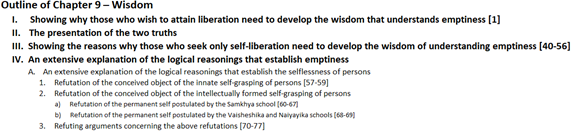
Modern Bodhisattva’s Way of Life: Can an Independent Creator Create Anything?

(9.62) (Samkhya) “When no sound is present, the consciousness enjoys other objects such as visual forms.”
But if it is permanent, why does it not continue to apprehend sound?
(Samkhya) “Because there is no sound in the vicinity at that time.”
Well, if there is no object, sound, then there is no subjective apprehender of sound!

Shantideva’s point here is that if there is no subjective apprehender of sound then it shows that the consciousness has changed from there being a subjective apprehender of sound to there not being a subjective apprehender of sound, therefore the consciousness that the Samkhya’s is the I is not permanent.

(9.63) Moreover, how can an awareness whose nature it is to apprehend sound
Also be an awareness whose nature it is to apprehend visual forms?
(Samkhya) “It is like one person who can be considered to be both a father and a son.”
But this is mere imputation; he is not by nature both.

The Prasangikas do not disagree that consciousness can be aware of both sound and visual forms, they simply disagree that such a consciousness can be permanent. How is it possible then for us to refer to a continuously residing consciousness that the Prasangikas believe in? How exactly is that different from what the Samkhyas are asserting? The Prasangikas agree that the continuously residing consciousness is like one person who is considered to be both a father and a son, but that this difference is one of simply mere imputation by mind. The consciousness apprehending sound and the consciousness apprehending visual forms are two different consciousnesses because they are perceiving two different objects, but conventionally we can refer to them as our continuously residing consciousness by mere name or mere imputation. It is not inherently or permanently one or the other.

(9.64) The analogy of father and son does not work for you Samkhyas.
According to you, the independent creator of all manifests all forms.
Thus, father and son must be one nature, as must an apprehender of sound and an apprehender of visual forms –
But such things are not seen by a valid mind.

Once again, like the Christians, the Samkhyas believe in an independent creator of all phenomena.  Like many Christian Mystic traditions, the Samkhyas believe there is no distinction between the creator and its creation. Thus, father and son, the apprehender of sound of the apprehender of visual forms, must all equally be the same nature as this independent creator.

But how can there be an independent creator? If it is independent, then how could it come into a relationship with its creation? If it is permanent, then how can it create different things because does not it then change? Interestingly, it is only by embracing the Prasangika view that we can resolve these contradictions and view all things as the nature of our mind which is the creator of all, and that our mind is empty which enables it to change and create and come into contact with and know different things. We are able to make a nominal distinction between the mind that knows things and the objects that are known while still seeing them as being of one nature. All things are the nature of mind, and the ultimate nature of mind is emptiness.

(9.65) (Samkhya) “It is like an actor changing roles and being seen in different aspects.”
Well, if the I changes in this way, it cannot be permanent!
(Samkhya) “Although the aspects change, its nature remains one and the same.”
But you cannot establish an unchangeable nature of the I, because you deny the ultimate nature of I, the lack of a truly existent I.

Remember, the goal of the Prasangika refutations of the other schools is to gradually guide people to the Prasangika view. We do not disagree that it is like an actor changing roles but being seen in different aspects, we just disagree that such an I is permanent. We also do not disagree that although the aspects changed the nature remains one in the same, we simply say that the nature of that I cannot be truly existent. The only way in which the aspects can change and the nature remains one in the same is if everything is empty.  We can see the Prasangikas agree with much of what the Samkhyas say about the I, they just simply disagree with it being permanent and it being truly existent.