Happy National Coming Out Day: How Emptiness and Karma Can Explain LGBT Experience

The great Buddhist master Shantideva said in the 7th century:

(9.87) Therefore, what intelligent person
Would develop attachment for this dream-like form?
And since there is no truly existent body,
Who is truly existent male and who is truly existent female?

Needless to say, Shantideva was ahead of his time. On National Coming Out Day, I wanted to use this verse to provide a Buddhist perspective on LGBT experience.  A heteronormative view grasps at inherently existent males and inherently existent females – where one’s gender identity and one’s biological gender are the same. A heterosexist view grasps at males necessarily being sexually attracted to females, and females being sexually attracted to males. Anything that deviates from this “normal” is held by such views as an aberration. In contrast, how do Buddhists who understand both emptiness and karma explain the wide variety of gender and sexual orientations?  

According to the laws of karma, each time we engage in an action we create four different karmic causes. The ripened effect results in a future rebirth with a bodily basis somewhere within samsara. The tendency similar to the cause is a future tenancy to engage in similar actions, both bodily and mental. The effect similar to the cause results in us experiencing effects that are similar to the causes that we created in the past, for example, if we hit somebody we are likely to get hit back. And the environmental effect is that which surrounds us in our different rebirths.

Somebody who is a cisgender straight male is someone who has the ripened effect to be born male, and the tendencies similar to the cause to be attracted to females. Somebody who is a cisgender straight female is someone who has the ripened effect to be born female, and the tendency similar to the cause to be attracted to males. A gay man is someone who has the ripened effect to be born male and the tendency similar to the cause to be attracted to males. A bisexual person is someone who has the ripened effect to be born either male or female, but the tendencies similar to the cause to be sexually attracted to both males and females. A lesbian is someone who has the ripened effect to be born female and the tendencies similar to their cause to be attracted to females. A transgender female is someone who has the ripened effect of a male body, but the tendencies similar to the cause to think and feel in ways that are conventionally considered female. A transgender male is someone who has the ripened effect of a female body, but the tendencies similar to the cause to think and feel in ways that are conventionally considered male. A trans person can be sexually attracted to either males or females, in dependence upon the tendencies similar to the cause they have of being attracted to different genders. Since there is an infinite variety of karma that beings can create, it follows that there is an infinite variety of combinations in which this karma can ripen.

To simplify matters, we can think of things as existing along three axes. The first is the ripened effect of being born into a body that is biologically male or female. This has a spectrum of things, from those who are biologically extremely masculine males to effeminate males to masculine females to extremely feminine females. The second axis is what tendencies similar to the cause of how one thinks and feels are ripening. This determines how one individually identifies oneself as being male or female, which can be quite distinct from one’s biological basis. Once again, this exists upon a spectrum, from very strong male tendencies to very strong female tendencies. It is worth noting that what is male or female in this context is purely conventionally constructed based upon cultural norms. There are certain things that we identify with being conventionally male and conventionally female, although they are not inherently so. A two-spirit person is someone who has multiple nodes of tendencies similar to the cause of how one thinks and feels, both male and female. The third axis is the tendencies similar to the cause of what we are sexually attracted to, from being strongly attracted to males to being strongly attracted to females. Again this exists upon a spectrum. Someone who is asexual word for example be at zero along this axis.  A person’s gender and sexual identity can fall anywhere within this 3-dimensional space. From the perspective of karma and from the perspective of emptiness there is no basis for saying any one combination of these is better or worse than any other.  They are all simply different karmic possibilities.

How does the environmental effect factor into this? Some people live in very heterosexist societies where any deviation from the heteropatriarchal norm is considered wrong or bad in some way, and the societal structures create penalties for those who deviate from these norms. Other people live in an environment in which there is no judgment or no penalty, and everyone’s individuality is celebrated. How does the effect similar to the cause factor into this?  Some people experience persecution based upon their sexual identity whereas others do not. It is possible for someone to live in a heterosexist society, but themselves not experience any particular discrimination or oppression. Someone else might live in a very open society but nonetheless experience discrimination and oppression. Just as it is possible for someone to be born with any combination of the three axes of gender and sexual identity described above, so too it is possible for someone to be born into a wide variety of combinations of environments that are either oppressive or accepting and to experience either oppression or acceptance. While difficult to visualize, from a karmic perspective, we can imagine a five-dimensional space with five axes, and living beings being born into any number of possibilities.

In this way, we can understand that all of the different experiences and all of the different possibilities that arise with respect to LGBT experience can be understood from the perspective of the karma we have created. From a Buddhist perspective, there is no basis for value judgments about one combination or another. If we contemplate these different karmic effects deeply we can hopefully come to a greater understanding of the wide variety of human proclivities and human experiences as they relate to LGBT experience. The hope as if we understand how karma and emptiness work, we can all relate to each other with greater wisdom and compassion.

Happy Tsog Day: Remembering our Spiritual Guide’s Surpassing Qualities

In order to remember and mark our tsog days, holy days on the Kadampa calendar, I am sharing my understanding of the practice of Offering to the Spiritual Guide with tsog.  This is part 17 of a 44-part series.

Requesting by remembering that he is a supreme Field of Merit

Even just one of your hair pores is praised for us
As a Field of Merit that is superior to all the Conquerors
Of the three times and the ten directions;
O Compassionate Refuge and Protector, to you I make requests.

What is the field of merit? Just as farmers can plant seeds in fields that later produce crops that can nourish our body, spiritual practitioners can plant seeds of virtue in the field of merit which will later ripen in the form of a rich crop of Dharma realizations. We can understand how our spiritual guide is a supreme field of merit by understanding how he is kinder than all the Buddhas as explained above. Here, we emphasize how all three jewels are in fact emanations of our spiritual guide. Every Buddha, bodhisattva, and so forth are all emanated by our spiritual guide. The ultimate nature of our spiritual guide is an I imputed upon the bliss and emptiness of all things. In this way, we can say that everything is an emanation of our spiritual guide. Thus, any virtuous action we perform towards the three jewels or towards all living beings is an offering to our spiritual guide and the planting of seeds in his field of merit. Without this field, we would never be able to have our virtuous seeds ripen in the form of Dharma realizations, just as seeds alone cannot grow without the ground they are planted in. In this sense, our spiritual guide is truly indispensable for our attainment of enlightenment.

Requesting by expressing his outer qualities

From the play of your miracle powers and skilful means
The ornament wheels of your three Sugata bodies
Appear in an ordinary form to guide migrators;
O Compassionate Refuge and Protector, to you I make requests.

We can understand how important the outer aspect of our spiritual guide is by considering what our life would be like if we had never met Geshe Kelsang Gyatso or if he never appeared in this world. If he did not exist in this world, we would not have our Dharma books, our Dharma centers, our Dharma festivals, our global sangha, and so forth. We would have nothing. Because we met the outer form of our spiritual guide, he has introduced us to all sorts of enlightened beings such as Heruka, Vajrayogini, and Dorje Shugden. Through reliance upon these deities, we are quickly making progress towards enlightenment. But none of this would be possible without having encountered the outer form of our spiritual guide. With this verse, we request that our spiritual guide, who we understand to be the living Je Tsongkhapa, continue to appear in this world to guide living beings along the path to enlightenment. Without the outer form of the spiritual guide, there would be no bridge between our world of suffering and the pure worlds of the Buddhas. It would be as if the doorway to the Buddha lands was permanently closed to us.

We might wonder how we should understand this verse now that Venerable Geshe-la has passed. While the cute little Tibetan no longer appears, he continues to exist in this world through his various “emanations,” such as all our resident teachers, centers, and so forth. He promised that he would be with us always. So when we make these prayers, we can understand how he is continuing to appear through the various aspects of the NKT, and pray that the continue to do so.

Typically, at the end of some of our practices or festivals, we recite the Request to the Holy Spiritual Guide, which used to be one of the long-life prayers. After Venerable Geshe-la passed, we started doing this prayer in the place of the long-life prayers, but we should understand it has the same function – namely requesting that the Spiritual Guide’s emanations continue to appear in this world turning the wheel of Dharma in general and the Ganden Oral Lineage in particular. We can understand that the present appearance of our spiritual guide is really an outer emanation of our living spiritual guide Je Tsongkhapa, or more specifically Guru Sumati Buddha Heruka, who will always be the principal spiritual guide of the New Kadampa Tradition. In many ways, it is like our “living Jesus,” who is always with us and always our guide. When we make this request, in truth we are requesting Guru Sumati Buddha Heruka to continue to emanate outer spiritual guides in this world. When we make this request, we create the karma to have the spiritual guide appear to us in all our future lives between now and our eventual attainment of enlightenment. Further, by making this request with faith, when we meet our spiritual guide in our future lives, we will continue to have faith in him and be able to pick up where we left off on our spiritual path.

Requesting by expressing his inner qualities

Your aggregates, elements, sources, and limbs
Are by nature the Fathers and Mothers of the five Buddha families,
The Bodhisattvas, and the Wrathful Deities;
O Supreme spiritual guide, the nature of the Three Jewels, to you I make requests.

Samsara is sometimes best understood as being trapped within the cycle of the five contaminated aggregates – contaminated discrimination, contaminated feeling, contaminated compositional factors, contaminated consciousness, and contaminated form. Contaminated discrimination conceptually discriminates objects as inherently good, bad, and neutral. On the basis of these discriminations, we develop contaminated feelings where we experience objects as pleasant, unpleasant, or neutral. On the basis of these feelings, we then develop contaminated compositional factors, or different delusions and other mental factors related to the objects we are experiencing. These contaminated mental factors in turn lead us to engage in contaminated actions, in other words actions motivated by delusions or deluded minds. These actions subsequently plant contaminated karmic potentialities on our consciousness, which is the aggregate of contaminated consciousness. When this karma ripens, it appears as contaminated forms or contaminated appearances. These appearances appear to be inherently good, bad, or neutral, which our contaminated discrimination then discriminates objects as such, causing the cycle to continue forever.

To escape from samsara then, we need to develop the five omniscient wisdoms – the wisdom of individual discrimination, the wisdom of equality, the wisdom of accomplishing activities, the wisdom of the dharmadhatu, and mirror-like wisdom. The wisdom of individual discrimination discriminates every object individually as a manifestation of indivisible bliss and emptiness. The wisdom of equality then experiences all objects equally as great bliss unfolding in emptiness. The wisdom of accomplishing activities then generates pure minds in relation to every object it experiences, so that every action that subsequently follows is pure. These pure actions in turn, place pure karmic potentialities on our consciousness which is the wisdom of the dharmadhatu. The dharmadhatu is also a completely purified aggregate of consciousness, in other words there are no contaminated karmic potentialities on such a mind. Since there are only pure karmic potentialities on the mind, every karmic seed that ripens does so as pure forms which appear as manifestations of bliss and emptiness. Since all objects appear as manifestations of bliss and emptiness, the wisdom of individual discrimination is able to effortlessly discriminate each object as a manifestation of bliss and emptiness, and so the cycle continues indefinitely.

These five omniscient wisdoms correspond with the five Buddha families. The wisdom of individual discrimination arises in dependence upon reliance on Buddha Amitabha. Put another way Buddha Amitabha appears in the minds of living beings as the wisdom of individual discrimination. In the same way, Ratnasambhava appears as the wisdom of equality, Amoghasiddhi appears as the wisdom of accomplishing activities, Akshobya appears as the wisdom of the dharmadhatu, and Vairochana appears as mirror-like wisdom. By generating faith in and relying upon the five Buddha families, we can develop the five omniscient wisdoms. And then, instead of identifying with the five contaminated aggregates, we identify with the five omniscient wisdoms. Once we have changed the basis of imputation of our “I” from the five contaminated aggregates to the five omniscient wisdoms, we will have attained enlightenment.

In this verse, we recognize that the spiritual guide’s inner qualities are the five Buddha families or the five omniscient wisdoms. By making requests to our spiritual guide recognizing his inner qualities, we create the causes to receive the blessings of the five Buddha families and thereby experience and develop within our own mind the five omniscient wisdoms. In completion stage practice, we likewise rely upon the five Buddha families in the form of a collection of five wisdom drops that are the essence of each of the five Buddha families. When we engage in these completion stage practices, we should recall the meaning of the five Buddha families and the five omniscient wisdoms, strongly believing that by mixing our mind with the collection of five wisdom drops, we are mixing our mind with the wisdom of the five Buddha families.

In this verse we also recognize that our spiritual guide’s inner qualities include all the deities of Guhysamaja’s body mandala. There are three principal Highest Yoga Tantra yidam: Heruka, Yamantaka, and Guhysamaja. When we engage in the practice of Offering to the Spiritual Guide, we generate ourselves as Heruka, we recognize Lama Tsongkhapa as Yamantaka, and inside his body are the deities of Guhysamaja’s body mandala. In this way, we accomplish all the attainments of all the principal yidams of Highest Yoga Tantra in one single practice.

Happy Tsog Day: How to practise the perfection of mental stabilization

In order to remember and mark our tsog days, holy days on the Kadampa calendar, I am sharing my understanding of the practice of Offering to the Spiritual Guide with tsog.  This is part 39 of a 44-part series.

I seek your blessings to complete the perfection of mental stabilization
By abandoning the faults of mental sinking, mental excitement, and mental wandering,
And concentrating in single-pointed absorption
On the state that is the lack of true existence of all phenomena.

Happiness is a state of mind, therefore its cause comes from within the mind. In the preface of virtually every book Geshe-la has written and in the first class of every general program course taught in Dharma centers around the world, we are taught that the cause of happiness is inner peace. If our mind is peaceful, then we are happy regardless of what is happening externally. And if our mind is unpeaceful, we are unhappy regardless of what is happening externally. This shows that inner peace is the true cause of happiness. What then is the cause of inner peace? Mixing our mind with virtue. The more we mix our mind with virtue, the more our mind becomes peaceful both now, while we are mixing our mind with virtue, and in the future, when the karmic effects of our mental action of mixing our mind with virtue ripen. Concentration is being able to mix our mind with virtue single-pointedly, free from all distractions. The perfection of concentration is concentrating on virtue with the bodhicitta motivation.

There are three main faults to be abandoned when training in concentration: mental excitement, mental sinking, and mental wandering. Our mind naturally goes towards whatever it thinks is a cause of happiness. Because we currently think external objects of attachment are the cause of happiness, our mind naturally moves towards them. When our mind moves towards an object of attachment, this is mental excitement. Mental sinking is when our mind gradually loses clarity and focus of whatever it is we are trying to concentrate on. It becomes dull, heavy, and we can even fall asleep. Mental wandering is when our mind moves to some other object of Dharma that is not our chosen object of meditation. While technically not a delusion, it is a distraction. We overcome mental excitement by considering the relative benefits of thinking about our object of attachment compared with thinking about our object of Dharma, and then choosing to return our mind to the object of Dharma. We overcome mental sinking by uplifting our mind, improving our posture, and restoring our object of meditation by renewing the contemplation. We overcome mental wandering by reminding ourselves that our chosen object of meditation is not what our mind has wandered towards, and that allowing mental wandering can become a bad habit preventing us from ever making progress along the path.

Improving our concentration occurs in stages, called the mental abidings. With the first mental abiding, we are able to meditate on our object single-pointedly for one minute. On the second mental abiding, we are able to concentrate on our object without distraction for five minutes. With the third mental abiding, every time we forget our object of meditation, we are able to regenerate it very quickly, like effortlessly picking up a ball we just dropped. And on the fourth mental abiding we overcome all faults of gross mental sinking and gross mental excitement for our entire meditation session. In other words, we never completely forget our object of meditation, but we may still have subtle faults to our concentration, such as subtle mental sinking and subtle mental excitement. If we attain the fourth mental abiding on an object of meditation, we can then enter into retreat and it is said we can attain tranquil abiding within six months. Tranquil abiding is an extremely powerful mind of concentration that is free from all gross and subtle mental seeking and mental excitement and is able to remain single-pointedly focused on our object of meditation for as long as we wish, indeed for the rest of our life.

The mind of tranquil abiding is equivalent to a first form realm god mind. Just as it is possible to have a human body but have the mind of a hell being, so too it is possible to have a human body but the mind of a god. Even in sutra, tranquil biting is not the pinnacle of our concentration, but rather the first major milestone in improving our concentration. Our mind can move further and further up into the god realms, attaining increasingly profound levels of concentration, up to an including the peak of samsara. A detailed explanation of these different levels of concentration can be found in the book Ocean of Nectar.

According to tantra, the very subtle mind of great bliss is infinitely more powerful than the mind of tranquil abiding. It is also much easier to generate the mind of great bliss than it is to attain tranquil abiding. Geshe-la explains in and Oral Instructions of Mahamudra that if we can attain the fourth mental abiding on the indestructible drop at our heart, our winds will enter, abide, and dissolve into our central channel. We will then perceive the eight dissolutions until eventually we arrive at the very subtle mind of the clear light of bliss. Through further training in the five stages of completion stage of Heruka, we can increase the quality with which we are able to cause our inner winds to enter, abide, and dissolve into our central channel and thereby generate increasingly qualified experiences of the mind of clear light of bliss. The mind of clear light is the most concentrated mind possible. Why is this? The reason is our mind naturally moves towards whatever we consider to be a cause of happiness. But since there is no experience more sublime than great bliss, our mind has no desire whatsoever to go anywhere else because to do so would be to move from the most pleasant state possible to something less pleasant. Thus, our mind settles into the clear light of bliss much like a marble would settle at the bottom of a bowl.

Not Mixing Dharma and Politics is Very Subtle

One extreme is using Dharma for worldly purposes, saying to disagree with our politics is to disagree with the Dharma. Another extreme is when we let our political views block us from accepting some natural conclusion of Dharma – we reject the Dharma because it doesn’t conform with our tightly held political views.

However, not mixing Dharma and politics does not mean Dharma practitioners cannot have political views or that the Dharma should not inform what are political views are. Sometimes we misunderstand the instruction on not mixing Dharma and politics to mean Kadampas shouldn’t have any political views at all. Politics is part of modern life and our mission is to attain the union of Kadampa Buddhism and modern life. Especially those of us in democracies, we have certain political responsibilities to the societies we live in, and we should embrace these responsibilities and try fulfill them in ways consistent with our understanding of Dharma.

The core principle of any Kadampa center (or on-line Kadampa community) is “everybody welcome.” The Kadam Dharma makes no distinction between race, gender, socioeconomic class, worldly position, mental or physical disability, and so forth. It also makes no distinction between our political views. The truth is most Dharma centers and communities tend to lean left politically, making more right-leaning Kadampas feel less welcome. Just as we need to make sure we are not being racist, sexist, abelist, or whatever in our cultivating a Dharma community culture, we likewise need to make sure we make people of all political stripes feel equally welcome within Kadampa communities.

It is perfectly possible for two sincere Kadampas to arrive at completely contradictory political views. It’s natural that this happens because we each have a different understanding of the world we live in according to our karmic perception of things. We might also occupy different positions in society and so see things differently – yet we still 100% agree on every aspect of the Dharma.

I often find it helpful to consider the experience of Kadampas with schizophrenia. There are quite a number of them, actually. The world that appears vividly to them is sometimes quite different than the world that appears to others. And yes, there is a difference between a schizophrenic hallucination and the conventional world we normally see (though not as much of a difference as we like to think…). In helping them, of course we try help them differentiate between what is a hallucination and what is conventional reality, but sometimes that is not possible. So what advice should we give them? We tell them to respond with Lamrim minds to whatever appears – whether it is demons, their bodies covered in spiders, or fairies adorning everyone with flowers. It doesn’t really matter what appears to their mind, the way they pacify their delusions and mind is to respond with Lamrim to whatever appears. If they do so consistently, even with respect to things that are not there at all even conventionally, their mind will gradually come under greater and greater control, they will create better and better karma, and their appearances will become increasingly pleasant and pure.

The exact same thing is true for Kadampas of different political persuasions. Things like pandemics, wars, elections involving certain political leaders, structural discriminations, or major societal developments can trigger a whole host of different political opinions within the Kadampa community and it can lead to all sorts of divisive debates about what is the correct Kadampa response to the political development, with accusations flying in all directions about who is mixing Dharma with politics and others saying we shouldn’t have any political views at all.

The resolution to all these debates is simple: we all agree on the Dharma but we perceive a different world. Our job for each of us is to respond to whatever appears to OUR mind with as much wisdom and compassion as we can. For some it will lead to one political conclusion and for another it may lead to a completely contradictory political conclusion and that is perfectly OK. We all agree on the Dharma and we respect we may all come to different political conclusions when we apply the Dharma to the world as it appears to us. Then, no problems. Then, everybody welcome.

Modern Bodhisattva’s Way of Life: Understanding LGBT Experience

(9.87) Therefore, what intelligent person
Would develop attachment for this dream-like form?
And since there is no truly existent body,
Who is truly existent male and who is truly existent female?

I am sure most of you know what Tara had to say, in this world there is no man, there is no woman.  But we grasp at us being inherently male or inherently female.  Many people become Heruka or Vajrayogini for this reason, but this is completely mistaken.  We need to identify within ourselves how we grasp at our gender.  Many problems come from this, such as sexism, homophobia, etc.  Male and female, we are just making it up, but we grasp at it as if it were intrinsically so.  We are making up everything, we are making the distinctions.  But then we think the distinctions exist from the side of the object and now how we are discriminating it.

I wanted to take advantage of this verse to discuss a Buddhist perspective on LGBT experience.  A heteronormative view grasps at inherently existent males and inherently existent females – where one’s gender identity and one’s biological gender are the same. A heterosexist views grasps at males necessarily being sexually attracted to females, and females being sexually attracted to males. Anything that deviates from this “normal” is viewed as an aberration. How do Buddhists who understand both emptiness and karma explain the wide variety of gender and sexual orientations?  

According to the laws of karma, each time we engage in an action we create four different karmic causes. The ripened effect results in a future rebirth somewhere within samsara. The tendency similar to the cause is a future tenancy to engage in similar actions, both bodily and mental. The effect similar to the cause results in us experiencing effects which are similar to the causes that we created in the past, for example if we hit somebody we are likely to get hit back. And the environmental effect is that which surrounds us in our different rebirths.

Somebody who is a cisgender straight male is someone who has the ripened effect to be born male, and the tendency is similar to the cause to be attracted to females. Somebody who is a cisgender straight female is someone who has the ripened effect to be born female, and the tendency similar to the cause to be attracted to males. A gay man is someone who has the ripened effect to be born male and the tendency similar to the cause to be attracted to males. A bisexual person is someone who has the ripened effect to be born either male or female, but the tendencies similar to the cause to be sexually attracted to both males and females. A lesbian is someone who has the ripened effect to be born female and the tendencies similar to their cause to be attracted to females. A transgender female is someone who has the ripened effect of a male body, but the tendencies similar to the cause to think and feel in ways that are conventionally considered female. A transgender male someone who has the ripened effect of a female body, but the tendencies similar to the cause to think and feel in ways that are conventionally considered male. A trans person can be sexually attracted to either males or females, independence upon the tendencies similar to the cause they have of being attracted to different genders. Since there is an infinite variety of karma that beings can create, it follows that there is an infinite variety of combinations in which this karma can ripen.

To simplify matters, we can think of things as existing along three axes. The first is the ripened effect of being born into a body that is biologically male or female. This has a spectrum of things, from those who are extremely masculine males to effeminate males to masculine females to extremely feminine females. The second axis is what tendencies similar to the cause of how one thinks and feels are ripening. This determines how one individually identifies oneself as being male or female, which can be quite distinct from one’s biological basis. Once again, this exists upon a spectrum, from very strong male tendencies to very strong female tendencies. It is worth noting that what is male or female in this context is purely conventionally constructed based upon cultural norms. There are certain things which we identify with being conventionally male and conventionally female, although they are not inherently so. A two-spirit person is someone who has multiple nodes of tendencies similar to the cause of how one thinks and feels, both male and female. The third axis is the tendencies similar to the cause of what we are sexually attracted to, from being strongly attracted to males to being strongly attracted to females. Again this exists upon a spectrum. Someone who is asexual word for example be at zero along this axis.  A person’s gender and sexual identity can fall anywhere within this 3-dimensional space. From the perspective of karma and from the perspective of emptiness there is no basis for saying any one combination of these is better or worse than any other.  They are all simply different karmic possibilities.

How does the environmental effect factor into this? Some people live in very heterosexist societies where any deviation from the hetero patriarchal norm is considered wrong or bad in some way, and the societal structures create penalties for those who deviate from these norms. Other people live in an environment in which there is no judgment or no penalty, and everyone’s individuality is celebrated. How does the effect similar to the cause factor into this?  Some people experience persecution based upon their sexual identity whereas others do not. It is possible for someone to live in a heterosexist society, but themselves not experience any particular discrimination or oppression. Someone else might live in a very open society but nonetheless experience discrimination and oppression. Just as it is possible for someone to be born with any combination of the three axes of gender and sexual identity described above, so too it is possible for someone to be born into a wide variety of combinations of environments that are either oppressive or accepting and to experience oppression or acceptance. While difficult to visualize, from a karmic perspective, we can imagine a five-dimensional space with five axes, and living beings being born into any number of possibilities.

In this way, we can understand that all of the different experiences and all of the different possibilities that arise with respect to LGBT experience can be understood from the perspective of the karma we have created. It is not my place to dictate what are the Buddhist conclusions one can draw from such an analysis. But if we contemplate these different karmic effects deeply we can hopefully come to a greater understanding of the wide variety of human proclivities and human experiences as they relate to LGBT experience. The hope as if we understand how karma and emptiness work, we can all relate to each other with greater wisdom and compassion.

On Embracing Unpleasant Feelings

Throughout my practice, I have been too much in my head and not enough in my heart. I’ve found that as I increasingly move into my heart, I’m unlocking all sorts of other feelings that I have been repressing, some of which are very unpleasant. I’ve realized that I have been running away to my head to escape not knowing how to deal with my unpleasant feelings. It’s basically been my coping mechanism.

While at one level it has protected me from being hurt, it has likewise prevented me from getting into my heart. But I need to get into my heart. The whole point of Dharma practice is to have the Dharma touch and ultimately reside at our heart. To put it in Star Trek terms, I need to see past my Vulcan like tendencies and embrace my human side. 🙂

I’m realizing that, to a certain extent at least, I have been inadvertently using the Dharma as just another inner coping mechanism to escape dealing with my unpleasant feelings. The Dharma is always good for us, but relating to it in unhealthy ways is, um, unhealthy. Many people develop unhealthy relationships with the Dharma and it usually ends badly, both for the person and for the faith of others – and sometimes for the whole tradition.

For me, it seems it is my non-acceptance of my unpleasant feelings that is at the root of all my unhealthy coping mechanisms, both externally like turning to self-destructive behaviors or internally such as guilt, self-discouragement, hopelessness, etc. I suspect I am not alone.

While it’s absolutely true that our feelings are empty and changing our discriminations will change what feelings arise, from a practical point of view of daily experience, feelings arise and we need to respond to them with good discriminations. To put it in karmic terms, feelings are the karmic effects of our previous discrimination kamric causes.

But karma ripens with a lag. The karma that is ripening now (in other words, the feelings arising in my heart) is the result of actions I engaged in long ago, some of which were good, some bad, some pure. How I respond to those feelings determines what new karma I create now.

Sometimes unpleasant feelings arise. Instead of thinking I need to shut them down or change them, I need to accept them wholeheartedly – welcome them into my heart, allow them to pass through me. Accepting them (as opposed to repressing them or thinking they are a problem) enables me to train in correct discriminations towards them, embracing them as teachings, purification, empowerments, and opportunities to train my mind.

In short, unpleasant feelings are not an object of abandonment, delusions and negative actions are. Responding to unpleasant feelings with delusions and negative actions is. Unpleasant feelings, like pleasant ones or even pure ones, are just another condition for our practice. We know sufferings, we abandon origins.

Accepting them, welcoming them, no-longer fearing them, are all part of being a healthy Kadampa. They will still arise, but they won’t be a problem for us.

Eventually, through training long enough, we will change our karma and they will no longer arise for us. We will have exhausted or purified all the karma giving rise to them and we will no longer create any more karma for future unpleasant feelings, but long before that we will have overcome our fear of them. Indeed, we can start doing that right now.

Modern Bodhisattva’s Way of Life: The Parts Are Empty Too

(9.85) Just as the body lacks true existence, so do its parts such as the hands;
For they too are merely imputed upon the collection of their parts, the fingers and so forth.
The fingers, in turn, are merely imputed upon the collection of their parts, such as the joints;
And, when the joints are separated into their parts, they too are found to lack true existence.

(9.86) The parts of the joints are merely imputed upon a collection of atoms,
And they, in turn, are merely imputed upon their directional parts.
Since the directional parts, too, can be further divided,
Atoms lack true existence and are empty, like space.

And when we look for the parts, we just find the parts of the parts, nothing more.  We keep looking, and no matter where we look, we find nothing.  We think we are surrounded by reality, but in truth it is all an illusion.  There is nothing here at all, it just appears that there is.  It’s a very nice meditation to do sometime, just go to the parts of the parts, and just end up finally meditating on space-like emptiness, realizing that even the atoms lack true existence.

Again, this does not require any faith to realize.  This is something we can prove to ourselves with investigation.  Emptiness is the definitive valid reason that establishes the rest of the path.  If we can establish emptiness, we can prove every other stage of the path – death, lower realms, karma, renunciation, cherishing others, taking and giving, bodhichitta, tantra, everything. 

When we think about it, it is truly amazing. Everything appears so vivid and appears so real, but when we actually look for it, we find nothing. It is all one giant illusion. It appears real, it has shape it has form it functions we can touch it, yet when we look for what is behind these appearances we find nothing. Our mind simply connects the dots and projects everything in between them. In fact when we look, we don’t even find the dots. Each dot itself is simply yet another hallucination, another illusion, another hologram.

Very often we can develop doubt, am I wasting my life practicing the spiritual path? I see everybody else off doing different things, enjoying life. But here I am, dedicating all of my time to trying to attain some state beyond this life. I am trying to construct a pure land and identify with myself as a deity. What if this is all a bunch of nonsense? What if none of it is true. What if it is all just a waste of time and I’m just engaging in make believe?

We can have these doubts. If we do not have an answer to these doubts, they can become crippling, and we lose all the motivation to engage in our spiritual path. We start to think that our spiritual guide and our sangha are perhaps deceiving us or themselves have been fooled into wasting their life chasing these fantasies.

How do we overcome this doubt? Through this meditation on emptiness. We identify the emptiness of our body, then we look at the emptiness of each of the parts of our body, then we look at the emptiness of the parts of the parts of our body, and so forth all the way down to atoms. We then look at the emptiness of atoms – made up of electrons, neutrons, and protons. Each of these things can be broken down further and further yet no matter how much we break it down, we continue to find absolutely nothing. There is nothing actually there. Our mind is simply projecting that there is something there, connecting dots that are not there, creating a mental illusion that our ignorance grasps at as real.

This is something we can prove to ourselves through investigation. There’s no doubt when we investigate, we find nothing. The self we normally see, the body we normally see, the world we normally see does not exist. It just appears to exist, like an illusion. It is all created by mind. We’re like those people who believe in conspiracy theories who see random data points and then fill in elaborate stories connecting those dots, grasping at their stories as somehow being true. We are exactly the same. Somebody trapped in samsara is in fact simply somebody who’s grasping at its conspiracy. But when we check, when we investigate, we realize it is all a big lie. Samsara is fake news. It is all created by mind.

If it is created by mind, then mind can create new worlds, different worlds. Here again we have direct experience. Before we viewed something as a hardship, later we came to view it as a blessing. What was it? Was it a blessing or was it a hardship? In reality it was nothing. From its own side it is absolutely nothing. But our mind can relate to it in different ways, and then we experience it in different ways. This shows that we can create with our mind the world that we inhabit and the world that we experience. Seeing this, we realize we can create any world, including the pure land. It just takes enough mental action to create enough karma to cause our abiding within the pure land to become a self-sustaining experience. Karma is proven by emptiness. Tantra is proven. Future lives are proven. Everything is established through emptiness. We could have 100% confidence in our spiritual path because of emptiness, which itself can be proven.

Happy Protector Day: Helping the Pure Kadam Dharma Flourish

The 29th of every month is Protector Day.  This is part 9 of a 12-part series aimed at helping us remember our Dharma Protector Dorje Shugden and increase our faith in him on these special days.

All my harmful thoughts and actions
That have offended your mind, O Great Protector,
I confess from the depths of my heart.
Please purify them swiftly, and care for me with love, like a mother for her child.

With this verse, we can purify all the negative karma that obstructs our ability to receive the care and protection of Dorje Shugden.  Such negative karma is like interference preventing a reception of our mobile phones or junk clogging up the arteries of a person.  We can generate a regret for whatever we have done in the past which has created negative karma preventing us from receiving the care and protection of Dorje Shugden.  Then we strongly imagine from Dorje Shugden purifying light rays and nectars flow down and touch all the beings inside the protection circle, ourself included, purifying all of the negative karma obstructing us from receiving Dorje Shugden’s care and protection.  We then strongly believe that all of these being are now without obstruction.

I beseech you from the depths of my heart, O Supreme Deity,
Please cause the tradition of Je Tsongkhapa to flourish,
Extend the life and activities of the glorious Gurus,
And increase the study and practice of Dharma within the Dharma communities.

We can understand this as follows:  The key point here is we realize how the Dharma of Je Tsongkhapa is the solution to all the problems of all beings.  The reason why beings suffer is because they too are trapped in a dream-like world of suffering created by their own self-centered minds.  They need to wake up from this dream into the pure world of the Buddhas.  The Dharma of Je Tsongkhapa provides a solution for destroying this self-centered mind, thereby enabling all beings to wake up from their worlds of suffering.  This is the solution to all of their problems.

Please be with me always like the shadow of my body,
And grant me your unwavering care and protection.
Destroy all obstacles and adverse conditions,
Bestow favourable conditions, and fulfil all my wishes.

Here we request Dorje Shugden to accomplish his main function, namely to arrange perfect conditions and to eliminate obstacles to our practice.  There are two types of condition:   When we are confronted with a situation which we think could be better, we request Dorje Shugden to arrange whatever is best and imagine that a protection circle radiates out accomplishing this function.  If the external situation changes, then we know the situation was beyond our capacity and we can use that to develop bodhichitta, wishing later to have a capacity that can transform anything and everything.  If the external situation remains the same (or gets worse) then we can know that we need to work on the delusions that this situation generates for us.  We can equally do this with internal conditions.  An important thing worth noting at this point is Dorje Shugden will arrange what is best for our practice, not what is necessarily best for our worldly concerns.  We might even say Mick Jagger is actually part of Dorje Shugden’s mandala when he sung ‘you don’t always get what you want, but you get what you need.’

Now is the time to show clearly your versatile strength
Through your four actions, which are swift, incisive, and unobstructed,
To fulfil quickly my special heartfelt desires
In accordance with my wishes;

Here we request Dorje Shugden to arrange whatever is best in general, in his own mysterious ways and imagine that a protection circle radiates out accomplishing this function. Ask people their Dorje Shugden stories when you are at festivals, and you will be amazed.  If our motivation is pure, he can arrange anything.

Now is the time to distinguish the truth and falsity of actions and effects;

Here we request him to make clear the relationship between cause and effect for all the beings within the protection circle.  At present, we think negativity is entertainment and exciting and we think virtue is boring.  In reality, negativity creates the cause for enormous suffering and virtue is the cause of all happiness.  Here we request that Dorje Shugden to bestow special wisdom blessings on all beings within the protection circle so they naturally, from their own side, make good choices.

Now is the time to dispel false accusations against the innocent;

Here we request Dorje Shugden to enable all beings within the protection circle to stop making mistaken and false imputations on others, but to correctly impute onto everybody ‘emanation of my spiritual guide’ and imagine that a protection circle radiates out accomplishing this function.  At present, we impute onto others ‘object of attachment’ ‘object of aversion’ or ‘irrelevant.’  These are false accusations we impute on others, and we relate to them as if they were really these things from their own side.  This creates all our problems.  The only valid imputation of anybody is ‘emanation of my spiritual guide.’  The ultimate nature of all things is the Dharmakaya, so it is correct to say that everybody is an emanation of my spiritual guide.

Now is the time to protect the pitiful and protectorless;

The reason why people are pitiful and protectorless is because we have been neglecting them.  Their experience is what we have karmically created for them in our empty dream.  So here we request that he provide protection for all the beings we have been neglecting and imagine that a protection circle radiates out accomplishing this function.

Now is the time to protect Dharma practitioners as your children.

It is particularly important to provide care and protection for Dharma practitioners because by helping them directly, indirectly it helps all living beings since they have vowed to attain enlightenment for the benefit of all.  It is like opening up a second cash register at the supermarket.  Everybody gets through the line twice as fast.

In short, from now until I attain the essence of enlightenment,
I shall honour you as the embodiment of my Guru, Deity, and Protector.
Therefore please watch over me during the three periods of the day and the night
And never waver in your actions as my Protector.

The biggest fear of a Dharma practitioner is the fear of losing the path.  If we do not lose the path, we have nothing to fear; but if we do lose the path, we have all of samsara to fear.  When we recite this verse, we are creating the causes to be able to meet Dorje Shugden and rely upon him again in all our future lives.  In this way, we maintain the continuum of our practice and go from joy to joy until we attain enlightenment.

Happy Tsog Day: Generating Admiring Faith in our Spiritual Guide

In order to remember and mark our tsog days, holy days on the Kadampa calendar, I am sharing my understanding of the practice of Offering to the Spiritual Guide with tsog.  This is part 16 of a 44-part series.

Requesting by remembering his good qualities as explained in the Vinaya scriptures

Great ocean of moral discipline, source of all good qualities,
Replete with a collection of jewels of extensive learning,
Second Buddha, venerable saffron-robed monk,
O Elder and Holder of the Vinaya, to you I make requests.

The practice of moral discipline is the primary cause of upper rebirth. Engaging in moral discipline with a spiritual motivation enables us to take another precious human rebirth, liberation, or enlightenment. Normally, we divide our practice of moral discipline into the different levels of our vows: refuge, pratimoksha, bodhisattva, and tantric vows. The essence of our refuge vows is to make effort to receive Buddha’s blessings, receive help from Sangha, and to put the Dharma into practice. The essence of our pratimoksha vows is to not harm living beings, either ourself or others. The essence of our bodhisattva vows is to put others first, and the essence of our tantric vows is to maintain pure view out of compassion. At the beginning of the sadhana, we emphasized our practice of refuge. Here, we emphasize our pratimoksha vows by recalling our spiritual guide maintains perfect outer moral discipline. This is symbolized by his outer aspect as a fully ordained monk. During the prayer of the stages of the path later in the sadhana, we generate both aspiring and engaging bodhichitta for our bodhisattva vows, and we maintain pure view throughout the practice and especially after we dissolve the Guru at the end of the practice. In this way, the practice of Offering to the Spiritual Guide is a supreme practice of all types of moral discipline.

In order to understand all the different vows and how we practice them in the context of our Kadampa life, I did a series of posts on each of the 200+ vows and commitments of Kadampa Buddhism. You can find the explanation here. The posts are listed in reverse chronological order, but you can scroll down to the bottom and work your way up if you want to read them in order.

Requesting by remembering his good qualities as a Mahayana spiritual guide

You who possess the ten qualities
Of an authentic Teacher of the path of the Sugatas,
Lord of the Dharma, representative of all the Conquerors,
O Mahayana spiritual guide, to you I make requests.

In Hundreds of Deities of the Joyful Land we recite, “I rejoice in the great wave of your deeds.” What does this mean? Je Tsongkhapa’s special strategy for ripening and liberating all living beings is for himself to become a spiritual guide, then train others to become fully qualified spiritual guides, who then in turn form yet more spiritual guides, and so forth. In this way, gradually all living beings are guided to enter, progress along, and eventually complete the path to enlightenment. This is the great wave of Je Tsongkhapa’s deeds, and his actions as a Mahayana spiritual guide. This is symbolized by Buddha Shakyamuni appearing at the heart of Lama Losang Tubwang Dorjechang.

Requesting by remembering his good qualities as a Vajrayana spiritual guide

Your three doors are perfectly controlled, you have great wisdom and patience,
You are without pretension or deceit, you are well-versed in mantras and Tantra,
You possess the two sets of ten qualities, and you are skilled in drawing and explaining,
O Principal Holder of the Vajra, to you I make requests.

In the sutra teachings, we generate the wish to become a Buddha. But it does not explain exactly how we do so. The actual method for attaining enlightenment is only explained in buddha’s tantric teachings. When Buddha taught tantra, he appeared as Buddha Vajradhara. The tantric teachings explain how to change the basis of imputation of our “I” from the contaminated aggregates of an ordinary samsaric being to the completely purified aggregates of a deity. We can say but there are five principal aspects of the path: renunciation, bodhichitta, the correct view of emptiness, generation stage, and completion stage of Highest Yoga Tantra. These can be understood as follows. There is only one action on the path – changing the basis of imputation of our “I” from an ordinary samsaric being to an enlightened being. There are two reasons why we do this, for the sake of ourselves or renunciation, and for the sake of others or bodhicitta. Realizing the ultimate nature of phenomena or emptiness enables us to change the basis of implication of our “I”. This is the essence of the tantric teachings that Buddha Vajradhara taught. This is symbolized by Buddha Vajradhara appearing at the heart of Buddha Shakyamuni who himself is at the heart of Je Tsongkhapa.

Requesting by remembering that he is kinder than all the Buddhas

To the coarse beings of these impure times who, being so hard to tame,
Were not subdued by the countless Buddhas of old,
You correctly reveal the excellent path of the Sugatas;
O Compassionate Refuge and Protector, to you I make requests.

We can say that the spiritual guide is kinder than all the Buddhas because all the Buddhas are in fact emanations of our spiritual guide. There are two helpful ways to understand this. First, our spiritual guide is like a magic portal through which we can gain access to and communicate directly with all the Buddhas. By making offerings and requests to our spiritual guide directly, we are making offerings and requests to all the Buddhas indirectly. Second, our spiritual guide is like a diamond, and all the Buddhas are like different facets of this diamond. When we look at one facet, we might see Tara or Avalokiteshvara or Manjushri, but by nature they are all the diamond of our spiritual guide. Understanding this we can see that our spiritual guide is kinder than all the Buddhas.

Requesting by remembering that he is kinder even than Buddha Shakyamuni

Now, when the sun of Buddha has set,
For the countless migrators without protection or refuge
You perform exactly the same deeds as the Conqueror;
O Compassionate Refuge and Protector, to you I make requests.

Buddha is incredibly kind because he shows us how to wake up from the nightmare of samsara. Ultimately, samsara is like a Rubik’s Cube in which there is no solution. Yet we fundamentally believe that there must be a solution, and we spend all our time trying to arrange samsara in a way in which we do not suffer. Despite committing ourselves fully to this task since time without beginning we still continue to suffer. The reason for this is samsara is the nature of suffering, and that will never change. Buddha helps us recognize this, enabling us to let go of trying to fix the unfixable. Instead, we can focus on waking up from the contaminated dream of samsara. Only Buddha provides us this solution which is why Buddha is so kind. But our spiritual guide is kinder still. The reason is he is the Buddha who appears to us now and is helping us along the spiritual path. Buddha Shakyamuni while still living, does not appear directly to us because our minds are too impure. But he can emanate himself in the aspect of our spiritual guide who then introduce us to the path. In this way, we can say that our spiritual guide is even kinder – to us at least – than Buddha Shakyamuni. Ultimately, this is not correct because our spiritual guide himself is an emanation of Buddha Shakyamuni. But conventionally, we can say our spiritual guide is even kinder.  

Modern Bodhisattva’s Way of Life: Our Body We Normally See Does Not Exist

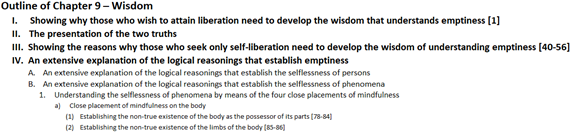
Shantideva now goes on to give reasons establishing the selflessness of phenomena. This is the largest section of Chapter 9. He essentially provides two main arguments establishing the selflessness of phenomena. The first is the four close placements of mindfulness. These look at the emptiness of the aggregates that form the basis of imputation for our I. The second method is to examine the relationship between emptiness and cause and effect. According to the Three Principal Aspects of the Path, Je Tsongkhapa says that when emptiness reaffirms karma and karma reaffirms emptiness, then our understanding of both emptiness and karma is correct. The outlines of Shantideva’s argument are quite detailed and it is easy to get lost in the details and forget what the main point is that he’s trying to establish. The goal is to establish the emptiness of phenomena. There are two ways that he does so: establishing the emptiness of our aggregates and establishing the emptiness of cause and effect. Everything else flows from this.

What follows is a classic meditation on the emptiness of our body. We are all familiar with this meditation since it shows up in all of our Dharma books. The fundamental point is we first need to identify the object of negation: the body that we normally see. The body that we normally see appears to exist from its own side, independent of our mind. It appears to be a singular entity we call my body. If such a body exists, it should be findable. There are three possibilities it is one of its parts, it is the collection of its parts, or it is somehow separate from its parts. There is no other possibility. If it cannot be found in one of these possibilities, then the body that we normally see does not exist. First, Shantideva looks to see if the body is one of its parts.

(9.78) Neither the feet nor the calves are the body,
Nor are the thighs or the loins.
Neither the front nor the back of the abdomen is the body,
Nor are the chest or the shoulders.

(9.79) Neither the sides nor the hands are the body,
Nor are the arms or the armpits.
None of the inner organs is the body,
Nor is the head or the neck.
So where is the body to be found?

None of the individual parts are the body itself, they are parts of the body.  We make a distinction between the parts and the part possessor.  The body itself is the part possessor, which is necessarily distinct from that which it possesses. 

(9.80) If you say that the body is distributed
Among all its different parts,
Although we can say that the parts exist in the parts,
Where does a separate possessor of these parts abide?

When we look, we find only parts.  There is no actual part possessor.  None of the individual parts of the body is the body, and there is no thing separate or within the body that is the possessor of these parts.  We simply have parts. 

(9.81) And if you say that the entire body exists
Within each part, such as the hand,
It follows that there are as many bodies
As there are different parts!

I don’t know anybody who actually thinks that the entire body exists within one of its individual parts.  Obviously that is absurd.  But, when we do a conventional search, that is exactly what we do.  Someone says, “point to your body,” and we then point to some part of our body and say, “it is here.”  We don’t mean that it is within an individual part, we are referring to the whole thing, but in fact we are just pointing to a part of our body.

(9.82) If a truly existent body cannot be found either inside or outside the body,
How can there be a truly existent body among the parts such as the hands?
And since there is no body separate from its parts,
How can there be a truly existent body at all?

Recall above we established that there is no fourth possibility.  Either the body is one of its parts, the collection of the parts, or separate from the parts.  But when we look in each of these three places, we cannot find something that is “my body.”  We only find parts, perhaps collected together, but there is no part possessor anywhere that is “my body.”  Yet, that is precisely the sort of body we normally see, grasp at, and refer to when we speak of my body.  When we look for such a body, we don’t find it anywhere.  If we can’t find it, then it does not exist. 

The danger is we have engaged in these sorts of contemplations perhaps hundreds of times, and they no longer move our mind.  We just intellectually go through them, “yeah, yeah, not one of its parts, not the collection, not separate, check.”  We need to instead, each time we meditate, go looking for the object just as we would go looking for our keys.  We know they have to be somewhere.  We have to be convinced we will find it so that when we don’t, we get the point – the body we normally grasp at and are convinced exists in fact does not exist at all.  There are just parts here, nothing more. 

(9.83) Therefore, there is no truly existent body,
But, because of ignorance, we perceive a body within the hands and so forth,
Just like a mind mistakenly apprehending a person
When observing the shape of a pile of stones at dusk.

(9.84) For as long as the causes of mistaking the stones for a person are present,
There will be a mistaken apprehension of the body of a person.
Likewise, for as long as the hands and so forth are grasped as truly existent,
There will be an apprehension of a truly existent body.

Normally we see a body within its parts.  But when we check, we do not find one.  The key question in identifying emptiness – what is the part possessor?  We think there is one, but when we check, there is none.  The analogy of a pile of stones at night is very good.  From a distance, we see a body, one that appears vividly to our mind.  But when we investigate closer, the appearance disappears and we see just a pile of stones.  In the same way, we see a body, one appears vividly, but when we check, we find only parts.  The appearance of a body is a mistaken apprehension.