Modern Bodhisattva’s Way of Life: The Impossibility of an Independent Creator of All

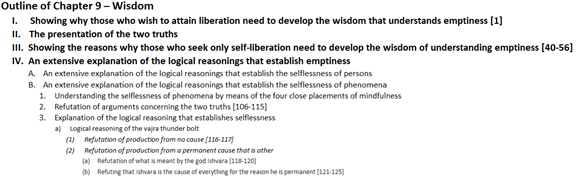
(9.121ab) Precisely what is it that Ishvara is supposed to create?
(Naiyayika and Vaisheshika) “He creates the world, living beings, and his own subsequent continuum.”

This is quite similar to conceptions of God held by many religions. Again, our goal in examining these views is not to refute other religions, but rather to identify within our own mind how we still hold onto these views we may have been enculturated into by virtue of living within societies that hold such views. If other people want to believe in such things, we respect that and rejoice in their faith and spiritual path.

But within our own mind, we strive to identify how we are still holding onto different forms of grasping at inherent existence and refute them. One of the areas where we have the most difficulty an understanding emptiness is the relationship between our grasping at inherent existence and production. This is why Shantideva focuses like a laser on demonstrating the contradiction between inherent existence and production of anything. When we dis entangle these two contradictory views our mind naturally opens up into a correct understanding of emptiness.

(9.121cd) But if this is so, how did such an independent creator himself develop?
Moreover, consciousness is produced from its previous continuum,

(9.122) And, since beginningless time, happiness and suffering have been created by karma, or actions.
So, tell us, what does Ishvara create?
If the cause has no beginning,
The effect must also have no beginning.

(9.123) So why, if their production does not depend upon other conditions,
Are effects such as happiness and suffering not constantly produced without interruption?
And if, as you say, there is nothing other than phenomena created by Ishvara,
Upon what conditions does Ishvara depend when he creates an effect?

(9.124) If a collection of causes and conditions produces an effect,
That effect is not produced by Ishvara.
If the causes and conditions are assembled, even
Ishvara does not have the power to prevent the effect being produced;
And, if they are not assembled, he cannot possibly produce that effect.

(9.125) If effects such as suffering are produced without Ishvara’s wishing for them,
It follows that they are produced through the power of something other than him.
You say that all effects are produced according to Ishvara’s wishes,
But those wishes have no power to produce all things, so how can Ishvara be the creator of everything?

Shantideva’s reasoning is like standing in front of a machine gun firing wisdom bullets at our wrong views. His actual reasoning is not difficult to understand. The spiritual practice here is to not intellectually appreciate what he is saying, but rather deeply contemplate each one of these points within our own mind to arrive at a clear and definitive valid cognizer that the view grasping at an external creator of all is completely impossible.

Venerable Tharchin explains that 80% of the meditation on emptiness is identifying correctly the object of negation within our own mind. This is not a philosophical exercise asking ourselves whether inherent existence could exist in the abstract, rather it is a deeply personal investigation of the views held within our own mind to realize how we innately grasp at inherent existence. Only when we fully unearth the different ways in which our mind, perhaps even subconsciously, grasps at inherent existence will contemplating Shantideva’s words produce a profound transformative effect upon our mind. When Shantideva explains the views of the other schools, what he is actually doing is engaging in an extended explanation of the object of negation.

All of us, unless we are already enlightened, still grasp at there being externally existent creation. Intellectually, we call ourselves Kadampas and say of course I don’t think that way.  But denying we still have grasping is a form of laziness, indeed it is a form of deluded pride. It is much better to assume that yes indeed we still have deep grasping about these things, then honestly look within our mind and realize how we hold onto such views, and then contemplate Shantideva’s points. If we practice in this way, it is definite that our mind will change. We will feel our mind unlock and open up as our wrong views are definitively left behind, not simply intellectually refuted as if these views were somehow separate from us.

I could provide commentary on each one of these points. But I do not believe I need to because I think most of them are self-evident if we take the time to contemplate them. It is therefore better for us, on our own, to pause and contemplate deeply each reason to arrive at a clear conclusion that yes it is impossible for there to be an externally existent, permanent creator as we normally grasp at.  

Even if we do not grasp at an external creator of all, we do still grasp at external creation. There is an extent to which our mind is still holding onto these sorts of views. It is not enough to just simply say there is not an external creator of all. We have to realize there is no external creator of anything.

How to Help our Non-Dharma Loved Ones

Once we start loving others, we will begin to find their suffering unbearable and the desire to help protect them from their suffering will naturally arise.

Our first instinct will be to jump in to rescue them by offering all sorts of Dharma advice about how they can change their mind. But this usually proves counter-productive. They can find our Dharma advice as blaming them for their troubles, giving a pass to all those harming them, or not understanding their external problems. Our advice can also sometimes come across as proselytizing or cult-like. This in turn causes them to reject the Dharma – advice they needed – and us.

So how can we help? There are six steps I have found helpful and can be used in almost any situation.

The first thing we need to do is become at peace with them suffering – we need to accept they are suffering and it does not disturb our peace of mind. It is important to make the distinction between attachment to our loved ones not suffering and compassion. Both find the suffering of others unbearable, but the former believes they need to be free from suffering for us to be happy. The latter is able to peacefully accept they are suffering without it diminishing in any way our desire to help. If we are attached to them not suffering, we then start trying to control them so they get better so we don’t suffer from them suffering. If we have compassion, our happiness or peace of mind does not depend upon them not suffering. So, like a good doctor, we can offer advice without needing them to follow it. We leave them free to make their own choices and to ignore our advice if they wish.

The second thing we need to do is find within ourself the delusions the other person appears to be suffering from in their problem. Mind is the creator of all. This means the others we perceive are nothing more than reflections of our own mind and karma. They appear to have these delusions because we still have the same delusions within our own mind. We can view them as a mirror of Dharma revealing back to us what still needs to be healed within our own mind. They are helping us “train in the first difficulty,” namely identifying our own delusions.

By removing their same delusions within our own mind three magical things happen. First, we then naturally show the best possible example to others of somebody who lives free from the delusions that trouble them. Second, by removing their delusions from our own mind, we will gain the wisdom to know how to do so, thus enabling us to offer better advice based upon personal experience. Third, their delusions will actually start to dis-appear because ultimately they are coming from our mind anyways. This is a special spiritual technology for helping others – it is a scientific method that will work for any who try it for long enough. At a minimum, by abandoing the delusions within our mind, we will become that much closer to enlightenment, the only real way we can provide lasting benefit to them.

The third step is we need to check, “what are they asking of me?” It’s quite possible they are asking for nothing from us, they don’t want us involved at all. If they are not asking, offering any advice or help is almost invariably counter-productive. They reject what we have to say and us. This does not help them, indeed it creates the conditions for them to create the karma of rejecting Dharma and us. If they are asking for something, we need to check, “do they just want me to compassionately listen or do they also want advice?” If we are not sure, we can simply ask. I would say 80% of the time, people just want us to listen and understand. Providing them a safe environment in which they can verbalize their struggles often gives them the space they need to process their difficulties and find their own solutions. It is particularly helpful to share back with them what we have heard and understood from their story, showing that we get it and their feelings about it are normal. In sharing back with them, try not to implicitly give them advice – remember, they are not asking for that. And if they don’t think we understand their problem, they will assume all of our advice is misplaced. So check in with them to see, “am I understanding your situation correctly?”

Fourth, if they are also asking for advice, after you have listened empathetically to their struggles and repeated back to them what you heard to demonstrate you understood their situation, we should first provide them practical advice for how to address the external dimensions of their problem. Remember, for them, their outer problem is their problem. They don’t know yet about the difference between the outer problem and the inner problem. There are almost always external things we can change which can make the external situation less bad or even a little better. Sometimes Dharma practitioners wrongly think there is some fault in also providing practical advice, as if we should only give Dharma advice. That’s ridiculous and the opposite of what Geshe-la encourages us to do. We help in every way we can, both practically and spiritually, depending upon the capacity of the other person.

In the fifth step, if they are open to it, you can begin to provide some advice on how they can address their inner problem – the delusions that are arising in their mind in relationship to the situation. You can do this according to the teachings on “training in the three difficulties” from the book Universal Compassion. First, help them identify the delusions within their mind. Since at present we lack the ability to read others minds, we need to be very skillful at this stage. If you did the second stage above well, you can simply share your own experience how when you find yourself in situations like theirs, your mind starts generating this or that delusion, suggesting perhaps something like that may also be happening in their mind. Pause to see if they relate to that. If they do, then you can move to the second of the three difficulties – applying the opponents to reduce the delusions. Help them accept it is normal that they have these delusions so they avoid falling into the extreme of beating themselves up or self-hatred. Delusions are not us, they are clouds in the sky of their mind. We are the sky itself. From the space of their pure potential, help them realize this difficult situation gives them an opportunity to grow internally in some way. Almost all good Dharma advice has this as its common denominator – remember, bodhichitta is the quintessential butter that comes from churning the milk of Dharma. Share your own stories about how you have dealt with similar inner difficulties and ways of thinking that have proven helpful for shifting your point of view. The external situation is still what it is, but instead of it being a problem, it is an opportunity to develop ourselves into a better person. Err on the side of giving them too little advice than too much that they can’t process. Very often, less is more. Finally, you can move to the third difficulty – applying the antidote of the wisdom realizing emptiness. Most people aren’t ready to view everything as a creation of their mind, but most people can accept that their opinion about the situation depends upon how their mind relates to it. That’s a good enough start.

When offering advice, especially to non-Dharma loved ones, it is very important to express yourself in language that they can accept and understand. Avoid Dharma jargon. Dharma words may mean something to you, but if they don’t have prior exposure to the Dharma teachings, it will mean almost nothing to them. Use analogies, examples, and wisdom that they can relate to based upon their life experience. The great Dharma translators are not just those in the past who went to India to bring back the Dharma to Tibet, they are every day Dharma practitioners who are able to transmit the essential meaning of the Dharma in ways people of the modern world can relate to and understand.

It is also quite important when giving advice that you have no personal need whatsoever for them to follow your advice. Leave them completely free to take it or leave it, without the slightest trace of emotional penalty if they don’t. If they feel manipulated into following your advice, they will most certainly rebel against it, defeating the whole purpose of offering advice in the first place. If they find your advice helpful, great; if not, that’s OK too – you can just empathize with their struggles and let them know you are there for them if they need you.

Sixth, finally, you can pray for them. Buddhas accomplish virtually all of their virtuous deeds through the power of their prayers and dedications. Since we are training to become Buddhas ourselves, we should do the same. We are spiritual people, so of course prayer is actually our principal method for helping others. We may not yet be Buddhas ourselves, but we know the Buddhas and if we make pure prayers with deep faith free from any attachment, they can definitely help. Generally speaking, we don’t emphasize making prayers that people’s external problems go away. We can, but it is very easy for that to lead to all sorts of attachment and aversion, grasping at the external situation as the real problem. Instead, we should direct the bulk of our prayers to helping them overcome their inner problem. We can pray that they find strength, compassion, and wisdom. Above all, people need wisdom. I have found the most effective prayer is to Dorje Shugden, “please bless their mind so that this situation becomes a powerful cause of their enlightenment.” Dorje Shugden wastes nothing. It may not be immediately obvious how he will do so, but we can be certain he is on the job. If we have unshakeable faith in Dorje Shugden we can be certain he is working to accomplish our pure prayer – if not in this life, in future lives. We can also pray that their situation becomes a cause of our own enlightenment so that we can one day help our loved ones perfectly.

We can use these six steps with virtually anybody – our kids, our family members, our friends, our students, our co-workers, and even sometimes somebody we see crying alone on a bench. At first, we might not be very good at it, but with practice and familiarity, it will get easier and flow more naturally.

Geshe-la says it is not enough to know the Dharma, we need skillful means. The above is what I have personally found useful as I have tried to help those I love in my life. I don’t pretend to have mastered the method or that it always works – or that it is the only way to help – but it is hard-won experience that I hope others find helpful.

Happy Tsog Day: Offering Tsog to All Sentient Beings and All Buddhas

In order to remember and mark our tsog days, holy days on the Kadampa calendar, I am sharing my understanding of the practice of Offering to the Spiritual Guide with tsog.  This is part 23 of a 44-part series.

HO This ocean of tsog offering of uncontaminated nectar,
Blessed by concentration, mantra, and mudra,
I offer to please the assembly of mother sentient beings.
OM AH HUM
Delighted by enjoying these magnificent objects of desire,
EH MA HO
May suffering and mistaken appearance be pacified.

In this final verse, which Gen-la Dekyong said is her favorite, we make the tsog offering to the assembly of mother sentient beings. When we do so, they receive special blessings that cause all suffering and mistaken appearance to be pacified. According to Highest Yoga Tantra, the roots of samsara are ordinary appearances and ordinary conceptions. Ordinary appearances are the things that we normally see, such as computers, cars, food, and so forth. All these things appear to exist from their own side, independent of our mind. Ordinary conceptions are when we mentally assent to ordinary appearances, believing that the objects exist in the way that they appear. When we free our mind from ordinary conceptions, we attain liberation from samsara. But it is only when we free our mind from ordinary appearances that we attain enlightenment. When we say, “may suffering be pacified,” we are referring to ordinary conceptions that are the root of all our samsaric suffering; and when we say, may “mistaken appearance” be pacified, we are referring to ordinary appearances that prevent our full enlightenment. In other words, after partaking of the tsog offering, we strongly believe that all living beings have now attained enlightenment. This mental action of believing that they have done so creates the karma for them to appear to do so in the future. To strongly believe something in the Dharma does not mean to strongly believe the thing we are imagining inherently exists, rather it means we engage in the mental action of believing something conventionally exists because this mental action is how we create the karma for the thing we are imagining to later appear. In this way, we can understand how engaging in the tsog offering is a method for fulfilling our bodhichitta wish to lead all beings to everlasting freedom.

Making the tsog offering to the Vajra Master

EH MA HO Great circle of tsog!
O Great Hero we understand
That, following in the path of the Sugatas of the three times,
You are the source of all attainments.
Forsaking all minds of conceptualization
Please continuously enjoy this circle of tsog.
AH LA LA HO

Here we make the tsog offering directly to our spiritual guide Buddha Vajradhara at the heart of Lama Losang Tubwang Dorjechang. In making the offering, we remember that Vajradhara is the source of all attainments. Geshe-la explains in Joyful Path of Good Fortune that all happiness comes through the kindness of Buddha. The reason for this is all happiness comes from virtue, and virtue arises only in dependence upon receiving blessings from Buddha. If Buddha is the source of all happiness, then certainly he is the source of all spiritual attainments which depends upon both his teachings and his blessings. When we make the offering to the spiritual guide in particular, we recall non-conceptual bliss and emptiness of all phenomena. The spiritual guide himself arises non-conceptually and we view everything that appears to our mind as manifestations bliss and emptiness. When we recite AH LA LA HO, we imagine that the spiritual guide partakes of our tsog offering through a straw of wisdom light.

The Master’s reply

OM With a nature inseparable from the three vajras
I generate as the Guru-Deity.
AH This nectar of uncontaminated exalted wisdom and bliss,
HUM Without stirring from bodhichitta
I partake to delight the Deities dwelling in my body.
AH HO MAHA SUKHA

This verse is particularly blessed. After our spiritual guide has partaken of the tsog offering, we imagine that he replies directly to us with the above words. We should strongly feel that we are in his living presence and he is speaking directly to us. With the first line, we understand that the spiritual guide is inseparable from the visual body, speech, and mind of all the Buddhas. With the second line, we recall his outer form as they guru deity – in this context he generates himself as Heruka. With the third line, we imagine that as a result of enjoying the tsog offering he generates a non-contaminated experience of exalted wisdom and bliss. With the fourth line, we recall that his motivation is bodhichitta. Sometimes we may wonder why a Buddha would need to generate the mind of bodhicitta. Aren’t they already a Buddha, so therefore why would they wish to become one? There are two answers to this doubt. First, the principle wish of bodhicitta is to lead all living beings to enlightenment, the wish to become a Buddha ourselves is simply a secondary wish or the assistant wish that enables us to fulfill our primary wish. When a Buddha attains enlightenment, they do not abandon their bodhichitta, but rather their bodhicitta continues to inform all their actions. Second, the spiritual guide generates within his mind all the realizations of the stages of the path as subtle emanations that we as practitioners can mix our mind with. He generates bodhichitta so that when we mix our mind with his we are also able to generate bodhichitta. The same is true for all the other realizations of the stages of the path. With the fifth line, we imagine that all the deities of the body mandala inside our spiritual guide’s body also partake of the tsog offering. As a result, we create a special karma for them to fulfill their function, which is to bless the subtle body, speech, and mind of ourselves. And with the last line, which means “oh what great bliss,” we imagine that our spiritual guide experiences not only himself but all phenomena as great bliss.

One of our refuge commitments is to offer the first portion of whatever we eat to the three jewels. In the eleven yogas of Vajrayogini explained in Guide to Dakini Land and Modern Buddhism, we are encouraged to recite this verse whenever we ourselves eat. This is a method for fulfilling our refuge commitment according to Highest Yoga Tantra. Since we eat many times every day, by memorizing and subsequently practicing this verse we will be able to recall our tantric practice day and night. The way to engage in the practice can be understood from the explanation above. More detail can be found in Guide to Dakini Land.

Happy Tara Day: Why we turn to Tara

This is the second installment of the 12-part series sharing my understanding of the practice Liberation from Sorrow.

Going for refuge

I and all sentient beings, until we achieve enlightenment,
Go for refuge to Buddha, Dharma and Sangha.   (3x)

Je Tsongkhapa explains the primary causes of going for refuge are fear and faith.  Fear of lower rebirth, samsaric rebirth, or solitary peace; and faith in the three jewels to provide us protection from these fears.  When we engage in Tara practice, even though the refuge prayer we recite is the same as in so many of our other practices, we should mentally generate a specific faith in Tara, understanding her function.  In particular, Tara promised Atisha that in the future she would provide special care for all of his followers.  Atisha is the founder of the Kadampa tradition, and all Kadampas take his Lamrim as our main practice.  Tara is, in many ways, the Buddha of Lamrim.  Her mantra reveals that her main function is to bestow upon our mind the realizations of the initial, intermediate, and great scope of Lamrim, thus protectingus from lower rebirth, samsaric rebirth, and solitary peace.  Viewing her as our spiritual mother and the Buddha of Lamrim, we go for refuge to her with deep faith.

Generating bodhichitta

Through the virtues I collect by giving and other perfections,
May I become a Buddha for the benefit of all.   (3x)

The way we generate bodhichitta is different for each practice we engage in, even if the words we recite are exactly the same.  Of course, our compassionate wish to become a Buddha for the sake of all living beings is the same, but the specific flavor of the bodhichitta we generate will depend upon the practice we are doing.  The difference is identified in how the practice we are about to engage in contributes to our enlightenment based on its uncommon function.  Tara helps us in ways that are different than say Manjushri or Avalokiteshvara, and so generating bodhichitta for Tara practice is different because it is informed by how she helps us.  The more clearly we understand her function, the more precisely we will understand how reliance upon her will help move us towards enlightenment, giving our bodhichitta prayers a unique Tara-like flavor.  What is Tara’s function?  She is our spiritual mother, she helps us gain Lamrim realizations, and she swiftly helps us dispel all fears.  We need a spiritual mother, the lamrim realizations, and fearlessness in order to progress swiftly towards enlightenment.  Wanting these things and understanding her power to help us attain them, we generate bodhichitta.

Generating the four immeasurables

May all sentient beings possess happiness and its causes,
May they be free from suffering and its causes,
May they never be separated from the happiness that is without suffering,
May they abide in equanimity, without feeling close to some out of attachment or distant from others out of hatred.

As with bodhichitta practice, our practice of the four immeasurables should also have a Tara-like flavor when we recite them.  To do so, we should not just generate the four immeasurable wishes in a generic sense, but we should try align ourselves with Tara’s four immeasurable wishes for all living beings.  How Tara feels and experiences these four immeasurable wishes will be informed by her own understanding of her function and how she helps people realize these four wishes.  If we are to align ourselves with Tara’s blessings, we need to not only generate faith in her, but we need to align our motivation with hers.

When Tara thinks may all sentient beings possess happiness and its causes, she does so as a spiritual mother would.  When she thinks may they be free from suffering and its causes, she does so as somebody who has the power to dispel all fears would.  When she wishes everyone never be separated from the happiness without suffering, she does so as somebody who has the power to bestow the lamrim realizations of freedom from lower rebirth, samsaric rebirth, and solitary peace would.  When she wishes everyone abide in equanimity, she does so as a mother would who loves equally all her children and wishes only that they also love each other.  As you engage in the four immeasurables, ask yourself, “how would Tara feel these wishes,” and then try to feel them in the same way she would.  This will make your practice particularly powerful and align your mind more precisely with her blessings.

Inviting Arya Tara

From the supreme abode of Potala,
Born from the green letter TAM,
You who liberate migrators with the light of the letter TAM,
O Tara, please come here together with your retinue.

Potala is her Pure Land.  Definitive Potala is the clear light Dharmakaya of all the Buddhas.  An enlightened mind is the union of the completely purified wind and mind.  The completely purified very subtle wind is the vajra body of the Buddha, and the completely purified very subtle mind is the vajra mind of the Buddha.  When bodhisattvas are progressing along the Tantric grounds, they imagine that out of the Dharmakaya their vajra body (or illusory body) emerges out of the Dharmakaya.  Their very subtle wind takes the form of a seed letter of the future Buddha they are to become.  For Tara, her seed letter is the green letter TAM.  Once a Buddha attains enlightenment, they send out countless emanations and blessings to help all living beings – these are their emanation bodies.  Taken together, this verse means from her inner pure land of Dharmakaya Potala, she emerges as her enjoyment body in the aspect of a letter TAM, which then sends out infinite light rays in all directions ripening and liberating all living beings, who then appear in the aspect of countless Taras surrounding her and the twenty one Taras.

Prostration

Gods and demi-gods bow their crowns
At your lotus feet;
O Liberator from all misfortune,
To you, Mother Tara, I prostrate.

Typically, gods and demi-gods bow to nobody thinking themselves superior to all, but when they are in Tara’s presence, they spontaneously bow their crowns out of respect a her lotus feet.  They do not do so out of fear or political loyalty, but deep respect understanding her to be the Holy Mother of all the Buddhas.  When we recite that she is the Liberator from all misfortune, we understand that she has the power to liberate all beings who are now around us in the aspect of Taras, and we imagine that all beings spontaneously bow down to her out of love and respect to her as our spiritual mother. 

The feeling this evokes for me is like in Game of Thrones with Daenerys Stormborn liberated countless slaves from their masters, and tens of thousands of them spontaneously started calling out to her as Mhysa, their liberating mother.  Tara is our Mhysa, and we imagine all living beings surrounding us feel the same loving respect. 

Modern Bodhisattva’s Way of Life: God is Not Unknowable

(9.120) Space is not Ishvara because it cannot produce anything,
And a permanent self cannot be Ishvara because this has already been refuted.

The idea here is simple. Shantideva is trying to demonstrate that the way in which people conceive of Ishvara is actually impossible. Space is the absence of obstructive contact. It cannot do or produce anything, so how can it be a creator. Likewise, Ishvara cannot be permanent, because something permanent does not change and if it does not change how can it create anything? The point of these refutations is to help us let go of grasping at and externally existent creator of all. The alternative the Prasangikas offer is mind as the creator of all.

Our goal in explaining these things is not to judge or criticize other religious views. We should never have discussions like this with other people who believe in an inherently existent God. We should leave them free to believe whatever they want. Our job is to look in our own mind and examine what we consider to be a reasonable view.

(Naiyayika and Vaisheshika) “Although he is the creator, Ishvara is unknowable.”

This is also something very common that we hear in modern society. It’s usually said in some sort of new-agey mystical sense of the truth is beyond our ability to comprehend it since it is so magical. Because it is unknowable, we therefore think it is something worthy of veneration. We say that whatever is divine must be beyond our limited abilities and so therefore we never think to question or try to understand, we just worship in awe.

What is the point of talking about something that cannot be known?

Shantideva refutes all of these with one simple question, what is the point of talking about something that cannot be known? If it cannot be known, then anything we have to say about it is pure speculation at best. If we can even talk about it, then that implies that there is something of it that can be known, which reveals it is not unknowable. We developed a sort of laziness not wishing to investigate further or a complacency with our ignorance about what is still unknown.  Or worse, we assent to a view that there will always be an unbridgeable gap between us and the divine.

But more profoundly, all of the Buddhist schools agree that for an object to exist it must be able to be known by mind. If it cannot be known by mind then it implies that Buddha is not omniscient, which is in contradiction with fundamental view of enlightenment.

Happy Protector Day: Introduction to series

The 29th of every month is Protector Day, when we emphasize our reliance upon the Dharma Protector for the New Kadampa Tradition.  In order to strengthen our connection with him, increase our faith in him, and learn how to practically rely upon him, on the 29th of every month, I will explain my understanding of how to rely upon Dorje Shugden, our Dharma protector.  All of Dharma essentially has one purpose:  to bring the mind under control.  Delusions are that which make our mind uncontrolled.  For me personally, I overcome about 90% of my delusions “merely by remembering” Dorje Shugden.  In this series of posts I will explain how.

Our ability to rely upon Dorje Shugden depends primarily upon one thing:  are we a worldly being or a spiritual being.  If we are a worldly being, reliance on Dorje Shugden will not work.  If we are a spiritual being, reliance on Dorje Shugden will change everything for us – we will never be the same again.  All fear, all anxiety, all grasping will vanish.  Our mind will become smooth, balanced, flexible and peaceful all of the time. 

There is one question we need to ask ourself:  what kind of being do I want to be, a worldly being or a spiritual being?  A worldly being is somebody who is primarily concerned with securing happiness in this life.  Their actions are aimed at securing worldly happiness in this life.  A spiritual being is somebody who is primarily concerned with securing happiness of future lives.  Their actions are aimed at laying the foundation for happiness in future lives, up to the supreme happiness of full enlightenment.

It is important to understand whether our life is a worldly one or a spiritual one does not depend on what activities or job we do, rather it depends on what mind we do these activities with.  Sometimes we think that our families, jobs, vacations and so forth are necessarily ‘worldly’, but this is not the case.  They are only worldly if we engage in them with a worldly mind.  If we engage in these same activities with a spiritual mind, then they become spiritual activities and part of our spiritual life. 

What does it mean to live our life with a spiritual mind?  It means what we are looking to get out of a situation is different.  For example, I have a close friend who is a very successful businessman.  He views everything through the lens of the business opportunity.  We went to Magic Mountain together once (Magic Mountain is an amusement park with very big roller coasters, etc.).  For my friend, because he looked at things through the glasses of a businessman, what he took home from his trip to Magic Mountain was lessons in business. 

For a worldly being, what they are looking to get out of a situation is external happiness in this life.  Their actions are aimed at improving their reputation, increasing their resources, receiving praise and experiencing pleasure (and avoiding the opposite of these things).  For a spiritual being, what they are looking to get out of a situation is opportunities to train their mind and create good causes.  They view situations from the perspective of the opportunity they afford the person to train their mind and create good causes for the future.  To be a spiritual being doesn’t mean we do not care about this life, rather it means we also care about future lives.  We include future lives in our calculations for how we use today and how we use this life.

Before we can actually become a spiritual being, we have to have at least some belief in future lives.  Without such belief, it is difficult to view our life as a preparation for them.  So how can we develop some conviction, or at least some virtuous doubt, about the existence of future lives?  The definitive reason which establishes everything in the Dharma is emptiness.  Emptiness explains that all phenomena, ourselves included, are mere karmic appearance of mind.  ‘Mere’ means they are like appearances in a dream, and ‘karmic appearance’ means that these appearances arise from karma.  This life and all its appearances are just mere karmic appearances of mind that were triggered by previous minds.  The quality of our mind determines the quality of the karma activated.  Every karmic seed has a certain duration, and when it exhausts itself the appearance supported by that karma will cease.  It is just like during a dream. 

The nature of the mind is clarity and cognizing.  Clarity means our mind itself is without form, shape, color, etc.  If our mind had a color, for example, then everything that appeared to our mind would be that color.  It is because it lacks any color that it can perceive or know any color; because it lacks any form, it can know any form and so forth.  Cognizing means it has the power to know objects.  Lacking form alone is not mind – there are many things that lack form, but do not know.  Only something that both lacks form and knows is a mind.  Our mind is like a formless field of knowing.  It is like a giant container in which new karmic appearances are projected.  Think back to two hours ago.  What is appearing to our mind now is completely different.  What used to appear no longer appears at all, yet our mind itself remains clarity and cognizing.  In the same way, when the appearances of this life and this body cease, our mind itself will remain clarity and cognizing, it will just know new appearances.

If none of these ideas work for us, then it is useful to consider even if we are not sure, it is nonetheless better to live our life as if there are future lives.  Why?  If there are future lives, but we assume there are not, then we won’t be prepared for them when they come and our future will be uncertain.  It is like somebody denying that there is a tomorrow.  If there are not future lives, but we assume there are, then we will at least be able to have the happiest possible life during this life because a spiritual outlook on life is simply a happier way to relate to the world.  Why is this so?

Why is it a good idea to adopt a spiritual way of life?  Doing so can make every moment of our life deeply meaningful.  Our lives are as meaningful as the goals towards which we work.  If our goal is to lead each and every living being to the complete freedom of full enlightenment, then since this is the most meaningful goal, our life in pursuit of this goal will be felt to be full of great meaning.  We can find a true happiness from a different source – the cultivation of pure minds. 

External happiness, if we check, is really just a temporary reduction of our discomfort.   Even if it does provide us with temporary moments of happiness, we have no control over it and so our happiness is uncertain.  We feel we cannot be happy without our external objects.  In Buddhism, we have identified a different source of happiness – a peaceful mind.  If our mind is peaceful, we are happy, regardless of what our external circumstances are.  The cause of a peaceful mind is to mix our mind with virtue, such as love, compassion, etc.  When we engage in the actions of mixing our mind with virtue, we plant the karmic seeds on our mind which will ripen in the form of the experience of inner peace.  Understanding this, we have an infinite source of happiness just waiting to be tapped.  When our mind is at peace, we can then enjoy all external things, not just the ones we like.

We are all going to die, and the only things we can take with us are the causes we have created for ourself.  Everything else we have we need to leave behind.  The only riches we can take with us into our future lives are the karmic causes we have created for ourself.   When we think about this carefully, we realize that only they matter.  The rest of this life is not guaranteed to happen, but our future lives are, and they are very long.  Now is the time to assemble provisions for our future lives.  We do not know when we are going to die. 

Making our Mantra Recitation Powerful

Making our mantra recitation powerfully primarily comes down to a mental recognition that the nature of the mantras is our inner winds. When we engage in body mandala meditations, we recognize each of the deities as being by nature our subtle channels and drops appearing in the aspect of the deities of the body mandala. Just as gold appears as coins, our channels and drops appear as the deities of the body mandala. This recognition functions to cause the deities to mix into our channels and drops which purifies them. Wherever you imagine a Buddha, a Buddha actually goes and performs their function.

In exactly the same way, we mentally recognize the mantras as by nature our inner winds. Mantras are subtle emanations of Buddhas. Wherever you imagine a Buddha, a Buddha actually goes and performs their function. By maintaining this recognition, subtle emanations become one with our inner winds just as happens in our body mandala meditations, and this functions to purify them at a very deep level.

How deeply this purification goes depends upon at what level we are engaging in the mantra recitation. There are three main ways we engage in mantra recitation – verbal, mental, and vajra. Roughly speaking, we can say that verbal recitation purifies our gross inner winds, mental recitation purifies our subtle inner winds, and vajra recitation purifies our very subtle inner winds. Vajra recitation is supreme. Here, we imagine our guru is reciting the mantra in our mind for us, like performing some sort of spiritual surgery on us, and we are basically hearing him do so. We take everything we know about relying upon the guru’s mind alone and activating the inner spiritual guide and bring that into our mantra recitation.

The important thing to know about winds is winds are the mounts for minds. If the winds are impure, the minds will be impure; if the winds are pure, the minds will be pure. If we purify our root and branch winds, we purify all our minds.

Most of our tantric practices are fundamentally about gaining control of our inner winds, with the goal of being able to gather them into our indestructible drop, absorb them into the seed letter/our root mind in the center of that, and ultimately dissolve them into the clear light. When we do, all the waves of samsara subside and we are left with the completely still, clear, and empty ocean of the Dharmakaya. This is the foundation for all Mahamudra meditations and ultimately all transfers of consciousness (of ourself or others) to the pure land.

The power of our mantra recitation – well really the power of any of our Dharma practices – depends upon four things. First, the degree of our faith that the mantras are subtle emanations of the deity coursing through our mind mixed inseparably with our inner winds, purifying them at a very deep level. Second, the purity of our motivation in reciting the mantra, ideally bodhichitta. Third, the extent of our single-pointed concentration as we recite the mantra. And fourth, the thoroughness with which we combine all of this with an understanding of emptiness. In other words, we bring the entire Lamrim into our mantra recitation.

We can also do all of this for the benefit of others, such as our family or loved ones, imagining that the mantras are entering into their inner winds, purifying them, etc.

We can read more about all of this in Tantric Grounds and Paths. There is a very extensive section on inner winds, mantras, etc., which explains everything. When doing mantra counting retreats or even in our daily practice of mantra recitation, that section is our root text.

On the Relationship Between Winds, Karma, Emptiness, and Enlightenment:

When karma activates, inner winds are generated. Impure winds kick up waves of contaminated appearances or reflections on the ocean of our mind, pure winds kick up waves of pure appearances. Contaminated appearances are mirages that appear to be things that exist separately from the ocean. Pure appearances are seen and understood directly to be karmic waves inseparable from the ocean of our mind.

The winds carry the wave-like appearance a certain distance depending upon the intensity of the karmic wind activated, but they eventually dissipate and the wave returns back into the ocean and the reflected appearance disappears with it. This is why all karma has a duration to its appearance.

When we engage in actions motivated by delusion or the engaged object of our mind is contaminated, we create contaminated karma that has the potential to generate impure winds. When we engage in actions motivated by renunciation or bodhichitta or the object of our mind is one that exists outside of samsara, such as visualized Buddhas, we create pure karma that has the potential to generate pure winds. Our tantric practices create huge collections of pure karma because both the motivation and the objects of mind are all pure. This is one of the main reasons why they are the quick path.

Mantra recitation is a special type of action that functions to directly purify all our winds. It does so by mixing subtle emanations of Buddhas with our root and branch winds, much like body mandala meditations do for our subtle channels and drops, from which all our other inner winds arise. By purifying our root and main branch winds directly, we indirectly purify all our other winds, making all waves of appearance pure. We want to mix our mantra recitation with our gross, subtle, and very subtle root and branch winds. We do this through verbal, mental, and vajra recitation of mantras respectively.

Our Mahamudra practices are the real quick path because through them we purify our gross, subtle, and very subtle minds directly. Sutra Mahamdura settles the waves of our gross mind. Tantra or Vajrayana Mahamudra settles the waves of our subtle and very subtle minds. This is like purifying the ocean itself of all contaminated currents flowing within it (delusion obstructions) and all contaminants in the ocean itself (obstructions to omniscience). By purifying our mind itself – the ocean – all the waves themselves settle into the ocean, causing all the reflections on the waves we normally see to disappear and we are left with only the completely still ocean of the emptiness of our very subtle mind.

This experience is extremely blissful. It’s a feeling of sustained release from all suffering of all beings because the pain of samsara itself has vanished. This is also why the substantial cause of the tantric mind of great bliss is the sutra mind of great compassion. And the nature of this mind itself is so subtle and so pure, it is blissful. Moksha in Sanskrit means release from samsara. Bliss is what moksha feels like. Training in bliss through our tantric practices helps us tune into or connect with this underlying moksha. It is a way of getting to the enlightened experience through our aggregate of feeling. Our wisdom meditations bring us to the enlightened experience through our aggregate of discrimination, which is also why we can say bliss is what emptiness feels like.

When all our conceptions are pure we understand ourselves to be in the pure land, but it still appears ordinary due to impure karmic legacy. We are generating no new contaminated winds and waves, but the ones that had previously been activated haven’t yet exhausted themselves, much like when the wind stops blowing waves continue to rise and fall on the ocean, but eventually they settle down into perfect stillness. When all our appearances are pure, we see ourselves in the pure land. When all these pure appearances are seen to be one with emptiness, we attain enlightenment.

Modern Bodhisattva’s Way of Life: Loving Our Creation as a Good God Would

(9.118d) Then why go to the trouble of giving them the name “Ishvara”?

The Prasangikas then ask the very simple question of why do you then call it Ishvara? If it is just the four elements, why do you attribute a personality and God-like intentions?  If all we have are the four elements, then why add the extra God-like qualities?

There are many atheists who ask similar questions of Christians.  Some Christians answer this question by saying God started it all, but then everything else unfolded according to the laws of physics. God also created the laws of physics and phenomena have been unfolding according to those laws. Therefore, they see no contradiction between creationism, namely God is the creator of all, and modern science. But to this too, the Prasangikas could ask the question, why give that the name God? The cause of the Big Bang, for example, could simply be the collision of two universes, why give it the name God and God-like intentions and qualities?

The answer is typically that creation is so magnificent and so intricate only a God-like mind could have created such an amazing creation. But that is simply a variant on the logic of production from no cause. Just because we do not know all the causes and conditions that gave rise to the universe does not mean that there are not perfectly explainable causes and conditions, like the four elements and the variety of causes giving rise to the variety of appearances. There is no need to add additional conceptions of God-like intentions and God-like qualities.  

It is important to note that we should not have these sorts of conversations with others. If others want to believe in God, we should not undermine their faith. We should not poke holes in their beliefs. We do not like it when people challenge or criticize our beliefs, so we shouldn’t do the same to others. If others are generating minds of faith and the conclusions they are arriving at or causing them to engage in virtuous actions, then undermining that does no good. We could wind up being like the son of the woman who was able to cook stones by reciting a special mantra, despite the fact that her mantra was wrong. Because she had faith in the mantra, the mantra worked and she was able to cook the stones. But when her son pointed out that her pronunciation was wrong, her faith was shattered and then she was unable to cook stones whether she pronounced the mantra correctly or incorrectly. In exactly the same way, when we consider ourselves particularly clever and smarter than others because we can refute their, according to us seemingly naive religious views, we wind up being no different than this mother’s arrogant son.

Rather, we should understand that these debates are an internal dialogue we should be having with ourselves. We should identify within ourselves where we have the doubts expressed by the other schools, and then we use the Prasangika reasoning to dismantle those doubts within our own mind. This is the correct way to understand and relate to the debates. 

(9.119) Since the elements such as earth are multiple substances,
Impermanent, unmoved by mind, non-divine,
And something trodden upon and unclean,
They cannot possibly be Ishvara.

It is a contradiction to say that Ishvara, or in a modern western context God, is both everything and completely pure. There are plenty of impure and imperfect things, so either we have to say that God is not everything or that he is impure and imperfect.

The Prasangikas avoid this problem by saying that all things are created by mind. An impure mind creates an impure world and pure mind creates a pure world. The contradiction above only arises if we grasp at an external creator of all that is perfectly pure and perfectly good. As soon as we accept that mind is the creator of all, all these contradictions fall away and what we need to do individually becomes clear, namely purify our mind. The final conclusion of the Prasangikas is that we need to act as a good God would. If we are the creator of all, then we should be kind to our creation. All that we understand to be good about God is what we ourselves should do towards others. Jesus in many ways showed this example. He was willing to take all of the negative karma of all living beings upon himself so that others did not have to experience its effects because that is what a good God would do for his creation. We should do exactly the same.

Happy Heruka Day: Enjoying An Ocean of Bliss and Emptiness

Today is Heruka Day, which takes place during Heruka and Vajrayogini month (otherwise known as January), and is a special day when his blessings are particularly powerful.  Most of all, on this day we can recall his kindness and make an effort to bring him to life in our world.

Who is Heruka?

Heruka is the manifestation of the compassion of all the Buddhas.  Out of his Truth Body, he emanates himself as a complete path from the deepest hell to the highest enlightenment.  He is Keajra Pure Land, which is not some distant place but rather a different way of looking at our world.  He emanates in this world as Spiritual Guides who in turn introduce us to Keajra Pure Land.  We then begin to connect with it, and as we do, we are guided progressively to purer and purer states of mind.  Geshe-la once said the mind of Lamrim is Akanishta Pure Land – a revealing way of phrasing things, a mind as a place.  Heruka is the principal deity of Akanishta Pure Land.  Our Spiritual Guides first guide us into Lamrim (Akanishta), then conventional Keajra Pure Land through generation stage, then definitive Keajra Pure Land through completion stage.  Finally, we attain union with definitive Heruka, the omniscient mind of great bliss realizing directly and simultaneously the emptiness of all things.  Heruka is not just this final state, he is the entire path to it.  He is the compassion of all the Buddhas manifesting as the quick path to enlightenment.

My favorite description of Heruka is Chakrasambara.  As Geshe-la explains in Essence of Vajrayana:

“Another term for Heruka is ‘Chakrasambara.’  ‘Chakra’ means ‘wheel,’ and in this context refers to the ‘wheel’ of all phenomena.  ‘Sambara’ means the supreme bliss, which is called ‘spontaneous great bliss.’  Together ‘Chakra’ and ‘sambara’ reveal that by practicing Heruka Tantra we gain a profound realization that experiences all phenomena as one nature with our mind of great bliss.  This realization directly removes subtle dualistic appearances from our mind, and due to this we quickly become definitive Heruka.”

This realization is called “meaning clear light,” and Geshe-la explains in Guide to Dakini Land that if we gain this realization, we can attain enlightenment within six months.  This does not mean we can attain enlightenment in six months from the time we start practicing Heruka.  It will take a long time to gain the realization of meaning clear light, but once we do, we can attain enlightenment in six months.  Practicing Heruka is the quickest method for attaining the realization of meaning clear light.  At a minimum, through our sincere practice of Heruka in this life, if we can die with a mind of compassion and faith in Heruka, it is definite we can be reborn in his pure land.  From there, we will be able to quickly attain meaning clear light and then enlightenment.  This is our incredible good fortune. 

Recalling the Kindness of Heruka

The very heart of the sadhana Offering to the Spiritual Guide is the Single-Pointed Request, which can be understood as a prayer to Heruka as Keajra Pure Land. 

You are the Guru, you are the Yidam, you are the Daka and Dharma Protector;

From now until I attain enlightenment I shall seek no refuge other than you.

In this life, in the bardo, and until the end of my lives, please hold me with the hook of your compassion,

Liberate me from the fears of samsara and peace, bestow all the attainments, be my constant companion, and protect me from all obstacles.  

The first line reveals the vastness of Heruka.  Heruka is by nature our Guru and our Guru is Heruka.  All Tantric practices are fundamentally trainings in guru yoga – a special way of viewing the deity and the guru as inseparably one.  Saying Heruka is our Guru and our Guru is Heruka evokes different meanings, and both are true simultaneously.  Heruka is also our Yidam or our personal deity.  He is the Buddha we seek to become and our ultimate role model.  Christians ask, “what would Jesus do,” we ask, “what would Heruka do,” and we seek to do that.  Heruka is also the Daka, which here refers to the Heroes and Heroines of his body mandala.  These deities are his retinue, but also his spiritual limbs.  Heruka is also the Dharma Protector.  He manifests Dorje Shugden as the Protector of the Guru’s words.  Conventionally, Heruka appears as the totality of his Pure Land, from the HUM at his heart to the principal deity (Yidam); to the body mandala deities (Daka); to his celestial mansion, Mount Meru, and the continents (his gross body); to the charnel grounds (his perception of samsara); to Dorje Shugden’s protection circle surrounding it all transforming whatever appears into a perfect condition for the enlightenment of all beings within Heruka’s pure land.

The second line explains how we rely upon Heruka.  It begins with an understanding of both why we go for refuge to him and for how long our commitment to doing so is – namely to attain enlightenment and until we do.  Geshe-la explains Heruka’s power is only unleashed within us in dependence upon our motivation of Bodhichitta, the wish to become a Buddha for the benefit of all. 

The third line makes our reliance upon Heruka pure.  In Joyful Path, Geshe-la explains what makes our spiritual practice pure instead of worldly is whether we are engaging in it for the sake of all of our future lives or the sake of this life.  We rely upon Heruka in this life, in the bardo, and in all of our future lives.  What do we request of him?  That he always hold us with the hook of his compassion.  The ocean of samsara is vast and it is easy to get lost at sea and drown, but out of his compassion for us, he throws us a hook we can grab onto.  If we never let go, he will pull us to safety.  What is this hook and how does it appear in our life?  It primarily appears as our Spiritual Guide, but it also manifests as the Daka and the Dharma Protector. 

The fourth line reveals Heruka’s main function; or put another way, the principal benefits of relying upon him.  His aspect of the Guru functions to liberate us from the fears of samsara and peace.  Peace here refers to the solitary peace of individual liberation, which is nice for us but useless for others.  We pray to never get trapped in solitary peace but instead strive to become a Buddha who works until the end of time to free others from their suffering.  His aspect of the Yidam functions to bestow all the attainments.  Bestow is a beautiful word as it implies the giving of something precious.  In truth, we attain enlightenment by the Buddhas bestowing the realizations of their mind upon ours, like a gift.  Of course, we must do certain things from our side to open up our mind to receive these precious gifts, but by nature, our future realizations of the stages of the path are actually by nature aspects of our Yidam’s mind.  His aspect of Daka functions to be our constant companion.  In other words, the deities of the body mandala – Heruka’s retinue – are his companions who not only bless our own channels, drops, and winds, but similarly bless all living beings as they fulfill Heruka’s wishes in this world.  His aspect of Dharma Protector functions to protect ourselves and all the beings inside Heruka’s mandala from all obstacles to our spiritual practice.  Nothing is an obstacle from its own side.  Things only become obstacles when we relate to them in a deluded way.  Dorje Shugden is first and foremost a wisdom Buddha, meaning he grants us the wisdom to be able to see how whatever arises is perfect for our spiritual training.  Since his protection circle envelopes all of Keajra, from the Charnel Grounds to the HUM at Heruka’s heart, he is likewise bestowing similar wisdom blessings on the minds of all living beings.  This is why for Heruka samsara appears as the Charnel Grounds.  In the Charnel Grounds, even though conventionally horrific things appear, they are all understood and seen as powerful Dharma teachings propelling us towards enlightenment.  When we have this wisdom, when others come to us with their difficulties, we fail to even see a problem, we see only spiritual opportunity.  We then share our perspective with others, empowering them to transform their life into a joyful path of good fortune. 

For myself, I recite the Single-Pointed request with these recognitions day and night as I go about my day.  It is my daily mantra, and with every recitation, it draws me closer to Heruka.  In my meditation itself, I try to gain experience for what it feels like to be Heruka in Keajra.

Bringing Heruka to Life in our World

We can sometimes feel like Heruka is not in this world and our attainment of union with him is very far off.  Both of these perceptions are completely wrong.  Heruka is the ultimate nature of everything in this world and attaining union with him is simply one recognition away.  How can we bridge the gap between these two very different views?  Through the practice of the Eight Lines of Praise of the Father.  This is a special method for activating Heruka’s function in this world through us.  On the basis of this feeling we simply recognize ourselves as Heruka.  Through continual training in this practice, the gap between our normal perception and our enlightened perception collapses until eventually, we experience ourselves directly as Heruka in this world performing his enlightened deeds for the benefit of all.   As Geshe-la says in Essence of Vajrayana, “By sincerely reciting these praises we swiftly purify our ordinary appearances and reach Heruka’s Pure Land.”

The Eight Lines of Praise are almost like words of a magical spell, which function to invoke or activate the different functions of Heruka we are praising. 

OM I Prostrate to the Blessed One, Lord of the Heroes HUM HUM PHAT

When we recite this line, we request Heruka’s body to become active in this world.  His body is the form aspect of Keajra Pure Land.  In Keajra, every form that appears is understood as a powerful Dharma teaching by all those who behold it.  Heruka manifests as whatever living beings need to be led to enlightenment.  While Keajra Pure Land is shaped like a mountain, it’s spiritual gradient is more like a funnel.  No matter where you drop something in a funnel, it is eventually guided down into the center of the funnel.  In the same way, no matter where you find yourself in Keajra Pure Land – from the Charnel Grounds to the principal deity’s body – you are inexorably drawn towards the indestructible wind inside Heruka’s heart chakra.  By activating Heruka’s form body in our world, we are “inviting all beings to be our guests” in our Pure Land where we engage in the pleasing supreme practices of enlightenment.  We then strongly believe that whatever forms appear to the minds of any living being, they are by nature emanations of Heruka’s form body, revealing the truth of Dharma and guiding all beings towards his heart. 

In particular, when we recite this line, we can imagine that our body is Heruka’s majestic body.  Our eyes may continue to perceive the body that we normally see, but our mind’s eyes of faith see ourselves as Heruka.  In Essence of Vajrayana, it explains the symbolism of Heruka’s body.  The short version is it reveals all of the essential stages of the path to enlightenment.  Buddhas can manifest their inner realizations as forms.  The main point is we should disregard, even forget, our body that we normally see and believe that through our recitation of this line of the prayer we perceive our body to be Heruka’s body.

OM To you with a brilliance equal to the fire of the great aeon HUM HUM PHAT

When we recite this line, we invoke/activate Heruka’s speech.  In Keajra, every sound is arising from Heruka’s enlightened speech and it functions to reveal the truth of Dharma.  When we recite this, we imagine that every sound, even the rustling of leaves in the wind, is actually vajra songs teaching Dharma.  His speech burns away the ordinary conceptions and ignorance of living beings like a great wisdom fire that radiates out and burns away all delusions.  In particular, we should imagine that from this point forward all of our own speech is actually Heruka’s speech being spoken through us.  Instead of saying whatever comes to our mind, we get out of the way and let him speak through us.  If we are practicing this at the level of completion stage, we can recall that the nature of sound is wind, and so all sounds are actually the whistling of Heruka’s pure winds blowing through the world.

OM To you with an inexhaustible topknot HUM HUM PHAT

With this line we imagine we invoke/activate Heruka’s mind in our world, symbolized by his topknot.  There are two aspects of his mind in particular worth noting.  First, his mind sees all past, present, and future phenomena directly and simultaneously.  He sees everything that has been, everything that is, and everything that will be as one inseparable ocean.  This wisdom knowing the three times is extremely effective for being able to help people because we can see the karmic why they are currently facing the situations they are facing and all of the different possible futures they will experience depending upon how they respond to their present circumstance.  Heruka sees everything as currents and continuums, like spiritual winds blowing through time, not static pictures that seem arbitrary and bewildering.  Second, his mind has the power to bestow the realizations of Chakrasambara on others, in other words, his mind functions to gather and dissolve all phenomena into the ocean of bliss and emptiness.  When impure winds cease to flow, the waves of appearance subside, and the ocean of our mind settles into a blissful clarity.  Heruka’s mind naturally draws all phenomena back into this original source of all purity.  When we recite this line, we feel as if these two powers of his mind are now active.  We start to see the three times as Heruka does and we feel all phenomena settling down into the ocean of our mind of clear light emptiness.

OM To you with a fearsome face and bared fangs HUM HUM PHAT

When we recite this line, we imagine we gain Heruka’s great wisdom knowing clearly and unmistakenly what are the objects to be abandoned and what are the objects to be attained, not only for ourselves, but for all living beings.  Not being clear about this is our fundamental problem and the source of all of our suffering.  In Modern Buddhism, Geshe-la makes a clear distinction between our outer problem and our inner problem.  If our car breaks down, normally we think, “I have a problem.”  No, our car has a problem.  Our problem is our inner problem of relating to this appearance in a deluded way.  We need a mechanic to fix our car, and we need to change our mind to solve our inner problem.  Fixing our outer problem will not solve our inner problem.  If we continue to have our inner problem, we will just project it onto some other external circumstance and think now that needs to be fixed too.  Worldly beings are convinced their problem is what is happening externally, and they expend all of their energy trying to solve all of their outer problems, but no matter how many times they do, they continue to have the same sorts of problems just with different faces or different sets of external appearance.  The reason for this is they have not solved their inner problem.  Heruka’s great wisdom enables us to see clearly that our own and others’ actual problem lies within.  Once we are clear that our problem is our inner problem, then his great wisdom helps us see clearly our delusions as mistaken minds.  It is one thing to identify that we have delusions, but if we do not see why they are wrong or deceptive, we will continue to follow them believing them to be true.  His great wisdom also helps us easily know what is the correct way of looking at things that leaves our mind peaceful and calm.  We not only know the wisdom way of thinking, we actually think that way – or at least believe it to be correct, even if the winds of our mind are blowing in opposite directions. 

When we recite this line, we have this wisdom not only for ourselves but also for others.  When others talk to us, we see clearly the difference between their outer and their inner problem, and with respect to their inner problem, we know and can explain in a way they can understand the objects to be abandoned and the objects to be attained.  Traveling outer paths is accomplished through taking steps, inner paths are traveled through knowing what thoughts to believe.  The great wisdom of knowing the objects to be abandoned and the objects to be attained is like always knowing which paths to travel so that we never get lost.  It is like an inner GPS that is always set for the City of Enlightenment, and no matter where we find ourselves, we always know how to get to where we want to go.

OM To you whose thousand arms blaze with light HUM HUM PHAT

When we recite this line we imagine we invoke/activate countless emanations of Heruka who spontaneously burst forth from his heart of compassion to benefit living beings through acts of loving-kindness.  This line refers to how Heruka is the compassion of all the Buddhas, he is the highest yoga tantra version of thousand-arm Avalokiteshvara.  Some people wonder how Buddhas gain the ability to send out emanations.  The answer is their compassion wishing to protect all living beings from all suffering is so great, emanations naturally burst out of their hearts.  Because they realize emptiness of all phenomena, their compassion is like blowing air into the soap of their realization of emptiness producing countless bubbles of emanations.  Normally, when people come to us for help, we think, “I can’t help all of these people,” and we wish some of them would go away and stop putting so many demands on us.  But a bodhisattva thinks, “I would want to help all of these beings, but right now, unfortunately, I can’t.  That’s why I need to become a Buddha because then I will be able to be with each and every living being every day.”  We imagine that through reciting this line, we gain this ability to send out countless emanations and to be like thousand-arm Avalokiteshvara, able to help living beings in countless ways.

OM To you who hold an axe, an uplifted noose, a spear, and a khatanga HUM HUM PHAT

With this line, we imagine we gain Heruka’s ability to engage in wrathful actions, and we invoke his wrathful actions pervade the entire universe.  What are wrathful actions?  They are the ability to use force out of compassion.  They are of two types:  outer and inner.  Outer wrathful actions are when somebody is hurting themselves or others and we can stop them through using whatever power we have (physical, our position, our speech, etc.).  We do this not out of anger, but to protect the person they are harming and to protect the person committing the harm from accumulating negative karma.  Our wish is not to harm the other person, but to protect them.  Sometimes outer wrathful actions take the form of telling people the hard truths of their situation, such as they are acting like a jerk or the only reason why they are suffering is that they are jealous or attached to companionship, or whatever.  Whether our outer wrathful actions are effective depends upon whether our mind is truly free from anger and whether the other person has enough faith in us to take well what we are saying.  If either of these two conditions is not met, our wrathful actions will just be anger or they will just be self-defeating.  Inner wrathful actions are the ability to be utterly ruthless with our delusions, but kind to ourselves.  We can only successfully engage in them if we have truly differentiated between ourselves and our delusions and we have realized that renunciation is true self-love or self-compassion.  It is loving or having compassion for our true selves, our pure potential.  Inner wrathful actions of a Buddha are powerful blessings that help people see clearly the error of their ways, sometimes at an epic scale, but without inducing guilt causing the person to beat themselves up.  When we recite this line, we imagine we gain the ability to engage in such wrathful actions and we imagine we invoke Heruka to engage in such wrathful actions through the appearances of this world.

OM To you who wear a tiger-skin garment HUM HUM PHAT

This refers to Heruka’s ability to pacify anger and conflict.  There is no evil greater than anger.  Almost all of the harm in this world is caused by anger.  Hell realms are the nature of anger, and those who remain consumed by anger in life wind up taking rebirth in hell after death because that is the nature of their mind.  Anger prevents us from accepting samsara as it is, making us wish it was different.  It leads to frustrations, great and small, leaving us always internally uncomfortable, agitated, and unhappy.  Guilt is anger directed at ourself and is a major obstacle to our ability to view Dharma as refuge instead of a mirror we perceive to be judging us for all of our failures and shortcomings.  Conflict in the world ranges from large-scale wars to spats between siblings, but it leaves a wake of pain wherever it goes.  In Eight Steps to Happiness, Geshe-la says the mind of cherishing others is like a magic crystal that has the power to heal whole communities.  In Toronto, he said, “love is the real nuclear bomb that destroys all enemies.”  Heruka’s compassion is his magic crystal and his love is his nuclear bomb that ends all conflict.  We imagine by reciting this line, we activate this power and it functions to pacify all anger, all guilt, and all conflict, not only in our own lives but in the whole world.  We feel as if his love radiates out, pulsing peace into the world.  In Transform Your Life Geshe-la says, “without inner peace, outer peace is impossible.”  We imagine through Heruka’s blessings, we bestow inner peace on all living beings, resulting in universal peace for all.

OM I bow to you whose smoke-coloured body dispels obstructions HUM HUM PHAT

In Essence of Vajrayana, Geshe-la explains:

“In the Condensed Root Tantra it is said that just by seeing a sincere Heruka practitioner we purify our negativities and attain liberation; just by hearing or being touched by such a practitioner we receive blessings and are cured of sickness; and just by being in the presence of such a practitioner our unhappiness, mental disturbances, delusions and other obstacles are dispelled.  Why is this?  It is because the actual Deities of Heruka abide within the body of the practitioner and therefore seeing the practitioner is not so different from seeing Heruka himself.”

When we recite this line of the Praise we recall this special quality of Heruka which makes merely being in their presence a cause of liberation for others.  There are two types of obstructions – the obstructions to liberation, or our delusions; and the obstructions to omniscience, or the karmic imprints of our past delusions.  Merely being in Heruka’s presence dispels both of these, just as being exposed to the sun will melt ice cream.  When we recite this line with faith, we imagine that our Heruka body attains these qualities and when others are merely in our presence, it functions as a cause of their enlightenment – even if we are doing nothing other than watching football together.  We further imagine that Heruka’s body pervades all phenomena, and while our ordinary eyes may perceive the things we normally see, our wisdom eyes see Keajra Pure Land, which is nothing other than Heruka’s pure form body.  By being in this world, the two obstructions of all living beings are dispelled away, all ordinary appearances and conceptions dissolve, and all beings awaken into a world of pure wonder. 

Through continuously engaging in the Eight Lines of Praise, we will gradually purify our mind and samsara will gather and absorb into the clear light, like clouds into a clear blue sky.  We will feel Heruka as Keajra Pure Land become increasingly manifest and we will realize it is not far away, but actually the true nature of all things.  Having activated these eight abilities of Heruka and feeling them work through us, we will have no difficulty generating a qualified divine pride thinking we are Heruka.  As our experience with these verses deepens, the duality between ourselves and our Yidam will dissolve away until we experience union with this marvelous being.  In this way, we will fulfill all of our own and others’ pure wishes.

Heruka day is a particularly auspicious day when Heruka’s blessings are especially powerful.  The karma we create familiarizing ourselves with Heruka in our life and drawing closer to him on this day will pay dividends for aeons to come.  If we have not yet memorized the Eight Lines of Praise, today is a perfect day to do so.  Once we have learned it, we can then practice it day and night and swiftly move out of samsara and into Keajra Pure Land!