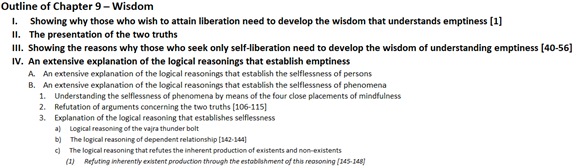
The third reason Shantideva gives to establish selflessness is reputation of inherent production of existents and non-existents. Before with the logical reasoning of the vajra thunder bolt we looked at the impossibility of inherently existent production from the side of the causes. Here Shantideva looks at the impossibility of either an existent or a non-existent being inherently produced, in other words looking at it from the point of view of the effect.
(9.145) If something is truly existent,
What need is there for a cause to produce it?
And if something is non-existent,
Again, what need is there for a cause to produce it?
First Shantideva shows there is simply a contradiction between saying an object is inherently existent and that it is produced. If it is inherently existent, then it exists inherently and therefore does not need to be produced since it already exists on its own. Likewise, it makes no sense whatsoever to talk about production of a non-existent since a non-existent does not exist.
(9.146) Even with a hundred million causes,
A non-thing will never transform into a thing.
If it remained a non-thing, how could it become a thing?
From what state could it transform into a thing?
(9.147) While it is not a thing, it cannot exist as a thing;
So when could it ever become a thing?
It would be unable to separate from being a non-thing
Without first becoming a thing;
(9.148) But without its being separated from the state of being a non-thing,
It is impossible for the state of a thing to arise.
Likewise, a functioning thing cannot become a permanent thing
Because, if it did, it would have two mutually exclusive natures.
Those the grasp at inherent existence say that an object is either inherently existent or inherently non-existent. In moment one for example the object does not exist, and those that grasp at inherent existence would say that it truly does not exist. It inherently does not exist. In moment two, those that grasp that inherent existence say the object inherently exists. Yet they have no explanation for how something can transform from a state of inherently not existing to a state of inherently existing. Transforming from being a non-thing to a thing. How does that happen? Where does the thing come from? Yet when it exists, we grasp it as having its own independent existence. All of this is quite impossible.
I’ll try to simplify with an example of a seed and a sprout. If the sprout were truly existent, it would not need a cause, seed, to produce it. It would be self-existent. With respect to the sprout at the time of the seed, again it wouldn’t need a cause to produce it either since it is a non-existent. So the question is how does an inherently existent sprout, a thing, come into existence from being a non-thing at the time of the seed? This would be impossible.
Essentially all we need to know is — something cannot arise from nothing. Also, it cannot arise from that which is itself not an effect of some other cause. It can only be produced from that which is itself a product, so nothing is inherently existent.
 Kadampa Working Dad