We now turn to the refutation of cause that is other. The following refutes the possibility of creation by an inherently existent God. In the West, most of us have been brought up to believe in a God that is the creator of all. We must have some imprints to have been born into a society such as this. We must have some imprints to have met the Christian religion. Realizing emptiness does not mean we have to reject God, but we need to understand God in a different way. That is all. We just understand God in a different way. This is helpful for us and for the flourishing of Kadampa Buddhism in the West.
Sometimes many Kadampas or Buddhists feel that they need to reject Christianity or Christian teachings. In fact, many of us came into Buddhism by rejecting our Christian past. We sometimes feel the need to debate with our Christian friends or family members, explaining why they are wrong. All of that is completely unnecessary. Indeed, such an approach is often counterproductive because in our rejection of Christianity we wind up rejecting many things that we need to believe in Buddhism. For example, many people reject Christianity because they do not like the teachings on the hell realms, so when they hear them in Buddhist teachings, they either reject them or reject Buddhism altogether. Likewise, because many people wind up rejecting the idea of God, they struggle with understanding correctly the relationship they are supposed to have with Buddhas. Because they reject God, they wind up rejecting many aspects of our reliance upon buddhas that is similar to what the Christians have in their reliance upon God. We reject too much, and wind up creating intellectually formed wrong views which obstruct our ability to realize Dharma. In reality, the only thing we reject about the Christian notion of God is him as an inherently existent creator of all. If we understand the emptiness of God and the emptiness of his creation, then there is absolutely no problem. When we recognize that our mind is the creator of all, the natural conclusion is we need to create a world as a good God would. In other words, we need to engage in tantric practices of building our pure land where all living beings can take rebirth as our guests and then complete the path.
I’d like to share what Geshe-la said in his teachings on Mahamudra.
“In Guide to the Middle Way it says Buddha rejects any creator other than mind. There is a big debate. Many believe the world is created by God. We cannot say their view is mistaken or wrong. There is no meaning in checking others’ view, we don’t know the real meaning of their view. For example, they say God is the creator of all things. We say the mind is the creator, so how do we clarify? Superficially there is a difference. We cannot say others’ view is mistaken until we understand the real nature of God. We cannot say they are correct or incorrect unless we understand the nature of God. Through their faith, it works. The nature of God is not clear in this society. In Guide to the Bodhisattva’s Way of Life some people say the nature of God is an independent permanent self. Such a self does not exist because self, person, I are the same, and necessarily impermanent. There is no independent self because every self depends upon causes and conditions. At least they are dependent upon imputation by mind. Some say the nature of God is the four elements. … some say the nature of God is the Dharmakaya, like empty space. The Dharmakaya is generally possessed by Buddhas. The very subtle mind is called the basic Dharmakaya. It is the basis through which we accomplish the actual Dharmakaya. In Buddhism it is given the name Dharmakaya. Therefore, the nature of God is Dharmakaya. This is very comfortable.”
From a Buddhist perspective, we can say everything created by God means everything is created by Dharmakaya. So we can say the same words, but we understand them differently. Then, we are able to relate to others without conflict, the Dharma can flourish in Christian societies without tension.
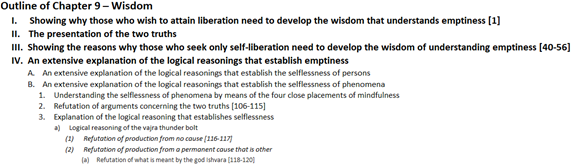
(9.118abc) If you Samkhyas want to say that Ishvara is the creator of all things,
Then please explain who or what Ishvara is.
(Samkhyas) “He is basically the nature of the four great elements.”
The Samkhyas were the Christians of Shantideva’s time, they believed in Ishvara as a God-like creator of all things. Shantideva begins the discussion about production from other by asking the Samkhyas to clarify exactly who or what Ishvara is?
The Samkhyas say that Ishvara is the nature of the four great elements – earth, water, fire, and wind. Every phenomena according to the Samkhyas is some combination or mix of these four elements. Buddhists also agree with this view. They too say that all phenomena are a mix of the four elements. Sometimes, modern people can look at this and find it to be scientifically naive. Phenomena are comprised of elements, but those found on the periodic table, not the four elements of earth, water, fire, and wind. How can we reconcile this? In so many other respects, we can say that modern science is just now starting to catch up with Buddhist teachings, but this discussion of the four elements can seem very archaic.
For Prasangikas this is not a problem. Prasangika’ do not say that things are inherently comprised of earth, water, fire, and wind. They also do not say that things are not comprised of the elements on the periodic table. Rather, they say all things are like holograms. A hologram is something that appears to be one thing when looked at from one perspective and appears to be something else when looked at from a different perspective. For example, the number 6 viewed upside down looks like the number 9. If one person said it is a 6 and the other person said it is a 9, the two could debate endlessly. So what is it? Is it a 6 or is it a 9? It is neither one nor the other, but both simultaneously. All phenomena exist in the same way. To take perhaps a more difficult example, we can look at Donald Trump. For some, he is the worst president ever. For others he is the best president ever. So what is he? Is he the best or the worst president ever? In truth, he is neither one or the other, but both simultaneously. Yes, even Donald Trump is empty.
In the same way, from one perspective we can say all phenomena are comprised of the four elements, and from another perspective they are comprised of the elements on the periodic table. Both views are just different ways of categorizing or understanding or conceptualizing phenomena. Things are neither comprised of the four elements nor comprised of the elements of the periodic table, but are both simultaneously. To debate whether it is one or the other is as asinine as the debate as to whether it is a six or it is a nine.
 Kadampa Working Dad