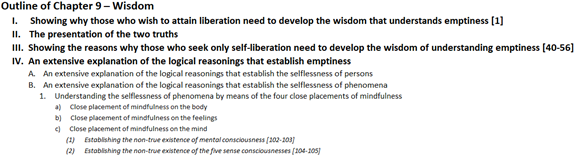
Now Shantideva looks at the emptiness of the sense consciousnesses:
(9.104) If a sense awareness exists prior to its object,
What is it aware of?
If it arises simultaneously with its object,
In dependence upon what object does it arise?
(9.105) And if a sense awareness is truly existent,
How can it arise subsequently in dependence upon an object condition?
In this way, we can understand
That all six consciousnesses lack true existence.
This is a very powerful logic. It looks at the sequential relationship between an object of our sense powers and the sense consciousness aware of the sensory experience. Either the truly existent sense power exists before it comes into contact with its object, at the same time as its object, or after its object. There is no fourth possibility. Clearly a sense consciousness cannot arise before it encounters its object because that would imply is it possible to have an awareness of something without an object that it is aware of. Likewise, the sense awareness does not arise after encountering the object because that would imply that the object of an eye awareness can exist without being known. How can there be an object of awareness without there being an awareness aware of that object?
Understanding why a truly existent sense consciousness cannot arise simultaneously with the object is a bit more subtle. It is true that the eye awareness and the visual form arise simultaneously. The two arise in mutual dependence upon one another. You cannot have one without the other as the above logic demonstrates. But you cannot have a truly existent sense consciousness arise simultaneously with the object of consciousness because a truly existent sense consciousness is one that exists independently of all other phenomena. If the sense consciousness arises simultaneously independence upon the object of consciousness then it clearly shows there is a dependent relationship between the consciousness and the object. The sense consciousness cannot be simultaneously independent and have a dependent relationships with other things. So while a non-truly existent sense consciousness can arise simultaneously with a non-truly existent object of consciousness, a truly existent consciousness cannot arise simultaneously with a truly existent object because both the sense consciousness and the object exist independently of one another. If they exist independently of one another they cannot enter into contact with one another or into enter into any sort of relationship with one another.
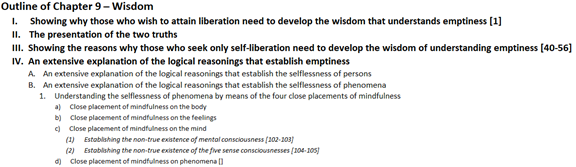
In Shantideva’s commentary there are not any verses that correspond with the close placement of mindfulness of phenomena. However, the traditional explanation of the four close placements includes the close placement of mindfulness on phenomena. Since Shantideva explains the close placements of mindfulness on the body, on the feelings, and on the mind, we can be certain he also wishes to explain the close placement of mindfulness of phenomena. He does not actually add a verse here because one is not necessary. The explanation of the emptiness of phenomena has already been explained in detail above in the presentation of the two truths.
However, Shantideva’s explanation of the close placement of mindfulness of the five sense consciousness indirectly reveals the close placement of mindfulness on phenomena. The Prasangikas do not negate that phenomena exist, they negate that truly existent phenomena exist. Truly existent phenomena are phenomena that exist independent of the mind. But as the explanation above on the close placement of mindfulness on the mental consciousness and the close placement of mindfulness on the sense consciousness reveal, it is impossible for a truly existent phenomena to come into contact with a truly existent consciousness because both consciousness and the object exists independently. Two independent things cannot have a dependent relationship with one another because if they have a dependent relationship they necessarily are not independent.
Indeed, if an independent object truly existed it could not ever be known. Because to be known would imply that it enters into a relationship with a consciousness. For it to be an independent object it must exist entirely independently of consciousness. But if it exists entirely independently of consciousness, how could it possibly be known? Since objects are known, it follows that they cannot possibly exist independently. Thus, all phenomena lack true independent existence.
 Kadampa Working Dad