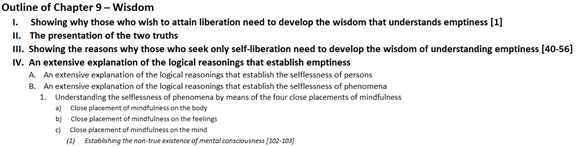
Now Shantideva explains how mental consciousness is empty.
(9.102) Mental consciousness cannot be found in the six powers,
In the six objects of consciousnesses, such as forms, or in the collection of the two.
It cannot be found either inside or outside of the body,
Nor can it be found anywhere else.
This meditation is exactly like the meditation on the emptiness of our I or our body. It starts with the premise that if our mental consciousness exists it should be findable. All consciousness arises from the meeting of a power with an object. For example, when our eye sense power meets a visual form we generate an eye consciousness and when our mental powers meets a phenomena source, which is an object that appears to mind, we generate a mental consciousness. If the mental consciousness is to be found we should be able to find it either in the power, in the objects of consciousness, in the collection of the two, or separate from the two.
The mental consciousness is not the mental power because the mental power is the ability to know, not an awareness itself. Without an object to be aware of the mental power cannot know anything, and therefore there is no mental consciousness. Likewise, the mental consciousness is not in the phenomena source because that is the object known by the consciousness, and the object known and the mind that knows it are two different things. It is not the collection of the two because neither the mental power nor the phenomena source are the consciousness, so how can a collection of two things that are not a consciousness magically transform into a consciousness. There is nothing there that is the possessor of the power and the object known. It likewise cannot be found separate from the mental power or the phenomena source because without either how can we speak of a consciousness when there’s nothing to know and nothing that has the power to know?
Understanding this, we can see clearly that the mental consciousness does not exist independently. It is a mere name we impute upon the collection of a mental power and an object of consciousness.
(9.103) Mental consciousness is neither the body nor inherently other than the body.
It is not mixed with the body, nor is it entirely separate from it.
It is not the slightest bit truly existent.
This lack of true existence, the emptiness of the mind, is called the “natural state of nirvana”.
Why do you think Shantideva refers to the body when trying to find the mind? Because we think that our mind comes from our body. This is our current scientific view. Modern thought believes that the brain is the mind. It is true there is a relationship between our mind and our brain. We can think of our brain as like a radio receiver, and our mind as like the radio waves pervading everything. There are currently radio waves all around us playing music, but it is only when we connect a radio receiver that we can transform the waves into sounds that we can hear. In the same way, the brain is like the radio receiver and the mind is like the radio waves pervading everything. Just as there are powerful radios and weak radios, so too there are powerful brains and weak brains. But the radio waves themselves are different from the radio receiver itself. The mind is different from the brain, yet there is a functional relationship between the two.
Modern science does not have an explanation for how a physical blob of the brain is able to a formless continuum that knows. Without a theory of the relationship between the form that is the brain and the formless phenomena that is the mind, we cannot say the brain is the mind. How do the Prasangikas escape this dilemma? For the Prasangikas, the mind is formless. But all of the things we normally see are by nature objects of mind. They too are the nature of mind. Mind can easily know a projection of mind.
 Kadampa Working Dad