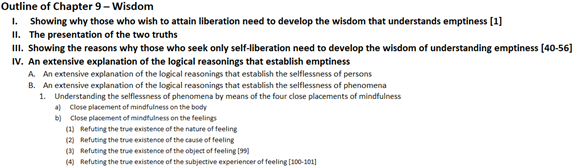
Previously the Prasangikas refuted truly existent feelings by showing that there is no such thing as a truly existent feeling because our feelings change, and therefore enter into some sort of dependent relationship with other things. If our feelings change, then how can we say they exist independently?
The other schools answer this objection by saying we continue to have a memory of our past feelings, so the feelings are still there, just not manifest. Once again, this corresponds with how we normally think. Psychotherapy is almost entirely about removing the effects of negative past experience on our present experience of life. Perhaps we experienced some trauma as a child, and this trauma is continuing to serve as a drag on our present experience. In psychotherapy, we try identify these past wounds and the negative feelings associated with them, and then relate to our past experience and these feelings in a different way so as to heal our mind of them. In this way we come to view our greatest wounds as our greatest blessings because they shaped us into the person we are today. Therefore, we say the feelings still exist even though we are no longer experiencing them directly – they truly exist.
In the same way, our normal view is we project some future and then worry about that future. Even though we are not yet experiencing the future, we can nonetheless “feel” it now by thinking about it. We feel the future now, therefore, it is truly existent, just experienced at different levels of intensity.
(9.100) Moreover, even if you assert that it can remember feelings that have passed, it cannot experience them;
And it cannot experience feelings that have yet to arise because they do not exist.
So, feelings cannot experience themselves,
And no truly existent other consciousness can experience them either.
The Prasangikas refute the view of the other schools by saying we are not actually experiencing the feelings of our past, we are experiencing our present memory of our feelings of our past. Our feelings in the present are arising from our present memory of our past. Thus, the feeling of the past completely ceased when our past moments experiencing those feelings ceased.
(9.101) Thus, since the person who experiences feelings does not truly exist
And feelings themselves do not truly exist,
How can this selfless collection of aggregates
Be harmed or benefited by painful or pleasant feelings?
We are not prepared, are we, to experience suffering. We do not tolerate it. We find it unacceptable. And we like, prefer, actually we crave, to a great extent, comfort, pleasure. When we frame the choice as endure suffering or go for pleasant feelings, what will we choose? We will lose this every time. So we need to reframe the choice as move deeper into samsara or move out of samsara with our actions. Then, when we really understand the nature of samsara, we will make the right choices.
We have a choice to make of what we think matters: our feelings or our intention. Our answer to this choice will determine everything. Our focus on our feelings is the root of our worldly concerns, being focused on present feelings as opposed to creating causes for the future. Because we are not creating any good causes for our future, it will be hard and miserable.
We base our whole life on our feelings. The things that matter to us the most are what we are feeling, whether good or bad. Shantideva is pointing out that in fact the feelings that we normally grasp at do not exist at all. If we go looking for them, we cannot find them. What is the point of dedicating our life to something that does not exist at all? We can understand since there are no truly existent feelings, why bother avoiding unpleasant feelings? Why bother pursuing pleasant feelings? You cannot be harmed by the one, benefited by the other. Whether we are harmed or benefited from a feeling depends entirely upon how we relate to it. What we actually feel depends entirely upon how we discriminate the object. Nothing is actually pleasant, they become pleasant when we relate to them with a pleasant mind. Nothing is actually unpleasant, they become unpleasant when we relate to them with an unpleasant mind.
Likewise, our self that experiences these feelings does not exist. So who are we trying to serve? Does it make sense to dedicate our whole life to serving the interests and needs of an illusion or a hallucination? It is not enough to just intellectually understand, “oh yeah our feelings are self that we normally see do not exist.” We need to deeply internalize what this means. It means that everything we have considered to be important in fact is meaningless. Everything we have worked for does not exist at all. Our priorities are completely mistaken. When we realize this, we naturally then reorient our priorities in a spiritual way. We dedicate our life to waking up from samsara, not trying to find the most comfortable place within it. We start to cultivate our true self, not an illusion.
When we meditate on the emptiness of our feelings, they disappear. Imagine you are feeling pain somewhere in your body. You can try find it and when you do not, the pain will go away. It is the ultimate pain killer, and the more you take it the more effective it becomes.
But we do not want our feelings of pleasure to go away, so we are reluctant to meditate on their emptiness. But when we have renunciation, we do not want to have contaminated happiness because we know that just strengthens the chains to samsara. By letting go of contaminated happiness we can come to enjoy a pure bliss which is infinitely better. But to get that bliss we have to let go of our attachment to worldly pleasure. The interesting thing about meditating on the emptiness of contaminated pleasant feelings is when you do so, the pleasure does not go away, rather it becomes released. You realize that it is coming from your mind, so it becomes uncontaminated pleasure. We actually experience the pleasure more deeply, more thoroughly. The gap between ourselves and the pleasure dissolves away, we quite literally become the pleasure itself.
 Kadampa Working Dad