Some of the other schools assert the existence of a partless particle and they claim this particle is the building block of everything. They claim that these partless particles truly exist, independent of the mind. Most of experimental physics is aimed at trying to find partless particles. I used to live in the Geneva area where they had a giant supercollider called CERN. This supercollider would accelerate atomic particles almost at the speed of light and have them smash into each other, breaking the atomic particles apart into smaller and smaller bits. Even though they were able to break atomic particles into even smaller parts, most of the engineers assumed there must be something that survives all of these collisions that is a partless particle. But even when they would smash these smaller bits, they would find yet smaller bits.
Understanding this, modern physics has moved into quantum physics. Quantum physics says objects come into existence when they are observed by an observer. This is quite similar to emptiness, but quantum physics has not yet gotten to the point in which it concludes there is nothing there behind the observation of the mind. They still think there must be something there that is being observed, but it comes into existence upon observation. The other schools are like the quantum physicists who grasp at some sort of partless particle. They simply think these objects come into existence through observation. The Prasangikas agree objects come into existence through observation, but they are never and will never be anything more than mere appearance to mind. In other words, there is no partless particle behind the observation.
Why does any of this matter? Our normal way of thinking, as expressed by the other schools, is that there must be something there that is the cause of our pleasant or unpleasant feelings. When we eat ice cream or get hit by a baseball bat, we experience pleasure and pain. We think the ice cream causes pleasure and the baseball bat causes pain. We therefore assume there must be something in the ice cream or the baseball bat that causes these feelings. According to the other schools, and according to our “common sense,” pleasure and pain arise from the meeting of this external cause and our sense powers. The Prasangikas now go on to refute this “common sense” view.
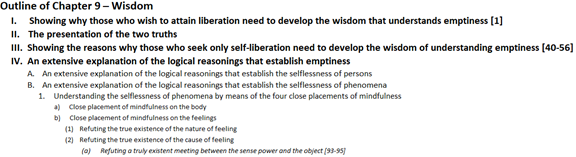
(9.93) If there is space between the partless particles of a sense power and those of its object,
How can you maintain that they have met?
But if there is no space between them, they must mix and become completely one;
In which case, what is it that meets with what?
The Prasangikas say there are two possibilities, either there is space between the partless particles and the sense power or there is not. If there is space, then they never actually meet and therefore we cannot say feelings arise from the meeting of the partless particles with the sense powers. If there is no space between the partless particles and our sense powers, then the partless particles and our sense powers are one in the same. If that is the case, what is the point of differentiating the partless particles from the sense power? Further, if they can be nominally differentiated between the partless particle itself and the sense power itself, even though the two are one in the same, then we can no longer say the particle is partless since it has a part that is the particle itself and a part that is the sense power. This logic is irrefutable. It completely destroys the possibility of our normal way of thinking.
We should not take this merely as an intellectual exercise, but realize that the way we have been thinking about the world makes absolutely no sense. Nothing external ever causes any feeling. This is an incredibly liberating thought. If external things are not the cause of our feelings, then we no longer need to be preoccupied with what happens externally since it has no fundamental bearing upon what we feel. Further, if our feelings come from within, then the way in which we change our feelings is by changing what is within, namely our mind. This realization that external objects have no means of causing feelings helps us stop looking for happiness where it cannot be found, and start looking where it can be found.
The other schools respond to this objection by saying the partless particles of the external cause of feeling and the partless particles of our sense powers penetrate one another and therefore generate feelings.
(9.94) But one partless particle could never penetrate another
Because they would both be equal in size without any empty space inside.
Without penetrating, they could not mix;
And without mixing, they could not meet.
The Prasangikas say this is a logical contradiction. If one partless particle penetrated another they would have to do so completely without any gaps, otherwise there would be part of the partless particle that is penetrated by the other partless particle and part of the partless particle that is not penetrated by the other partless particle. If that was the case, then how can we say it is a partless particle since it now has two parts, one part penetrated and one part not? But if they do not actually penetrate one another, they do not ever mix, and therefore they do not meet. If they do not meet, then we cannot say feelings arise from the meeting of the partless particles and the sense power.
(9.95) To say that two partless things can meet
Is completely illogical.
If it were possible, you would be able to detect it;
So please show me an example!
Since the other schools are asserting this is how feelings arise , then the burden of proof is on them to provide an example demonstrating the truth of their view. If they cannot even provide one example, then how can they say their view is valid?
 Kadampa Working Dad