On Not Being Attached to our Solitude:

Many Dharma practitioners prefer their alone time to being with other people. We may even rationalize this with the teachings from Shantideva in Chapter 8 about the glories of being alone and the futility of dealing with the childish.

But this can also be a form of running away from others because, frankly, it can be tiring to be around deluded and needy people who only see faults in us anyways. This is just another form of attachment, aversion, and self-cherishing.

So how do we get it right? The test is what is best for all living beings. Sometimes it’s best for others to be directly with them, cherishing them, training in patience with them, overcoming the delusions we generate towards them, etc. Sometimes we can help them more by being away on retreat or quasi-retreat-like conditions. Sometimes the best way to help them is to not help them directly so they learn how to do things themselves. Theoretically, of course, Shantideva is right – we can help people more by attaining enlightenment as swiftly as possible for them, and retreat-like conditions are often the best way to do that. One way or the other, our motivation needs to be what is best for all living beings, and more profoundly, what is best for our swiftest possible enlightenment for their sake.

How then can we know if being directly with others or being alone is best, even if our motivation is this correct bodhichitta?

At one level, we just have to be honest with ourselves and examine our real motivations. Are we driven by a desire to get away from them? Are we using our time alone for deeper spiritual training? Are we really motivated by bodhichitta or are we just using the Dharma to rationalize what our delusions want? If we find ourselves falling short on our motivation, we can do the inner work to make our motivation more authentic and heartfelt. Perhaps that is why we are alone – to get past the intellectual and have the time to learn to make it genuinely heartfelt.

At another level, we actually don’t have a clue what is best for all living beings. But fortunately, we know a Buddha who does – Dorje Shugden. We can, with the most sincere bodhichitta motivation we can generate, request him to reveal to us and arrange whatever is best. If it is best for me to continue to have alone conditions, then please reveal to me why and keep them going. If it is best for me to be with others, cherish them directly, and train my mind in that context, then please reveal that to me and arrange the conditions for that to happen. Then, we accept whatever subsequently arises as what he is arranging for us. We need to continue to do this on a fairly regular basis because karma shifts and we need to be prepared to shift with it.

If we have faith in Dorje Shugden and our motivation is genuinely to do what is best for others, then we will be able to happily shift between times where we are with others and times when we are alone. We will understand this as basically like our spiritual high intensity interval training. The sign we have it right is we have genuine equanimity towards the two possibilities, seeing them both as equally good just in different ways, and trusting that Dorje Shugden is giving us exactly what we need.

Then, no problems.

Modern Bodhisattva’s Way of Life: Your Mind is Empty Too

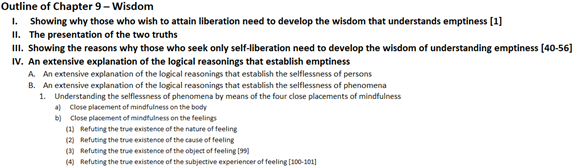
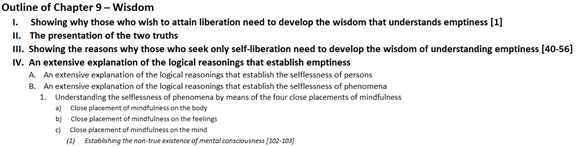
Now Shantideva explains how mental consciousness is empty.

(9.102) Mental consciousness cannot be found in the six powers,
In the six objects of consciousnesses, such as forms, or in the collection of the two.
It cannot be found either inside or outside of the body,
Nor can it be found anywhere else.

This meditation is exactly like the meditation on the emptiness of our I or our body. It starts with the premise that if our mental consciousness exists it should be findable. All consciousness arises from the meeting of a power with an object. For example, when our eye sense power meets a visual form we generate an eye consciousness and when our mental powers meets a phenomena source, which is an object that appears to mind, we generate a mental consciousness.  If the mental consciousness is to be found we should be able to find it either in the power, in the objects of consciousness, in the collection of the two, or separate from the two.

The mental consciousness is not the mental power because the mental power is the ability to know, not an awareness itself. Without an object to be aware of the mental power cannot know anything, and therefore there is no mental consciousness. Likewise, the mental consciousness is not in the phenomena source because that is the object known by the consciousness, and the object known and the mind that knows it are two different things. It is not the collection of the two because neither the mental power nor the phenomena source are the consciousness, so how can a collection of two things that are not a consciousness magically transform into a consciousness. There is nothing there that is the possessor of the power and the object known. It likewise cannot be found separate from the mental power or the phenomena source because without either how can we speak of a consciousness when there’s nothing to know and nothing that has the power to know?

Understanding this, we can see clearly that the mental consciousness does not exist independently. It is a mere name we impute upon the collection of a mental power and an object of consciousness.

(9.103) Mental consciousness is neither the body nor inherently other than the body.
It is not mixed with the body, nor is it entirely separate from it.
It is not the slightest bit truly existent.
This lack of true existence, the emptiness of the mind, is called the “natural state of nirvana”.

Why do you think Shantideva refers to the body when trying to find the mind?  Because we think that our mind comes from our body.  This is our current scientific view.  Modern thought believes that the brain is the mind. It is true there is a relationship between our mind and our brain. We can think of our brain as like a radio receiver, and our mind as like the radio waves pervading everything. There are currently radio waves all around us playing music, but it is only when we connect a radio receiver that we can transform the waves into sounds that we can hear. In the same way, the brain is like the radio receiver and the mind is like the radio waves pervading everything. Just as there are powerful radios and weak radios, so too there are powerful brains and weak brains. But the radio waves themselves are different from the radio receiver itself.  The mind is different from the brain, yet there is a functional relationship between the two.

Modern science does not have an explanation for how a physical blob of the brain is able to a formless continuum that knows. Without a theory of the relationship between the form that is the brain and the formless phenomena that is the mind, we cannot say the brain is the mind. How do the Prasangikas escape this dilemma? For the Prasangikas, the mind is formless. But all of the things we normally see are by nature objects of mind. They too are the nature of mind. Mind can easily know a projection of mind.

Happy Protector Day: All the Attainments I Desire Arise From Merely Remembering You

The 29th of every month is Protector Day.  This is part 11 of a 12-part series aimed at helping us remember our Dharma Protector Dorje Shugden and increase our faith in him on these special days.

In the last post I explained most of the things we request Dorje Shugden to do.  In this post I will explain the summary requests from the sadhana.

Please remain in this place always, surrounded by most excellent enjoyments.
As my guest, partake continuously of tormas and offerings;
And since you are entrusted with the protection of human wealth and enjoyments,
Never waver as my guardian throughout the day and the night.

All the attainments I desire
Arise from merely remembering you.
O Wishfulfilling Jewel, Protector of the Dharma,
Please accomplish all my wishes.   (3x)

This verse is the synthesis of the entire Dorje Shugden practice.  Everything is contained within this verse.  We can understand this verse as follows:  The first line refers to our pure wishes, not our mundane wishes.  The second line refers to wherever we imagine a Buddha, a Buddha actually goes, and where ever they go, they accomplish their function.  If we remember Dorje Shugden, he will infuse himself into the situation and transform it into something we see as perfect for our practice.  The third and fourth lines explain how Dorje Shugden can become a wishfulfilling jewel.  Since he accomplishes all our spiritual wishes, if we make all of our wishes spiritual ones, he will accomplish all our wishes.

Whenever we are in a difficult situation, we can recite this verse like a mantra requesting him to provide us immediate protection.  Then we should strongly believe that he has infused himself into the situation and everything is now perfect.  We may wonder why is it that all the attainments we desire arise from merely remembering Dorje Shugden.  The reason for this is Dorje Shugden is a wisdom Buddha, which means he primarily helps us by blessing our mind to be able to see how the conditions we have are perfect for our practice.  When we remember him, we recall that everything is emanated by him and thus perfect.  Just believing this to be the case with faith opens our mind to receiving his powerful blessings.  Sometimes we understand immediately how the situation is perfect for our spiritual training, other times it is not so clear.  But even when it is not clear why the conditions are perfect, our remembering him gives us the faith that things are perfect, so we can more easily accept them.  Understanding exactly why things are perfect for our practice is obviously best, but sometimes simply understanding that things are perfect is good enough to set our mind at peace.

If we do not have time to engage in the whole Dorje Shugden sadhana, we can just recite this verse three times and this will maintain our commitments.  One verse said out of deep faith and a pure motivation is far more powerful than hundreds of hours of sadhana practice with a distracted, unfaithful mind.  If we offer our life completely into his care, it does not matter how much recitation we do.  But with that being said, reciting the full sadhana is obviously more effective than just reciting this last verse assuming our faith and motivation are equal in both situations.

After reciting the “all the attainments I desire…” verse, it is customary to pause and make personal requests for ourself and the people we care about.  The following are some example requests we can make.  General requests can include, “May I gain all the realizations necessary to lead all those I love to enlightenment.” This is the essence of our bodhchitta wish.  We can also make the request, “Please arrange all the outer, inner and secret conditions so that all those I love may enter, progress along and complete the path to enlightenment in this lifetime.”  This request fulfills our superior intention to lead all beings along the path to enlightenment.

Some specific requests we can make are:  When we do not know what is best, we can request “Please arrange whatever is best with respect to _____.”  When we think something is best, but we have some attachment to getting it our way, we can make the request, “With respect to ____, if it is best, please arrange it; otherwise, please sabotage it.”  When we have some situation that needs transforming, we can request, “May my/his experience of _____ become a powerful cause of my/his enlightenment.”  Finally, we can request anything that has a pure motivation, but we shouldn’t become attached to getting things the way we think is best.  We do not know what is best, which is why we need an omniscient Dharma protector managing these things for us.

After we have made our requests, we can maintain three special recognitions.  We can hold these recognitions in the meditation session and the meditation break, and indeed for the rest of our life.  First, we can think, from now until we attain enlightenment, and especially in this lifetime, everything that appears to us physically is emanated by Dorje Shugden for our practice.  Certain appearances will be for us to overcome certain delusions.  Certain appearances will be for us to generate virtuous minds.  But we can be certain that from this point forward, there is not a single physical appearance that has not been emanated by him for us, so we can correctly see everything as an emanation of him for our practice.

Second, from now until we attain enlightenment, and especially in this lifetime, everything that we hear is emanated by Dorje Shugden to teach us the Dharma.  Obviously, this includes all the Dharma teachings we receive.  But it also includes conversations we overhear, songs we hear, even the wind blowing through the leaves.  But we can be certain that from this point forward, there is not a single sound that has not been emanated by him to teach us the Dharma.  We can correctly imagine that all sounds are mounted upon his mantra, and that when we hear the sounds they teach us the Dharma.

Third, from now until we attain enlightenment, and especially in this lifetime, everything that arises within our mind will be emanated by Dorje Shugden to provide us an opportunity to train our mind.  Obviously, this includes every time we generate virtuous minds with our Dharma practice.  He will also help us generate the virtuous minds of the stages of the path.  This additionally includes all the delusions that arise within our mind.  For example, if strong anger arises, we can believe it is emanated by him so that we can practice patience.  If strong jealousy arises, we can think it is emanated by him so we can practice rejoicing, etc.  This also applies to what others think, for example what they think about us, etc.  We can view everything that others are appearing to think to be emanated by Dorje Shugden for our practice.  We can be certain that from this point forward, there is not a single thought that will arise within our mind or the mind of others that has not been emanated by him to provide us an opportunity to train our mind, so we can fully accept everything that happens as perfect for our practice. 

In the next post I will explain how we can increase the power of our practice of Dorje Shugden.

Modern Bodhisattva’s Way of Life: Using Emptiness to Heal our Past Traumas

Previously the Prasangikas refuted truly existent feelings by showing that there is no such thing as a truly existent feeling because our feelings change, and therefore enter into some sort of dependent relationship with other things. If our feelings change, then how can we say they exist independently?  

The other schools answer this objection by saying we continue to have a memory of our past feelings, so the feelings are still there, just not manifest. Once again, this corresponds with how we normally think. Psychotherapy is almost entirely about removing the effects of negative past experience on our present experience of life. Perhaps we experienced some trauma as a child, and this trauma is continuing to serve as a drag on our present experience. In psychotherapy, we try identify these past wounds and the negative feelings associated with them, and then relate to our past experience and these feelings in a different way so as to heal our mind of them. In this way we come to view our greatest wounds as our greatest blessings because they shaped us into the person we are today. Therefore, we say the feelings still exist even though we are no longer experiencing them directly – they truly exist. 

In the same way, our normal view is we project some future and then worry about that future.  Even though we are not yet experiencing the future, we can nonetheless “feel” it now by thinking about it.  We feel the future now, therefore, it is truly existent, just experienced at different levels of intensity. 

(9.100) Moreover, even if you assert that it can remember feelings that have passed, it cannot experience them;
And it cannot experience feelings that have yet to arise because they do not exist.
So, feelings cannot experience themselves,
And no truly existent other consciousness can experience them either.

The Prasangikas refute the view of the other schools by saying we are not actually experiencing the feelings of our past, we are experiencing our present memory of our feelings of our past.  Our feelings in the present are arising from our present memory of our past.  Thus, the feeling of the past completely ceased when our past moments experiencing those feelings ceased. 

(9.101) Thus, since the person who experiences feelings does not truly exist
And feelings themselves do not truly exist,
How can this selfless collection of aggregates
Be harmed or benefited by painful or pleasant feelings?

We are not prepared, are we, to experience suffering.  We do not tolerate it.  We find it unacceptable.   And we like, prefer, actually we crave, to a great extent, comfort, pleasure.  When we frame the choice as endure suffering or go for pleasant feelings, what will we choose?  We will lose this every time.  So we need to reframe the choice as move deeper into samsara or move out of samsara with our actions.  Then, when we really understand the nature of samsara, we will make the right choices.

We have a choice to make of what we think matters:  our feelings or our intention.  Our answer to this choice will determine everything.  Our focus on our feelings is the root of our worldly concerns, being focused on present feelings as opposed to creating causes for the future.  Because we are not creating any good causes for our future, it will be hard and miserable. 

We base our whole life on our feelings. The things that matter to us the most are what we are feeling, whether good or bad. Shantideva is pointing out that in fact the feelings that we normally grasp at do not exist at all.  If we go looking for them, we cannot find them. What is the point of dedicating our life to something that does not exist at all? We can understand since there are no truly existent feelings, why bother avoiding unpleasant feelings?  Why bother pursuing pleasant feelings?  You cannot be harmed by the one, benefited by the other.  Whether we are harmed or benefited from a feeling depends entirely upon how we relate to it.  What we actually feel depends entirely upon how we discriminate the object.  Nothing is actually pleasant, they become pleasant when we relate to them with a pleasant mind.  Nothing is actually unpleasant, they become unpleasant when we relate to them with an unpleasant mind.

Likewise, our self that experiences these feelings does not exist. So who are we trying to serve? Does it make sense to dedicate our whole life to serving the interests and needs of an illusion or a hallucination? It is not enough to just intellectually understand, “oh yeah our feelings are self that we normally see do not exist.” We need to deeply internalize what this means. It means that everything we have considered to be important in fact is meaningless. Everything we have worked for does not exist at all. Our priorities are completely mistaken. When we realize this, we naturally then reorient our priorities in a spiritual way. We dedicate our life to waking up from samsara, not trying to find the most comfortable place within it. We start to cultivate our true self, not an illusion.

When we meditate on the emptiness of our feelings, they disappear.  Imagine you are feeling pain somewhere in your body.  You can try find it and when you do not, the pain will go away.  It is the ultimate pain killer, and the more you take it the more effective it becomes. 

But we do not want our feelings of pleasure to go away, so we are reluctant to meditate on their emptiness.  But when we have renunciation, we do not want to have contaminated happiness because we know that just strengthens the chains to samsara.  By letting go of contaminated happiness we can come to enjoy a pure bliss which is infinitely better.  But to get that bliss we have to let go of our attachment to worldly pleasure.  The interesting thing about meditating on the emptiness of contaminated pleasant feelings is when you do so, the pleasure does not go away, rather it becomes released.  You realize that it is coming from your mind, so it becomes uncontaminated pleasure. We actually experience the pleasure more deeply, more thoroughly.  The gap between ourselves and the pleasure dissolves away, we quite literally become the pleasure itself.

Happy Tsog Day: Receiving the blessings of the four empowerments

In order to remember and mark our tsog days, holy days on the Kadampa calendar, I am sharing my understanding of the practice of Offering to the Spiritual Guide with tsog.  This is part 20 of a 44-part series.

Through the force of requesting three times in this way, white, red, and blue light rays and nectars, serially and together, arise from the places of my Guru’s body, speech, and mind, and dissolve into my three places, serially and together. My four obstructions are purified and I receive the four empowerments. I attain the four bodies and, out of delight, an emanation of my Guru dissolves into me and bestows his blessings.

At this point we meditate briefly on receiving the blessings of the four empowerments according to the commentary. Then we imagine that an emanation of Lama Losang Tubwang Dorjechang comes to the crown of our head and, entering into our central channel, descends to our heart. We imagine that our subtle body, speech, and mind become of one taste with our Spiritual Guide’s body, speech, and mind, and meditate on this special feeling of bliss for a while. After this we recite the mantras according to the commentary.

The single-pointed request also has the function of requesting the spiritual guide to bestow the four empowerments. The four empowerments are the empowerment of the body; speech; mind; and the body, speech, and mind together of Je Tsongkhapa. The first empowerment bestows the body of a Je Tsongkhapa, which has the ability to emanate countless forms according to the needs of living beings. The speech empowerment bestows upon us the vajra speech of Je Tsongkhapa, which has power to guide all living beings to enter onto, progress along, and complete the path to enlightenment. By attaining the vajra speech of Je Tsongkhapa, our every sound will function to teach the truth of Dharma. The mind empowerment bestows the vajra mind of Je Tsongkhapa, which possesses the five omniscient wisdoms and can see clearly and directly all phenomena in all three times. The empowerment of the body, speech, and mind together functions to unite the vajra body, vajra speech, and vajra mind of Je Tsongkhapa so that they function together in harmony. Receiving the empowerments in this way is exactly the same as receiving the Je Tsongkhapa empowerment. In this way, the practice of Offering to the Spiritual Guide has the same function as self-initiation of Je Tsongkhapa.

We can also understand the empowerments at a deeper level where the vajra body empowerment is the similar in nature as the vase empowerment of Heruka that has the result of enabling all the meditations on the profound generation stage of the body mandala and leads to the final resultant attainment of the Emanation Body. The speech empowerment is similar in nature as the secret empowerment of Heruka, which empowers us to meditate on the completion stage of illusory body and have the good fortune of attaining the resultant enjoyment body. The mind empowerment is similar in nature to the wisdom mudra empowerment which empowers us to meditate on the completion stage of the clear light of the Mahamudra and will give us the good fortune of attaining the resultant Truth Body. And the body, speech, and mind empowerments together is similar in nature to the precious word empowerment, which empowers us to meditate on the completion stage of inconceivable and have the good fortune to attain the resultant union of Vajradhara.

When we receive the empowerments, we imagine that from the crown of our spiritual guide comes white wisdom lights that bestow the body empowerment; from the throat of our spiritual guide come red lights that bestow the speech empowerment; from the heart of our spiritual guide come blue lights which bestow the mind empowerment; and then from the body, speech, and mind of our spiritual guide simultaneously come white, red, and blue lights which bestow the body, speech, and mind empowerment together. As these light rays and nectars descend, we should feel as if we are receiving a subtle infusion of our Guru’s body, speech, and mind into our own body, speech, and mind bestowing upon us all the attainments.

After receiving these blessings, we then imagine that the entire field of merit dissolves into our spiritual guide in the space in front of us, who then comes to our crown, descends through our central channel down to our heart, where he mixes in separably with our indestructible wind and mind. It should feel as if his mind has entered into ours, and our mind is now his. Essentially, we receive a mind transplant where his enlightened mind becomes our own. Since the ultimate nature of our Guru’s mind is the union of great bliss and emptiness, we feel as if our mind has merged with an ocean of bliss and emptiness. Perceiving only the clear light, experiencing great bliss, and seeing directly the mere absence of all the things that we normally see, we recognize this clear light emptiness as our definitive spiritual guide and we impute our “I” upon it, strongly believing that we are Truth Body dharmakaya of our spiritual guide.

On Replacing Delusions as our Friends:

Why do we turn to our delusions? It seems there are two main reasons. First, they seem to be our friends, promising us some benefit if we listen to them; and second, we don’t know who else to turn to that might be better.

Dharma practice largely comes down to finding new inner friends. We don’t need to beat ourselves up for having relied upon the wrong friends. Sometimes the best way to let them go is to thank them for their service, but say we’ve got this from here. Essentially, we don’t need them anymore because we can satisfy the need they used to fill in healthier ways.

At the end of the day, we all wish to be free from inner pain and to feel happy. Our delusions have basically been our different coping mechanisms we have been using. Dharma helps us see how ultimately, they don’t work. But we won’t be willing to let them go until we first come up with something to replace the need they seemed to fill. Otherwise, we will feel like we have to give up some of the protection they seemed to provide. When we’ve got something better, namely the Dharma opponents, we don’t need the delusions anymore. We can thank them for their past service – no point beating ourselves up with guilt, we did the best we could – but we no longer need them because we have new, better tools to meet those same needs.

So yes, as Shantideva says, we do need to be at war with our delusions, but we don’t need to be at war with ourselves. This is a very important distinction.

For example, our attachment to worldly pleasures promises us at least something good in what is otherwise our generally difficult lives. Better to have at least some moments of respite – or changing suffering – than none at all. We work really hard, we deserve some rewards for our labors. It can’t be all grind, grind, grind. Turning to them is a coping mechanism. But it leaves us vulnerable to our happiness being dependent upon external things and they never quite bring the satisfaction we hoped for. They gradually lose their effectiveness in lifting us up and eventually we need more and more to just not feel bad. In this sense, they are no different than addiction to drugs, just to different degrees. So they seem to be fulfilling some need, but not doing a very good job at it – and ultimately, they are causing us even more problems, the not least of which is keeping us going back into samsara again and again. All delusions are deceptive in this way – they promise us something, kinda deliver, but with a hidden cost that leaves us worse off.

Jealousy promises us to get whatever we covet that others have, but usually just drives it further away. Anger promises us protection from harm, but creates enemies who attack and leave us internally miserable. Self-grasping ignorance promises to help us know who we are, but leaves us chasing phantoms. Deluded doubt promises to protect us from believing something that isn’t true, but prevents us from believing anything that could help us. Pride promises self-respect and dignity, but makes us insecure and our sense of self-worth dependent upon what others think or their failure.

The key point is this: Delusions promise to fulfill legitimate needs. There is nothing wrong with wanting to be happy, fulfilling our wishes, being protected from harm, knowing who we are, following the truth, or having self-respect and dignity. And there is an extent to which delusions kinda work. We have to acknowledge this or we won’t realize why we keep turning to them. But they don’t actually work. They don’t provide any real protection. And they always come with a hidden cost that leaves us worse off – both in this life and in all our future lives. Following delusons is always a Faustian bargain. In short, they are not reliable inner friends.

The various opponents taught in the Dharma are our new inner friends. The Buddhas introduce us to them, explain how we cultivate a friendship with them, and show why they are simply more reliable. We need reliable friends, healthy friends, that bring out the best in us. Such friends do not exist outside of us, but must be grown through our inner efforts. They will never arise on their own, though when we receive blessings we are given a taste of their friendship.

Contentment helps us be happy with what we’ve got. Rejoicing helps us be happy with what others have. Patience helps us accept things as they are. Cherishing others is the source of all our future happiness. Humility makes us stable. Wisdom realizing emptiness makes everything possible. These are more reliable inner friends. They actually meet our legitimate inner needs, but without the hidden costs.

When our delusions arise and we are tempted to believe them, what is actually happening is we have some legitimate need which is going unfulfilled, but we just don’t know any better method for fulfilling it, so we say, “f*ck it, let’s go.” Then we go down the wrong roads, it kinda works at first, but then we pay the price. Happens every time. We can’t blame ourselves for this process, we simply didn’t know any better. But now we do. We have been shown how these strategies – these mistaken coping mechanisms – just don’t work. We have also been given different, more effective coping mechanisms for meeting the same needs, namely the opponents.

So when our deluded tendencies arise in our mind, instead of developing guilt and quickly repressing them down since we are a Dharma practitioner and know we shouldn’t have delusions, take the time to ask yourself, “what legitimate need is this delusion trying to fulfill? Will it work? What could meet this need better?” When we ask ourselves these questions, we will know what to do. We will be able to tell our delusions, “thanks, but no thanks. I’m going to do this instead.” We won’t feel tempted to follow them and it won’t be a struggle to not. We don’t need to deny the legitimate need they represent, we just need to employ healthier methods for fulfilling them.

In short, we don’t need to be at war with ourselves. Like with our veterans of past wars, we can thank our delusions for their past service, embrace what they really represent (namely the wish to fulfill some legitimate inner need) into our mind, and begin to build a harmonious inner community among the different parts of our mind. In other words, we cultivate inner peace. Without inner peace, outer peace is impossible.

We Each Experience Different Worlds, But Some Are More Valid Than Others

Because everything is empty – a mere projection of our mind – the worlds we experience, others experience, and Buddhas experience are all different. They are similar enough that we can use the same words to describe things so we know what each other is talking about, but what appears and what is understood by these words can be quite different.

There is no point debating with people, “it is like this,” “no, it is like that.” It ISN’T any one particular way. Both are true – it is like this for me, it is like that for you. When we create the space in our mind for that to be, much of the unnecessary conflict in our life begins to melt away and we develop a more accommodating heart.

The risk, though, in understanding this is we can fall into an extreme of relativism or nihilism. Who’s to say Hitler was wrong, for example? Normally, when we grasp at things existing from their own side, we think truth is established by identifying what is “objectively true,” meaning true from the side of the object. But when we understand emptiness, we know such a thing doesn’t exist at all.

On what basis, then, can we differentiate which world view is more valid than another? The Prasangikas have two answers – a philosophical one and a practical one.

Philosophically, what is valid or true is not established on the side of the object, but rather on the side of the mind. If the mind is a true mind, the objects known to that mind are true. If the object is a valid mind, the objects known to that mind are valid. But that begs the question, how do we know what is a true or a valid mind? This is where enlightened beings come in. Their minds know only the truth. Their minds are completely valid. We can use what they understand to be the truth as the relative basis for establishing degree of validity and truth in what we understand to be true. Further, the more our mind begins to resemble theirs, the more our mind is true or valid. If Buddhas see things one way (all beings our our mother) and we see them a different way (friend, enemy, and stranger), then we can say relatively speaking their perspective is more true or more valid, and we can work to bring our mind around to their point of view.

Practically, we might not know what Buddhas think or how they see things, so how are we to navigate through life? Fortunately, both Gen Tharchin and Gen Losang explain there is a compass which always points us in the right direction, namely “what is more beneficial to believe.” A good example of this would be the Kadampa version of Pascal’s Wager. If hell exists and we believe it doesn’t, then we might think we can engage in negative actions with impunity. This will result in us hurting others and us confronting a terrible reckoning when we fall into the lower realms. But if hell doesn’t exist, but we nonetheless believe it does, then we will be extremely careful to avoid negative actions. This will mean we hurt others less and our own mind will be more peaceful because we will have a clean conscience. So it is clearly more beneficial to believe hell exists, even if it doesn’t (which it does).

The same logic can be applied to any situation. Take, for example, the conflict between the Israelis and Palestinians. Who’s right? They both are right from different perspectives, and both wrong from different perspectives. Believing one is right and the other is wrong is what keeps the war going. Creating the space in our mind for both to be right from different perspectives opens up new possibilities and recognizes the dignity of the other, creating the possibility for peace. We all know without inner peace, outer peace is impossible. Creating this space in our mind is the foundation for both.

Likewise, we can ask ourselves, “how would a Buddha see this?” They would no doubt see it as a powerful lesson in cycles of karma and delusion. What is most beneficial for all concerned to believe? That these are all our kind mothers killing each other and experiencing – and creating the karmic causes for – a resembling hell. When we recognize the happiness of each being is equally important, we stop rationalizing why it is OK to kill each other’s children. What needs to change is not positions on the battlefield or poltical control over different populations or territory, but how we think about these things.

If this understanding is good enough for pointing the way towards peace in such intractable problems as the millennia of conflict in the holy land, then it is probably good enough to help us navigate through our conflicts within our family, at work, or even within our Dharma communities.

More practically still, within our tantric practice, these understandings guide us on how to move from samsara first into the charnel grounds and ultimately into Keajra itself. How to move from seeing ourself as a suffering sentient being to a bodhisattva and ultimately to a Buddha. Ordinary appearances and ordinary conceptions are both less valid and less beneficial than pure appearances and pure conceptions. Our tantric practice of pure view (grounded in an understanding of emptiness) moves us from mistaken appearance to unmistaken appearance. This is not an on/off switch, but rather a volume knob as we slowly make our way to the pure land.

But in the end, it is not enough to just understand these things. We need to do the work in our mind to abandon our invalid, impure minds; dismantle our mistaken and harmful views; and come to believe and ultimately realize the world as a Buddha knows it. Dharma explains how. Sangha are those in the world trying to do the same thing. The more we enmesh ourselves in these three, the more we will naturally move into the truth, the more harmonious all of our relations will become, and the happier both we and those around us will be.

Modern Bodhisattva’s Way of Life: Stop Blaming External Things for Internal Feelings

All the schools agree all feelings must have an object related to them. This is because the aggregate of consciousness compiles both the aggregate of feeling and the aggregate of discrimination. The aggregate of discrimination perceives an object, and the aggregate of feeling experiences that object as a feeling. And the aggregate of consciousness knows these two simultaneously in a single mind.  

For the lower schools however, they believe there are truly existent objects giving rise to truly existent feelings. Again, this corresponds with our normal view. It seems as if we encounter objects and then experience them in different ways, therefore we conclude the objects give rise to the feelings. We have no sense whatsoever that the way our mind discriminates these objects determines how our aggregate of feeling experiences them. We feel as if we are a passive experiencer of objects. We encounter the object, it gives rise to a feeling. The object is what the object is, the feeling that arises is the feeling that arises, and our mind has no role in this process.

(9.99) All objects of consciousness that give rise to feelings – from visual forms to tactile objects –
Are like dreams and illusions, utterly devoid of true existence.
If the mind experiencing feelings is truly existent,
It cannot experience any feelings that arise simultaneously with it.

The Prasangikas point out that our normal way of looking at things is actually impossible. If the object is truly existent, then how do we come into contact with it since it exists independently of the person experiencing it?  If it exists independently, how can it enter into a relationship with anything else? If it can enter into a relationship with something, then it does not exist independently since being in a relationship with something else implies some degree of dependence. Likewise, if the mind experiencing feelings is truly existent, it also exists independently. If it exists independently, how can it come into relationship with an object?  If it can come into relationship with an object, then there is some dependence between the two, at which point it is no longer independent. If the aggregate of feeling existed independently, then how could it experience different feelings at different times? There would have to be some sort of dependent relationship between the objects and the feelings that arise in the aggregate of feeling to bring about the change. But if there is a dependent relationship between the objects and the feelings, then how can we say the aggregate of feeling exists independently? It is impossible for an independent thing to exist and change in dependence upon other things.  Therefore, a truly existent aggregate of feeling would not be able to feel anything at all. Or it would experience the same feeling at all times without ever changing.

A Pure Life: Abandoning Pride

This is part eleven of a 12-part series on how to skillfully train in the Eight Mahayana Precepts.  The 15th of every month is Precepts Day, when Kadampa practitioners around the world typically take and observe the Precepts.

The actual precept here is to avoid sitting on high thrones, but the broader meaning is to not develop pride or to try put yourself in positions of superiority over others.  Very few of us have opportunities to sit on thrones, but we often generate pride.

Sometimes people get confused thinking bodhichitta is a supremely arrogant mind.  Who do we think we are to aspire to become the savior of all?  It is like we have some Jesus-complex or something.  But actually, pride and bodhichitta are exact opposites.  Pride thinks our ordinary mind is somehow special.  Bodhichitta fully accepts and acknowledges the limitations of our ordinary mind and sees how a Buddha’s mind is far superior.  So humility with respect to our ordinary body and mind are actually prerequisites for generating bodhichitta. 

Faults of pride

From a practical point of view, pride is actually the most harmful of all the delusions.  Why?  Because pride functions to blind us to our own faults.  If we are unaware of our faults, then there is no way we can overcome them.  Our pride does not prevent others from being able to catalog clearly all of our faults, but with pride even when others point out to us our shortcomings we fail to see them and we instead see all of the faults of the person “attacking and criticizing us.”  When we suffer from pride, when we do become aware of our faults or limitations, we quickly become despondent, deflated and discouraged.  We swing from misplaced overconfidence to a wish to give up trying.  We somehow think we should be naturally endowed with perfect abilities, and we think we should enjoy great success without putting in the necessary preparatory work.  We would rather not try at all than give something our all and then come up short.  With pride we become obsessed with “winning” and “losing,” and most importantly with whether or not we are better than everyone else.  This introduces haughtiness towards some, competitiveness towards others, and jealousy towards everyone else.  With pride, we are loathe to look at our faults because doing so shatters our inflated sense of our own abilities, and we would rather knowingly live a lie than come down to earth and begin rebuilding.  If we have every delusion except pride, we can identify our faults and gradually overcome them all.  If we have pride, however, we can never go anywhere on the spiritual path.  We may even occupy a high spiritual position, be venerated by everyone, but inside we know we are a charlatan; or worse, we don’t even realize that we are.   

Pretentious pride

I have a long history of being attached to what others think of me, especially what my spiritual teachers think of me.  For many years (and even now, if I am honest), I try get my teachers to think I am better than I really am.  I do this because I think they will like me more if they think I am this great practitioner. 

Another common example is refusing invitations or gifts.  If someone with a good motivation invites us to do something and without a good reason we decline merely out of pride, laziness, or anger, we incur a secondary bodhisattva downfall.  Similarly, if we are given gifts and, without a good reason, we refuse them merely out of pride, anger, or laziness we incur a secondary downfall. 

Likewise, there are some people – myself included – who are too proud to accept the help of others.  Sometimes we need help to get out of a situation we are in.  If due to our pride we fail to reach out to others for help when we need it, who are we helping?  We are unnecessarily bad off, and sometimes we can be in over our head and our situation can become much worse.  When that happens, we then have to ask people for help, but now we are asking for much more.  We shouldn’t be like this.  Likewise, by seeking help from others we can sometimes accomplish much more than if we do everything ourselves, and so therefore we can help even more people.  So in an effort to accomplish great things, we ask for help from others.

In the early days of the tradition, everyone spoke of their teachers as if they were Buddhas without fault.  This then lead to the teaches pretending to be better than they are thinking it was helpful to the student’s faith.  The teachers would then repress their delusions, develop all sorts of strange forms of pride and then either implode from repression or explode by doing something stupid thinking it was divine to do so.  This is why Gen-la Khyenrab is such a good example.  There is not an ounce of pretention in him and he constantly encourages us to keep it real.  Such behavior is perfect.

In my last meeting with Gen Lekma as my teacher before I moved to Europe, I asked her for some final advice.  She said, “train in the three difficulties, in particular identifying your own delusions.”  The most dangerous thing about pride is it makes you blind to your own faults and delusions.  If you can’t see them, you can’t overcome them.  Once we become aware of a sickness in our body, we are naturally motivated to find a remedy and to apply it.  It is the same with the inner sickness of our delusions.  Most doctors all agree medicine is 80% correct diagnosis, 20% cure.  Once the illness is correctly diagnosed, the cure is usually self-evident.  Again, the same is true with our inner sickness of delusions.

Praising ourself and scoring others

The reality is this:  everytime we say anything even slightly negative or judgmental about somebody else, we are implicitly saying we are somehow better.  If we check carefully and honestly, we will see that virtually everything we say is directly or indirectly saying we are somehow better than others who make the mistakes we cite. 

One of the bodhisattva vows is we need to abandon praising ourself and scoring others.  In my own speech, I try live by three rules:  First, never say anything bad about anyone ever.  I don’t always succeed at this, but I do try.  My Grandmother, who lived to 104 years old, basically never said anything bad about anybody.  The closest I have heard her say anything bad about anybody was during the first Iraq war, and she said, “Saddam Hussein, ehhhh, …”  And then she cut herself off.  Second, I try to never make any comparisons – ever.  When I make any comparisons between people, invariably I am putting somebody down.  When I make comparisons between myself and others, I invariably develop pride, competitiveness or jealousy.  But if I never compare, then these minds don’t have as much occasion to arise.  Third, I try to never miss a chance to praise somebody for some quality I see in them.  Of course we have to be skillful with this.  Our compliments should be genuine and well grounded.  If somebody doesn’t actually have a good quality and we praise it, they usually know we are not being sincere and it just makes things worse.  Likewise, we can’t do this too much where it becomes obnoxious or uncomfortable for the other person.  But even though we might not be able to say all the compliments you would like to, mentally we can still think them. 

Pride in our Dharma practice

Few among us, though would actually outright belittle those who travel other paths, but there are many subtle levels where we do this.  First, it is not uncommon for Mahayana practitioners to, even if only internally, generate pride thinking they are somehow better because than those travelling another path that leads only to liberation.  This downfall can take the form of a pride in thinking the Mahayana practitioner is somehow superior to the Hinayana practitioner.  Does a roof think it can stand alone without its walls supporting it?  Can a mountain tower above without the earth underneath it? 

This can also take the form when we generate pride in our Dharma lifestyle.  There is sometimes a pride that develops in some Dharma practitioners who do live the more traditional Dharma life thinking that those who do not do so are somehow inferior or less serious about their practice.  Such practitioners think they are the real tradition, the real practitioners, and the only reason why people live a different mode of life is because they are too attached to samsara to let go of it, etc.  Such practitioners then unskillfully make others feel like they are somehow doing something wrong if they live a normal modern life, if they don’t make it to every festival, etc.  

Ordained people can feel like only they are the real practitioners and everybody else just can’t let go of samsara.  Prasangikas read there is no enlightenment outside of the wisdom realizing emptiness and then conclude they have the monopoly on the truth.  Mahayanists look down on Theravadan practitioners as being “lesser.”  Dorje Shugden practitioners look down on the Dalai Lama’s followers as having sold out the pure Dharma for Tibetan politics.  Buddhists look down on devout Christians with their grasping at an external creator and denials of basic science.  Resident Teachers look down on those who are not “committed enough” to follow the study programs perfectly.  Center administrators look down on those who contribute little to the functioning of the center.  So called “scholars” look down on those with a simplistic understanding of the Dharma.  So-called “practitioners” look down on scholars as just intellectual masturbators.  Those from more established, successful Dharma centers look down on those whose centers are struggling to survive.  Those who have not yet been fired by Geshe-la look down on those who have been.  Those who have been fired several times look down on those who haven’t yet.  Those who have been around for many years look down on those who are naively enthusiastic in the honeymoon stage.  Those on ITTP look down on those just on TTP; those on TTP look down on those just in FP; those on FP look down on those just in GP.  Those who go to pujas at the center look down on those who don’t.  Highest Yoga Tantra practitioners look down on those who are not.  The list goes on and on and on.  It’s all the same though:  people look at some good aspect of their Dharma practice as being somehow superior to that of others, and they use this as a basis for generating pride.

Do not be boastful  

 Our purpose in training the mind is to attain enlightenment for the benefit of all, therefore it is quite inappropriate to become conceited and boast to everyone what we are doing.

Those who suffer from pride, such as myself, often become very attached to what other people think of them.  Our sense of self-confidence and self-worth is based on an inflated perception of how great we are.  When others don’t share the same “exalted view” of us, then it threatens our self-narrative, and so we quickly become defensive.  Ultimately, of course, arrogance and pride are a reflection of deeper-seated insecurity.  Since we don’t want to confront that, we try get everyone else to likewise think we are so wonderful.

When we apply for jobs, we exaggerate our past accomplishments.  When we tell stories of particularly difficult situations we have dealt with, we almost always make it out worse than it really was.  We lie about our grades in school to our friends, we overstate the success we have enjoyed in our extra-curricular activities.  Especially among our Dharma friends, we put on a show of how we are free from delusions and are such a great Dharma practitioner.  

Many, many, conversations among work colleagues revolve around telling stories about how stupid our co-workers, clients or bosses are.  Every time we point out the faults of somebody else, what we are implicitly trying to say is that we are better than the person we are criticizing.  There is a very perverse logic in the world that thinks, “if I can criticize something good that everybody else likes, then it means I am even better.”  Rich people are praised for their “discriminating taste,” which essentially means they can’t be happy with anything but the very best of everything.  Why would we want to be like that, when the actual meaning of this is we are unhappy most of the time because rarely do we get the best of anything.  We see this dynamic all throughout our society:  criticizing famous people, disliking popular movies, judging those who eat fast food when who amongst us does not occasionally like a good burger!  Pride is so ridiculous, it can take any small personality characteristic we might possesses, and then use that as a basis for thinking we are better than everyone else.

Very often prideful and boastful people are not satisfied with knowing themselves that they are the best at everything they do, but they do not rest until everyone else agrees they are the best.  When somebody doesn’t agree, our mind is suddenly filled with an exhaustive list of all the faults of this insolent person!

Besides being absurd, what are some of the problems with such an attitude?  First, as a general rule, the more boastful we are with others, the more they dislike us and want to knock us down a peg or two.  Second, as a general rule, truly great people don’t talk about how great they are, they simply quietly do their thing.  Third, it feeds our dependency on what other people think of us, thus making us feel increasingly insecure.  Fourth, we close the door on ourselves of being able to ask for help from others, including our Dharma teachers.  I remember I used to be very attached to whether or not my Dharma teachers thought I was a great practitioner, so I actually didn’t want to go talk to them about what problems and delusions I was having because to do so might threaten their vision of me.  This makes our going for refuge impossible because we can’t admit we need help.  Fifth, pride in our contaminated aggregates makes renunciation, bodhichitta and our Tantric practice impossible.  It is only by coming to terms with the hopeless nature of our samsaric condition that we can make the decision to leave, become a Buddha and train in identifying with the pure aggregates of the deity.  Sixth, and worst of all, it makes it impossible for us to learn from anybody.  If we think we are better than others, we feel we have nothing to learn from them.  If we aren’t learning, how can we possibly progress along the path?
On Transforming our Family’s Suffering, Delusions, and Negative Actions:

My struggle is since I know delusions and negative karma lead to suffering, when I see my family or those I love going down those paths, I quickly develop attachment to them not doing so. This then causes me to try manipulate or change them to not act in these ways, which not only makes me miserable but invites resistance to my efforts and ultimately causes them to reject what could actually help them.

What has helped is realizing I am not responsible for their feelings, reactions, or experiences of life – they are. They are going to feel what they are going to feel, react how they are going to react, and experience what their karma leads to. I need to accept all of that. It doesn’t mean I don’t care or wash myself of any responsibility, it is just an acceptance of how things work. I can’t create karma for them, they have to.

It’s hard, though, since I so don’t want them to suffer. But just as I need to be at peace with my own unpleasant experiences and transform them into my path, I likewise need to be at peace with their unpleasant experiences and negative or deluded reactions and similarly transform the appearances of these things into my path.

It requires me accepting in the short-run, there is not a lot I can do. I can set a good example, I can offer advice when asked, but mostly I just need to accept and do my own inner work. But I need never feel discouraged because I know in the long-run, their suffering is pushing me towards attaining enlightenment for them. I often think of what Gen Tharchin said, namely for every step we take towards enlightenment we bring all beings with us in proportion to our karmic connection with them. He also said those beings who were the primary basis for our generating bodhichitta are among the very first that we will liberate when we become a Buddha.

By playing the long game, eventually I will be in a position to always be with them, for as many lifetimes as it takes, until they gradually do what it takes to free themselves from their misery. Just as my enlightenment is inevitable, theirs is too. We know how this story ends.

From a tantric perspective, we can bring this future result into the path and believe in our correct imagination that they are all actually emanations. This view helps ripen them by bestowing blessings and drawing out their good qualities through our appropriate attention. Ultimately, my suffering family that I normally see does not exist at all. They are just karmic hallucinations of my delusions. I will see the end of their suffering when I attain enlightenment. From the perspective of a tantric practitioner, all beings attain enlightenment with us – even if they don’t see it for themselves.

But in the meantime, a huge part of generating qualified bodhichitta is learning how to both find other’s suffering completely unbearable yet still maintain a happy mind. This is my struggle, but I’m working on it.