Happy Protector Day: May the Doctrine of Losang Dragpa Flourish Forevermore

The 29th of every month is Protector Day.  This is the last part of a 12-part series aimed at helping us remember our Dharma Protector Dorje Shugden and increase our faith in him on these special days.

The most effective way of increasing the power of our reliance is to engage in sincere dedication prayers.  When we dedicate the merit we have accumulated it is like putting our spiritual savings in the bank where they can never be destroyed and they can earn spiritual interest.  Each sadhana has a different dedication prayer which summarizes the main function of the spiritual practice.  In the case or Dorje Shugden, the dedication prayers are as follows:

By this virtue may I quickly
Attain the enlightened state of the Guru,
And then lead every living being
Without exception to that ground.

This is the first effect of this practice.  This is the explicit strategy of Je Tsongkhapa’s tradition for emptying samsara.  Je Tsongkhapa is a spiritual guide who trains others to also become spiritual guides.  These new spiritual guides then train others still and so on.  In this way, generation after generation, the beneficial effects of Je Tsongkhapa’s deeds continue forever.  This is the “great wave of Je Tsongkhapa’s deeds.” 

The person who got me into spirituality was a close friend in college.  He opened the door for me and encouraged me to step through.  After several years of practicing, I thought back to the fact that without the kindness and encouragement of this one friend I would not have a spiritual life at all.  When I later saw him, I asked him, “how can I pay you back?”  His answer was a very powerful teaching:  he said, “do the same for others.  And when others ask you how they can pay you back, give them the same answer.  In this way, the kindness keeps going forever.”  Venerable Tharchin says that the highest spiritual goal to aspire to is to take our place in the lineage.  At some point, we will be the lineage guru whose responsibility it is to carry forward the lineage.  We must prepare ourselves for that responsibility in much the same way people prepare themselves for big missions or assignments.

Through my virtues from practising with pure motivation,
May all living beings throughout all their lives
Never be parted from peaceful and wrathful Manjushri,
But always come under their care.

This is the second effect of this practice.  If beings are never separated from peaceful and wrathful Manjushri, in other words Je Tsongkhapa and Dorje Shugden, then their enlightenment is just a question of time.

The following two verses, known as the Prayers for the Virtuous Traditon, were actually written by a previous incarnation of Dorje Shugden, and we recite them after every practice. 

So that the tradition of Je Tsongkhapa,
The King of the Dharma, may flourish,
May all obstacles be pacified
And may all favourable conditions abound.

This should be fairly self-explanatory by now.  It is the essential meaning of the entire Dorje Shugden part.

Through the two collections of myself and others
Gathered throughout the three times,
May the doctrine of Conqueror Losang Dragpa
Flourish for evermore.

The two collections are the collections of merit and wisdom, and the three times are the past, present and future.  In other words, we mentally invest all of the merit every accumulated into the flourishing of Je Tsongkhapa’s Dharma (Losang Dragpa is another name for Je Tsongkhapa). 

To summarize, the practice of Dorje Shugden can be reduced to the following:

  1. We renew our motivation as a spiritual being – we realize that the only thing that matters is the causes we create because they are the only things we can take with us.
  2. We request with infinite faith that Dorje Shugden provide us with perfect conditions for our swiftest possible enlightenment.
  3. We then accept with infinite faith that whatever subsequently arises is the perfect conditions for our practice that we requested.
  4. We then practice in these conditions to the best of our ability.  It doesn’t matter what appears, what matters is how we respond.  So we try to respond well.

If we do these four things, I guarrantee that we will be gradually lead to enlightenment.  It will just be a question of time.

There is much much more to say about the practice of Heart Jewel, but I wanted to keep things simple.  I strongly encourage everyone to read again and again the book Heart Jewel, which Geshe-la has said is his most important book.  We should also take advantage of the opportunity to speak with some senior practitioners about how to establish a daily practice and we should request teachings and empowerments on this practice from our local teacher.

I dedicate any merit I accumulated from doing this series of posts so that every living being joyfully establishes a daily practice of Dorje Shugden.  I pray that everything that happens to every living being is perfect for their swiftest possible enlightenment.  I request the wisdom to be able to understand how whatever happens to anybody is perfect for their enlightenment and I request that all of the conditions be arranged for me to share this perspective with others in a way that they can accept it.  In this way, we can all happily accept everything that happens in our life and swiftly make progress to enlightenment.  OM VAJRA WIKI WITRANA SOHA!

Happy Tsog Day: Making the Actual Tsog Offering

In order to remember and mark our tsog days, holy days on the Kadampa calendar, I am sharing my understanding of the practice of Offering to the Spiritual Guide with tsog.  This is part 22 of a 44-part series.

Making the tsog offering

HO This ocean of tsog offering of uncontaminated nectar,
Blessed by concentration, mantra, and mudra,
I offer to please the assembly of root and lineage Gurus.
OM AH HUM
Delighted by enjoying these magnificent objects of desire,
EH MA HO
Please bestow a great rain of blessings.

When we make the tsog offering itself we do so in successive rounds to the different parts of the field of merit. In this verse we make the tsog offering to the assembly of root and lineages Gurus. With the first line, we recall the outer aspect of the offerings we previously blessed. With the second line, we recall their cause, namely our concentration on emptiness, the mantra of all the Buddhas OM AH HUM, and our hand mudras performed during the blessing of the offerings. With the third line, we should imagine that countless offering goddesses holding skull cups scoop up the nectar of our offerings and fly to the assembly of root and lineages Gurus. With the fourth line we should imagine that the root and lineages Gurus partake of the offering through straws of wisdom light. With the fifth line we imagine that the root and lineages Gurus experience great bliss in dependence upon enjoying the offerings. With the sixth line we recall that ourselves, the offerings, the deities, and their experience of great bliss all lack inherent existence and are of one nature, like water mixed with water, or like different waves on the ocean of bliss and emptiness. With the last line, we request the root and lineages Gurus to perform their primary function, which is to bestow a great rain of blessings to realize all the stages of the path to enlightenment. Venerable Tharchin explains that a blessing is like a subtle infusion of the Buddha’s mind into our own. In modern terms, it is like we are downloading the Guru’s realizations into our own mind. By requesting that we receive the Guru’s blessings, we create the causes to do so. We should then strongly imagine that light rays and nectars descend from all the root and lineages Gurus and dissolve into our root mind at our heart.

HO This ocean of tsog offering of uncontaminated nectar,
Blessed by concentration, mantra, and mudra,
I offer to please the divine assembly of Yidams and their retinues.
OM AH HUM
Delighted by enjoying these magnificent objects of desire,
EH MA HO
Please bestow a great rain of attainments.

Here, we are making the tsog offerings to the assembly of Yidams and their retinues. The first, second, fourth, fifth, and sixth lines can be understood in exactly the same way as the first verse above. With the last line, we request the Yidams to perform their specific function which is to bestow a great rain of attainments.

There are a few different types of attainments that the Yidams bestow upon us. The first is according to the types of enlightened actions that a Buddha engages in, namely pacifying, increasing, controlling, and wrathful actions. The ability to engage in these types of actions are four different types of attainment.

A second set of attainments is mundane and super mundane attainments. Mundane attainments are the ability to accomplish things in this life. These are important because the more effective we are in this world, the greater the benefit we can bring causing the Dharma to flourish. Geshe-la explains in Joyful Path of Good Fortune the eight attributes of a fully endowed human life. These are: long life, beauty, high status, wealth and resources, persuasive speech, power and influence, freedom and independence, a strong mind, and a strong body. These eight mundane attainments all help us accomplish the ultimate purpose of human life, namely to attain enlightenment and to lead others to the same state. Geshe-la explains these attainments provide us “the very best opportunity to attain liberation and enlightenment in one lifetime.” A long life gives us the time we need to complete our Dharma practice. Beauty helps us attract disciples and makes it easier for them to generate faith in us. High status makes people more inclined to listen to our advice. Wealth and resources provide us with the means of benefiting living beings and Dharma centers in material ways. Persuasive speech makes others trust what we have to say so that our good advice is taken to heart. Power and influence enables us to operate at a higher scale and therefore bring greater benefit in all our actions. Freedom and independence enables us to be free from interferences with our Dharma practice. A strong mind enables us to easily understand the Dharma and help others do so as well. A strong body enables us to be healthy and also to live a long life.

The supermundane attainments are the realizations of the stages of the path, namely renunciation, bodhicitta, the correct view of emptiness, generation stage, and completion stage of Highest Yoga Tantra. All the supermundane attainments can be understood from the explanation of the stages of the path that follows.

HO This ocean of tsog offering of uncontaminated nectar,
Blessed by concentration, mantra, and mudra,
I offer to please the assembly of Three Precious Jewels.
OM AH HUM
Delighted by enjoying these magnificent objects of desire,
EH MA HO
Please bestow a great rain of sacred Dharmas.

With this verse we make the tsog offering to the three precious jewels. After making the tsog offering to the three precious jewels, we request them to accomplish their specific function which is to bestow a great rain of sacred Dharmas. The Buddhas bestow Dharma jewels through their teachings and blessings. Sangha bestow Dharma jewels through their good example and wise advice. The Dharma itself is both the teachings and also, more importantly, the actual realizations of the stages of the path inside our mind. In Joyful Path of Good Fortune, Geshe-la explains there are two types of refuge: simple and special. Simple refuge is simply requesting blessings that the three jewels help us. Special refuge is our actual refuge in the form of the realizations of the stages of the path within our mind. These realizations protect us from lower rebirth, rebirth in samsara, or becoming trapped in the solitary peace of a Hinayana Foe Destroyer.

HO This ocean of tsog offering of uncontaminated nectar,
Blessed by concentration, mantra, and mudra,
I offer to please the assembly of Dakinis and Dharma Protectors.
OM AH HUM
Delighted by enjoying these magnificent objects of desire,
EH MA HO
Please bestow a great rain of virtuous deeds.

In this verse we make off the tsog offering to the assembly of Dakinis and Dharma protectors, and we request them to accomplish their specific function, which is to bestow a great rain of virtuous deeds. As explained above, the Dakinis refer primarily to the deities of Heruka’s and Vajrayogini’s body mandala. These deities attained enlightenment for the express purpose of healing the subtle body of living beings in order to help them engage in completion stage practices. Our subtle body is comprised of channels, drops, and winds. At present our subtle body is a mangled mess with blockages and imperfections everywhere. As a result, our drops and winds are not able to flow freely and unobstructedly throughout our subtle body.

When blockages in our subtle body occur, we develop both outer and inner sicknesses. Outer sickness can take the form of things like cancer, infections, and other diseases. Inner sickness includes developing different types of delusions. When we heal our subtle body, our drops and inner energy winds can flow effortlessly without obstruction, resulting in the healing of both outer and inner sickness. Additionally, by virtue of healing our subtle body, when we engage in completion stage practices, all our inner energy winds can gather, absorb, and dissolve into our central channel at our heart. It is only through causing our winds to dissolve into our central channel that we can experience the eight dissolutions culminating in a qualified experience of clear light. Once we have generated the mind of clear light, we can then meditate on emptiness and quickly purify our mind of all delusions and their karmic imprints, thereby attaining enlightenment.

The Dharma Protector’s job is to arrange all the outer, inner, and secret conditions necessary for our swiftest possible enlightenment. Buddhas can only work with the karma on our mind. Their blessings can function to activate different karmic potentialities on our mind in specific ways that are conducive to our enlightenment. The principal Dharma protector of the New Kadampa Tradition is Dorje Shugden. He is a manifestation of the wisdom Buddha Manjushri. In dependence upon receiving his blessings, we come to see how whatever karma ripens is perfect for our spiritual training. There is no such thing as an inherently existent obstacle to our Dharma practice. Everything can be a condition for training our mind. Because we are currently strongly attached to certain things and averse to others, we think somethings are good for our practice and other things are obstacles. This is ignorance. Dorje Shugden’s blessings enable us to understand how everything is perfect for our training, therefore nothing is an obstacle to our Dharma practice. Things may still be a problem for our worldly concerns, but they are not a problem for our spiritual path. In this way, he removes all obstacles. Understanding this, we request him to perform this function for our self and for all living beings.

Christmas for a Kadampa

For those of us who live in the West or who come from Western families, Christmas is often considered the most important holiday of the year.  Ostensibly, Christmas is about the birth of Christ, and for some it is.  For most, however, it is about exchanging gifts, spending time with family, and watching football.  Or it’s just about out-of-control consumerism, depending on your view.  Kadampas can sometimes feel a bit confused during Christmas time.  It used to be our favorite holiday as kids, but now we are Buddhists, so how are we supposed to relate to it?

It’s true, Christmas time has degenerated into a frenzy of buying things we don’t need.  It is easy to criticize Christmas on such grounds.  Of course, as Kadampas, we can be aware of this and realize its meaninglessness.  We can correctly identify the attachment and realize it’s wrong.  But certainly being a Kadampa means more than being a cynic and a scrooge.  Instead, we should rejoice in all the acts of giving.  Giving is a virtue, even if what people are giving is not very meaningful.  There is more giving that occurs in the Christmas season than any other time of the year.  Yes, the motivations for giving might be mixed with worldly concerns, but we can still rejoice in the giving part.  Rejoice in all of it, don’t be a cynic.

Likewise, I think we should celebrate with all our heart the birth of Christ into this world.  Why not?  Our heart commitment is to follow one tradition purely while appreciating and respecting all other traditions.  Instead of getting on our arrogant high horse mocking those who believe in an inherently existent God, why don’t we celebrate the birth of arguably the greatest practitioner of taking and giving to have ever walked the face of the earth?  The entire basis of Christianity is Christ took on all of the sins of all living beings, and by generating faith in him, believing he did so to save us, we open our mind to receive his special blessings which function to take our sins upon him.  He is, in this respect, quite similar to a Buddha of purification.  By generating faith in him, his followers can purify all of their negative karma.

Further, he is a doorway to heaven (his pure land).  If his followers remember him with faith at the time of their death, they will receive his powerful blessings and be transported to his pure land.  In this sense, he is very similar to Avalokiteshvara, a Powa Buddha.  Christ taught extensively on being humble, working for the sake of the poor, and reaching out to those in the greatest of need.  Think of all the people he has inspired with his example.  Sure, there are some people who distort his teachings for political purposes, but that doesn’t make his original intent and meaning wrong.  In many ways, one can say he gave tantric teachings on maintaining pure view and bringing the Kingdom of Heaven into this world.  Who can read the Sermon on the Mount and not be moved?  Who can read the prayers of his later followers, such as Saint Francis of Assisi, and not be inspired?  Think of Pope Francis.  You don’t have to be Catholic to appreciate his positive effect on this world and the church.  All of these things we can rejoice in and be inspired by.  A Bodhisattva seeks to practice all virtue, and there is much in Jesus’ example worth emulating.  Trying to be more “Christ-like” in our behavior is not mixing.  If we can see somebody in our daily lives engaging in virtue and be inspired to be more like them, then why can we not also do so for one of the greatest saints in the history of the world?  Rejoicing in and copying virtue is an essential component of the Kadampa path.

Geshe-la has said on many occasions that Buddhas appear in this world in Buddhist and non-Buddhist form.  Is it that hard to imagine that Christ too was a Buddha who appeared in a particular form in a particular place in human history for the sake of billions?  Surely all the holy beings get along just fine with one another, since they are ultimately of one nature.  It is only humans who create divisions and problems.  Geshe-la said we do believe in “God,” it is just different people have a different understanding of what that means.  Christians have their understanding, we have ours, but we can all respect and appreciate one another.

Besides celebrating Christ, Christmas is an excellent time for ourself to practice virtue.  Not just giving, but also patience with our loved ones, cherishing others, training in love, and so forth.  It is not always easy to spend time with our families.  The members of our family have their fair share of delusions, and it is easy to develop judgmental attitudes towards them for it.  It is not uncommon for some of the worst family fights to happen during the holiday season.  Christmas time gives us an opportunity to counter all of these delusions and bad attitudes and learn to accept and love everyone just as they are.

When I was a boy, Christmas was both my favorite time of year and my worst time of year.  My favorite time of year because I loved the lights, the songs, and of course the presents.  It was the worst time of the year because my mother had an unrealistic expectation that just because it was Christmas, everything was supposed to work out perfectly and nothing was supposed to go wrong.  This created tremendous pressure on everyone in the house, and when the slightest thing would go wrong, she would become very upset and ruin the day for everyone.  This is not uncommon at all.  People’s expectations shoot through the roof during the Christmas season and especially on Christmas day.  These higher expectations then cause us to be more judgmental, to more easily feel slighted, and to be quicker to anger.  We can view this time as an excellent opportunity to understand the nature of samsara is for things to go wrong, and the best answer to that fact is patient acceptance and a good laugh.

As I have grown older, Christmas has given rise to new delusions for me to overcome.  When I was little, I used to get lots of presents.  Now, I get a tie – if anything at all.  Not the same, and it always leaves me feeling a bit let down.  I give presents to everyone, yet nobody seems to give me any.  As a parent, I cannot help but have hopes and expectations that my kids will like their presents, but then when they don’t I realize my attachment to gratitude and recognition.  During Christmas, even though I am supposed to be giving, I find myself worrying about money and feeling miserly.  I find myself quick to judge my in-laws or other members of my family if they don’t act in the way I want them to.  Since I live abroad, far away from any family, I start to feel jealous of the pictures I see on Facebook of my other family members all together and seeming to have a good time while we are alone and forgotten on the other side of the planet.  When kids open presents, they are often like rabid dogs, going from one thing to the next without appreciating anything and I can’t help but feel I have failed as a parent.  Trying to get good pictures is always a nightmare, and getting the kids to express gratitude to the aunts and grandmas is always a struggle.  The more time we spend with our family, the more we become frustrated with them and secretly we can’t wait until school starts again and we can go back to work.  None of these are uncommon reactions, and these sorts of situations give rise to a pantheon of delusions.  But all of them give us a chance to practice training our mind and cultivating new, more virtuous, habits of mind.

Christmas is also a time in which we can reach out to those who are alone.  Suicide and depression rates are the highest during the holiday season.  People see everyone else happy, but they find themselves alone and unloved.  Why can we not invite these people to our home and let them know we care?  Make them feel part of our family.  There are also plenty of opportunities to volunteer to help out the poor and the needy, such as giving our time at or clothes to homeless shelters.  People in hospitals, especially the old and dying, suffer from great loneliness and sadness during the Christmas season.  We can go spend time with them, hear their stories, and give them our love.

Culturally, many of us are Christian.  People in the West, by and large, live in a Christian culture, though this has been decreasing over time.  Geshe-la has gone to great lengths to present the Dharma in such a way that we do not have to abandon our culture to understand the Dharma.  Externally, culturally, we can remain Christian; while internally, spiritually we are 100% Kadampa.  There is no contradiction between these two.  On the whole, Christmas time gives us ample opportunities to create virtue, rejoice in goodness, and battle our delusions.  For a Kadampa, this is perfect.

Modern Bodhisattva’s Way of Life: Mind and its Object Arise in Mutual Dependence

(9.109) (Other schools) “When an analytical mind realizes an object to be non-truly existent,
Another analytical mind must analyze that mind to realize that it too is non-truly existent.
That analytical mind, in turn, must be analyzed by another,
And so the process is endless, which is absurd.”

The Prasangikas say that we need to realize the emptiness of our mind. All of our contaminated karma is stored on our very subtle mind and by realizing the emptiness of our very subtle mind, we purify our mind of all of the previously accumulated contaminated karma stored on that mind. Here, the other schools say it is impossible to realize the emptiness of both the object and the mind because there needs to be an additional mind that realizes the emptiness of the mind that realizes the emptiness of the object. And there would then need to be another mind that realizes the emptiness of that mind. For everything to be empty and for that emptiness to be knowable there would have to be an infinite regression of minds knowing the emptiness of the other minds, which is impossible. Thus, they say the Prasangika view is absurd.

(9.110) When a valid mind directly realizes the lack of true existence of all phenomena,
The true existence of that mind is implicitly negated at the same time.
This non-true existence of both subject and object
Is also called the “natural state of nirvana”.

One of the fundamental Prasangika tenets is the mutual dependence between subject and object.  They are distinct things, but they exist in mutual dependence upon one another.  In other words, you can’t have an object without a mind and you cannot have a mind without an object.  If you could, then either the mind or its object would exist inherently. 

The Prasangikas escape the problem of an infinite regression of minds by pointing out the mutual dependence of the subject mind and its object is the valid reason establishing the emptiness of both subject and object simultaneously. Thus, we do not need to realize the emptiness of the mind realizing the emptiness of the mind realizing the emptiness of the object because we can establish the emptiness of the mind directly through realizing the mutual dependence between subject and object. This one valid reason establishes the emptiness of both and therefore the emptiness of both can be realized validly. Again, the logic here is simple. If an object truly existed, it would exist independently of all other phenomena. But if the mind and its object arise in mutual dependence upon one another, which Shantideva’s arguments established above, then they clearly cannot exist independently because they have a dependent relationship.

Shantideva is also saying that the subject/object distinction is likewise merely imputed.  The two are actually the same entity, but nominally distinct, like two sides of the same coin.  This has important practical implications because it means if you make the mind pure, then all the objects of mind will necessarily be pure.  And if you engage only pure objects, all minds you generate will necessarily be pure because they must have the same nature.

(9.111abc) Despite your attempts, you Chittamatrins are unable to establish
The true existence of the apprehending mind and the object apprehended.
(Chittamatrin) “On the contrary, forms, for example, are truly existent because consciousness apprehends them to be so.”

Both the Chittamatrins and the Prasangikas agree for an object to exist, it must be able to be established by a valid mind. The Prasangikas say that the Chittamatrins are unable to establish the true existence of the mind with a valid reason. Therefore, the Prasangikas conclude that the truly existent mind asserted by the Chittamatrins does not exist at all.

The Chittamatrins reply by saying the truly existent mind can by established by saying the objects known to that mind are truly existent, therefore the mind that knows them is also truly existent. The true existence of its object establishes the true existence of the mind knowing it.

Modern Bodhisattva’s Way of Life: What Does It Mean to Exist Conventionally?

(9.106) (Other schools) “Well then, it follows that phenomena cannot exist even conventionally,
In which case your presentation of the two truths is invalid.
Moreover, if conventional truths are merely imputed by mistaken minds,
How can living beings pass beyond sorrow even nominally?”

Once again, it is important that we fully internalize the doubts and questions raised by the other schools and realize that we ourselves have these same doubts and questions. Only when we do this will we appreciate the prasangika refutation. First, the other schools say that if the prasangikas are correct, then phenomena cannot exist even conventionally and therefore there is no such thing as the two truths. Buddha explained the two truths: ultimate truth and conventional truth. All Buddhist schools agree there is ultimate truth and conventional truth. Where they differ is in the meaning of these terms. The other schools are saying if things do not exist inherently then things do not exist at all, so to say things do not exist inherently is to say there are no conventional truths, and thus there can be no presentation of the two truths.

Additionally, the other schools say if there are no conventional truths, then it is impossible for beings to attain enlightenment because we do so in dependence upon conventional truths. If conventional truths are mistaken, then how can they produce an unmistaken mind? A mistaken cause cannot create an unmistaken effect.

(9.107) According to our system, to exist conventionally
Does not mean to be imputed by a mind grasping at true existence.
A conventional truth, such as body, is imputed by a valid conceptual mind having perceived a valid basis of imputation.
Without such imputation by a valid mind, there would be no conventional truths.

The Prasangikas answer this doubt by saying they do not deny the existence of conventional truths, they deny the conventional truths as understood by the lower schools. The lower schools all grasp at conventional truths as existing inherently or existing truly. It is this form of conventional truth that the Prasangikas negate.

The conventional truth that the Prasangikas assert is a valid conceptual imputation upon a valid basis of imputation. For example, a forest is a mere imputation by mind, a label, that we impute upon a collection of trees. An army is a mere name imputed by mind upon a collection of soldiers. The forest and the army are by nature mere projections or imputations by mind, but they are valid imputations because they are imputed upon a valid basis of imputation for that object. For an imputation to be valid the basis of imputation has to conventionally correspond with the nature, aspect, and function of the object being imputed as understood in society. For example, a tennis racquet can strain the water out of spaghetti, but it is not a valid basis of imputation for imputing a spaghetti strainer. While the function is accomplished, the nature and aspect do not correspond to conventional understandings.

(9.108) The imputing mind and the object imputed
Are established in mutual dependence upon each other.
Each distinct phenomenon is posited by an analytical mind
According to what is validly known in the world.

How are conventional truths established?  As explained above, they need to have a conventionally valid nature, aspect, and function.  Nature generally refers to what the object is made of, or its uncommon characteristic.  For example, the nature of a gold coin is the gold itself.  According to the Tantra Prasangika view, the conventional nature of all objects is mind and the ultimate nature of the object is the emptiness of the object, or the emptiness of the mind.  Aspect refers to the form that the object takes, for example, the gold in the shape or aspect of a coin.  Function refers to what it does, what it accomplishes.  In the case of a gold coin, we can use it to buy things.  Nature, aspect, and function are what constitute a valid basis of imputation.  It is just convention to call things with different natures, aspects and functions different names.  The only thing negated by emptiness is its mode of existing independent of the mind.  It is just an object of mind, nothing more.

Here Shantideva also emphasizes that objects and the minds that know them arise in mutual dependence upon one another.  This is central to the Prasangika understanding of emptiness. All Buddhist schools agree all existent things are knowable by mind. To say there is something that is not knowable by mind is to say that Buddha is not omniscient. The lower schools believe that there are objects that exist from their own side independently of mind and that there are minds that exist from their own side independently of their objects. This corresponds with our normal way of thinking about things. We think objects exist out there and our mind, existing separately from those objects, knows them. Our mind has no role in the creation of the objects, we simply know what is there.

The Prasangikas, in contrast, say that mind and its object arise in mutual dependence upon one another.  They say it is impossible to have a mind without an object known to that mind, and it is impossible to have an object without a mind that knows it. Thinking deeply about the dependent relationship between object and mind reveals the lack of inherent existence of both the mind and the objects known to mind. Truly existent minds and truly existent objects exist independently of all other phenomena. If they exist independently then how can they enter into a relationship with one another?  If they have a relationship with one another, then there must be some sort of dependent relationship between them. We can even say that the definition of a truly existent object is an object that can exist without being known by mind. And the definition of a truly existent mind is one that could exist without an object being known by that mind. But such things are clearly impossible and have never been seen. Simply understanding the dependent relationship between mind and its object reveals the emptiness of both.

But this then begs the question how do the pairs of mind and object arise in dependence upon one another?  Do they simply arise out of nothingness without a cause? We will get into the answers to these questions when we look at the logic of the Vajra Thunderbolt. The short answer is when a karmic seed ripens, it produces the subject-object pair simultaneously. The quality of the previous mind determines the quality of the karma that gets activated. So we have a self-perpetuateing cycle in which mind activates karma, and karma produces subject-object pairs.

A Pure Life: Abandoning Meaningless Activities

This is the last part of a 12-part series on how to skillfully train in the Eight Mahayana Precepts.  The 15th of every month is Precepts Day, when Kadampa practitioners around the world typically take and observe the Precepts.

The actual precept here is to abandon wearing ornaments, perfume, etc, and singing and dancing and so forth. Like with the precept about not eating after lunch, the purpose of this practice is not to say wearing ornaments, perfume and so forth are inherently negative, rather it is an opportunity for us to recall all of the negative karma we have accumulated with respect to pursuit of these things and to view our training in the precept as a practice of purification for that negative karma.  More broadly, this precept is advising us to abandon all meaningless activities.

What sort of negative karma have we created with respect to wearing ornaments? This refers more broadly to the negative karma we have created in the pursuit of wealth. Attachment to wealth and resources is one of the eight worldly concerns. Beings in samsara create all sorts of negative karma in pursuit of wealth. For example, the vast majority of wars are directly or indirectly related to the pursuit of resources. In business, people lie and cheat all the time in an effort to get more wealth from others. Criminals lie and steal trying to get wealth. Wealthy people who are jealous of other wealthy people engage in all sorts of divisive and hurtful speech towards those they are jealous of.  The demigod realm and the hungry ghost realm are both pervaded by negative actions engaged in in pursuit of wealth.  We ourselves have created all of this negative karma and it still remains on our mind unpurified.

We have also engaged in all sorts of negative actions with respect to wearing perfume.  This can be interpreted more broadly as negative actions we have engaged in with respect to pursuit of our sexual attachment. People wear perfume to make themselves more attractive to others, which is quite frequently motivated by an underlying sexual attachment. Sexual attachment is one of the primary causes of negative actions. Once again, people lie, cheat, steal, say hurtful things, or divisive things, they covet other people’s partners, etc, etc, etc. Look at how many spiritual or political leaders have lost everything due to some sort of sex scandal. We see similar behavior in the animal realm and the demigod realms. Once again, all of this negative karma remains on our mind because we have not purified it.

Singing and dancing in this context refers more broadly to engaging in meaningless activities. This is not to say that singing and dancing per se are meaningless or negative activities.  An activity becomes meaningless if we engage in it with a meaningless mind. If we engage in singing and dancing with a virtuous motivation, then such actions are virtuous; but if we engage in them out of attachment, then such actions and activities are meaningless. What is wrong with engaging in meaningless activities? Fundamentally, doing so creates the habits of failing to seize and appreciate our precious human life. It is like idle chatter amongst the 10 non virtuous actions. Idle chatter is not a terribly non virtuous action, but if engage in it repeatedly, it can become a habit and then we wind up wasting our precious human life. We would all find it to be an incredible waste to use $100 bills to build a bonfire. Using the moments of our precious human life in a meaningless way is even more wasteful, and for this reason, it is non-virtuous.

When we take the precepts, we are in essence making the promise to abandon all negative actions associated with the pursuit of wealth, sexual attachment, or meaningless activities. When the temptation arises in our mind to do these things, we can recall all of the negative karma we have created with respect to these activities, and use our training in the precept as our opponent forced to purify this negative karma. We then promise to no longer engage in such activities in the future. In this way, we can purify the negative karma we have created with respect to these activities.

In short, the training in the eight Mahayana precepts is not simply a promise to refrain from engaging in these eight specific sorts of activities, but rather it is a more general promise to refrain from any form of negative action. By learning how to spend an entire day without engaging in any negative actions, we can counter the deluded tendencies on our mind that want to engage in negative karma and thereby weaken them so they have less hold over us in the future. We likewise create tendencies similar to the cause of believing in the wisdom of living a pure life. This karma will gradually build up momentum within our mind until eventually we refrain from non-virtuous actions and engage in virtuous actions not simply one day of the month, but every day of the month, every month of the year, every year of our life.

To avoid lower rebirth, we must purify all the negative karma that remains on our mind and engage only in virtuous actions in the future. If we do this, it is karmically guaranteed we will avoid a lower rebirth. This is important not simply because lower rebirth is so horrific, but rather we do not want to take the risk of losing the continuum of our spiritual practice.  If we fall into the lower realms, it will be almost impossible for us to engage in the spiritual path and we can quickly become lost for countless eons. But if we can maintain the continuum of our precious human life, in life after life, there is great hope that we will soon escape from samsara. Our training in the eight Mahayana precepts, therefore, as an indispensable friend ensuring that we remain on an uninterrupted path out of samsara.

I dedicate all of the merit that I have accumulated by writing this series of posts so that all living beings may become determined to purify all of their negative karma and engage only in virtuous actions. May they realize that non-virtue is the cause of suffering and virtue is the cause of happiness, and therefore realize if they wish to be happy they must embark upon a pure life.

Training in Being an Emanation: Meet People at the Gate

If we look at the flow of all living beings with Dharma wisdom, we will notice at any given moment, they are either moving deeper into samsara or they are moving out.

Geshe-la tells the story of the person who stood in a doorway and asked “am I going in or going out?” The other person correctly answered, “it depends upon your intention.” In many ways, this describes the situation of pretty much everyone every moment of every day. They stand in front of a choice – do they go deeper into samsara or do they head out?

Most people are completely unaware of the fact that this is the choice they face. They may not have even ever heard of samsara or nirvana, much less know the directions in or out. But that doesn’t change the fact that at each moment they have to choose between moving deeper into samsara or heading out. How they choose to act determines which direction their mind heads. Sadly, most people are like zombies heading straight for the cliff into the lower realms.

When we engage with others, we should not just meet them where they are at, but specifically we should meet them at the points in their mind where they face this choice of going deeper into samsara or heading towards the exit. This is where we need to meet them – at the gate. What form that takes will vary from moment to moment and person to person, but all beings are always standing at this gate. We just need to see it and meet people there.

When we stand at the gate, we of course should stand on the side of inside heading in the direction of enlightenment. We cannot force people to make the choice to head in our direction, they have to make that decision themselves. But we can position ourselves in such a way that it seems perfectly doable and sensible to take a step in our direction – we can’t be so far from where they are at that heading in our direction seems out of reach.

We adopt a posture of invitation, welcoming others to join us, but in no way manipulating or controlling them to do so. We don’t tell them what they should do, we simply embody the better choice in how we ourselves think, speak, and behave. We show an understanding of the difficult circmstances they are in and choices they have to make. We cast no judgment nor impose any emotional penalty if they make a choice to head deeper into samsara. They might not know any better or see any viable alternative.

If they move deeper into samsara, that’s OK, we just pivot with them, standing at the new gate they find themselves. Our door always remains open, no matter how far they may stray. We don’t join them, we remain on our side of the gate, but we show our compassion can expand to wherever they might find themselves.

If they ask for our advice or ask where we are headed, we can of course explain to them in a way that they can accept or understand. With some people, we can explain with Dharma words directly, but with most people we need to be skillful to explain things in a way they can relate to.

Je Phabongkhapa explained merely seeing a pure Heruka practitioner is a cause of enlightenment for others. A pure HYT practitioner is the real liberating by seeing, hearing, or wearing. We don’t need to say or do anything in particular, often our silence and stillness is our most effective way of being. We just need to be present as Heruka in their life, even if they have no idea what we are doing.

A Buddha is like a magic cystal that always spontaneously appears to each and every being every day in exactly the most appropriate way to inspire others to head towards them – towards enlightenment, out of samsara. We often don’t see them, but they are always there if we look. They are like a compass that always points towards the city of enlightenment. These are their emanations. They always stand inside the gate, inviting us to join them. If we wish to become a Buddha ourselves and have emanations that serve a similar function, we can start to train how to do so today. How? Meet people at the gate.

Happy Tsog Day: Enlightened Party Preparation

In order to remember and mark our tsog days, holy days on the Kadampa calendar, I am sharing my understanding of the practice of Offering to the Spiritual Guide with tsog.  This is part 21 of a 44-part series.

The Tsog Offering

If we wish to make a tsog offering to emphasize the swift attainment of the realizations of the stages of the path, we should do so after reciting the mantras.

As explained in the first post of this series, we are encouraged as part of our Highest Yoga Tantra empowerments and commitments to make a tsog offering on the two 10th days. Doing so with faith and imagination is a guaranteed method for attaining the pure land. What is a tsog offering? Essentially, it is an enlightened party in which we accumulate merit, develop close connections with the Buddhas, and create the causes to generate the qualified great bliss of completion stage.

Within the context of Offering to the Spiritual Guide, we can perform the tsog offering in a variety of different places in order to emphasize different aspects of the practice. For example, we can do so before purification practice, receiving blessings, and so forth. Here, in order to emphasize the importance of Lamrim meditation, I am explaining the tsog offering just prior to the prayer of the stages of the path in the sadhana. Wherever we do the tsog offering, we can believe that it supercharges whatever comes afterwards and our mind becomes specifically blessed to gain the realizations of what comes next in the sadhana.

The Kadampa Buddhist tradition takes the Lamrim as our main practice. Everything we do, in sutra and in tantra, are all part the Kadam Lamrim. Geshe-la explains in Mirror of Dharma that there are three different prayers of the stages of the path. The short prayer is the one in Prayers for Meditation, the middling prayer is the one from Hundreds of Deities of the Joyful Land according to Highest Yoga Tantra explained in Oral Instructions of Mahamudra, and the extensive Lamrim prayer is in Offering to the Spiritual Guide. In many ways, the extensive Lamrim prayer is the most comprehensive yet synthesized explanation of the entire New Kadampa Tradition path. Just as we are encouraged to memorize the middling prayer, so too we should strive to memorize the long Lamrim prayer.

Blessing the offering substances

OM AH HUM  (3x)

By nature exalted wisdom, having the aspect of the inner offering and the individual offering substances, and functioning as objects of enjoyment of the six senses to generate a special exalted wisdom of bliss and emptiness, inconceivable clouds of outer, inner, and secret offerings, commitment substances, and attractive offerings, cover all the ground and fill the whole of space.

EH MA HO Great manifestation of exalted wisdom.
All realms are vajra realms
And all places are great vajra palaces
Endowed with vast clouds of Samantabhadra’s offerings,
An abundance of all desired enjoyments.
All beings are actual Heroes and Heroines.
Everything is immaculately pure,
Without even the name of mistaken impure appearance.

Geshe-la explains in Joyful Path of Good Fortune that there is no difference between making offerings to a statue or making offerings to the living Buddha. The reason for this is twofold: first, both the statue and a living Buddha are equally empty, meaning they are equally mere karmic appearances of mind. Second, wherever we imagine a Buddha, a Buddha goes, so when we imagine a Buddha in the space in front of us, he is present and receives our offerings. In the same way, there is no difference between making actual offerings and imagined offerings, because once again both are equally empty and Buddhas are present to receive our offerings.

It is quite difficult to fill the universe with Samantabhadra’s offerings, but it is easy to do so with our faith and imagination. In this section of the tsog offering, we bless the offerings, environment, and world. We first dissolve everything into emptiness, and then from the space of emptiness generate pure offerings and a pure world as described in the sadhana. We should strongly believe that the entire world has transformed into a pure land and all of space is filled with exquisite offerings that would delight the gods. We recognize all these offerings and the pure world to be the nature of indivisible bliss and emptiness appearing in the aspect of the offerings and pure world.

HUM All elaborations are completely pacified in the state of the Truth Body. The wind blows and the fire blazes. Above, on a grate of three human heads, AH within a qualified skullcup, OM the individual substances blaze. Above these stand OM AH HUM, each ablaze with its brilliant colour. Through the wind blowing and the fire blazing, the substances melt. Boiling, they swirl in a great vapour. Masses of light rays from the three letters radiate to the ten directions and invite the three vajras together with nectars. These dissolve separately into the three letters. Melting into nectar, they blend with the mixture. Purified, transformed, and increased,

EH MA HO They become a blazing ocean of magnificent delights.

OM AH HUM  (3x)

Here, we are specifically blessing the tsog offering itself. Externally, we imagine that from the space of emptiness appears a large skull cup inside of which are the offerings, we then imagine that a wisdom fire burns beneath the skull cup causing all the offerings to melt, and then we imagine the seed letters OM, AH, and HUM all dissolve into the offerings blessing them and purifying them as described explicitly in the sadhana. Internally, we can engage in tummo meditation inside our central channel. We imagine that our inner tummo fire at our secret place blazes, it causes the drops within our central channel to melt, giving rise to an experience of great bliss. An extensive explanation for how to do this can be found in Guide to Dakini Land and Essence of Vajrayana. Someone who is able to train in tummo meditation while blessing offerings will make very swift progress to enlightenment.

Inviting the guests of the tsog offering

O Root and lineage Gurus, whose nature is compassion,
The assembly of Yidams and objects of refuge, the Three Precious Jewels,
And the hosts of Heroes, Dakinis, Dharma Protectors, and Dharmapalas,
I invite you, please come to this place of offerings.

With this verse we invite all the deities of Highest Yoga Tantra to join us for the tsog offering. There are three points in particular we should emphasize. First, that all the invited deities are in essence our spiritual guide, who himself is the nature of compassion. Buddhas themselves have no need for emanation bodies, rather they generate them out of compassion to be able to communicate with living beings such as ourselves. Second, we should understand the different functions of the spiritual guide emanating these different forms. Our Yidams provide us with the actual Buddha we strive to become. The three precious jewels help us by bestowing blessings, setting a good example, and revealing to us the stages of the path to enlightenment. The Heroes and Dakinis bless our subtle body – our channels, drops, and winds – enabling us to easily cause our inner winds to dissolve into our central channel, giving rise to the appearances of the eight dissolutions, resulting finally in the mind of the clear light of bliss. The Dharma protectors and dharmapala’s arrange all the outer and inner conditions necessary for our swiftest possible enlightenment. Understanding the value of receiving all this benefit from our spiritual guide, we imagine all these deities come into the space in front of us. And third, we strongly believe we are in the living presence of all these deities. We should not think they are simply objects of our imagination, but rather that the holy beings themselves have entered into our mind and we are directly communing with them when we make the tsog offering.

Amidst vast clouds of outer, inner, and secret offerings,
With light radiating even from your feet,
O Supremely Accomplished One please remain firm on this beautiful throne of jewels
And bestow the attainments that we long for.

Here we recall all the offerings that we previously generated and the reason why we invited all the holy beings, namely so that they can bestow all the attainments that we long for. It is important to remember that the Buddhas want nothing more than to bestow blessings and attainments upon us. The reason why they attained enlightenment was to be able to do so, so we should feel that they are overjoyed to come into our presence to receive our offerings and to bestow their blessings.

Modern Bodhisattva’s Way of Life: Emptiness of our Five Senses

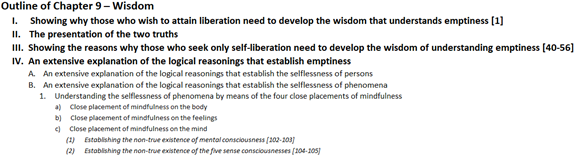
Now Shantideva looks at the emptiness of the sense consciousnesses:

(9.104) If a sense awareness exists prior to its object,
What is it aware of?
If it arises simultaneously with its object,
In dependence upon what object does it arise?

(9.105) And if a sense awareness is truly existent,
How can it arise subsequently in dependence upon an object condition?
In this way, we can understand
That all six consciousnesses lack true existence.

This is a very powerful logic. It looks at the sequential relationship between an object of our sense powers and the sense consciousness aware of the sensory experience.  Either the truly existent sense power exists before it comes into contact with its object, at the same time as its object, or after its object. There is no fourth possibility. Clearly a sense consciousness cannot arise before it encounters its object because that would imply is it possible to have an awareness of something without an object that it is aware of.  Likewise, the sense awareness does not arise after encountering the object because that would imply that the object of an eye awareness can exist without being known. How can there be an object of awareness without there being an awareness aware of that object?

Understanding why a truly existent sense consciousness cannot arise simultaneously with the object is a bit more subtle. It is true that the eye awareness and the visual form arise simultaneously. The two arise in mutual dependence upon one another. You cannot have one without the other as the above logic demonstrates. But you cannot have a truly existent sense consciousness arise simultaneously with the object of consciousness because a truly existent sense consciousness is one that exists independently of all other phenomena. If the sense consciousness arises simultaneously independence upon the object of consciousness then it clearly shows there is a dependent relationship between the consciousness and the object. The sense consciousness cannot be simultaneously independent and have a dependent relationships with other things. So while a non-truly existent sense consciousness can arise simultaneously with a non-truly existent object of consciousness, a truly existent consciousness cannot arise simultaneously with a truly existent object because both the sense consciousness and the object exist independently of one another. If they exist independently of one another they cannot enter into contact with one another or into enter into any sort of relationship with one another. 

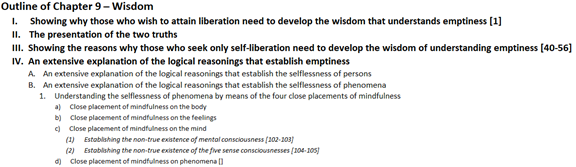
In Shantideva’s commentary there are not any verses that correspond with the close placement of mindfulness of phenomena. However, the traditional explanation of the four close placements includes the close placement of mindfulness on phenomena. Since Shantideva explains the close placements of mindfulness on the body, on the feelings, and on the mind, we can be certain he also wishes to explain the close placement of mindfulness of phenomena. He does not actually add a verse here because one is not necessary. The explanation of the emptiness of phenomena has already been explained in detail above in the presentation of the two truths.

However, Shantideva’s explanation of the close placement of mindfulness of the five sense consciousness indirectly reveals the close placement of mindfulness on phenomena. The Prasangikas do not negate that phenomena exist, they negate that truly existent phenomena exist. Truly existent phenomena are phenomena that exist independent of the mind. But as the explanation above on the close placement of mindfulness on the mental consciousness and the close placement of mindfulness on the sense consciousness reveal, it is impossible for a truly existent phenomena to come into contact with a truly existent consciousness because both consciousness and the object exists independently. Two independent things cannot have a dependent relationship with one another because if they have a dependent relationship they necessarily are not independent.

Indeed, if an independent object truly existed it could not ever be known. Because to be known would imply that it enters into a relationship with a consciousness. For it to be an independent object it must exist entirely independently of consciousness. But if it exists entirely independently of consciousness, how could it possibly be known? Since objects are known, it follows that they cannot possibly exist independently. Thus, all phenomena lack true independent existence.

Happy Tara Day: May there be the auspiciousness of her presence

This is the final installment of the 12-part series sharing my understanding of the practice Liberation from Sorrow.

Dedication

By this virtue may I quickly
Become Arya Tara,
And then lead every living being
Without exception to that ground.

The dedication of any sadhana indicates the practice’s main function.  By engaging in the practice, we create the karmic causes for the ends we dedicate towards in the dedication.  Then, when doing the dedication, we “seal” the karma we have created through doing the practice so that it continues to work without interruption until the dedication is realized.  For me, the best analogy is dedication is like putting our savings into a retirement account, where it will continue to accumulate interest until eventually we have reached our retirement goals.  Geshe Chekhawa says there are two activities:  one at the beginning and one at the end.  In the beginning, we establish our motivation for engaging in the practice; and in the end, we dedicate our merit towards the accomplishment of our desired spiritual goals.  As Mahayanists, our motivation and our dedication are the same – we wish to become a Buddha for the sake of all living beings and then we dedicate at the end towards the same end.  Thus it is important that we recall our bodhichitta motivation for having engaged in the practice, and now we solidify it by dedicating our merits towards the same goal.

Sometimes it is easy to get lazy and distracted with our dedications, but this is a big mistake.  By the end of our practice, we are tired and we are also anticipating everything that we will have to do once our practice is over.  Our mind is already positioning itself for what comes after.  Shantideva explains that anger can quickly destroy all undedicated merit, but dedication functions to protect our merit from subsequent anger.  Given how easily we get angry, it is safe to say that any merit we have not dedicated has already been destroyed by our past anger.  In other words, the only merit we have left on our mind is that which we have dedicated.  Whenever good karma ripens, we should recall that the only reason why we are able to enjoy our present good circumstance is due to our past practice of dedication.

Here, we dedicate to become Arya Tara and to lead all living beings to the same ground.  We are Kadampas, so it is only natural for us to wish to become a Lamrim Buddha just like Tara.  Her special power is to bestow Lamrim realizations and her uncommon mission is to care for all Atisha’s future disciples.  We wish to do the same. 

Through the virtues I have collected
By worshipping the Blessed Mother,
May every living being without exception
Be born in the Pure Land of Bliss.

Here, we specifically recall that she is our blessed spiritual mother, who cares for and nurtures our spiritual life to maturity.  When we recite this dedication, we should mentally generate the wish that she be our spiritual mother in all of our future lives until we attain enlightenment.  Geshe-la once said that the mind of Lamrim is Akanishta Pure Land.  In other words, if we transform our mind into Lamrim, the world which will naturally appear is Akanishta Pure Land.  When we help others develop Lamrim minds, we are in fact bringing them into our Pure Land.  We do not have to wait until others die for them to be reborn in the Pure Land of Bliss, they can do so now through generating Lamrim minds.

Auspicious verse

You, who having abandoned all bodily faults, possess the signs and indications,
Who having abandoned all verbal faults, possess a heavenly voice,
Who having abandoned all mental faults, realize all objects of knowledge;
O Lady of blessed, glorious renown, may there be the auspiciousness of your presence.

This verse reveals how we should rely upon Tara in the meditation break.  We generate faith by considering the good qualities of a Buddha, but sometimes we forget to connect that to our own life.  In this verse, we bridge the gap by praying that we always be in the living presence of Tara and experience firsthand her good qualities.  A Buddha’s body is not just their form, such as a Green Deity with an outstretched leg; rather, their body pervades the entire universe and we can correctly view all things as her emanations.  With the first line, we pray that we “see” her in every form we encounter, and that we understand what we see as the signs and indications of her presence in our life.  To strengthen this experience, during the meditation break, we should take the time to view everything that appears to us as her bodily emanations in our life.  In particular, we can view the food we eat, the home we live in, the clothes we wear, etc., all as provided by our spiritual mother caring for us.

With the second line, we pray that every sound we hear – even the rustling of the leaves in the wind – is recognized by us as her heavenly voice teaching us the Kadam Lamrim.  During the meditation break, we hear countless sounds, but whether those sounds teach us Lamrim depends upon our familiarity with the Lamrim teachings and the blessings we receive from the Buddhas.  By practicing pure view recognizing every sound as Tara’s heavenly voice, she will enter into every sound and our mind will be blessed to hear everything as Lamrim teachings.  Then, day and night, it will be as if we are in her holy temple at her lotus feet.

With the third line, we pray that every thought that arise in our mind arise from her omniscient wisdom.  Thoughts arise in our mind like bubbles from the bottom of the sea, but the majority of them are contaminated, deluded views.  If we can unite our mind with Tara’s, then every thought we have will be a manifestation of her omniscient wisdom arising in our mind.  Gen Tharchin says a blessing is like a subtle infusion of a Buddha’s mind into our own.  When we feel the presence of Arya Tara’s mind within our own, then we will receive a steady stream of her blessings.  Throughout the meditation break, we should recall Tara has mixed inseparably with our root mind at our heart, and view every thought that arises as her quick wisdom.  By maintaining this view, she will enter every thought we have and bless us to have a Lamrim perspective with respect to every appearance.  In this way, everything that arises, both externally and internally, are all viewed as Tara.  In short, our practice during the meditation break is to always remember we are in her presence in these three ways.

Dedication:  I dedicate all of the merit I have accumulated through sharing my understanding of Tara practice so that in all our future lives she remains our spiritual mother, who gives birth to us as Kadampas and nurtures us to spiritual maturity on the Kadampa path.  Through her blessings, may our every experience give rise to Lamrim minds, and may we always feel ourselves to be in her holy presence.  May every person who reads this series of posts make the firm determination to engage in the Liberation from Sorrow practice the 8th of every month for the rest of their lives, and may Tara appear to them at the time of their death and lead them to her Pure Land.