How to Respond to False Accusations or Criticism

As individuals, groups, countries, even species, we will be subject to all sorts of false accusations or criticisms. This is sometimes very painful, especially if they come from those we love or are close to, or it touches on something dear to us like our role as a worker or parent, or it is about something important to us, such as our spiritual tradition or practice. In the Dorje Shugden prayers, it says, “now is the time to dispel false accusations against the innocent.” What follows are various ways we can do that, or at least things I have found to be helpful.

False accusations can take many forms, from others accusing us of doing something we didn’t do, having ill intent, misunderstanding what we are doing or saying but believing that misunderstanding to be true, being a worse person than we actually are, of being the cause of problems that aren’t our fault, and so forth. The list is endless.

So what can we do when this happens? Here are a few suggestions of things that have helped me.

First and foremost, we need to check is the accusation indeed false? We need to be honest both with ourselves and with others here. If the accusation or criticism is correct and we lie to ourselves, we never become a better person. If the accusation is correct and we pretend or lie to the other person that it is not, that’s gaslighting and usually fools nobody. If the criticism is fair, then the correct response is to be genuinely grateful that the other person pointed it out, regardless of whether their intention in doing so was love for us or hatred of us. Most often, whatever criticisms are lobbed our way are a mix – part correct and part false. For the correct part, we should admit it, apologize, and then apply effort to change. For the incorrect part, we can try the ideas below.

Second, we need to accept patiently as purification that this is our karma to have people lodge false accusations against us and believe them to be true. When you think about it, we do this to others all the time. Every time our delusions project some exaggerated or distorted image of another person and we believe it to be true, we create the karma of mentally making false accusations. If we verbalize it, then that is one step further. When you think about it, all delusions are actually false accusations. They project a distorted image and then grasp at that distortion as if it were actually true. We have been doing this since beginningless time, so we shouldn’t be surprised when some of that karma ripens. What does it mean to accept false accusations as purification? It does not mean we assent to the false accusation as being true nor does it mean we do nothing about it. It simply accepts that, “yup, this has happened. It is my karma that it has happened. My patiently accepting it is what it is will gradually purify the karmic seed giving rise to it.” When negative karma ripens for me, I like to imagine that I take on all the negative karma of all beings (including all my future selves) to experience such things and my experiencing of it is actually me purifying not only my negative karma but all the negative karma of everyone else so nobody ever has to go through what I’m going through. So I can think, “May I take on all the negative karma of false accusations of all beings (including all my future selves), and may my patiently accepting this false accusation now purify all of it for them and for me.” It goes without saying we should not retaliate in kind because that just restarts the karmic cycle all over again.

Third, we need to let go of all attachment to what other people think about us. Of course we care what other people think about us because we cannot help others or have good relationships with them if they think bad things of us. But we don’t need to be attached to what other people think about us, even those very close to us such as our family, coworkers, or friends. To be attached to something means we think our happiness depends upon this external thing. We need this external thing to be happy and we can’t be happy without it. To be attached to what others think about us means we think we need others to think good things about us to be happy and we can’t be happy if they think bad things about us. No, our happiness depends upon our inner peace. If our mind is at peace, we can be happy, even if other people think terrible and false things about us. We need to be mentally at peace with the fact that people believe false things about us. This doesn’t mean we are happy that they think false things about us, but that their thinking false things about us does not disturb our inner peace. When it hurts that people think false things about us we are being clearly shown where there is still such attachment in our mind, and this episode gives us an opportunity to root it out. Great! When we don’t have attachment to what other people think about us for some things, it is easier to let go of this attachment for all things. So much inner pain comes from being concerned with what others think about us. Rooting out this attachment from our mind is one of the most liberating things we can do in life and will likely make one of the biggest differences to our overall well-being.

Fourth, once our mind has accepted the situation as it is (others believe false things about us) and we have removed (or at least sufficiently reduced) any attachment from our mind thinking our happiness depends upon what they think about us, we can then try clarify our perspective on the situation (if the other person is open to hearing our perspective, that is). When we clarify, we shouldn’t say, “you’re wrong.” Because we are appearing vividly to the mind of the other person to be that way and to tell them they are wrong will likely either be taken as gaslighting, obliviousness to our obvious faults, or cause them to just grasp even more tightly to their false view of us. Instead, we should say things like, “I can see how you could view it that way, “ or “I understand your perspective,” and “if indeed I were that way, I could see why you would be upset since obviously that would be bad.” This acknowledges that the other person sees what they see, but simultaneously acknowledges that there are other ways of viewing things. If they are open to hearing your perspective on the situation, you can then offer it – not saying it is right and the other person is wrong, just this is how you see it and understand it. There is more than one way of viewing this. They may or may not accept your perspective, they may or may not be able to accept that there is any perspective other than theirs, but that is not something we can control. If despite our clarification, they continue to falsely view us negatively, then we need to accept that they have their opinion and we have ours and that is perfectly OK. They may be mad at us that we don’t share their perspective, but that is their issue, not ours (though it is still our karma to have people be mad at us and something we also need to accept as purification). We are not responsible for managing how other people view us or react to the things that appear in their life. That is their responsibility.

Fifth, we can view the false criticism as an indication of what we need to work on next as we proceed with our bodhisattva training. A bodhisattva seeks to abandon all faults and attain all good qualities. If somebody is making a false accusation against us and believing it to be true, we could just blithely say, “not my problem, that is their karma to see me this way.” Yes, it is true, how they see us is not our problem (meaning their distorted view of us is something happening in their mind and thus not something we can control) and it is their karma to see us that way, but to stop there would be to miss out on a great opportunity for improvement. Yes, realizing it is not our problem helps us let go of our attachment thinking how they view us matters for our inner peace and it prevents us from developing self-hatred by internalizing their distorted, negative view of us, so in this sense it is very good. But we can do even better. We can view their false accusation of us as a sign from Dorje Shugden that we need to do the work within ourselves to remove any last possible valid basis for others to view us falsely in this way. For example, if somebody views us as a bad parent, then view this as a sign we should work on becoming a better parent. Just because we can become a better parent doesn’t mean we are presently a bad parent, just we still have room for improvement. So improve! Do a better job. If others doubt us, thinking we are worse than we are, then we can view this as an opportunity to work on proving them wrong by getting better and improving in the ways that they see wrongly. Doing so can’t hurt us. If over time we consistently show the example of somebody who does NOT have the faults the other person is falsely accusing us of having, and instead we show the example of somebody who is the opposite of these things, there is a chance the other person can gradually change their view of us because there will be no valid basis for their wrong view of us. It may take time, but if we prove ourselves to not be what they think we are, they may gradually come to see us differently. Or maybe they won’t. Maybe they are not capable of letting go of their view of us. Maybe for some reason unknown to us they need to view us in this negative way. This is not something we can control. But even if it doesn’t work, we will at least have improved thanks to their false accusation of us, so we will be better off. In short, when somebody makes a false accusation against you, “prove them wrong.” Not because you are attached to what they think or because you want to be right, but because by proving them wrong you become a better person, which is the essence of our bodhisattva training. You can even dedicate your efforts so that in the future you will be able to help the person making false accusations against you.

There is much more I could say about the karmic effects of tantric pure view, emptiness, etc., but I think the above are some practical things we can do to at least maintain our inner peace despite other people thinking bad things of us or making false accusations against us (or things we hold dear, such as our tradition or practice). That’s a good enough start. On the foundation of being at peace with these things, we can then engage in more advanced practices. But without this basic foundation, these other things can become some sort of spiritual cos play that is really an act of repression, not the dismantling of delusions and faults within our mind.

I hope this helps. If not, I at least found it helpful to clarify my own thoughts about the subject. It has helped me move closer to being at peace with the false accusations in my life.

Modern Bodhisattva’s Way of Life: Realize the Real Meaning of Meeting Geshe-la

Shantideva makes this final prayer, so beautiful the way he ends this chapter on wisdom.

(9.166) May I be able to extinguish the fires of suffering
That torment all these beings,
With a vast rain of happiness
Descending from the clouds of my merit;

(9.167) And, through sincerely accumulating a collection of merit,
While endowed with the wisdom realizing non-true existence,
May I teach emptiness to all living beings
Who suffer because of their self-grasping.

I feel this is one of our greatest responsibilities now, to teach emptiness, to teach emptiness to others.  Geshe-la has said many times at the real meaning a meeting Geshe Kelsang is the opportunity to learn about emptiness.  First of all, we must gain and deepen our understanding.  I think it is our responsibility to gain a clear and precise understanding of emptiness through our study.  If we really do have compassion for others then we will take that responsibility to study emptiness, to gain a clear precise understanding and teach emptiness, understanding there is no other way to bring an end to suffering than gaining a deep, deep experience of emptiness.

If we gain this experience, we will be able to teach emptiness like no other actually.  We will be able to teach emptiness in a very simple way.  The person who has the greatest understanding can teach in the simplest way.  So we’ll be able to teach in a simple way, we’ll be able to teach in a very, very practical way, and importantly a clear unmistaken way.  We will do so in dependence upon this foundation that we are building upon our study of emptiness.  We are taking that responsibility.

At some point in the future, I hope to do a similar series of blog posts on chapter 6 of chandrakirti’s guide to the middle way, which is our definitive explanation of emptiness. We can generate the wish to study Ocean of Nectar and be able to study such reasoning in a lot more detail, line by line, either on our own or as part of a study program.  I would say between now and when we do finally study such texts, there’s a lot of preparation to do to gain this practical experience.  On the basis of that, the reasonings will make sense.  I think all of us need to prepare ourselves well.  As a preparation, we can study books like Heart of Wisdom.  We can study the chapter on emptiness which appears in Transform your Life, Eight Steps to Happiness, and Mahamudra Tantra.  This is most important, actually, for where we are. 

We need to learn to love our study, make it a game.  We need to be like a child at play, constantly contemplating Dharma, and sharing with our Dharma friends our latest discoveries.  For us, it should be fun.  We dig deep into the Dharma trying to understand what it means, we play with it and contemplate it, and jewels will emerge.  Then we should put our understanding into practice and gain some experience of this insight.   Then, it will lead to deeper insights and new understandings, and more amazing contemplations and study.

I would say we need to meditate on emptiness as much as possible.  Yes, this means we must spend time on our meditation cushion, trying to mix our mind with emptiness, gaining a clear understanding through our study, trying to identify more and more clearly the object emptiness, mixing our mind with emptiness.  But off the meditation cushion, too, we must try throughout the day to meditate on emptiness.  When we are working with others, keep meditating on emptiness.   

We should try to keep the advice of being on retreat at all times.  We can remember the illusion-like nature of things throughout the day.  If we are mindful, if we’re concentrating, then definitely we will accomplish great results, just as we would do if we were in actual retreat.  In this way, definitely we create the cause to go into retreat, strict retreat, at some time in the future, when hopefully our mind will completely mix with emptiness, and we will destroy all traces of our grasping.

I think what is most important is that we appreciate the opportunity that we have been given as members of a Dharma center and a Dharma community.  This is the best opportunity.   We should not think other people have a better opportunity than we do to gain experience in exchanging self with others, to gain experience in the wisdom realizing emptiness.  No one has a better opportunity than we do.  Remember, we are the people who have the responsibility of teaching emptiness to all living beings.  We have been given the greatest opportunity.

Venerable Geshe-la is giving us the opportunity to bring about both external and internal growth of the Dharma in this world.   We must be bringing about an internal as well as an external growth – both – with the one helping the other.  We must feel that we have the best opportunity to gain experience, deep experience, of exchanging self with others.  The best opportunity to gain experience, deep experience of emptiness, the best.  There is no reason why, in dependence upon the opportunity that we have been given, that we cannot come to possess ultimate Bodhichitta, even in our lifetime.  It is possible, definitely it is possible.

If we appreciate our opportunity, then we will enjoy having this opportunity, we will enjoy the responsibility that we have.  We would not have it any other way.  I think more and more over time we must feel that we do have the greatest opportunity and the responsibility that we have, we are so lucky, really, so lucky to have.  So we can enjoy, we can enjoy.  We must over time be enjoying ourselves more and more and more.  As far as spiritual growth is concerned, I have to say that we have the best conditions of all.  We can become teachers of emptiness.  We can become valid teachers just like Geshe-la.

Finally, we need to be patient with ourselves.   We should not expect anything, just have a patient mind, we need to be patient, especially with understanding texts like this, Ocean of Nectar, and so forth.  We are not going to gain a clear, precise understanding after a few weeks or months. It is going to take years, maybe even lifetimes.  So if we understand that, then we consider it our lifetime’s work to understand clearly precisely the meaning of Guide to the Bodhisattva’s Way of Life, Ocean of Nectar, and so forth.  We can be patient, we can enjoy creating the cause.  Everything will come naturally from that in time.

This concludes the ninth chapter of Guide to the Bodhisattva’s Way of Life, entitled The Perfection of Wisdom”.

A Pure Life: Abandoning Sexual Activity

This is part seven of a 12-part series on how to skillfully train in the Eight Mahayana Precepts.  The 15th of every month is Precepts Day, when Kadampa practitioners around the world typically take and observe the Precepts.

The actual Mahayana precept we take on precepts days is to abandon all sexual activity. Ordained people take a vow to not engage in sexual activity with other people, in other words they have a vow of celibacy. I am not ordained and so therefore I am certainly not qualified to definitively interpret the vows of ordained people, but I have been told an ordained person’s vows do not prohibit masturbation, though doing so is considered to weaken the vows but not actually break them. In contrast, when we take the Mahayana precept to not engage in sexual activity, it does include not masturbating.

Many people misunderstand vows of celibacy and abandoning sexual activity as saying that there is something inherently wrong with sexual activity. They argue that sexual activity is entirely normal and healthy, and such vows are misguided and guilt-inducing, and therefore harmful. In truth, there is nothing wrong with sexual activity itself. But there is something wrong with the mind of sexual attachment. Attachment is a delusion that believes happiness comes from external objects. Sexual attachment is a specific form of attachment related to sexual activities. Engaging in sexual activities without attachment is not a problem, but engaging in sexual activities with sexual attachment is a problem.

The reason why we take a vow to abstain from sexual activity on precepts days is to force us to confront the tendencies of sexual attachment within our mind. Because we have taken a vow to not engage in such activity on this day, when the temptation arises to do so within our mind, we will see the power of our sexual attachment. It will actually be painful or difficult to not follow the impulses we are feeling. All sorts of rationalizations will arise as to why it is a good thing to follow our sexual attachment. When this occurs, we can then recall the disadvantages of the mind of attachment in general, and sexual attachment in particular, and we can contemplate the benefits of having a mind that is completely free from such attachment to strengthen the desire within our mind to become free of this extremely powerful delusion. The point of taking this precept is not to say sexual activity itself is bad, but rather to create the karmic habits of not being a puppet on the strings of our sexual attachment and to instead become free from it.

Driven by sexual attachment living beings engage in all sorts of negative actions, including killing, stealing, sexual misconduct, lying, divisive speech, and so forth. We also waste so much of our precious human life and our hard-earned resources in pursuit of satisfying our sexual attachment. Most of our most shameful behavior can be traced back to our sexual attachment. Much of the conflict we have with those we love comes from sexual attachment. This mind creates so much suffering in the world and within our own mind, yet we still continue to follow it believing happiness can be found in doing so.  Imagine how much easier our life would be if we were not a slave to our sexual attachment. These are the sorts of things we need to consider when the temptation to break our precept arises within our mind. Engaging in these contemplations gradually weakens the hold our sexual attachment has over us enabling us to become more free.

While on precepts days we vow to abstain from any sexual activity, every other day we should strive to abandon all forms of sexual misconduct.  The object of our sexual misconduct is if we have a vow of celibacy, it is any other person; if we are not celibate and we have a partner, it is anyone other than our partner; if we are not celibate and do not have a partner, it is anyone else’s partner, our own parent, a child, anyone with a vow of celibacy, pregnant women, animals, or anyone who does not consent.  As far as the intention is concerned, we must know that they are an object of sexual misconduct.  We must be determined to commit sexual misconduct.  And we must be motivated by delusion.  Usually, it is committed out of desirous attachment.  As far as the preparation is concerned, there are many ways to engage in this action but we already know all of those!  This action is complete when sexual bliss is experienced by means of the union of the two sex organs.  This last point on the action being completed sometimes gives rise to the question, “well then is it sexual misconduct if our sex organs do not come into union?”  The answer to this question is very simple:  if you think your partner would object, then it is not OK.  Full stop.

Please note, within Kadampa Buddhism, heterosexuality and homosexuality are treated in exactly the same way, there is no difference.  Please note, it also does not include masturbation.  Finally please note, this also doesn’t say it is wrong to engage in sexual activity for reasons other than procreation, it says nothing about anything wrong with birth control, etc., etc., etc. 

I have posted in the past why people engage in affairs (you can find it by doing a search of the archive).  The short version is we relate to our partner and to sexual activity in the same way we relate to any other object of attachment, like pizza.  The first few pieces are good, but the more we eat the less we enjoy it.  Other foods start to look more appealing, so we switch to eating something else.  This is the completely wrong understanding of sexual actions.  Sexual actions are opportunities to cherish others and give them happiness, not something we consume for ourselves.  We derive our enjoyment from loving others and making them happy.  Sexual activity is an opportunity to draw very close to somebody else and deepen a relationship.  If we do not get our attitude towards sexual activity correct, then even if it is not sexual misconduct, it is still not necessarily a good thing for us. 

It is not at all uncommon for one partner in a couple to have stronger sexual desire than the other, and this can be a source of frustration and a temptation to go elsewhere.  Aside from the fact that there are other means to relieve oneself, we should view these gaps in sexual desire as emanated by Dorje Shugden to give us an opportunity to bring our sexual attachment a bit more under control.  In this sense, it is a similitude of the ordination vows of celibacy.  We are essentially saying we will be celibate with everybody except our partner.  Bringing our sexual attachment under control is not easy, but it is still necessary.  Buddha said the three biggest chains holding us in samsara are sex, drugs and rock n’ roll (well, those weren’t his exact words, but the meaning was the same).  If we do not bring our sexual attachment under control, it will be very difficult to escape from samsara.  So from this perspective, the difference between an ordained person and a lay person in a committed relationship is not that different.  We have much we can learn from each other.

If we have strong sexual attachment, we can pursue a multi-prong strategy.  First, we should read Chapter 8 in Meaningful to Behold again and again to help us reduce our exaggerated notions of the attractiveness of another human body.  I love breasts, I will admit it, but if we check they are just bags of fat.  Second, as best we can, we should avoid things that fuel the fire, such as pornography, etc.  But the reality is sexual imagery is omni-present in our society, so there is no avoiding it.  But there is a difference between encountering it as we go about our life and seeking it out compulsively. 

Third, and this is the most important, we need to get to the point where we want to get out of samsara more than we want its pleasures.  We are desire realm beings, which means we have no choice but to pursue our desires.  If in our heart, our desire is still dominated by sexual attachment, if we try to force ourselves to avoid making contact, etc., then all we will do is just repress the desires.  They will build up, and eventually we will give in and do something we subsequently regret.  This is not Dharma practice.  Dharma practice is a very active process of picking apart and reducing our desirous attachment primarily by (1) reducing our exaggerated attitudes down to something in line with the underlying reality of what is actually there, and (2) considering the disadvantages of following the delusion. 

There are few delusions that create more problems for living beings than sexual attachment.  Just open any newspaper or consider your own life for more than 3 seconds and you will have plenty of material to work with.  At the same time, we need to consider the advantages of not following the delusion.  Every time a delusion arises but we choose to not follow it understanding it to be deceptive, we are engaging in the practice of moral discipline.  Each action of moral discipline creates the cause for a higher rebirth.  So quite literally, if in a given 5-minute period we successfully see through the lies of our sexual attachment and not follow it, say 20 times, then we just created 20 causes for 20 future higher rebirths.  What will bring more happiness, five minutes of some porn video or an entire lifetime in the upper realms?  Are we ready to sacrifice one for the other?  If so, which one will we sacrifice?  If we value the happiness of our future lives as much as we value our present happiness (the definition of a spiritual being) then the choice becomes obvious. 

There is much more that can be said, but I will stop here. 

Modern Bodhisattva’s Way of Life: Bring an End to the World of Suffering

(9.163) Oh, surely we must feel compassion for all these poor beings
Who are swept along in these vast rivers of suffering,
For, although they suffer in the extreme,
They do not recognize their suffering state.

(9.164) For example, some ascetics repeatedly wash in freezing water
And burn themselves with fire again and again;
And, although they experience great suffering,
They proudly maintain that they are happy!

(9.165) In the same way, those who live their lives
As if they were not going to be struck by sufferings such as ageing and death,
Will experience horrendous suffering at the hands of the Lord of Death
And then be cast into the unbearable torments of the lower realms.

People need our help, don’t they?  They really do need our help to show them where they are going wrong.  Crazy things people do for their freedom and happiness. They create the cause for more and more suffering and unhappiness.  So we have to show them where they’re going wrong.  They are powerless, helpless.

To do this, we have to first of all see where we are going wrong.  Otherwise, we will their wrong things are correct.  We suffer but maintain that we are happy.  Perhaps we feel ourselves that our life is bearable.  If we did not, I’m sure we would try end it by meditating on emptiness all the time.  We would say we hate this life of suffering.  So perhaps for us our life is a generally happy one, it is a bearable one.  But this will not last.

The fact is that our life at some time will become utterly unbearable.  In this lifetime, things will become unbearable.  We have giant tsunamis of sickness, ageing, and death bearing down on us.  If we do not do anything to get out, in our next life or in lives to come we will experience such immense suffering that we will be overwhelmed by it.  It is enough to just look at how it is for most other people.  They are a preview of what is to come for us if we remain in samsara.  We should not look at just this world, but think of other worlds as well, like the hells.  Even in this world, suffering for the vast majority is unbearable, isn’t it?  Most people in this world I would say are overwhelmed by suffering, mentally and physically.

But unfortunately for all of these beings they do not know how to end their suffering.  They just do not know.  They have no method.  Everything they do seems to just make the problems worse.  In this world alone, fears, dangers, and suffering are all increasing.  People are really helpless.

How can we bring an end to this world of suffering?  How can we bring an end to all worlds of suffering?  By meditating on emptiness.  There is no other way.  We need to deepen our conviction, don’t we?  We can bring an end to the world of suffering only by meditating on emptiness.  If we are not convinced ourselves, how on earth are we going to convince others, so they meditate on emptiness to bring an end to their world of suffering?   We must both deepen our conviction, and follow, follow our convictions.

Our belief must grow into a passionate belief, so we live by it.  Importantly, we need to be seen to live by it, not in a fake way, in an authentic way, because only that will inspire others to do the same.  We are passionate about our belief or beliefs, and of course naturally we live by our beliefs and others see that we do so.  Wanting to realize emptiness needs to be our most passionate wish, becoming the wish that other people too develop that same belief, and live by that belief.  Our most passionate wish is that others strive to realize emptiness. 

Abandoning Attachment to the Pure Kadam Dharma Flourishing:

The strong wish for the holy Dharma to flourish can be a virtuous wish or it can be an attachment. Most often it is a mix in our mind.

Attachment thinks some external thing or condition is a necessary requisite for our happiness – having this external thing is a cause of happiness, and I can’t be happy without this external thing.

For example, imagine I am attached to the people close to me not suffering. This means I mistakenly think my happiness depends on them being OK. If they are not OK, I can’t be OK. I need them to be OK before I can be OK. When they suffer, I suffer; when they go down, I go down with them. This is an attachment to them being OK. I think my happiness depends upon something external, not on my own inner peace. The wish that others were free from all suffering could be a mind of pure compassion (for the sake of others, free from all attachment) or it could be an attachment (for the sake of myself, motivated by a delusion of attachment). Most often it is mixed. I want others to be free from suffering for pure compassionate reasons and for attachment reasons. My training in compassion includes gradually purifying my compassion of all attachment so that it is completely pure, free from all self-concern or attachment.

In exactly the same way, strongly wishing for the pure Kadam Dharma to flourish can be a pure wish or it can be an attachment. For example, if I’m attached to the people in my life being free from delusions – thinking my happiness depends upon them not being deluded – then I could strongly wish that they appreciate or practice the Kadam Dharma so that their delusions could decrease since I find their delusions so annoying and disturbing to my mind. I need them to practice Dharma for me to be OK. That’s attachment in my mind to the Kadam Dharma flourishing.

Resident Teachers and Center Administrators develop attachment to the Dharma flourishing all the time, or at least that’s how it appears. They have dedicated their lives to the flourishing of the Kadam Dharma, often facing significant judgment and concern from their family members who fear they have gone off and joined some cult. They might become attached to their family appreciating the Dharma so that this painful judgment stops. Or they might show up to a Summer Festival and only 2 of their students came, or maybe none at all. They might feel they have failed as an RT. They might work for many years to cause the Dharma to flourish in their area of the world, but try as they might, nobody seems interested.

Any endeavor usually involves some sort of “key performance indicators” where our success is measured against some metric. For RTs and center administrators, it can easily become “how many students do you have, is your center able to financially support itself, are you opening up new branches, how many people from your center go to festivals, etc.” It is very easy to become attached to all these things. All of these wishes could also be completely pure wishes, or they could be motivated by attachment – thinking our happiness depends upon these external things and if we don’t have these external things we can’t be happy. Most often our wish is mixed – part pure, part attachment. So just as we purify our compassion of attachment, so too we need to gradually purify our wish for the pure Kadam Dharma to flourish of attachment as well.

Just because our wishes right now are mixed does not mean they are wrong. We need these wishes, but we also need to make them more and more qualified and we do so through gradually purifying them of any trace of attachment, self-concern, and ignorance.

In many ways, it appears (to me at least) that attachment to the pure Kadam Dharma flourishing is one of the biggest, most pervasive, most corrosive attachments within our tradition (within any spiritual tradition, really), even if it is subtle and operating hidden like a tiger underneath the surface. It seems so justified, surely attachment to this wish is a good thing. No, attachment is attachment, and all attachments are delusions. The wish isn’t necessarily an attachment, but it can be. It can also be a pure wish.

Pointing this out is not a criticism of our tradition, it is an act of love. It is because we love our tradition and want it to flourish that we feel compelled to dig deeper and see what is going on in our mind. This is not finding fault in our tradition, it is finding fault in delusion. VGL’s surely does not have attachment to the Dharma flourishing, his motivation is completely pure. He has done the work to abandon all attachment to it flourishing and so must we. Perhaps I’m the only one with this attachment in my mind, I don’t know. But I do know it is present in my mind and so it is my responsibility to root it out. What others do by looking in this particlar mirror is up to them. I also need to eliminate all attachment to the people of my tradition eliminating this attachment from their mind (if it even exists in their mind, which I don’t know).

To me, it seems our job is to make our wish for the pure Kadam Dharma to flourish a completely pure wish. The more we do, the more we align ourselves with VGL’s pure intention and the more all our pure deeds (and this tradition) will flourish. The more we do, the more we fulfill our heart commitment to Dorje Shugden and the more effective he can be in our life helping us fulfill all our pure wishes.

Indeed, it is because we want the pure Kadam Dharma to flourish that we need to purify our mind of all attachment to it flourishing. Like all attachments, attachment to the pure Kadam Dharma flourishing actually creates obstacles to it flourishing in this world. People will feel manipulated, we will act all cult-like, we will become defensive when attacked, and we will create the karma to be separated from what we are attached to.

Clearly it is better to be attached to the pure Kadam Dharma flourishing than to making a bunch of money or having a great professional reputation, but it is better to have a pure wish for the pure Kadam Dharma to flourish than to have this wish mixed with attachment.

Hardly anybody ever talks about this attachment, or at least not publicly. But we do need to look into the mirror of Dharma and see if we have it in our mind, see how it disturbs our inner peace, gradually reduce it with the opponents, and finally eliminate it with the wisdom realizing emptiness. We owe it to ourselves to do this work since it is a delusion in our mind creating unhelpful karma for ourselves. We also frankly owe it to VGL to do this work. We owe it to all our lineage gurus who have done so much to pass this lineage on to us to do this work. We owe it to all living beings who we have been charged with carrying the lineage forward for to do this work.

But the choice is ours, of course. It’s not like it is bad to have this attachment (well, actually it is bad to have this attachment since all delusions are objects of abandonment). Being attached to the Dharma flourishing is good. But purifying our motivation of all attachment is even better.

Again, perhaps I’m the only one.

Happy Tsog Day: Transforming Adverse Conditions into the Path (part 2)

In order to remember and mark our tsog days, holy days on the Kadampa calendar, I am sharing my understanding of the practice of Offering to the Spiritual Guide with tsog.  This is part 33 of a 44-part series.

In short, whether favourable or unfavourable conditions arise,
I seek your blessings to transform them into the path of improving the two bodhichittas
Through practising the five forces, the essence of all Dharmas,
And thereby maintain a happy mind alone.

The two bodhicittas refer to conventional bodhichitta and ultimate bodhicitta. Conventional bodhicitta is the wish to become a Buddha for the sake of others. Ultimate bodhicitta is meditating on ultimate truth emptiness with a motivation of conventional bodhicitta. With respect to conventional bodhichitta, when favorable conditions arise, we can view them as the result of our past virtuous actions which remind us that we need to continue to engage in virtue. Further, we can use the favorable conditions to make rapid progress in our spiritual path because things are easy at that time. When unfavorable conditions arise, we can view it as motivation to become a Buddha so that we can be free from all such unfavorable conditions and help others attain the same state. With respect to ultimate bodhicitta, when both favorable and unfavorable conditions arise, we can view them both as equally mere karmic appearances to mind. Both types of appearance are equally empty. Their mere appearance reminds us of their emptiness.

The five forces make all our practices more effective. The five forces are the force of motivation, the force of familiarity, the force of white seed, the force of destruction, and the force of aspirational prayer. The force of motivation is the motivation with which we engage in a virtuous action. The karmic effect of our actions depends upon the scope of our motivation. If our motivation is that of a worldly being, the karma will at best ripen in worldly ways either in this life or in a future life. If our motivation is that of a spiritual being, then the merit will ripen in our future lives. If our motivation is renunciation, the wish to escape from samsara, then the karmic effect of the action will be to enable us to take rebirth outside of samsara. And if our motivation is bodhichitta, the karmic effect of the action will ripen in the form of us attaining full enlightenment. This is true regardless of what kind of virtuous action we engage in. For example, just giving flowers to someone else can be performed with any one of these motivations, but have radically different karmic effects.

The force of familiarity is simply becoming more and more familiar with our virtuous actions. Gen-la Losang said what is natural is simply what is familiar. The reason why non-virtuous actions come so naturally is because we have deep familiarity with them, and the reason why virtuous actions are so difficult is because we have very little familiarity. But through the force of effort, we can change what is familiar and therefore what comes naturally. We remain in samsara simply due to bad habits. We can change these habits with effort, and therefore escape.

The force of white seed is accumulating merit. All good things come from merit, or good karma. Good karma depends upon engaging in virtuous actions. If our wishes are not being fulfilled, the reason is we lack merit. Instead of complaining or wondering why things never work out for us, we can use this as a reminder to accumulate merit. The supreme method for accumulating merit is to make mandala offerings. This was explained extensively in earlier posts during this series. There are many different types of merit, and each virtuous action produces its own specific type of merit that will ripen in a specific way. Therefore, as we learn to understand karma more deeply, and we understand the virtuous reasons why we want different outcomes, we can then engage in the specific types of actions to create the karma that we desire. The attributes of higher status explained earlier explain how this works, for example from giving comes wealth, from patience comes beauty and so forth.

The force of destruction refers to purifying our negative karma. The reason why things are difficult is because we have negative karma that remains unpurified. In particular, the most pernicious form of negative karma is that associated with holding onto wrong views denying Dharma. Due to this negative karma, we find it difficult to gain Dharma realizations and make progress along the path and as a result we remain trapped and even run the risk of giving up. Therefore, it is vital that we purify our negative karma. This was also explained extensively before.

The force of aspirational prayer refers to making specific prayers and requests to the Buddhas that they bless our mind in specific ways to gain the realizations of the stages of the path. If we check, the vast majority of our prayers are simply requests to the Buddhas to bestow upon us the different realizations. The mental action of making a request prayer with faith creates the karma to be able to receive blessings, which then activate the virtuous karma that exists on her mind and ripens in the form of realizations. Requesting blessings is the principal method for receiving them. While the Buddhas are constantly bestowing blessings on all living beings just as the sun shines equally on all phenomena, whether we receive these blessings depends upon whether or not there are clouds in the sky of our mind. Making aspirational prayers clears the clouds and allows the blessings to flow directly into our mind.

To rely upon a happy mind alone, does not mean to simply force ourselves “to be happy,” rather it means we only take as reliable and trustworthy the conclusions are mind reaches when it is happy and peaceful. For example, when our mind is very agitated, we are likely to send an email we will later regret. If instead, we wait until our mind is calm and then draft our email, we will avoid a great deal of problems. In the same way, every time our mind is under the influence of delusions our mind is necessarily unpeaceful, and the conclusions we reach when our mind is unpeaceful will always make our situation worse. Therefore, we should wait until our mind is calm and peaceful, and then make decisions about how to proceed.

I seek your blessings to make this freedom and endowment extremely meaningful
By immediately applying meditation to whatever I meet
Through the skilful means of the four preparations,
And by practising the commitments and precepts of training the mind.

We established before that we have a precious human life with all the freedoms and endowments. This gives us the ideal opportunity to train in Dharma and accomplish the real meaning of our human lives. We do this quite simply by responding to whatever arises with a Dharma mind. Before we found the Dharma, we encountered countless different objects and responded to them in countless different ways. After we found the Dharma, we still encounter countless different objects, but we can respond with a limited number of Dharma minds such as renunciation, compassion, patience, and bodhicitta. This greatly simplifies our life and enables us to transform every moment into the path. Many of us engage in the cycle of the 21 Lamrim meditations. If we do, we can then respond to everything that happens to us during the day with the conclusion of the Lamrim meditation we did in the morning. In this way, we are putting into practice the Lamrim meditation of the day all day long. Even if we do not engage in the 21 Lamrim meditations formally, we can still do the 21 Lamrim meditations as our meditation break practice. For example, no matter what happens, review it as a reminder of death, or as a lesson in karma, and so forth.

The commitments and precepts of training the mind are explained in the book Universal Compassion and are listed in the booklet on the vows and commitments of Kadampa Buddhism. They are methods for ripening our bodhichitta and for transforming adverse conditions into the path. For more information, please see the extensive series of posts I earlier did about how to practice all our vows and commitments and integrate them into our modern life.

Ten Steps for How to Help Others When they Come to Us with Their Problems:

When somebody comes to us with a problem, I have found the ten steps below to be helpful. They are born from my basically having made every mistake in the book and the sometimes painful lessons I have learned trying, but failing to help those I love. I share them with the hope that you might learn from my mistakes and help those you love.

First, just listen fully with a compassionate heart free from any personal attachment to them not suffering, nodding often, seeking to understand how they are perceiving, feeling, and experiencing what they are going through. Give them the time and space to say whatever it is they need or want to say, no matter how long it may take. Sometimes this is all people need from you – just somebody they can express themselves to or a shoulder to cry on. Often just giving people the space to verbalize what is happening inside of them is enough for them to realize the answers to their own questions or to at least get it all off of their chest. That is perfectly OK and often enough. While you are listening to them, generate Venerable Geshe-la (or Guru Sumati Buddha Heruka) at your heart, imagining the person we are speaking with is actually in his presence and they are expressing themselves to him. You can also generate Avalokiteshvara or Tara in them, reciting their mantras as appropriate requesting that their minds be blessed.

Second, repeat back what you understood them to say from their perspective (not your interpretation of their experience). Explicitly recognize what happened to them and how that made/makes them feel and what they thought about it. It’s often helpful to ask to confirm that you understood them correctly to make sure you are understanding them and everything as they are experiencing it. This step is important because unless they know we understand their problem as they are experiencing it, they won’t accept, appreciate, or understand any advice we might later give.

Third, empathize with them about how hard that is, how sorry you are that they are going through all of that, and reassure them that it is entirely normal that they are having the reaction that they are having to it. If somebody has wronged them in some way, it is very important to call that out explicitly as wrong, hurtful, and harmful. We must be able to call a spade a spade, call out wrong as wrong, and acknowledge what happened to them was hurtful. This step is important because people need to feel validated in their reactions and experiences of things before they are open to viewing things differently. If we don’t do this, then there is a real risk that any advice we later might give gets misperceived as us gaslighting them, telling them that the are wrong to experience what happened to them as harmful and that they are the one at fault for their suffering or the other person’s wrong behavior. Indeed, they may think we are saying the other person’s wrong behavior is somehow correct and our friend is the one in the wrong to take things as they did.

Fourth, we can either explicitly ask or do our best to intuit (requesting blessings helps) if the person wants any advice or suggestions or whether they just want to be heard and perhaps receive a loving hug. Here again, it is super important that we abandon any last trace of attachment in our mind to them being OK. If we need them to be OK for ourselves to be OK, then we will feel compelled to try change them and give them advice (and attached to them accepting our advice) so they can get better so that we can be better. This corrupts the whole process and just creates obstacles to them accepting any advice we might offer. It’s not our job to control or manage other people’s emotional reaction to things. Our job is to accept them as they are exactly where they are at, without any personal need whatsoever for them to change or get better.

If they are not open to receiving advice, then don’t give any. Let me repeat that: if they are not open to receiving advice, then hold yourself back – don’t give any. Just be loving and compassionate acceptance. Our job is to be for them what they need, not impose upon them what we think they need. If we give unsolicited advice, all we often do is create the causes for them to reject the advice they very well may need, which doesn’t help anybody.

Fifth, if they are open to receiving advice, don’t offer any yet. Ask questions first. How does this make you feel? What do you think is driving that? What are your thoughts about how to deal with it? What does this make you want to do? If you did that, how do you think it would play out? Have you dealt with situations like this in the past? What worked and what didn’t work in those situations? Just ask questions with genuine curiosity and no implied judgment of what you think are the right answers. Ask the questions that help them find their own answers. Do not ask them the questions that guide them towards your answers or solutions because they will sense that and again it can be mispreceived as a form of judgment, gaslighting, manipulation, or the offering of unsolicited advice. Much better to help people uncover their own solutions than be given solutions by you. Request Venerable Geshe-la at your heart to help guide you to ask the right questions.

Sixth, ask again (or intuit with blessings) if they want your perspective on the whole thing. Sometimes they will, sometimes they won’t. Again, let go of all attachment to them being OK or wanting to be their savior or giving advice or them receiving advice.

Seventh, if they do want your perspective, begin with once again repeating what you understood, call a spade a spade recognizing what the other person did was wrong, empathizing with what they are going through, acknowledging it is both hard and normal how they are reacting, and then flag what you agree with in terms of their own responses or solutions they identified in step five. Reinforce all that you have previously done and validate where you agree with their proposed solutions.

Eighth, if they are open to more, begin explaining your perspective by making a distinction between the outer and the inner problem as you see it. The outer problem is what happened and what external situation they need to deal with and the inner problem is how it may have triggered delusions in their mind that are disturbing them or they are unable to see how this bad thing that happened to them is actually good for their inner personal growth. Begin by offering very normal, very practical advice for how to deal with the outer problem. When the car breaks, take it to the mechanic. Sometimes Kadampas are reluctant to offer normal practical external advice, as if doing so is somehow not our place or takes away from the Dharma solutions we also have to offer. This is total nonsense. We should help people in all ways we can, both normal external good advice and internal advice. Most people strongly grasp at the external situation as THEIR problem, and so if you don’t show them how they can also address the external situation, they won’t feel like you understand or heard what their problem is. They also have a broken down car and need to get it fixed, so explain to them what they need to do so fix it. We should feel free to share our own experiences of when we faced similar situations and what we did externally to try address it, all while making clear that the external solution may or may not work. As Kadampas, we also need to know how to function in this world and get stuff done. Worldly wisdom is still wisdom. Once people feel like they have a solution – or at least a course of action – for their external problem, then they are more willing to be open to what we might have to say for addressing their internal problem.

Ninth, now you can turn to thoughts and suggestions on addressing their internal problem. The first thing you need to ask yourself is are they open to receiving internal advice using Dharma terminology or not. Most often, frankly, they are not; but sometimes they are. If they are not open to or familiar with Dharma terminology, don’t use it. You need to be like the ancient Tibetan translators who first had to learn the Dharma in Sanskrit and then translate it into Tibetan. We learned how to speak Kadampa through our own training, but we need to learn how to translate it into normal speech that the person we are speaking with can accept and understand. Sometimes it will be through personal stories, sometimes sports analogies, and sometimes it will be through passing on wisdom you got from your grandma. Your job is to explain things to them in a way they can understand, not how you understand it. Begin by helping them accept the situation for what it is, differentiating what we can control and what we cannot control. For the things we can control, help them see what they can do – how they can change their mind towards the situation or view it differently. More often than not, people can understand that while they may not be able to change the external situation, they can change their opinion about it. This is the beginning of the wisdom realizing emptiness. Usually, any difficult situation reveals many truths of Dharma. For the things they cannot control, help them see how this difficult situation gives them to a chance to develop some valuable internal qualities like patience, love, compassion, a backbone, setting boundaries, etc. A thorough understanding of the Lojong teachings on transforming adversity into the path is usually all we need. It is typically best to transmit this through telling stories about how you dealt with things when you faced similar situations and then let them apply the story to their own situation in their own way. Resist the temptation to tell them how they should be thinking or feeling, rather give them options they can choose from about how they might be able to view or relate to the situation differently and leave them free to decide what to take or not take from your stories or suggestions.

Tenth, ask them questions about what they think of what you had to share, if any of that was helpful or if you missed the mark. When you ask, you need to be completely free from any attachment whatsoever that they understand, appreciate, or follow anything you said. They may get mad at you for what you said and reject everything. Or they may think you are nuts and your advice is crap. Or they may appreciate what you said but you know they will not act on it. All of that is TOTALLY OK. You need to accept any and all of that. Be patient with them as Venerable Geshe-la has been with us. They may only take a fraction of what we offered and that is perfectly OK. Sometimes they hear what we say now, but will need to go through a few more similar life experiences before what we said makes any sense to them. What they take from what you offered is entirely up to them. We have no need for them to listen to us, follow our advice, or even get better. Of course we hope they do all these things, but we have no personal need for them to do so. We leave them completely free to ignore us or even hate us for what we had to say. We can request Dorje Shugden that their conversation with us becomes a cause of their enlightenment, even if they reject everything.

I’m not saying any of these ten steps are guaranteed to help and there may be many circumstances when they are not appropriate. But generally speaking, I have found them to be helpful when people have come to me with their problems. Each thing above comes from having learned the hard way that doing the opposite doesn’t work. I hope others reading this might be able to learn from my mistakes and be more helpful to those they love.

If we can learn how to help others, then we can really help the Dharma flourish in this world. If we are not able to help people with their personal problems – help them solve their problems with Dharma – then what, really, is all our practice about? But if people start coming to Kadampas when life gets hard and we are able to help them, then people will start to see the value of ancient Kadampa wisdom in the modern world. This is how it flourishes. Everyone needs Kadam Dharma. Skillfully helping them when they come to us with their problems is part of how we make it available to them.

Happy Tara Day: Tara can fulfill all our pure wishes

This is the seventh installment of the 12-part series sharing my understanding of the practice Liberation from Sorrow.

They will attain greatness here
And advance to the ultimate state of Buddhahood.

Greatness here does not mean high position, but rather the great scope of Lamrim, namely the precious mind of bodhichitta.  Atisha’s Lamrim has three scopes – initial scope, intermediate scope, and great scope.  In the initial scope, we abandon lower rebirth; in the intermediate scope, we abandon samsaric rebirth; and in the great scope, we abandon solitary peace.  In other words, we abandon merely seeking our personal liberation, and instead we seek to become a fully enlightened Buddha with the complete power to lead all living beings to the same state.  The essence of the great scope is bodhichitta, the wish to become a Buddha for the sake of all.  Since Tara is the Lamrim Buddha, we can be certain the greatness we will attain through our reliance upon her is becoming a great scope being.  Once we attain bodhichitta, our eventual enlightenment is guaranteed.  This is why it is said we prostrate to the new moon of bodhichitta, not the full moon of enlightenment because the former is the definite cause of the latter.

Their violent and great poisons,
Both stable and moving,
And even those that they have eaten or drunk,
Will be thoroughly eliminated by remembering her.

They will be able to prevent all suffering
That arises from spirits, diseases or poisons;
And be able to help others in the same way.

There are two types of poison – outer and inner.  Outer poisons, including intoxicants, pollution, and unhealthy food, are extremely destructive.  Every year, smoking kills 7 million people globally, alcohol kills 2.8 million, and drugs kill 750,000; bringing the global death toll from intoxicants to 10.5 million people every year.  Pollution each year kills 4.8 million globally.  Unhealthy food is even more deadly, with 2.8 million dying from obesity, 1.6 million dying from diabetes, and a whopping 17.9 million dying from heart disease, the overwhelming majority of which comes from unhealthy diets.  All of these are outer poisons, with a cumulative death toll of almost 38 million every year.  Outer poisons are the leading cause of death in the world by a significant margin.  But the reality is outer poisons only have the power to kills us due to our inner poisons of delusions that run towards these causes of death as if they were causes of happiness.  Our inner poisons of attachment and ignorance conspire to make us voluntarily consume or create outer poisons, which in turn kill tens of millions every year.  Thus, if we have any hope of actually preventing the suffering that arises from outer poisons, we must abandon their deeper cause – the inner poisons of delusions. 

But ultimately, outer poisons can only kill us in just this one life.  The inner poisons of delusions harm and kill us in all of our future lives without end.  The scale of the destruction is beyond imagination.  Delusions are the cause of all death, since beginningless time.  There will be no end to the slaughter until the inner poisons of delusions are abandoned once and for all.  Relying upon Tara ends the inner poisons, both for ourself and for all other living beings.  She not only blesses our mind to prevent them from ripening, but more definitively she bestows upon us Lamrim realizations which lead us to permanently abandon all delusions.  All delusions, directly or indirectly, find their opponent in the Lamrim.  Our gaining Lamrim realizations is the only lasting way to end samsara’s ongoing devastation.  People rightly dedicate their lives to fighting for justice in the world, but there will be no justice, no peace, no end to suffering until the tyranny of delusions has finally been defeated.  The only way to do that is through gaining Lamrim realizations, and reliance upon Tara supercharges our practice of Lamrim.  

If they recite these seven times, six times a day,
Those who wish for a son will attain a son,
And those who wish for wealth will attain wealth.

Typically at least once a year, most major Kadampa centers will do a 24 hour Tara puja, which involves a session every four hours engaging in this practice reciting the praises seven times.  When the Coronavirus broke out, Geshe-la encouraged us to rely upon Tara, and many centers started doing the 24 hour Tara Puja every month on Tara day.  For those unable to join such practices at a center, Manjushri center livestreamed the practice on Tara day every month, so we could join in from anywhere in the world.  I pray one day they resume doing this, even if the pandemic has passed.

If we are unable to do all six sessions referred to in the sadhana, it is perfectly good to do as many as we can.  Some is always better than none.  There is something particularly powerful about engaging in group pujas.  Gen Tharchin says that every time we engage in a group puja, we create the causes to do the same thing with the same people again in the future.  It is like an insurance policy for refinding our Kadampa Sangha in life after life until we attain our final spiritual goals. 

“Son” here refers to the son or daughter of the Buddhas, namely becoming a bodhisattva.  We can wish to become a son or daughter of the Buddhas ourselves, and we can also wish that multitudes of sons or daughters of the Buddhas arise from within our Kadampa centers around the world.  Wealth here refers to the inner wealth of Dharma realizations.  Outer wealth can be helpful if our motivation for using it is virtuous, but it can be dangerous if our motivation is not.  The inner wealth of Dharma realizations, in contrast, is an unalloyed good.  The more we give it away, the more it reproduces itself.  It makes us content in this life and provides for us in all our future lives.  The inner wealth of Dharma realizations is an inexhaustible fountain of good fortune.

All their wishes will be accomplished.
No more obstacles will arise for them,
And those that have already occurred
Will all be completely destroyed.

This refers to Tara’s ability to also function as a Dharma protector.  Dharma protectors arrange all the outer and inner conditions necessary for our swiftest possible enlightenment.  Normally, Dorje Shugden is the principal protector of the Kadam Dharma, but Tara also accomplishes a similar function.  There are two types of obstacle to our Dharma practice – outer and inner.  Ultimately, though, outer obstacles do not exist.  They arise only due to a lack of imagination or experience for how to transform adversity into the path to enlightenment.  But temporarily, outer obstacles can exist due to current limitations in our wisdom.  Tara can prevent outer obstacles from arising (or minimize the extent to which they do, based on our karmic possibilities).  Our job is to then use the space to practice she creates for us to then gain the inner wisdom necessary to transform any adversity into the path.  If we can succeed in doing that, then no more “obstacles” will arise for us because we will not impute anything as an obstacle.  Everything will push us towards enlightenment.  Existing obstacles are destroyed, either through purifying the karma giving rise to their appearance or through gaining the wisdom that knows how to see them all as causes of our enlightenment.

On Embracing Our Place in the Mandala:

Sometimes people may criticize or judge our practice thinking we are prioritizing a small number of living beings around us (our family, friends, work colleagues, etc.) and supposedly neglecting all living beings. That may be, but for me, I view the people in my life as proxies for all living beings like them. So by cherishing them, I mentally imagine I am cherishing all beings who are like them.

Long ago, there was this one practitioner on NKT-chat who once said, “all I need is my Spiritual Guide and my son. Through my Spiritual Guide, I receive the blessings of all the Buddhas. By cherishing my son, I can imagine I am cherishing all living beings.” I think this is exactly perfect.

I would just add that we can also view oursleves as a proxy for all those who have karma similar to our own. My blog is called “Kadampa Working Dad.” I can view myself and my life as a proxy for all Kadampas, all those who work, and all parents – in other words, all living beings. If with a bodhichitta motivation I learn how to transform my karmically appearing life into the path and gain the realizations I need to navigate through a life like mine without delusion, I am forging myself into the specific Buddha I will need to become to assume my place in the mandala.

Gen Tharchin said the specific bodichitta we develop as a bodhisattva shapes the specific type of Buddha we will become. We have Buddhas of compassion, wisdom, spiritual power, protection, and those that bless specific channels, drops, and winds. Why not a Buddha who can specifically help people with a normal modern life like mine? Why not a Buddha who can specifically help people transform tragedies and challenges similar to what I have faced into the path? The same is true for all of us.

Venerable Geshe-la wants us to make the Kadam Dharma available to everyone. Everyone is welcome. Everyone needs the Kadam Dharma. There is so much unnecessary grasping within this tradition that thinks dedicating one’s life to the practice of Dharma looks a certain way – becoming ordained, becoming a Resident Teacher or a center administrator, or living in a center, etc. Hogwash! So much mental suffering comes from grasping at such notions, causing us to think some people or life situations are obstacles to our path. It’s a form of divisive speech, really. VGL dedicated his life to breaking the Dharma free from the confines of monastic communities in Tibet. He didn’t do that to replace it with a modern version of the same ignorance within Kadampa Meditation Centers.

But if other people want to judge or misunderstand our practice, that’s their choice – and their problem. We can understand what we are doing. VGL understands what we are doing. Dorje Shugden understands what we are doing, indeed he is orchestrating the whole thing. So accept the judgment, but don’t let it bother you. Be confident in your path. You are exactly where you need to be, experiencing exactly the challenges you need to face. We are fulfilling VGL’s vision. We are assuming our place in the mandala.

Everything is perfect.

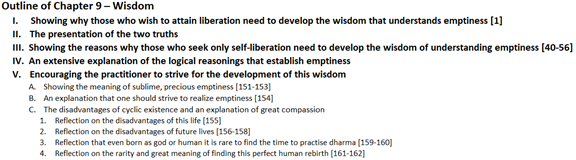
Modern Bodhisattva’s Way of Life: Seizing our Precious Opportunity to Study Emptiness

(9.161) Furthermore, demonic forces are constantly striving
To cast us into the vast wasteland of the lower realms.
There are many mistaken paths to mislead us,
And we find it difficult to resolve stultifying doubts.

(9.162) It will be very hard to find the freedom and endowment of a human rebirth again.
Buddhas rarely appear in this world, and it is difficult to find a qualified Mahayana Spiritual Guide.
Without these, there is no way to stop the flood of delusions –
Alas, the suffering of living beings will continue without interruption!

Each one of us here has a precious opportunity, I would say quite a unique opportunity, a chance not just of a lifetime, it seems the chance of lifetimes.  We will encounter difficulties, of course.  But we can overcome them with effort, such is our present situation, we can overcome them with effort.  We must remember that we make things difficult, don’t we?  We make things difficult, and we actually give power to our maras.  From their own side, there are no difficulties, from their own side there are no maras.  They have no power.

But I would say that we are relatively free from obstacles right now.  Those that we do encounter, we can use for our spiritual training.  We can regard them as necessary in order to bring about our spiritual growth.  And to say that we have relatively good conditions I think would be a gross understatement.  Venerable Geshe-la himself knows how good our conditions are, which is why he has said we should not just to enjoy them, we need to build from here.  But also we must use this opportunity we have to free others too.  Out of compassion, we must strive to take the self of others out of their samsara and place it in the firm ground of liberation, as Shantideva finally encourages us to do.