Modern Bodhisattva’s Way of Life: How Kadampas Can Believe in God

We now turn to the refutation of cause that is other.  The following refutes the possibility of creation by an inherently existent God.   In the West, most of us have been brought up to believe in a God that is the creator of all.  We must have some imprints to have been born into a society such as this. We must have some imprints to have met the Christian religion.  Realizing emptiness does not mean we have to reject God, but we need to understand God in a different way. That is all.  We just understand God in a different way.  This is helpful for us and for the flourishing of Kadampa Buddhism in the West. 

Sometimes many Kadampas or Buddhists feel that they need to reject Christianity or Christian teachings. In fact, many of us came into Buddhism by rejecting our Christian past. We sometimes feel the need to debate with our Christian friends or family members, explaining why they are wrong. All of that is completely unnecessary. Indeed, such an approach is often counterproductive because in our rejection of Christianity we wind up rejecting many things that we need to believe in Buddhism. For example, many people reject Christianity because they do not like the teachings on the hell realms, so when they hear them in Buddhist teachings, they either reject them or reject Buddhism altogether. Likewise, because many people wind up rejecting the idea of God, they struggle with understanding correctly the relationship they are supposed to have with Buddhas. Because they reject God, they wind up rejecting many aspects of our reliance upon buddhas that is similar to what the Christians have in their reliance upon God. We reject too much, and wind up creating intellectually formed wrong views which obstruct our ability to realize Dharma. In reality, the only thing we reject about the Christian notion of God is him as an inherently existent creator of all. If we understand the emptiness of God and the emptiness of his creation, then there is absolutely no problem. When we recognize that our mind is the creator of all, the natural conclusion is we need to create a world as a good God would. In other words, we need to engage in tantric practices of building our pure land where all living beings can take rebirth as our guests and then complete the path.

I’d like to share what Geshe-la said in his teachings on Mahamudra.

“In Guide to the Middle Way it says Buddha rejects any creator other than mind. There is a big debate. Many believe the world is created by God. We cannot say their view is mistaken or wrong. There is no meaning in checking others’ view, we don’t know the real meaning of their view. For example, they say God is the creator of all things. We say the mind is the creator, so how do we clarify? Superficially there is a difference.  We cannot say others’ view is mistaken until we understand the real nature of God. We cannot say they are correct or incorrect unless we understand the nature of God. Through their faith, it works. The nature of God is not clear in this society. In Guide to the Bodhisattva’s Way of Life some people say the nature of God is an independent permanent self. Such a self does not exist because self, person, I are the same, and necessarily impermanent. There is no independent self because every self depends upon causes and conditions. At least they are dependent upon imputation by mind.  Some say the nature of God is the four elements. … some say the nature of God is the Dharmakaya, like empty space. The Dharmakaya is generally possessed by Buddhas. The very subtle mind is called the basic Dharmakaya. It is the basis through which we accomplish the actual Dharmakaya. In Buddhism it is given the name Dharmakaya. Therefore, the nature of God is Dharmakaya. This is very comfortable.”

From a Buddhist perspective, we can say everything created by God means everything is created by Dharmakaya.  So we can say the same words, but we understand them differently.  Then, we are able to relate to others without conflict, the Dharma can flourish in Christian societies without tension.

(9.118abc) If you Samkhyas want to say that Ishvara is the creator of all things,
Then please explain who or what Ishvara is.
(Samkhyas) He is basically the nature of the four great elements.”

The Samkhyas were the Christians of Shantideva’s time, they believed in Ishvara as a God-like creator of all things. Shantideva begins the discussion about production from other by asking the Samkhyas to clarify exactly who or what Ishvara is?

The Samkhyas say that Ishvara is the nature of the four great elements – earth, water, fire, and wind. Every phenomena according to the Samkhyas is some combination or mix of these four elements. Buddhists also agree with this view. They too say that all phenomena are a mix of the four elements. Sometimes, modern people can look at this and find it to be scientifically naive. Phenomena are comprised of elements, but those found on the periodic table, not the four elements of earth, water, fire, and wind. How can we reconcile this? In so many other respects, we can say that modern science is just now starting to catch up with Buddhist teachings, but this discussion of the four elements can seem very archaic.

For Prasangikas this is not a problem. Prasangika’ do not say that things are inherently comprised of earth, water, fire, and wind. They also do not say that things are not comprised of the elements on the periodic table. Rather, they say all things are like holograms. A hologram is something that appears to be one thing when looked at from one perspective and appears to be something else when looked at from a different perspective. For example, the number 6 viewed upside down looks like the number 9. If one person said it is a 6 and the other person said it is a 9, the two could debate endlessly. So what is it? Is it a 6 or is it a 9? It is neither one nor the other, but both simultaneously. All phenomena exist in the same way. To take perhaps a more difficult example, we can look at Donald Trump. For some, he is the worst president ever. For others he is the best president ever. So what is he? Is he the best or the worst president ever? In truth, he is neither one or the other, but both simultaneously. Yes, even Donald Trump is empty.

In the same way, from one perspective we can say all phenomena are comprised of the four elements, and from another perspective they are comprised of the elements on the periodic table. Both views are just different ways of categorizing or understanding or conceptualizing phenomena. Things are neither comprised of the four elements nor comprised of the elements of the periodic table, but are both simultaneously. To debate whether it is one or the other is as asinine as the debate as to whether it is a six or it is a nine.

A Pure Life: Motivation for Series

This is part one of a 12-part series on how to skillfully train in the Eight Mahayana Precepts.  The 15th of every month is Precepts Day, when Kadampa practitioners around the world typically take and observe the Precepts.

Normally we think of our vows and commitments as an afterthought at best or as chains at worst.  We have all taken our vows many times when we receive empowerments or when we engage in our daily practice, but most of us still have not started to take our practice of them seriously.  We often swing from either the extreme of not even giving our vows a second thought to the extreme of beating ourselves up with them out of guilt for all the different ways we fall short.  We swing from the extreme of over-interpreting the words “do your best” to mean “don’t even bother trying” to the extreme of thinking in absolutist terms about what they mean and imply.  We quite often view them as rules or restrictions imposed from the outside, or we view them as constraints on our having any fun in life.  To us, vows and commitments seem to restrict our freedom, but perhaps we accept we have to take them because we want to go to a given empowerment.  Perhaps for our first few empowerments, we take them seriously; but later perhaps we scarcely give it a second thought that we are retaking them or that it means something. But the reality is, perhaps most of the time we rarely think about them and we make almost no effort whatsoever to train in them.

This series of posts will attempt to reverse our attitude towards our vows and commitments, in particular with respect to the Eight Mahayana Precepts.  Instead of viewing them as restrictions on our freedom and fun, we can come to view them as an internal GPS guiding our way to the blissful city of enlightenment where the party never stops.  If we wanted to go to a particular city, we program our GPS, hit go, and start driving.  We happily follow the directions without feeling like we are being deprived of all the wonders on the side streets we could be exploring.  When we miss a turn, we usually say a curse word, but then the GPS plans a new route, and we happily continue on our way.  When we arrive at our destination, we think to ourselves, “this thing is great.  How did I ever get around without one?” 

It is exactly the same with our vows.  We want to go to the city of enlightenment (our good motivation), the Eight Mahayana Precepts are like the directions the GPS gives us along the way to keep us on our chosen route, and if we follow them happily but persistently, they will definitely deliver us to our final destination.  If we get lost or take a wrong turn, we don’t need to worry, because the GPS gives us new directions which we then follow.  No matter how lost we become, no matter how many wrong turns we make, we always know if we just keep following the directions it gives us, we will eventually get there.  It may take longer than what was originally planned (wrong turns), or there may be unexpected traffic (negative karma we need to purify), but if we just keep at it, we will get there. 

I know some people think their GPS gets upset at them when they make wrong turns.  But this is just our own anger at ourselves projecting our frustration onto the GPS voice.  But nowadays, we can program our GPS with all sorts of different voices to choose one more pleasant.  I actually know somebody whose GPS has the option of choosing the voice of a Porn Star (turn right, baby…)!  In the same way, we need to make an effort of giving the Eight Mahayana Precepts “the right voice” within our mind.  When we remember them or but up against them, we need to have them speak to us with the loving, understanding voice of our Spiritual Guide.  We need to hear him chuckle and say, “don’t worry, be happy, just try.”  The chuckle is important.  The sign that we have proper renunciation is we are able to have a good laugh at ourselves and our delusions.  It is OK and it is normal that we make a hash out of it.  When we make mistakes, we learn from them and move on.  We think beating ourselves up with guilt motivates us to do better, but it does not.  Guilt is anger directed against ourselves.  It destroys all joy in our training, and when we lose the joy, we lose our effort (effort is taking delight in engaging in our practices).  Without effort, we have nothing.  We might do our practice every day for aeons, but if we do not enjoy ourselves while trying, we actually have no effort and will therefore experience no results.  If we want, we can give the Eight Mahayana Precepts the seductive voice of Vajrayogini calling us to join her at her place! 

Our conception of freedom is completely wrong.  Freedom is the ability to choose.  But being a slave to every whim of our delusions is not freedom, it is bondage of an eternal order.  True freedom is the ability to choose to pursue what we know is actually good for us.  The Eight Mahayana Precepts run in exactly opposite of the direction our delusions want to go.  Since we are still fooled by the lies of our delusions, we think if we follow them they will lead us to happiness.  The reality is all delusions share the same final destination – the deepest hell.  They all eventually lead us to the same place, but they trick us by painting an image of an illusory paradise just over the horizon.  Duped again and again, we run towards suffering and away from true freedom. 

There are three main reasons why we should train in the moral discipline of the Eight Mahayana Precepts.  First, doing so creates the karmic causes to maintain the continuum of our Dharma practice without interruption between now and our eventual enlightenment.  Second, doing so strengthens the power of our mindfulness and alertness, which are the two most important muscles for strong concentration.  And third, moral discipline is the substantial cause of higher rebirth.  We seek the highest rebirth of all – enlightenment – but getting there is often like climbing many, many flights of stairs.  But it is a joyful climb, because the higher we go the more blissful we feel.  And it is certainly better than the alternative of falling down the stairs…

In this series of posts, I will first explain a skillful attitude to adopt towards our training in the Mahayana Precepts, then explain how we do so with a bodhichitta motivation, then I will provide a brief commentary for how to actually take our precepts on Precepts Day, and finally, I will provide some practice suggestions for how to practice to each of the Eight Precepts.  I will post these on the 15th of every month as a way of marking Precepts Day and a reminder/encouragement for people to take this practice to heart.  My hope by explaining all of this I might improve my own understanding and practice of the Precepts and then enjoy all the spiritual fruit that flows from this.  If others are also able to benefit from these explanations, then it is all the better.

Modern Bodhisattva’s Way of Life: Uniting Quantum and Newtonian Dharma

Each effect is produced from a specific potentiality in its preceding cause.

Nothing arises naturally, does it? Everything arises in dependence upon causes and conditions.  Each distinct effect has its own distinct cause, that is a specific potentiality existing within its preceding cause.  We don’t have to know what specific causes gave rise to specific things like a blue flower, but what is important is to know that everything arises in dependence upon causes and conditions, and is thus empty. 

Here again it is useful to consider what scientists say. In physics, there are two main schools: Newtonian physics and quantum physics. Newtonian physics says everything arises from very specific causes. Quantum physics says things arise independence upon being observed. At a deep level, these two forms of physics are still seem to be contradictory, yet there is an abundance of data which establishes the validity of each. The Holy Grail of physics is to find a way of uniting both Newtonian and quantum physics into one generalized theory of everything. Enormous super colliders have been built around the world to try answer these questions.

Interestingly, Newtonian physics is very similar to the laws of karma, namely everything has a distinct cause and effect. And quantum physics is very similar to the teachings on emptiness, namely things come into existence independence upon being observed by mind. We to tend to grasp at karma and emptiness as being contradictory. We think if things do not exist inherently then how can they possibly cause anything? There must be something there that pushes on something else to create an effect. If there is nothing there, then what causes any effect? This is why understanding the union of karma and emptiness is so important.  The final view that unites these two is the correct view of emptiness.  As long as these two views are seen as contradictory or incompatible, then our understanding is not correct or complete.

Shantideva unapologetically asserts a Newtonian view, namely every effect has a specific cause. It is true we observe all sorts of seemingly random things in daily life, but they seem to be random only because we are not aware of what their causes are.  It does not follow just because we do not know what the cause of something is that it does not have a cause. Our lack of understanding of their causes does not mean they do not have a cause, it simply means we do not know what those causes are. It is exactly the same with karma. There are all sorts of things that we cannot immediately understand the karmic cause of why it arose. But just because we do not understand what karma gave rise to the different appearance does not mean there was not an underlying karma that caused it. Only Buddhas are able to understand exactly the relationship and see the past karmic chains that lead to different effects. The fact that we cannot see it or understand it does not mean that there is not one there.

Likewise, scientists typically divide causes into necessary and sufficient causes. A necessary cause is something that must be for an object to arise, but the presence of a necessary cause does not guarantee about the phenomena will arise. That is why we need the sufficient causes that enable the phenomena to arise. A rainbow is a good example. Without water, a rainbow will not arise. The water is a necessary condition. But it is not sufficient. Without sunlight, the existence of rain alone will not produce a rainbow. In other words, a necessary cause is one where without that cause you cannot have the effect. A sufficient cause is one in which if you have that thing it is sufficient to create the effect. For example, decapitation is sufficient to cause death, but it is not necessary to cause death since many other things can also cause death.

In the Dharma, we divide cause causes differently.  There are two main types of cause: substantial causes and circumstantial causes. The substantial cause is the thing that transforms into the next thing. The circumstantial causes are the causes that bring about the transformation of the substantial cause from one thing into the next thing. For example, the substantial cause of an Oak tree is an acorn. The water, sunlight, and rich soil are the circumstantial causes which enable the transformation of the acorn into an Oak tree.  The circumstantial causes are the various things we would find in science for explaining why things are the way they are. 

While the conventional substantial cause of the Oak tree is the acorn, from a Buddhist perspective objects only come into existence if they are known by mind. Thus, the question is what gives rise to the mind that knows the Oak tree. From the side of the object, there is the substantial cause of the acorn being transformed by the circumstantial causes of water, sunlight, and rich soil. From the side of the mind, there is the substantial cause of the previous moment of mind being transformed by the circumstantial causes of, for example, being at a place in which you can observe an acorn transforming into an Oak tree and having a body with functioning eyes.  But such an analysis is not sufficient. We established earlier in the four close placements of mindfulness that objects and the minds that know them arise in mutual dependence upon one another. Simply looking at the substantial and the circumstantial causes on the side of the object and on the side of the mind is not complete because it still treats the object and the subject as being independent and distinct. In our previous analysis, we saw that mind and its object arise in mutual dependence upon one another. How exactly does this work? As explained before, the quality of the previous moment of mind activates a specific type of karmic seed. When this karmic seed ripens, it produces a subject-object pair of mind and its object that arise in mutual dependence upon one another. The minds generated in this subject-object pair then activate new karma giving rise to the next subject object pair known by the mind. In this way it continues indefinitely like a circle, or like an infinite spiral moving through time.  

If pressed, most of us would not be of the view that there is such a thing as production without cause. We are generally convinced by the idea that everything has a cause, even if we don’t know what that causes. Therefore, it is not that difficult to refute production without a cause.

Happy Vajrayogini Day: Becoming the Vajra Queen

Today is Vajrayogini Day, which takes place every year on the first tsog day of Heruka and Vajrayogini Month.  On this day, we can remember her amazing good qualities and try to ripen them within ourselves.  By doing so, we can draw closer to her and eventually become her.

Our Vajra Queen

Within the Kadampa tradition, our highest yoga tantra deities are Heruka and Vajrayogini.  Heruka is great bliss inseparable from emptiness and Vajrayogini is emptiness inseparable from great bliss.  Ultimately, they are the same person, differing only in aspect and emphasis.  Practically, they are our spiritual guide’s truth body inseparable from our own pure potential.  By relying upon Heruka and Vajrayogini, we can quickly ripen our Buddha nature and attain union with their enlightened state.  Our highest yoga tantra deity is also known as our “yidam,” which essentially means it is the actual Buddha we want to become.  Gen Tharchin explains we design our own enlightenment by the specific type of bodhichitta we generate.  In our tradition, we take Heruka and Vajrayogini as our yidam. 

Vajrayogini is known as the Vajra Queen because she is the highest of all the female enlightened deities for us.  Many people, both in movies and in real life, develop tremendous loyalty and respect for their political queen, willing to dedicate their lives to fulfilling the wishes of their noble queen.  How much more respect and devotion should we feel towards our Vajra Queen who leads us beyond samsara?

Gen Tharchin once told me, several years before I married her, that my girlfriend at the time was an emanation of Vajrayogini.  He explained this to me at my very first Heruka and Vajrayogini empowerment.  Of course, she is not inherently so since she is inherently nothing, but he was unambiguous that I should view her in this way.  I then asked him again several years later if he meant it that she was an emanation of Vajrayogini, and he said, “without a doubt, for you, she is.”  When we got engaged, the ring she gave me had seven diamonds in it, and she said, “like seven lifetimes.”  She had never read Guide to Dakini Land where it explains by relying upon Vajraygoini, an emanation will enter our life within seven lifetimes to lead us to Dakini Land, yet I was flooded with a clear recognition that was the meaning of her engagement ring to me.  For me, she has been my spiritual muse – learning how to relate to her purely, learning how to help her, and overcoming all of the delusions her behavior would provoke in me. 

Vajrayogini practice has many uncommon qualities that surpass even Heruka practice.  First, her three-OM mantra is the king of all mantras.  Geshe-la explains in Guide to Dakini Land:

“By reciting this mantra we can help others to fulfill their wishes and gain peace, good health, long life, and prosperity. We gain the ability to avert others’ diseases, such as cancer, strokes, and paralysis, as well as all physical pain and dangers from fire, water, earth, and wind.  Some practitioners who have a strong karmic link with Vajrayogini, through their daily practice or by merely reciting this mantra attain outer Dakini Land before their death, sometimes even without engaging in close retreats or intense meditation. Some attain Dakini Land in the bardo by remembering as if in a dream their daily recitation of the mantra, thereby enabling Vajrayogini to lead them to her Pure Land. In Dakini Land these practitioners are cared for by Heruka and Vajrayogini and, without ever having to undergo uncontrolled death again, they attain enlightenment during that life. It is for these reasons that the three-OM mantra of Vajrayogini is called the `king of all mantras’.”

Vajrayogini’s body mandala is also unequaled.  Again, Geshe-la explains in Guide to Dakini Land:

“In the practice of Heruka’s body mandala, Deities are generated at the outer tips of the twenty-four channels, at the twenty-four inner places. In Vajrayogini’s body mandala, however, the Deities are generated at the inner tips of the twenty-four channels, inside the central channel at the heart channel wheel. This is the main reason why Vajrayogini’s body mandala is more profound than those of other Yidams.”

Finally, Vajrayogini practice has an uncommon yoga of inconceivability, which is the most profound practice of self-powa in existence, enabling us to transfer our consciousness to the pure land where we can complete our spiritual training without ever having to take another samsaric rebirth.  Through this practice, Geshe-la explains:

“The uncommon yoga of inconceivability is a special method, unique to the practice of Vajrayogini, whereby we can attain Pure Dakini Land within this life without abandoning our present body.”

By contemplating these incredible benefits of Vajrayogini practice, we can generate a strong faithful wish to rely upon her in this and all our future lives.

How we can activate Vajrayogini’s good qualities in our life

We do not consider the good qualities of Vajrayogini to simply think how amazing she is, the goal is for us to generate wishing faith, wishing to acquire these good qualities ourselves.  At first, it can seem like her good qualities are so far away that knowledge of them is more academic than anything else.  But there is a method for activating her good qualities within us right now, where we quite literally start to become her and fulfill her function in the world.  How?  Through faithful recitation of the Eight Lines of Praise to the Mother.

Becoming Vajrayogini is not like an on-off switch but is rather like a volume knob – the more we rely upon her, the more we come to embody her good qualities until eventually we gradually become her.  In our practice of divine pride, we train in imputing our “I” onto Vajrayogini, thinking, “I am Vajrayogini.”  If we impute “I am Vajrayogini” onto our ordinary samsaric body and mind, this is not only a mistaken imputation, it might land us in a psychiatric hospital!  For an imputation to be valid, the basis of imputation must be valid.  For an imputation to be valid, the name, aspect, and function must all be in alignment.  A tennis racket may be used to strain spaghetti noodles, but we would not call it a strainer.  In the context of Vajrayogini practice, her aspect is the beautiful red Dakini, her function is to bestow the qualities of her mind, and her name is Vajrayogini.  If we impute our I onto these three – her name, aspect, and function – we can validly say we are Vajrayogini.

Oftentimes, especially in our early years of Vajrayogini practice, we tend to place primary emphasis on the “aspect” of Vajrayogini, imputing our “I” onto this mere image.  But this rarely works to generate much feeling of actually being Vajrayogini.  In contrast, when we feel like this aspect is performing the function of Vajrayogini in our mind, then when we impute our I onto Vajrayogini engaging in her enlightened deeds, it is very easy to generate a qualified feeling of divine pride being Vajrayogini leading all beings to freedom. 

For me at least, the supreme method for generating a feeling of Vajrayogini accomplishing her function is using the Eight Lines of Praise as an invocation for her to accomplish her special function through us.  When we do this, we will feel her enter us and accomplish these eight special functions through us; and on this basis, it is easy to generate a qualified divine pride.

We can understand how to do this as follows:

OM I prostrate to Vajravarahi, the Blessed Mother HUM HUM PHAT

To prostrate means to wish to become, it is a form of wishing faith.  Vajravarahi refers to her function of destroying ignorance, recognizing her as the essence of the perfection of wisdom that destroys ignorance.  Blessed Mother means she is the mother of all the Buddhas, both in the sense of all Buddhas are born from bliss and emptiness (definitive Vajrayogini), but also in the sense of the actual mother of all the Buddhas in that they arise from her.  In this sense, she is simply the highest yoga tantra version of Mother Tara.  When we recite this line, we imagine we invoke this power to destroy the ignorance of all living beings and give birth to all the Buddhas, requesting that this function be accomplished within our mind.

OM To the Superior and powerful Knowledge Lady unconquered by the three realms HUM HUM PHAT

Superior means she can see directly the ultimate nature of all phenomena, powerful Knowledge Lady means she has the power to bestow great bliss, and unconquered by the three realms means she has the power to overcome all delusions of the desire, form, and formless realm.  When we recite this line, we imagine we invoke her to bestow bliss on ourselves and all living beings, which bestows a direct realization of emptiness on the minds of all, enabling them to completely abandon all the delusions of the three realms.  We feel as if this is actually happening inside our mind.

OM To you who destroy all fears of evil spirits with your great vajra HUM HUM PHAT

Nobody is an evil spirit from their own side, they only become evil spirits for us if we relate to them in deluded ways.  It is our delusions that create all evil spirits in our life, and we can say from one perspective all evil spirits are really just our delusions so condense that they take on a life or personality of their own and function like they are an “evil spirit.”  But through Vajrayogini’s blessings, we can come to experience all beings and all phenomena as manifestations of her mind of bliss and emptiness.  In this way, what was previously experienced as an evil spirit in our life is now experienced as the dance of bliss and emptiness.  Instead of harming us, we receive blessings.  All fear is destroyed because they are now seen as bliss and emptiness, and indeed we can say all “evil spirits” themselves are destroyed, not in the sense of they are killed, but in the sense that there is no longer a valid basis for imputing “evil spirit.”  When we recite this line, we imagine that we come to see all phenomena as manifestations of bliss and emptiness, and so we fear nothing and nobody has the power to harm us in any way.  We strongly believe our view of everything has changed and now we fear nothing because we experience it all as great bliss.

OM To you with controlling eyes who remain as the vajra seat unconquered by others HUM HUM PHAT

Vajra seat here means she is always in union with Heruka who is eternally filling her with great bliss as she bestows the realization of emptiness on his mind.  Her controlling eyes can subdue negative behavior simply by looking at others, much in the way a mother’s firm stare brings her children in line without saying a word.   When we recite this verse, we imagine that while in union with Heruka – being filled with bliss and bestowing upon him the realization of emptiness – we can look out onto all living beings subduing all of their negative behavior in an instant.  We feel this compassionate power coursing through us and that this function is actually being accomplished.

OM To you whose wrathful fierce form desiccates Brahma HUM HUM PHAT

This refers to Vajrayogini’s ability to subdue the pride of all living beings, even the highest gods.  Geshe-la explains that pride is the death of all spiritual learning.  If we are free from pride, we can use the Dharma to overcome all our other faults; but if we are consumed by pride, we cannot overcome any of our faults.  Subduing our pride is, in this sense, a prerequisite for all spiritual progress.  Vajrayogini does not merely subdue our pride, she desiccates it, which means to drain of emotional or intellectual vitality.  We generate pride when we observe some uncommon characteristic we have and then think that somehow makes us better than others.  Perhaps a candle in a dark room provides some light but standing next to the blazing of the sun its luminescence is humbled.  In the same way, we may think we are special in some way, but standing before the Vajra Queen we are stripped away of all pretension and are drained of any emotional or intellectual basis for thinking we are special in any way.  Vajrayogini’s mere presence has this humbling effect on all living beings, opening their mind to generate faith in the spiritual path.  When we recite this line, we feel as if the pride of ourselves and all living beings has been thoroughly desiccated and everyone now bows down with humble faith in her magnificence, ready to learn from her.

OM To you who terrify and dry up demons, conquering those in other directions HUM HUM PHAT

This refers to the ability of her wisdom blessings to burn up the inner demons of ordinary appearances and ordinary conceptions of all living beings.  According to Sutra, the root of samsara is self-grasping ignorance, but according to Tantra, the root is ordinary appearances and conceptions.  Ordinary appearances are, essentially, the things that we normally see – all of which appear to exist from their own side, independent of our mind.  They appear to have some objective existence that we believe our mind merely observes accurately.  Ordinary conceptions are believing these appearances to be true.  We think everything really does exist in the way that it appears.  Due to ordinary appearances and ordinary conceptions, we remain trapped in the nightmare of samsara, and the same is true for all other living beings.  The fire of Vajrayogini’s wisdom blessings has the power to burn through all ordinary appearances and conceptions like the fire at the end of the aeon, stripping away samsara from everyone and enabling them to see directly pure worlds.  Samsara is nothing more than a dream that need not be.  Vajrayogini has the power to burn it all away.  When we recite this verse, we imagine we invoke the fire of her wisdom blessings to radiate out like a spherical burst in all directions stripping away the ordinary appearances and conceptions of all living beings, and then we strongly believe that as a result of this enlightened action all beings are now able to see directly her pure world, Keajra Pure Land.

OM To you who conquer all those who make us dull, rigid, and confused HUM HUM PHAT

This refers to her ability to protect us from evil spirits who would interfere with our spiritual practice by making our minds dull, rigid, or confused.  There are countless evil spirits who would interfere with our practice, and we have all experienced the effects of their interference in our practice.  Vajrayogini can subdue these spirits in four ways, the first of which was already explained above by viewing them as manifestations of bliss and emptiness.  The second is just as would-be attackers are deterred through knowing they are outmatched, so too evil spirits know they stand no chance against Vajrayogini and so they keep their distance.  The third is through the wisdom fire of her protection circle, the basis for any negativity is burned away as it approaches, and thus cannot even enter like a magical shield that disarms all those who would enter her realm.  Negativity simply can’t get through.  The fourth way is through the power of her love and compassion for evil spirits who would do harm.  Just as Buddha Shakyamuni under the Bodhi tree defeated all the spirits through the power of his love, so too Vajrayogini’s unconditional love defeats the evil intentions of all those who would interfere with our practice.  As Geshe-la famously said, love is the real nuclear bomb that destroys all enemies.  When we recite this verse, we imagine we invoke Vajrayogini to dispel all interference from evil spirits in these four ways, and strongly believe as a result all interference is permanently subdued.

OM I bow to Vajravarahi, the Great Mother, the Dakini consort who fulfills all desires HUM HUM PHAT

This refers to Vajrayogini’s ability to fulfill all the pure wishes of living beings.  Buddhas do not fulfill our worldly wishes – nothing can since samsara is by nature contaminated.  But they can fulfill all our pure wishes.  Like a loving mother who helps fulfill all the pure wishes of her children, Vajrayogini works tirelessly to fulfill all the pure wishes of all living beings.  What are pure wishes?  They are spiritual wishes, such as wishing to abandon lower rebirth, escape from samsara, and gain the ability to lead all beings to enlightenment.  They also include any wish to overcome our delusions, purify our negative karma, or gain any of the realizations of the stages of the path.  Vajrayogini is the real wish-fulfilling jewel who possesses the power to fulfill all the pure wishes of all living beings.  When we recite this verse, we strongly imagine that she does so in an instant and everyone is spontaneously born into the pure land. 

We can recite these Eight Verses anytime, both in meditation and out of meditation.  We can also recite specific lines of the eight verses as targeted prayers for specific situations we find ourselves in.  The effectiveness of our recitations depends primarily upon the purity of our motivation, the depth of our faith, the degree of our single-pointed concentration, and the extent of our realization of emptiness of all phenomena.  The more we improve these four conditions, the more we will begin to feel Vajraygoini entering into us and accomplishing her function through us in the world.  With deeper experience, it will almost feel like she takes on a life of her own inside of us, spontaneously accomplishing her function in this world.  Once we have a taste of this experience, generating qualified divine pride both in and out of meditation is easy.

May we all come under Vajrayogini’s loving care and behold her sublime face.  May we become empty vessels through which she may accomplish her enlightened deeds in this world, bringing benefit and happiness to ourselves and all living beings in the process.  May she burn away all ordinary appearance and conception until we see ourselves directly as the Vajra Queen.
Happy Tara Day: Getting to know our spiritual mother

The eighth of every month is Tara Day.  Geshe-la once said during a commentary to Tara practice that, “we should make our own commentary” based on our experience.  As my offering to her and to help celebrate her day and to deepen my own relationship with her, over the next twelve months, I will provide my own understanding of the practice Liberation from Sorrow.  Nothing I say should be taken as definitive in any way, I am simply sharing my personal experience of this practice.  I hope others might also share their own experience and understandings of the practice in the comments.  Then, we can all learn from each other.

In the introduction to the Sadhana, Geshe-la says:

Tara is a female Buddha, a manifestation of the ultimate wisdom of all the Buddhas. Each of the Twenty-one Taras is a manifestation of the principal Tara, Green Tara. Tara is also known as the ‘Mother of the Conquerors’.

The ultimate wisdom of all the Buddhas is the wisdom directly realizing the emptiness of all phenomena.  Sometimes we think of emptiness as a state that somehow exists on it’s own – everything is empty – but in reality, it does not exist without a mind realizing it.  Emptiness is also dependent upon the mind realizing it, and so is also empty.  Tara is a being who has imputed her “I” onto the ultimate wisdom of all the Buddhas – she is this ultimate wisdom.  She appears in the aspect of the twenty-one Taras, just like a single diamond can have twenty-one facets to it.  All other Buddhas arise from her ultimate wisdom, just as waves arise from an ocean.  In this sense, she is the Mother of all the Buddhas – they literally emerge from her, she gives birth to them all.

Tara is our common mother, our Holy Mother. When we are young we turn to our worldly mother for help. She protects us from immediate dangers, provides us with all our temporal needs, and guides and encourages us in our learning and personal development. In the same way, during our spiritual growth we need to turn to our Holy Mother, Tara, for refuge. She protects us from all internal and external dangers, she provides us with all the necessary conditions for our spiritual training, and she guides us and inspires us with her blessings as we progress along the spiritual path.

Our spiritual life can begin at any point in our life, sometimes when we are young or sometimes when we are older; but in either case, Tara is our spiritual mother.  She cares for us in the earliest stages of our spiritual life, nurturing it to make sure we eventually ripen into an independent, functioning spiritual adult able to sustain our practice on our own for the rest of our life.  This is why it is especially important for new practitioners to take Tara practice as their main deity practice.  Establishing an early relationship with Tara will ensure that we ripen onto the math in a mature and stable way.  All we need to do is put our faith in her and request that she nurture our spiritual life into spiritual adulthood.

In some New Age circles, they talk about us choosing our parents in this life.  Generally speaking, according to the Kadampa teachings at least, we are trapped in samsara, which means we necessarily take uncontrolled rebirth.  We did not “choose” our parents, we we karmically thrown into rebirth as their child.  It is true that we may have generated attachment for our mother as she was engaging in intercourse with our father, but that is quite different from “choosing” our mother.  Despite this, through reliance upon Tara in this life, we can choose to have her as our spiritual mother in all of our future lives.  The paths of future lives are very uncertain and samsara’s distractions and deceptions are endless, but our spiritual mother can care for us and guide us to the spiritual path, help us enter it, and then once again ripen us into spiritual adulthood.  People buy insurance policies all the time to protect themselves against eventualities.  Reliance upon Tara is like a spiritual insurance policy for making sure we once again find and enter the path in all of our future lives until we attain enlightenment.  Every day, I pray, “May Guru Tara be my eternal mother in all my future lives.” 

Tara’ means ‘Rescuer’. She is so called because she rescues us from the eight outer fears (the fears of lions, elephants, fire, snakes, thieves, water, bondage and evil spirits), and from the eight inner fears (the fears of pride, ignorance, anger, jealousy, wrong views, attachment, miserliness and deluded doubts). Temporarily Tara saves us from the dangers of rebirth in the three lower realms, and ultimately she saves us from the dangers of samsara and solitary peace.

There is a close relationship between the eight outer fears and the eight inner fears – indeed, the eight inner fears create the eight outer fears.  The eight outer fears are not just literal lions, elephants, snakes, and so forth.  Rather, these animals are symbolic of types of outer circumstances which give rise to fear.  Through relying upon Tara, we pacify the eight inner fears, and as a result we no longer fear the eight outer fears.

For example, pride is a mind that thinks we are better than we actually are, or that takes some characteristic we have about ourselves and generates a feeling of superiority over others due to this trait.  Lion-like outer fears are situations that call our exalted view of ourselves into question.  We fear others criticizing us or discovering that we are a fraud.  We try exert our domination or superiority over others and feel threatened by those who challenge our authority or position.  All of the outer things we fear as threats to our status, reputation, or position are fearful to us only because we have the inner fear of pride.

Ignorance has two types, conventional ignorance of not knowing what to do and ultimate ignorance of not knowing how things truly exist.  People’s lives are plagued by the elephant of insecurity and uncertainty.  We don’t know what the day will bring, and we have no idea what karma will ripen.  To try control against these fears, we try gain control and reduce uncertainty, and we fear anything that could increase our insecurity or uncertainty.  All of our outer fears associated with insecurity and uncertainty come from the inner fear of conventional ignorance.  If we knew clearly what objects are to be abandoned and what objects are to be attained, we would not fear an uncertain world because we would always know what to do and how to respond.  We would have confidence in the laws of karma that if we responded wisely to whatever arises, our karmic circumstance would definitely get better, so we would fear nothing.  Further, ultimately, the only reason why we fear anything is because we still grasp at things existing from their own side, independently of our mind as causes of our happiness or suffering.  But if we understood that everything depends upon how we look at it and everything can be transformed into a cause of our enlightenment, we would quite literally have nothing to fear at all.  Thus, eliminating the inner fear of ignorance removes all of our outer fears.

All of the other outer fears are likewise born from the inner fears of anger, jealousy, wrong views, attachment, miserliness, and deluded doubts.  We can think about all of the things that give rise to our anger, jealousy, wrong views, attachment, miserliness, and deluded doubts.  Normally we view these things as our “problems” because they give rise to feelings in our mind.  But if we eliminated these delusions from our mind, then we would no longer have outer fears.

If we rely upon Mother Tara sincerely and with strong faith, she will protect us from all obstacles and fulfil all our wishes. Since she is a wisdom Buddha, and since she is a manifestation of the completely purified wind element, Tara is able to help us very quickly. If we recite the twenty-one verses of praise, we shall receive inconceivable benefits. These praises are very powerful because they are Sutra, the actual words of Buddha. It is good to recite them as often as we can.

The power of any Buddha to help us depends almost entirely upon the strength of our faith.  Faith is like electricity for our spiritual life.  The entire modern world would come to a screeching halt without electricity, in the same way our spiritual life is inert without the electricity of faith.  Faith can also be likened to our sails, and the Buddhas blessings to winds filling our sails.  If our sails are raised and aligned with the pure winds of the Buddhas, we will be blown swiftly towards enlightenment.  Tara is the completely purified wind element, which means the winds of her blessings are particularly powerful and swift.  Through generating faith in her, we will enjoy all of the benefits and protections explained in the sadhana.  Through faith in her, we will come to feel her presence in our life and enjoy her protection, which will increase our faith further in her in a self-fulfilling cycle of enlightenment.

Modern Bodhisattva’s Way of Life: From Nothing Comes, um, Nothing

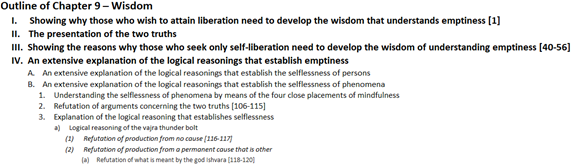
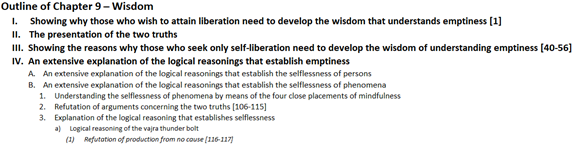
And now we come to the actual reasonings establishing selfless or emptiness.  In total, Shantideva provides three main lines of reasoning establishing emptiness. The first of these reasonings being the reasoning of vajra fragments or the vajra thunderbolt (a much cooler name, to be sure). This reasoning establishes selflessness by refuting inherently existing production, or how are things created.  The second is the logical reasoning of dependent relationship, which Je Tsongkhapa praises as the king of all reasons. The third is the emptiness of production of phenomena. You can find more detail on all of these in Ocean of Nectar and Meaningful to Behold.  As with all of Shantideva’s instructions, what matters is how we can extract some practical value for our daily lives. We should not relate to this as merely an academic or philosophical exercise.

The refutation of the vajra thunderbolt establishes that all of the different ways in which production lacks inherent existence. Shantideva does so by refuting production from no cause, production from a permanent cause that is other, production from a permanent general principle, again production from no cause, and then production from both self and other. This exhausts all the different possibilities for how a phenomena can be produced. If each one of these is established to be empty, then all forms of production are empty. If all production is empty, then all effects of that production are likewise empty because it is impossible for an empty cause to create a truly existent effect. Thus, by establishing the emptiness of cause and effect, we attained the union of the teachings on conventional truth, or karma, and ultimate truth emptiness. In Je Tsongkhapa’s Three Principal Aspects of the Path he explains that the final view of emptiness is the one in which by affirming karma we establish emptiness, and by affirming emptiness we establish karma.  This relationship is established through the vajra thunderbolt.

The first refutation is the refutation of production without a cause.

(9.116) Even worldly people can see clearly
That most things arise from causes.
The different types of coloured lotus, for example,
Arise from a variety of different causes.

(9.117a) (Charavaka) And what gave rise to that variety of causes?”

This question of the Charavakas is a very common question that modern people ask. How did it all begin? What started at all? The answer scientists give is The Big Bang. Other scientists then say, well what caused The Big Bang? Their answer is it arose from the collision of two different universes which then created our universe. But what then started those other universes? In our mind, there must be some point at which things began here. In the Bible, it says “in the beginning, …”

(9.117b) A previous variety of causes.

The prasangikas do not mess around. They simply say what caused the variety of causes? A previous variety of causes without beginning. Is very difficult for us to understand how something cannot have a beginning because everything we see appears to have a beginning , so we naturally assume the universe as well also has a beginning. There are a couple of analogies which can help us understand how something can exist , function, and change yet not have a beginning. The first is a circle. Where is the beginning of a circle? It has no beginning and it has no end. The second analogy is the ocean. Waves rise and waves fall but the ocean always remains. We can identify the beginning or end of a wave but not the underlying ocean. Now of course, we can identify the beginning of the ocean itself when water arrived on asteroids and hit this planet. But the point is making the distinction between the waves and the ocean. So we need to forget about the fact that the ocean did have the beginning. No analogy is perfect, so we take from the analogy what we need to be able to understand the point of Dharma.

If we think about it carefully, it is impossible to have a beginning. If there is a beginning, what caused the thing to begin? If there was a cause that existed before the beginning then there was something that was there before the beginning and thus the beginning is not the beginning. The only way to establish a beginning would be to say that the beginning itself had no cause. If there was a cause of the beginning, then the beginning would no longer be the beginning because cause must precede effect. This is why the first aspect of the vajra Thunderbolt is refutation of production from no cause.

(9.117cd) (Charavaka) “But how does a distinct cause give rise to a distinct effect?”

The Charavakas again ask a good question, namely how does a specific cause give rise to a specific effect?  The modern equivalent of the Charavakas would be those who believe in chaos theory. Essentially things are so complex, it is impossible to establish cause and effect of anything, it’s as if everything is somewhat random. If people assert that there is anything that is random then that thing is necessarily something without a cause. Most people believe there is a good deal of random in the world. Some things have causes and some things are just random.  Logically, all of the random things that happen are, for believers in random things, things produced with no cause.

New Year’s for a Kadampa

New Year’s Day is of course preceded by New Year’s Eve.  The evening before is usually when friends get together to celebrate the coming of the new year.  Sometimes Kadampas become a social cynic, looking down on parties like this, finding them meaningless and inherently samsaric.  They mistakenly think it is somehow a fault to enjoy life and enjoy cultural traditions.  This is wrong.

If we are invited to a New Year’s party, we should go without thinking it is inherently meaningless.  Geshe-la wants us to attain the union of Kadampa Buddhism and modern life.  New Year’s Eve parties are part of modern life, so our job is to bring the Dharma into them.  Venerable Tharchin said that our ability to help others depends upon two things:  the depth of our Dharma realizations and the strength of our karmic connections with living beings.  Doing things with friends as friends helps build those karmic bonds.  Even if we are unable to discuss any Dharma, at the very least, we can view such evenings as the time to cultivate our close karmic bonds with people.  Later, in dependence upon these bonds, we will be able to help them perhaps in Dharma and non-Dharma ways.

One question that often comes up at most New Year’s Eve parties is what to do about the fact that most everyone else is drinking or consuming other intoxicants.  Most of us have Pratimoksha vows, so this can create a problem or some awkward moments for ourself or for the person who is throwing the party.  Best, of course, is if you have an open and accepting relationship with your friends where you can say, “you can do whatever you want, but I am not going to.”  It’s important that we don’t adopt a judgmental attitude towards others who might drink, etc.  We each make our own choices and it is not up to us to judge anyone else.  We might even make ourselves the annual “designated driver.”  Somebody has to be, so it might as well be the Buddhist!

If we are at a party where we can’t be open about being a Buddhist, which can happen depending upon our karmic circumstance, what I usually do is drink orange juice or coke for most of the night, but then at midnight when they pass around the glasses of Champagne I just take one, and without a fuss when it comes time, I just put it to my lips like I am drinking but I am not actually doing so.  If we don’t make an issue out of it, nobody will notice.  Why is this important?  Because when we say we don’t drink, they will ask why.  Then we say because we are a Buddhist.  Implicitly, others can take our answer to mean we are saying we think it is immoral to drink, so others might feel judged. When they do, they then reject Buddhism, and create the karma of doing so. We may feel “right,” but we have in fact harmed those around us. What is the most moral thing to do depends largely upon our circumstance. It goes without saying that others are far more likely to feel judged by us if in fact we are judging everyone around us! We all need to get off our high horse and just love others with an accepting attitude.

Fortunately, most Kadampa centers now host a New Year’s Eve party.  This is ideal.  If our center doesn’t, then ask to host one yourself at the center.  This gives our Sangha friends an alternative to the usual New Year’s parties.  We can get together at the center, have a meal together, do a puja together and just hang out together as friends.  We are people too, not just Dharma practitioners, so it is important to be “exactly as normal.”  If our New Year’s party is a lot of fun, then people will want to come again and again; and perhaps even invite their friends along.  It is not uncommon to do either a Tara practice or an Amitayus practice.   Sometimes centers organize a retreat weekend course over New Year’s weekend.  For several years in Geneva, we would do Tara practice in six sessions at the house of a Sangha member.  The point is, try make it time together with your Sangha family.  Christmas is often with our regular family, New Year’s can be with our spiritual family.

But it is equally worth pointing out there is absolutely nothing wrong with spending a quiet evening at home alone, or with a few friends or members of your family. Just because everybody else is making a big deal out of it and going to parties doesn’t mean we should feel any pressure to do the same. I personally have never enjoyed the party scene, even when others are not getting drunk, etc. I much prefer a quiet evening or a solitary retreat. There is nothing wrong with this, and if that is how we prefer to bring in the New Year, we should do so without guilt or hesitation.

What I used to do (and really should start doing again), is around New Year’s I would take the time to go through all the 250+ vows and commitments of Kadampa Buddhism and reflect upon how I was doing.  I would try look back on the past year and identify the different ways I broke each vow, and I would try make plans for doing better next year.  If you are really enthusiastic about this, you can make a chart in Excel where you rank on a scale of 1 to 10 how well you did on each vow, and then keep track of this over the years.  Geshe-la advises that we work gradually with our vows over a long period of time, slowly improving the quality with which we keep them.  Keeping track with a self-graded score is a very effective way of doing this.  New Year’s is a perfect time for reflecting on this.

Ultimately, New Year’s Day itself is no different than any other.  It is very easy to see how its meaning is merely imputed by mind.  But that doesn’t mean it is not meaningful, ultimately everything is imputed by mind.  The good thing about New Year’s Day is everyone agrees it marks the possibility for a new beginning.  It is customary for people to make New Year’s Resolutions, things they plan on doing differently in the coming year.  Unfortunately, it is also quite common for people’s New Year’s Resolutions to not last very long.

But at Kadampas, we can be different.  The teachings on impermanence remind us that “nothing remains for even a moment” and that the entire world is completely recreated anew every moment.  New Year’s Day is a good day for recalling impermanence.  Everything that happened in the previous year, we can just let it go and realize we are moving into a new year and a new beginning.  We should make our New Year’s resolutions spiritual ones.  It is best, though, to make small changes that you make a real effort to keep than large ones that you know won’t last long.  Pick one or two things you are going to do differently this year.  Make it concrete and make sure it is doable.  A former student of mine would pick one thing that she said she was going to make her priority for the coming year, and then throughout the year she would focus on that practice. I think this is perfect. Another Sangha friend of mine would every year ask for special advice about what they should work on in the coming year. This is also perfect.

When you make a determination, make sure you know why you are doing it and the wisdom reasons in favor of the change are solid in your mind.  On that basis, you will be able to keep them.  Making promises that you later break creates terrible karma for ourselves which makes it harder and harder to make and keep promises in the future. We create the habit of never following through, and that makes the practice of moral discipline harder and harder.

Just because we are a Kadampa does not mean we can’t have fun like everyone else on New Year’s Eve.  It is an opportunity to build close karmic bonds with others, especially our spiritual family.  We can reflect upon our behavior over the previous year and make determinations about how we will do better in the year to come.

I pray that all of your pure wishes in the coming year be fulfilled, and that all of the suffering you experience becomes a powerful cause of your enlightenment.  I pray that all beings may find a qualified spiritual path and thereby find meaning in their life.  I also pray that nobody die tonight from drunk driving, but everyone makes it home safe.  Since that is unlikely to come true, I pray that Avalokiteshvara swiftly take all those who die to the pure land where they may enjoy everlasting joy.

Modern Bodhisattva’s Way of Life: Where Chittamatrins and Prasangikas Disagree

How can you establish anything with a consciousness that is truly existent?

The prasangika’s here ask an important question.  How can a truly existent consciousness know anything? And if the truly existent consciousness cannot know anything, then every object known to such a consciousness necessarily also does not exist because such a consciousness cannot know anything. It is like the child of a childless woman.

(9.112) (Chittamatrin) “We can establish that consciousness is truly existent because the objects it apprehends are truly existent.”

Chittamatrins say they can establish truly existent consciousness because the objects known to that consciousness are truly existent. The true existence of the object establishes the true existence of the mind, because how could a non-existent mind know something that is true? Because the object is true, the mind that knows it must also be true.

If you say this, on what basis is the true existence of these objects established,
Given that they and the consciousness that apprehends them are mutually dependent?
Surely this demonstrates that both consciousness and its object lack true existence.

(9.113) For example, if a man has no child, he cannot be a father;
And if there is no father, how can there be a child?
Since without a child, there is no father, they are mutually dependent and therefore neither is truly existent.
It is likewise with consciousness and its object.

This gets to the very heart of the debate between the Chittamatrins and the Prasangikas.  If consciousness were truly existent, and its objects were truly existent, then one could exist without the other.  But in reality, they are mutually dependent upon one another.  We have already gone over this logic a number of times in previous posts.  By definition a truly existent object is one that exists independently of all other phenomena. Likewise, a truly existent mind exists independently of all other phenomena. There is the fundamental problem of contact. How can two completely independent things ever come into contact with one another?  If they can come into contact with one another, then they are altered by that contact.  The mind is clearly altered by coming into contact with the object because it goes from a state of not knowing the object to knowing it.  The object also is altered by the contact, as even quantum physics agrees objects are altered by observing them.  If they are altered by that contact, then they are no longer independent. If they are independent, then they cannot ever come into contact and therefore it is impossible for a truly existent mind to know anything or for a truly existent object to be known. The fact that both object and mind exist in mutual dependence upon one another establishes the non-true existence of both the object and the mind.

(9.114) (Chittamatrin) “From the fact that a truly existent sprout arises from a seed,
We can understand the true existence of the seed.
So why, from the fact that a truly existent consciousness arises from an object,
Can we not understand that the object too is truly existent?”

Here the Chittamatrins say because the sprout is truly existent we can establish that its cause, the seed, is also truly existent. Only a true cause can create a true effect. If we observe a true effect, then we can indirectly establish a true cause. Since the consciousness that knows the object is truly existent, we can establish that the object known by that consciousness is also truly existent. In the analogy, the mind is the sprout and the object is the seed. The true existence of the object is established by the true existence of the mind that knows it. Otherwise, we would have to say a non-existent or falsely existent object gave rise to a truly existent mind, which would be impossible.

It is what we see, isn’t it?  A sprout arising from a seed.  A mind arising from its object.  Mind and its object must have the same nature.  If one is truly existent, the other must be as well.  If one is empty, the other must be as well.  If one is truly existent, it exists independent of the other, so the other must exist independently of it. 

(9.115) It is true that the existence of a seed can be inferred from the existence of its sprout
By a consciousness that is substantially distinct from that sprout;
But what consciousness can cognize a truly existent consciousness
That, according to you, indicates the true existence of its object?

The Prasangikas are quite clever here by using the seed and the sprout analogy against the Chittamatrins. It is true that observing the sprout establishes the existence of the seed, or its cause. All effects must have a cause, so therefore observing an effect establishes the prior existence of a cause. But according to all Buddhist schools, objects are established by being known by a valid mind. The Chittamatrins attempt to establish the true existence of the mind by referring to the true existence of the object, and they established the true existence of the object by referring to the true existence of the mind that knows it. But what mind establishes the true existence of the mind that knows the object? Without a mind that knows the truly existent mind, we cannot establish its existence. Thus, if the Chittamatrins want to assert a truly existent mind they must identify a valid mind that knows that mind. 

So what then establishes the mind?  This is the fundamental question for the debate between the Chittamatrins and the Prasangikas.  The Chittamatrins establish the mind with a self-cognizer, which has been refuted extensively in previous posts.  The Prasangikas establish the mind with the object condition.  If there is an object, there must be a mind.  If the object is empty, the mind must be as well.  No problem.  There is nothing that is the object from the side of the object.  But also there is no mind from the side of the mind.  Both are empty and mutually dependent upon one another.

So we understand the mind is a creator of all.  Everything, everything depends upon mind, and so is by nature empty.   But we must understand too that the mind depends upon that which it creates, and therefore also is by nature empty.  For example, a suffering mind depends upon the samsara or the samsaric world of its own creation, a pure mind depends upon the pure world of its own creation.

More on the creator of the world later.

Happy Protector Day: May the Doctrine of Losang Dragpa Flourish Forevermore

The 29th of every month is Protector Day.  This is the last part of a 12-part series aimed at helping us remember our Dharma Protector Dorje Shugden and increase our faith in him on these special days.

The most effective way of increasing the power of our reliance is to engage in sincere dedication prayers.  When we dedicate the merit we have accumulated it is like putting our spiritual savings in the bank where they can never be destroyed and they can earn spiritual interest.  Each sadhana has a different dedication prayer which summarizes the main function of the spiritual practice.  In the case or Dorje Shugden, the dedication prayers are as follows:

By this virtue may I quickly
Attain the enlightened state of the Guru,
And then lead every living being
Without exception to that ground.

This is the first effect of this practice.  This is the explicit strategy of Je Tsongkhapa’s tradition for emptying samsara.  Je Tsongkhapa is a spiritual guide who trains others to also become spiritual guides.  These new spiritual guides then train others still and so on.  In this way, generation after generation, the beneficial effects of Je Tsongkhapa’s deeds continue forever.  This is the “great wave of Je Tsongkhapa’s deeds.” 

The person who got me into spirituality was a close friend in college.  He opened the door for me and encouraged me to step through.  After several years of practicing, I thought back to the fact that without the kindness and encouragement of this one friend I would not have a spiritual life at all.  When I later saw him, I asked him, “how can I pay you back?”  His answer was a very powerful teaching:  he said, “do the same for others.  And when others ask you how they can pay you back, give them the same answer.  In this way, the kindness keeps going forever.”  Venerable Tharchin says that the highest spiritual goal to aspire to is to take our place in the lineage.  At some point, we will be the lineage guru whose responsibility it is to carry forward the lineage.  We must prepare ourselves for that responsibility in much the same way people prepare themselves for big missions or assignments.

Through my virtues from practising with pure motivation,
May all living beings throughout all their lives
Never be parted from peaceful and wrathful Manjushri,
But always come under their care.

This is the second effect of this practice.  If beings are never separated from peaceful and wrathful Manjushri, in other words Je Tsongkhapa and Dorje Shugden, then their enlightenment is just a question of time.

The following two verses, known as the Prayers for the Virtuous Traditon, were actually written by a previous incarnation of Dorje Shugden, and we recite them after every practice. 

So that the tradition of Je Tsongkhapa,
The King of the Dharma, may flourish,
May all obstacles be pacified
And may all favourable conditions abound.

This should be fairly self-explanatory by now.  It is the essential meaning of the entire Dorje Shugden part.

Through the two collections of myself and others
Gathered throughout the three times,
May the doctrine of Conqueror Losang Dragpa
Flourish for evermore.

The two collections are the collections of merit and wisdom, and the three times are the past, present and future.  In other words, we mentally invest all of the merit every accumulated into the flourishing of Je Tsongkhapa’s Dharma (Losang Dragpa is another name for Je Tsongkhapa). 

To summarize, the practice of Dorje Shugden can be reduced to the following:

  1. We renew our motivation as a spiritual being – we realize that the only thing that matters is the causes we create because they are the only things we can take with us.
  2. We request with infinite faith that Dorje Shugden provide us with perfect conditions for our swiftest possible enlightenment.
  3. We then accept with infinite faith that whatever subsequently arises is the perfect conditions for our practice that we requested.
  4. We then practice in these conditions to the best of our ability.  It doesn’t matter what appears, what matters is how we respond.  So we try to respond well.

If we do these four things, I guarrantee that we will be gradually lead to enlightenment.  It will just be a question of time.

There is much much more to say about the practice of Heart Jewel, but I wanted to keep things simple.  I strongly encourage everyone to read again and again the book Heart Jewel, which Geshe-la has said is his most important book.  We should also take advantage of the opportunity to speak with some senior practitioners about how to establish a daily practice and we should request teachings and empowerments on this practice from our local teacher.

I dedicate any merit I accumulated from doing this series of posts so that every living being joyfully establishes a daily practice of Dorje Shugden.  I pray that everything that happens to every living being is perfect for their swiftest possible enlightenment.  I request the wisdom to be able to understand how whatever happens to anybody is perfect for their enlightenment and I request that all of the conditions be arranged for me to share this perspective with others in a way that they can accept it.  In this way, we can all happily accept everything that happens in our life and swiftly make progress to enlightenment.  OM VAJRA WIKI WITRANA SOHA!

Happy Tsog Day: Making the Actual Tsog Offering

In order to remember and mark our tsog days, holy days on the Kadampa calendar, I am sharing my understanding of the practice of Offering to the Spiritual Guide with tsog.  This is part 22 of a 44-part series.

Making the tsog offering

HO This ocean of tsog offering of uncontaminated nectar,
Blessed by concentration, mantra, and mudra,
I offer to please the assembly of root and lineage Gurus.
OM AH HUM
Delighted by enjoying these magnificent objects of desire,
EH MA HO
Please bestow a great rain of blessings.

When we make the tsog offering itself we do so in successive rounds to the different parts of the field of merit. In this verse we make the tsog offering to the assembly of root and lineages Gurus. With the first line, we recall the outer aspect of the offerings we previously blessed. With the second line, we recall their cause, namely our concentration on emptiness, the mantra of all the Buddhas OM AH HUM, and our hand mudras performed during the blessing of the offerings. With the third line, we should imagine that countless offering goddesses holding skull cups scoop up the nectar of our offerings and fly to the assembly of root and lineages Gurus. With the fourth line we should imagine that the root and lineages Gurus partake of the offering through straws of wisdom light. With the fifth line we imagine that the root and lineages Gurus experience great bliss in dependence upon enjoying the offerings. With the sixth line we recall that ourselves, the offerings, the deities, and their experience of great bliss all lack inherent existence and are of one nature, like water mixed with water, or like different waves on the ocean of bliss and emptiness. With the last line, we request the root and lineages Gurus to perform their primary function, which is to bestow a great rain of blessings to realize all the stages of the path to enlightenment. Venerable Tharchin explains that a blessing is like a subtle infusion of the Buddha’s mind into our own. In modern terms, it is like we are downloading the Guru’s realizations into our own mind. By requesting that we receive the Guru’s blessings, we create the causes to do so. We should then strongly imagine that light rays and nectars descend from all the root and lineages Gurus and dissolve into our root mind at our heart.

HO This ocean of tsog offering of uncontaminated nectar,
Blessed by concentration, mantra, and mudra,
I offer to please the divine assembly of Yidams and their retinues.
OM AH HUM
Delighted by enjoying these magnificent objects of desire,
EH MA HO
Please bestow a great rain of attainments.

Here, we are making the tsog offerings to the assembly of Yidams and their retinues. The first, second, fourth, fifth, and sixth lines can be understood in exactly the same way as the first verse above. With the last line, we request the Yidams to perform their specific function which is to bestow a great rain of attainments.

There are a few different types of attainments that the Yidams bestow upon us. The first is according to the types of enlightened actions that a Buddha engages in, namely pacifying, increasing, controlling, and wrathful actions. The ability to engage in these types of actions are four different types of attainment.

A second set of attainments is mundane and super mundane attainments. Mundane attainments are the ability to accomplish things in this life. These are important because the more effective we are in this world, the greater the benefit we can bring causing the Dharma to flourish. Geshe-la explains in Joyful Path of Good Fortune the eight attributes of a fully endowed human life. These are: long life, beauty, high status, wealth and resources, persuasive speech, power and influence, freedom and independence, a strong mind, and a strong body. These eight mundane attainments all help us accomplish the ultimate purpose of human life, namely to attain enlightenment and to lead others to the same state. Geshe-la explains these attainments provide us “the very best opportunity to attain liberation and enlightenment in one lifetime.” A long life gives us the time we need to complete our Dharma practice. Beauty helps us attract disciples and makes it easier for them to generate faith in us. High status makes people more inclined to listen to our advice. Wealth and resources provide us with the means of benefiting living beings and Dharma centers in material ways. Persuasive speech makes others trust what we have to say so that our good advice is taken to heart. Power and influence enables us to operate at a higher scale and therefore bring greater benefit in all our actions. Freedom and independence enables us to be free from interferences with our Dharma practice. A strong mind enables us to easily understand the Dharma and help others do so as well. A strong body enables us to be healthy and also to live a long life.

The supermundane attainments are the realizations of the stages of the path, namely renunciation, bodhicitta, the correct view of emptiness, generation stage, and completion stage of Highest Yoga Tantra. All the supermundane attainments can be understood from the explanation of the stages of the path that follows.

HO This ocean of tsog offering of uncontaminated nectar,
Blessed by concentration, mantra, and mudra,
I offer to please the assembly of Three Precious Jewels.
OM AH HUM
Delighted by enjoying these magnificent objects of desire,
EH MA HO
Please bestow a great rain of sacred Dharmas.

With this verse we make the tsog offering to the three precious jewels. After making the tsog offering to the three precious jewels, we request them to accomplish their specific function which is to bestow a great rain of sacred Dharmas. The Buddhas bestow Dharma jewels through their teachings and blessings. Sangha bestow Dharma jewels through their good example and wise advice. The Dharma itself is both the teachings and also, more importantly, the actual realizations of the stages of the path inside our mind. In Joyful Path of Good Fortune, Geshe-la explains there are two types of refuge: simple and special. Simple refuge is simply requesting blessings that the three jewels help us. Special refuge is our actual refuge in the form of the realizations of the stages of the path within our mind. These realizations protect us from lower rebirth, rebirth in samsara, or becoming trapped in the solitary peace of a Hinayana Foe Destroyer.

HO This ocean of tsog offering of uncontaminated nectar,
Blessed by concentration, mantra, and mudra,
I offer to please the assembly of Dakinis and Dharma Protectors.
OM AH HUM
Delighted by enjoying these magnificent objects of desire,
EH MA HO
Please bestow a great rain of virtuous deeds.

In this verse we make off the tsog offering to the assembly of Dakinis and Dharma protectors, and we request them to accomplish their specific function, which is to bestow a great rain of virtuous deeds. As explained above, the Dakinis refer primarily to the deities of Heruka’s and Vajrayogini’s body mandala. These deities attained enlightenment for the express purpose of healing the subtle body of living beings in order to help them engage in completion stage practices. Our subtle body is comprised of channels, drops, and winds. At present our subtle body is a mangled mess with blockages and imperfections everywhere. As a result, our drops and winds are not able to flow freely and unobstructedly throughout our subtle body.

When blockages in our subtle body occur, we develop both outer and inner sicknesses. Outer sickness can take the form of things like cancer, infections, and other diseases. Inner sickness includes developing different types of delusions. When we heal our subtle body, our drops and inner energy winds can flow effortlessly without obstruction, resulting in the healing of both outer and inner sickness. Additionally, by virtue of healing our subtle body, when we engage in completion stage practices, all our inner energy winds can gather, absorb, and dissolve into our central channel at our heart. It is only through causing our winds to dissolve into our central channel that we can experience the eight dissolutions culminating in a qualified experience of clear light. Once we have generated the mind of clear light, we can then meditate on emptiness and quickly purify our mind of all delusions and their karmic imprints, thereby attaining enlightenment.

The Dharma Protector’s job is to arrange all the outer, inner, and secret conditions necessary for our swiftest possible enlightenment. Buddhas can only work with the karma on our mind. Their blessings can function to activate different karmic potentialities on our mind in specific ways that are conducive to our enlightenment. The principal Dharma protector of the New Kadampa Tradition is Dorje Shugden. He is a manifestation of the wisdom Buddha Manjushri. In dependence upon receiving his blessings, we come to see how whatever karma ripens is perfect for our spiritual training. There is no such thing as an inherently existent obstacle to our Dharma practice. Everything can be a condition for training our mind. Because we are currently strongly attached to certain things and averse to others, we think somethings are good for our practice and other things are obstacles. This is ignorance. Dorje Shugden’s blessings enable us to understand how everything is perfect for our training, therefore nothing is an obstacle to our Dharma practice. Things may still be a problem for our worldly concerns, but they are not a problem for our spiritual path. In this way, he removes all obstacles. Understanding this, we request him to perform this function for our self and for all living beings.