Modern Bodhisattva’s Way of Life: Emptiness of Cessation

(9.149) Just as there is no truly existent production of things,
So there is no truly existent cessation.
Thus, living beings are not truly born,
Nor do they truly cease.

If the cessation of things were truly existent, then there would be no production of things.  There would just be endings.  Nothing would change, everything would just stop.  For example, we would just die.  We don’t just die — we die and take rebirth.  We die and take rebirth because the cessation of things and the production of things are not truly existent.  If they were, then we would just die.  It appears that we do because we grasp at truly existent cessations.  But we do not really die, and we’re not really born.  And we do not really live either.

Another good example is karma.  We experience the results of the actions of previous lives, because the cessation of those actions was not truly existent.  If they were, there would be no karma carrying over, no cause and effect.  If actions truly ceased, then no effects would be experienced.  So our actions don’t really end.  Everything we do truly echoes in eternity.  If this makes sense, then it will so influence our life and our practice.

Happy Tsog Day: Destroying our Greatest Inner Demon

In order to remember and mark our tsog days, holy days on the Kadampa calendar, I am sharing my understanding of the practice of Offering to the Spiritual Guide with tsog.  This is part 29 of a 44-part series.

Equalizing self and others

In that no one wishes for even the slightest suffering,
Or is ever content with the happiness they have,
There is no difference between myself and others;
Realizing this, I seek your blessings joyfully to make others happy.

As explained above, there are two methods for generating bodhicitta: considering how all living beings are our mother and exchanging self with others. Meditation on equalizing self with others is the first meditation of the second method. The second method for generating bodhicitta is more powerful than the first method because we cherish ourselves more than we cherish our mother. Since it is more powerful, the practice Offering to the Spiritual Guide dedicates five full verses to the practice.

When we equalize self with others our objective is to generate the same degree of cherishing for others as we have for ourselves, in other words, to cherish others as we cherish ourself. This is not that uncommon of a mind. Political leaders who view their job as serving the public interest consider the happiness and welfare of all their citizens as being equally important. If some politicians can generate this mind, then surely we can generate this mind as a would-be-bodhisattva. We likewise find this mind in many families that consider every person in the family to be equally important and make decisions based upon what is best for the family as a whole. Some teachers do the same with the students in their classroom and some employers do the same with the people who work at their company. Even in normal society, we would say a political leader, a parent, a teacher, or an employer who puts their own interest ahead of the interests of those they serve is a corrupt person.

There are several different methods we can use to reach this mind. One method for doing so is to realize that all living beings have an equal wish to be happy all the time. There is nothing about our own happiness that makes it more important than the happiness of anybody else. Since we all share an equal wish, and there’s nothing that makes us more important than anybody else, it follows that we should cherish the happiness of each and every living being equally. A particularly powerful way of generating this mind is to consider how all living beings are like cells in the body of life. Just as we would not say the hand does not care what happens to the foot, so too when we have equalized self with others, we cannot say that we do not care about what happens to other living beings because we are all part of the same body of life. The definitive way of generating this mind is to consider how all living beings, including ourselves, are all equally empty and therefore equally projections of our mind. There is no basis for cherishing one appearance in our mind over another since they are all equally appearances to our mind. Whichever line of reasoning works for us, the goal is the same, namely to generate a feeling that cherishes all living beings equally.

The dangers of self-cherishing

Seeing that this chronic disease of cherishing myself
Is the cause that gives rise to unwanted suffering,
I seek your blessings to destroy this great demon of selfishness
By resenting it as the object of blame.

In the teachings on training the mind, we are encouraged to gather all blame into one. The meaning of this practice is every time we experience any problem, or we see anybody else experiencing any sort of suffering, we blame it entirely upon the mind of self-cherishing. In the Lord of all Lineages prayer it says, “since beginningless time the root of all my suffering has been my self-cherishing mind, I must expel it from my heart, cast it afar, and cherish only other living beings.”

How can we understand self-cherishing to be the cause of all our suffering? All our suffering comes from our negative karma, and all our negative karma is committed with a mind of self-cherishing. Self-cherishing considers our own happiness to be more important than the happiness of others and is therefore willing to sacrifice the happiness of others for the sake of ourselves. All non-virtuous actions fundamentally are willing to harm others in some way for the sake of ourselves.

Further, what happens to us is only a problem because we consider our own happiness to be important. If we did not consider our own happiness to be important, then what happens to us would also not be important, and therefore not a problem. From this we can see the only reason why we have any problems is because we cherish ourselves.

Intellectually this is not difficult to understand. The practice is to develop the habit of gathering all blame into one. We need to do this again and again and again throughout our life, whenever we see ourselves or others suffer, we do the mental exercise of identifying exactly how and why it is the fault of self-cherishing. The more we do this, the more determined we will become to destroy this demon within our mind.

Practicing from the Heart: “Please Reverse this Sad Situation”

I have spent the vast majority of my Dharma career being a Kadampa Vulcan, stuck in my head or intellectualizing or abstracting myself from all that I was experiencing. The Dharma just gave me powerful tools for doing that.

For me, one of the most important clarifications Venerable Geshe-la provides in Mirror of Dharma is when he explains the purpose of contemplation is to have the Dharma touch our heart, and it is only when it has touched our heart that we have found our object of meditation. For somebody who for decades viewed the goal of contemplation as arriving at clear intellectual understandings of the Dharma and the interconnections between the teachings, this was a revolution in my practice. This doesn’t mean we don’t also need to come to correct understandings intellectually, it means that is just the beginning. Our contemplation is not complete – we have not actually found our object of meditation – until we feel it in our heart. He then implored us, “please reverse this sad situation.” Mic drop…

When I was telling my story of all that had happened to myself and my family to a therapist, the therapist said, “wow, that’s a lot. But the way you describe it, it is as if you are talking about it in the abstract or what happened to somebody else.” This was a pivotal moment for me because she was exactly right. I think it is my defense or coping mechanism for dealing with all the hurt I have encountered in my life. I guess it is a trauma response not that different than what I’ve heard sometimes happens when people are being raped – their mind goes some place else because it is too traumatic to be where they are.

But something unexpected, but perhaps entirely predictable, happened when I started trying to reverse this sad situation. I became filled with rage. Rage at my father for hating my mom more than he loved us and for all the different ways he judged both me and my family over the years. Rage at my mother for not being able to emotionally hold it together as we were growing up and for her committing suicide the day before my wedding. Rage at others close to me for things I’d rather not discuss publicly.

But anger is the worst of all delusions, so repress, repress, repress. No wait, can’t do that. I need to acknowledge and accept the existence of delusions in my mind, take the time to see them for what they are and examine where they come from (thank you Gen Wangden for pointing me to the right place, you have a real skill for that).

So where did the rage come from? Even deeper hurt. But letting that out of the bottle, especially when I’ve been repressing it for 50 years, well, hurts. Overwhelmingly so. When I came back to India, everything that I had been repressing came flooding into my mind and it was overwhelming – more than I could handle. It became urgent to not feel such things. But the turning point for me was when Jim Travis told me, “feel it, brother.” This gave me permission to allow myself to feel the hurt I had been abstracting myself from. I then spent a week on retreat putting myself back together from a near total emotional meltdown.

Along the way, a dear friend told me when we allow our feelings to somatically pass through us – accepting them wholeheartedly instead of pushing them down or rejecting them – it unlocks the wisdom we need to heal our hurt. This was definitely my experience at the time and has been on a few other occasions since, but the Vulcan habits run deep and it is easy to slip into my old ways.

Enlightenment is not just the completely purified aggregate of discrmination, seeing all phenomena individually as manifestations of their emptiness. It is also the completely purified aggregate of feeling that according to Sutra is essentially the supreme good heart of compassion and bodhichitta and according to Tantra is the mind that genuinely feels great bliss when encountering anything (I would say compassion and bodhichitta are the substantial causes of the mind of great bliss. Opps, I did it again, another intellectualization when I’m trying to speak from my heart…).

To reverse our sad situation, we need to learn to practice from our heart. When we first embrace this way of practice, the truth is we don’t become more Zen or more kind-hearted, we become much more emotionally volatile. Again, like Spock when his human side comes to the surface and he has to battle the powerful emotions he had previously been repressing.

But here we discover a different problem: Culturally, within our tradition, we create little space for each other to be deluded or emotionally troubled. This is especially true for the so-called “senior practitioners.” There is so much pervasive pretension within our tradition, with people emotionally pretending to be all put together to supposedly show a good example. This leads to all sorts of “conflict averse” behaviors where people just pretend to be OK with what is going on when in fact they are not and there is very little ability to actually discuss these things with each other without being accused of being deluded or being a trouble maker or disturbing the harmony of the center or whatever. It is because I love my tradition that I point such things out. It is not a criticism, it is a diagnosis.

The truth is there is a great deal to which modern Kadampas use the precious Dharma Venerable Geshe-la has given us to repress and pretend, not accept and dismantle. I would say “please reverse this sad situation” is true not just at the level of our individual practice, but also at the level of us as a spiritual community.

So to all those who have known me for many years, I’m sorry if I have been a bit more emotional of late, even angry. Sorry for pushing conversations to put squarely on the table what I perceive is going on, even if it is uncomfortable to hear said out loud and it is easier to just pretend that all is OK both within myself and within us as a spiritual tradition. But you know what? Sorry, not sorry. This is where I am at in my heart. This is me practicing from my heart. This is me trying to reverse my sad situation.

Happy Tara Day: Causing the three worlds to shake

This is the fifth installment of the 12-part series sharing my understanding of the practice Liberation from Sorrow.

Praising Tara by the light that radiates from the letter HUM

Homage to you who strike the ground with the palm of your hand
And stamp it with your foot.
With a wrathful glance and letter HUM,
You subdue all seven levels.

This also refers to Tara’s ability to engage in wrathful actions and can be understood from the above.  I’m not sure what the seven levels are.

Praising Tara by her Dharmakaya aspect

Homage to you who are happy, virtuous and peaceful,
Within the sphere of the peace of nirvana.
Fully endowed with SÖHA and OM,
You completely destroy heavy evil actions.

This verse refers to definitive Tara.  The conventional Tara is the green deity we know and love.  She manifests this form so that living beings can more easily develop a relationship with her.  But actual Tara is Dhamakaya Tara, or Truth Body Tara.  This is definitive Tara.  The Dharmakaya is a Tara’s realization of great bliss mixed inseparably from the emptiness of all phenomena.  She is referred to as the mother of all Buddhas because all Buddhas arise out of her Dharmakaya – she gives birth to them from her realization of bliss and emptiness.  What does the Dharmakaya feel like?  Happy, virtuous, and peaceful.  This is her inner pure land, and anytime we ourselves feel happy, virtuous, or peaceful, we are experiencing a similitude of her pure land.

Praising Tara by her divine actions of peaceful and wrathful mantras

Homage to you who completely subdue the obstructions
Of those who delight in the Dharma Wheel;
Rescuing with the array of the ten-letter mantra
And the knowledge-letter HUM.

Peaceful actions refer to a Buddha’s ability to pacify negativity, delusions, or their imprints in either ourselves or in others.  All living beings possess Buddha nature.  What does this mean?  It means we all possess within ourselves the potential for an enlightened mind, and all we need to do is purify our mind of all that defiles it and our natural enlightened state will be unleashed or uncovered.  What is our mind defiled by?  Principally three things:  negative karma, delusions, and their imprints.  Technically negative karma is also an imprint of a delusion which is why we normally say the “two obstructions,” referring to delusions and their imprints.  But from a practical point of view, we place particular emphasis in the early stages of our practice on purifying our negative karma (lower scope meditations), then overcoming our delusions (intermediate scope meditations), and finally the remainder of our contaminated karma (great scope meditations).  Tara can help us pacify all three of these, as explained by her ten-letter mantra whose principal function is to bestow all of the Lamrim meditations.  According to Tantra, the two main objects to be pacified are ordinary appearances and ordinary conceptions.  Ordinary appearances are phenomena appearing to exist independently of our mind (the things we normally see), and ordinary conceptions are grasping at the wrong belief that objects do in fact exist in the way that they appear.  For example, when we think of ourself, we see our ordinary body and mind.  This is an ordinary appearance.  When we grasp at them actually being ourselves, this is an ordinary conception.  Tara also has the power to pacify all our ordinary appearances and conceptions.

Praising Tara by her divine actions of wrathfully shaking the three worlds

Homage to TURE, stamping your feet,
Born from the seed in the aspect of HUM,
Who cause Mount Meru, Mandhara and Vindhya,
And all the three worlds to shake.

Buddhist cosmology is incredibly vast.  The universe as we know it actually only one world system.  There are the thousand worlds, which is a thousand world systems or universes as we know them.  There are the two thousand worlds, which is a thousand of the thousand worlds, or one million universes.  And there are the three thousand worlds, which is a thousand of the two thousand worlds, or one trillion universes.  In truth, there are countless universes, and the three thousand worlds is a shorthand for implying countless that makes it somewhat easier to grasp.  Just as the stars in the sky form galaxies, super clusters, and so forth, the three thousand worlds also cluster together and are arranged in different ways, so too the three thousand worlds cluster together and are arranged in particular way.  In the center of the three thousand worlds is Mount Meru, which is actually comprised of countless different pure lands at different levels of purity, such as the Land of 33 Heavens where Buddha went to teach his mother after she took rebirth there.  At the top of Mount Meru is Heruka’s celestial mansion.  Surrounding Mount Meru are the four major and eight minor continents, like an archipelago of different clusters of universes – they can be likened to superclusters of galaxies.  The universe that we live in is simply one of many universes in what is known as the Eastern continent, but is in reality just a cluster of universes.  Traditional cosmology as we know it just talks of our one universe where the Big Bang unfolded, but this one universe is as insignificant as our own planet is in our universe.  The vastness of Buddhist cosmology is almost beyond comprehension.  Interestingly, some astrophysicists have a similar view arguing we live in a multiverse, or a n-dimensional multiverse, but they have no idea how these universes are shaped.  Just as the science of quantum physics is gradually catching up with Buddha’s teachings on emptiness, it is only a question of time before science catches up with Buddha’s teachings on cosmology.  Tara’s blessings and power pervade everywhere.  Vajrayogini and Tara are actually the same being, just appearing at two different levels – Action Tantra version as Green Tara and Highest Yoga Tantra version of Red Vajrayogini.  Vajrayogini is in union with Heruka inside his celestial mansion atop Mount Meru and her wisdom is able to cause all three thousand worlds to shake!

Praising Tara by her divine actions of dispelling internal and external poisons

Homage to you who hold in your hand
A moon, the lake of the gods;
Saying TARA twice and the letter PHAT,
You completely dispel all poisons.

Conventionally, Tara’s blessings are particularly powerful at dispelling external poisons, such as those we might ingest.  I personally suffer from terrible allergies, some of which are deadly.  When I have a strong allergic reaction to something I eat, I of course take my Benadryl or other allergy medications, but I also recite with great faith Tara’s mantra requesting that she protect me.  Those who have allergies can do the same, even allergies as light as hay fever.  But principally, Tara’s blessing dispel the inner poisons of our delusions.  Outer poisons can at most harm us in this one life, but the inner poisons of our delusions harm us in all our future lives.  Considering our delusions to be inner poisons is a particularly powerful way of thinking of them.  If we ingested an external poison, we would do everything we can as quickly as we could get rid of it from our body or to take an antidote.  But we would never think that the poison is us, we see clearly the difference between the poison and ourselves.  In the same way, our delusions are not us, but they do terrible harm to us, and we should feel great urgency to purge them from our system.  Tara is the antidote to all of the inner poisons of delusions.  She is known as the Lamrim Buddha because she helps Atisha’s followers and her blessings specifically function to bestow Lamrim realizations.  Lamrim is like a net of virtuous minds that functions to oppose all delusions directly or indirectly.  By weaving the Lamrim within our mind, we protect ourselves against any possible combination of delusions, and thus achieve protection from all inner poisons.  

How to Engage in Vajra Recitation when Reciting Heruka’s Mantras:

There are three ways of engaging in mantra recitation: verbal, mental, and vajra. Verbal recitation is when we verbally recite the mantras with our mouth and voice. Mental recitation is when we recite the mantras with our mind alone. Vajra recitation is when we imagine our guru is reciting the mantras for us in our mind as a blessing empowerment.

When we recite Heruka’s mantras, we imagine that our four mouths (from the four faces of ourself generated as Guru Heruka) and all the retinue deities (who are purified aspects of our guru’s subtle cannels and drops) recite the mantras like a collective chant as the mantras circle in and out of our central channel according to the visualization.

As they do so, we should imagine that they – who are seen as inseparable with our guru – are collectively reciting the mantras like a healing ceremony or a spiritual surgery by a team of enlightened doctors, bestowing the blessings of the function of each mantra we recite on our mind. We strongly believe this is happening and generate a profound feeling of joy.

We do all of this while maintaining deep faith in Guru Heruka, a bodhichitta motivation, single-pointed concentration, and an understanding that ourself, the mantras, and the guru deities reciting the mantras are all manifestations of emptiness.

We can engage in vajra recitation for the sake of ourself as described above or for the sake of others, imagining that we dissolve those we love into our self-generation, and then we – as Guru Heruka – perform vajra recitation on them, blessing and healing their mind as our guru does to us.

Such amazing spiritual technology!

Modern Bodhisattva’s Way of Life: Inherently Existent Objects Cannot Be Produced

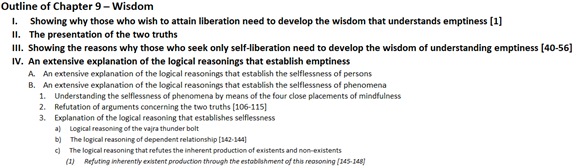
The third reason Shantideva gives to establish selflessness is reputation of inherent production of existents and non-existents. Before with the logical reasoning of the vajra thunder bolt we looked at the impossibility of inherently existent production from the side of the causes. Here Shantideva looks at the impossibility of either an existent or a non-existent being inherently produced, in other words looking at it from the point of view of the effect.

(9.145) If something is truly existent,
What need is there for a cause to produce it?
And if something is non-existent,
Again, what need is there for a cause to produce it?

First Shantideva shows there is simply a contradiction between saying an object is inherently existent and that it is produced. If it is inherently existent, then it exists inherently and therefore does not need to be produced since it already exists on its own. Likewise, it makes no sense whatsoever to talk about production of a non-existent since a non-existent does not exist.

(9.146) Even with a hundred million causes,
A non-thing will never transform into a thing.
If it remained a non-thing, how could it become a thing?
From what state could it transform into a thing?

(9.147) While it is not a thing, it cannot exist as a thing;
So when could it ever become a thing?
It would be unable to separate from being a non-thing
Without first becoming a thing;

(9.148) But without its being separated from the state of being a non-thing,
It is impossible for the state of a thing to arise.
Likewise, a functioning thing cannot become a permanent thing
Because, if it did, it would have two mutually exclusive natures.

Those the grasp at inherent existence say that an object is either inherently existent or inherently non-existent. In moment one for example the object does not exist, and those that grasp at inherent existence would say that it truly does not exist. It inherently does not exist. In moment two, those that grasp that inherent existence say the object inherently exists. Yet they have no explanation for how something can transform from a state of inherently not existing to a state of inherently existing. Transforming from being a non-thing to a thing. How does that happen? Where does the thing come from? Yet when it exists, we grasp it as having its own independent existence. All of this is quite impossible.

I’ll try to simplify with an example of a seed and a sprout.  If the sprout were truly existent, it would not need a cause, seed, to produce it.  It would be self-existent.  With respect to the sprout at the time of the seed, again it wouldn’t need a cause to produce it either since it is a non-existent.  So the question is how does an inherently existent sprout, a thing, come into existence from being a non-thing at the time of the seed?  This would be impossible. 

Essentially all we need to know is — something cannot arise from nothing.  Also, it cannot arise from that which is itself not an effect of some other cause.  It can only be produced from that which is itself a product, so nothing is inherently existent.

Realizing Non-Dual Karma and Emptiness:

Gross and subtle ordinary appearances and conceptions can be understood from the side of the object and from the side of the mind realizing it.

Overcoming gross ordinary appearances essentially means a direct realization of emptiness in meditative equipoise on emptiness. At such times we perceive directly the mere absence of all the things we normally see. We have attained the first union of non-dual appearance and emptiness – the union of the appearance of clear light and its emptiness. We see the clear light as non-dual with its emptiness. We see the clear light as a manifestation of its emptiness. This is essentially the first profundity. From a sutra perspective, this is realized with a gross mind. From a tantra perspective, this is realized with our very subtle mind of great bliss. In Mirror of Dharma, VGL differentiates the union of non-dual clear light and emptiness and non-dual bliss and emptiness as two different examples of the union of appearance and emptiness. But it is still just the first profundity, just at a deeper level.

But to “complete the practice of clear light” we need to purify our obstructions to omniscience. Just as the conventional nature of the mind is so clear it can know objects, the clear light is to empty it can appear subtle conventional objects as non-dual with emptiness. In Eight Steps to Happiness, VGL explains that subtle conventional truths are not conventional truths, but ultimate truths. They are various things appearing directly as emptiness. An omniscient mind perceives “only emptiness” but it appears in myriad ways, of which the appearance of clear light is merely one. The non-dual appearance of myself as the deity, my car, my computer, my phone, Donald Trump, etc., are others. They are these various things appearing directly as emptiness or, from another angle, only emptiness appearing as various things.

In other words, to directly overcome subtle dualistic appearance – attain a realization of non-dual emptiness and subtle conventional truths (seeing subtle conventional truths directly as ultimate truths, only emptinesses), we need to train in the second, third, and fourth profundities, both in meditation and outside of meditation. We do it inside of meditation by meditating on non-dual profundity and clarity, for example with our self-generation meditation; and we do it outside of meditation by training in subsequent attainment, in particular according to the instructions of training in the meditation break explained in Tantric Grounds and Paths in the section on Isolated Body. This process of realizing the second, third, and fourth profundities itself occurs at two levels: at the level of our gross mind (Sutra) and at the level of our subtle and very subtle minds (Tantra).

I would also add even this explanation is not sufficient. We need to realize Nagarjuna’s intention according to the Ganden Oral Lineage. VGL explained this in his oral commentary to Mirror of Dharma and through the Gen-la’s in Arizona. The difference between the explanation from the perspective of the four profundities and from the perspective of Nagarjuna’s intention is we realize not only the union of appearance and emptiness (four profundities), but the union of karma and emptiness (Nagarjuna’s intention). We realize not just the union of appearance and emptiness, but the union of KARMIC appearance and emptiness. This is like the difference between realizing a static picture (four profundities of the non-dual Toyota and emptiness) and a dynamic karmic movie (seeing the Toyota driving down the street as the unfolding of karma inseparable from emptiness, seeing it as a manifestation of emptiness, seeing it as only emptiness appearing as a karmic unfolding appearing in this way). Realizing non-dual karma and emptiness is even deeper than the mere realization of non-dual appearance and emptiness of the four profundities according to highest yoga tantra. I think only when we realize non-dual karma and emptiness with our very subtle mind of great bliss do we actually remove the last traces of obstructions to omniscience and realize Nagarjuna’s (and Buddha’s) ultimate intention and attain full enlightenment.

Happy Protector Day: Preliminary practice of the Guru Yoga of Je Tsongkhapa

The 29th of every month is Protector Day.  This is part 4 of a 12-part series aimed at helping us remember our Dharma Protector Dorje Shugden and increase our faith in him on these special days.

Within the Kadampa tradition we are advised to practice the sadhana Heart Jewel as our daily practice as explained in the book by the same title.  If we are a Tantric practitioner, we engage in the Tantric version of this practice known as Hundreds of Deities of the Joyful Land According to Highest Yoga Tantra as explained in the Oral Instructions of Mahamudra.   In either case, the sadhana begins with the Guru Yoga of Je Tsongkhapa.  I will explain things from the perspective of Heart Jewel since it is a common practice. 

In general, the practice of Heart Jewel is the method for practicing the entire path to enlightenment.  There are three main parts – affectionately called a ‘Heart Jewel Sandwich.’  The first part is the Je Tsongkhapa part – the function of this part of the practice is to be able to draw closer to Je Tsongkhapa, the founder and source of the Dharma of the New Kadampa Tradition.  Through reling upon him, we receive his external and internal guidance to be able to realize his Dharma of Lamrim, Lojong and Vajrayana Mahamudra.  The second part is our Meditation on Lamrim, Lojong and Vajrayana Mahamudra.  We do this in the middle of the practice.  And the final part is the Dorje Shugden part – this creates the causes to be able to receive Dorje Shugden’s care and protection for being able to gain the realization of Lamrim, Lojong and Vajrayana Mahamudra.  This series of posts is primarily about how to rely upon Dorje Shugden, but I will nonetheless give a brief explanation of how to engage in the first two parts of the Heart Jewel sandwich. 

To actually engage in the Je Tsongkhapa part, we do as follows.  First, we generate the mind of refuge and bodhichitta – here we establish our motivation for engaging in the practice:  “With the wish to become a Buddha so I can help all the beings around me attain the same state, I will now engage sincerely in the practice of Heart Jewel, trying to generate the minds indicated by the words.”  Then, we engage in the prayer of the seven limbs and the mandala.  This accomplishes two main functions:  First, we accumulate merit – merit is positive spiritual energy.  It is like gasoline in our spiritual car.  Second, we purify negativities – negative karma prevents us from engaging in spiritual practices and is the substantial cause of all our suffering.  It is like lots of traffic and debris on the roads.  On this basis, we then recite the Migtsema prayer and prayer of the stages of the path.  These two enable us to receive the blessings of all the Buddhas through our living spiritual guide Je Tsongkhapa.  Blessings are like spark plugs which ignite the gas of our merit to push us along the road to enlightenment.  The migtsema prayer draws us closer to Je Tsongkhapa and enables us to receive the blessings of the wisdom, compassion and spiritual power of all the Buddhas.  The prayer of the stages of the path is a special prayer for requesting the realizations of the Lamrim.

At this point in the sadhana we typically engage in meditation on Lamrim.  Usually people use the book the New Meditation Handbook and cycle through the 21 Lamrim meditations explained there, one each day.  Alternatively, we can practice the 15-day cycle explained in Mirror of Dharma.  Instead of engaging in a daily Lamrim meditation, it is also possible for us to recite with deep faith one of the longer prayers of the stages of the path.  There are three main Lamrim prayers – the short prayer as explained in Heart Jewel, the middling prayer as explained in Oral Instructions of Mahamudra, or the extensive prayer as explained in Great Treasury of Merit.  When we recite the Lamrim prayers as our main Lamrim practice, we should do so slowly and from memory, trying to sincerely generate in our heart and without distraction the Lamrim minds indicated by the words.  For more information, we can also attend classes on the Lamrim at our local Dharma centers, including Foundation Program on the book Joyful Path of Good Fortune, which is our principal Lamrim text.  After our meditation, we recite the dedication prayer from the Je Tsongkhapa part of Heart Jewel.

For more detailed information, we can read in the book Heart Jewel which provides an extensive commentary.  Geshe-la has said that this is his most important book, yet sadly it is often overlooked.  It is available for sale at www.tharpa.com

We should also take advantage of the opportunity to attend courses on Heart Jewel at our local Kadampa center, and we should make many requests that our local teacher grant the empowerments of Je Tsongkhapa and Dorje Shugden.  What is an empowerment?  An empowerment in general is method for establishing a very close connection with a particular enlightened being.  The closer our karma with a given enlightened being, the more ‘bandwidth’ they have for being able to help us.  It is a bit like making a connection with a very special friend.  When we meet somebody very powerful and we have a close connection with them, we can more easily call upon them and ask them for help.

An empowerment is like receiving a personal deity within our mental continuum.  We can all appreciate the qualities of the different Buddhas, and think how wonderful it would be to know them and be able to call upon them.  But how much more wonderful would it be to have a personal emanation of a Buddha who is available for us 24 hours a day, 7 days a week.  During the empowerment, we receive our own personal emanation of Dorje Shugden into our mental continuum.  We will be able to develop a personal relationship with this Dorje Shugden and he will care for us.  Geshe-la once told a very senior teacher about the Dorje Shugden empowerment, “people need this empowerment, they need this protection.”

Modern Bodhisattva’s Way of Life: Impermanence Reveals Emptiness

In the first of the three reasonings establishing selflessness or emptiness, Shantideva refutes inherently existent production.  Now the second reasoning, then, reasoning of dependent relationship.

(9.142) Effects do not come from anywhere else when they are produced,
They do not go anywhere when they perish, and they do not inherently abide.
They appear to be truly existent only because of ignorance,
But in fact they are like illusions.

(9.143) Examine something produced from causes
And compare it with an illusion conjured up by a magician.
Where do they come from when they arise?
Where do they go to when they perish?

(9.144) We can see that effects arise from causes
And that, without a cause, there cannot be an effect.
Thus, things are artificial, like reflections.
How can they possibly be truly existent?

This is actually quite useful for understanding subtle impermanence and production.  We can take three moments in the continuum of an object.  In moment one, the object of moment two does not exist, but its causes and conditions do.  In moment two, the conditions cease and the effect of the object appears.  The object is other than its conditions.  The objects of moment two are the conditions for the objects of moment three, and they too must completely cease for the objects of moment three to arise.  So in each moment, there are two things, a complete disappearance of everything of the previous moment and the complete arising of everything of the present moment.  Nothing remains at all.  Nothing to hold on to.

In reality production and cessation are simply two different points of view on the same process of change. From one perspective, there is cessation; from another perspective, there is production. We tend to grasp things remaining without changing. We might agree that things change on the margins, but we still grasped there being some sort of fundamental core essence which remains from one moment to another.  The teachings on impermanence show that there is nothing that remains from one moment to another.  There is just simply an ongoing continuum cessation and production.

In many ways impermanence reveals emptiness. Emptiness is the lack of inherent existence. Inherent existence is existence that does not depend upon anything else for its existence. If everything is undergoing continuous momentary change, then each moment depends upon the previous moment which shows that the object is not inherently existent.  Of course intellectually we understand that inherent existence doesn’t make any sense, but instinctively we grasp at this as being the case and we base our actions on those wrong views. Much of our ignorance remains hidden and it operates out of sight in the background not consciously. These sorts of teachings help us bring our implicit views to the surface enabling us to dismantle them.

It is important though that this not remain merely an intellectual exercise. We need to practically apply the teachings of impermanence to counter our delusions. Attachment wants to grasp on to things, but impermanence shows there’s nothing that remains that can be grasped onto. Instead, we learned to go with the flow and surf the endless continuum of change.

Where do the objects of the previous moment go?  They do not come from anywhere and they do not go anywhere.  They simply appear and dis-appear, since they were never anything more than mere appearances to begin with.  If we look more carefully at this, appearance and disappearance are just two different points of view on the same movement.  The disappearance of one is the appearance of the other.  If the object in moment two were truly existent, then this could not happen.   The fact that it does shows how things lack true existence.  This enables us to make the transition from impermanence to emptiness.  Since things like this object in moment two come from nowhere and go nowhere, they are like illusions, having no true existence at all.

Happy Tsog Day: Understanding the Truth of Samsara for Ourself and Others

In order to remember and mark our tsog days, holy days on the Kadampa calendar, I am sharing my understanding of the practice of Offering to the Spiritual Guide with tsog.  This is part 28 of a 44-part series.

Developing the wish to gain liberation

Being violently tossed by the waves of delusion and karma
And tormented by the sea-monsters of the three sufferings,
I seek your blessings to develop a strong wish for liberation
From the boundless and fearful great ocean of samsara.

Even if we take an upper rebirth, our situation is only temporary. It is just a question of time before we burn up the virtuous karma giving rise to our upper rebirth and we fall once again into the lower realms. Beings in the upper realms primarily just enjoy their good karma ripening. We can see this in our world with those who are extremely fortunate. How many dedicate their lives and their good karma to helping others? Besides Bill Gates, there is virtually no one. Taking an upper rebirth is extremely dangerous from a karmic perspective because we essentially create a bonfire for all our virtuous karma. Once it is burned up, all that remains on our mind is negative, and then we once again fall into the lower realms. Thus, to be in samsara is to be in the lower realms with only very temporary exceptions.

It is helpful to consider what exactly is samsara. In truth, it is a karmic nightmare that we are trapped in that we believe to be true. Everything we normally perceive does not exist, but we think it does, and as a result we suffer. To wish to escape from samsara, therefore is the wish to wake up.

How to practise the path that leads to liberation

Forsaking the mind that views as a pleasure garden
This unbearable prison of samsara,
I seek your blessings to take up the victory banner of liberation
By maintaining the three higher trainings and the wealths of Superiors.

All the so-called good experiences we have in samsara are in reality changing suffering – the temporary reduction of our discomfort. Eating temporarily reduces the suffering of hunger. Sleeping temporarily reduces the suffering of fatigue. Companionship temporarily reduces the suffering of being alone. The list goes on and on. And even if we were able to experience good things for all this life, we would still all inevitably get sick, get old, and die. We are imputing our “I” onto a sinking ship. From a tantric perspective, samsara is identifying with contaminated aggregates of body and mind. More profoundly, it is ordinary appearances and ordinary conceptions. These have all been explained in detail in previous posts. The point is, there is no lasting happiness to be found anywhere in samsara. If we contemplate this deeply, we see our only rational choice is to escape.

What are the three higher trainings? They can properly be understood as the process of letting go of samsara. The three higher trainings are higher moral discipline, higher concentration, and higher wisdom. They are called higher trainings because they are motivated by renunciation, the wish to escape from samsara. With higher moral discipline, we let go of deluded behavior. With higher concentration, we let go of our distractions being fascinated by samsaric objects. With higher wisdom, we let go of grasping at the things we normally see existing from their own side. In particular, we let go of grasping at our ordinary body in mind as ourself. Once we let go of samsara, it will gradually exhaust itself because it was never anything more than mere karmic appearance.

How to generate great compassion, the foundation of the Mahayana

Contemplating how all these pitiful migrators are my mothers,
Who out of kindness have cherished me again and again,
I seek your blessings to generate a spontaneous compassion
Like that of a loving mother for her dearest child.

Just as we are trapped in samsara, so too are all other living beings. But frankly, we generally do not care. Why? Because we do not think these other living beings are important, or that their happiness matters. Once we consider them to be important, then we consider how they too are suffering, and we will naturally generate a compassionate wish that they too escape from samsara. In the Lamrim teachings there are two principal methods taught for how to consider the happiness of others to be important. The first is to consider how all living beings are our mothers, and the second is to engage in the practice of exchanging self with others. In this verse, we train in the first method.

The logic here is very simple. Because we have taken countless rebirths in the past, we have had countless mothers. Where are all these mothers today? They are the beings around us. Buddha said there is not a single living being who has not been the mother of all the others. This is difficult for us to understand only because we fail to grasp the infinite past of our lives. We tend to think in very narrow terms just the human world on this planet. Time is without beginning, therefore there has been plenty of time for each and every living being to have at one point been our mother.

Some people also struggle with this meditation because they have a bad relationship with their mother of this life. For these people, considering how everyone is our mother does not help us to generate compassion for them because we do not like our present mother. There are two answers to this problem. The first is to see things in perspective. No matter how much harm our mother caused us after we were born, the truth is we would not even have this life if she had not kept us and kept us alive when we were younger. Thus, everything we have in this life is indirectly thanks to our mother. And even if she was abusive with us, this has taught us how not to be with others, and so even her negative actions have brought us benefit. The second way of avoiding this problem is to consider that all living beings are equally our child. We have been the parent or mother of all living beings at one point in the past. It is because our mother so mistreated us that we now wish to not repeat her mistakes and instead to care for all living beings as a good mother should that we can consider everyone as our child who we must care for. The point is to realize each and every living being is someone important whose happiness we should care for. It does not matter whether we reach this destination by considering how everyone is our mother or by considering how everyone is our child.