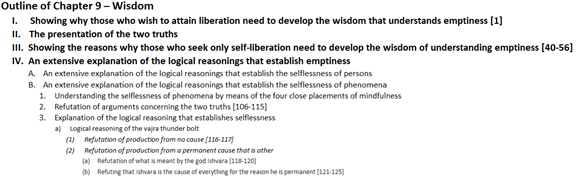
(9.121ab) Precisely what is it that Ishvara is supposed to create?
(Naiyayika and Vaisheshika) “ “He creates the world, living beings, and his own subsequent continuum.”
This is quite similar to conceptions of God held by many religions. Again, our goal in examining these views is not to refute other religions, but rather to identify within our own mind how we still hold onto these views we may have been enculturated into by virtue of living within societies that hold such views. If other people want to believe in such things, we respect that and rejoice in their faith and spiritual path.
But within our own mind, we strive to identify how we are still holding onto different forms of grasping at inherent existence and refute them. One of the areas where we have the most difficulty an understanding emptiness is the relationship between our grasping at inherent existence and production. This is why Shantideva focuses like a laser on demonstrating the contradiction between inherent existence and production of anything. When we dis entangle these two contradictory views our mind naturally opens up into a correct understanding of emptiness.
(9.121cd) But if this is so, how did such an independent creator himself develop?
Moreover, consciousness is produced from its previous continuum,
(9.122) And, since beginningless time, happiness and suffering have been created by karma, or actions.
So, tell us, what does Ishvara create?
If the cause has no beginning,
The effect must also have no beginning.
(9.123) So why, if their production does not depend upon other conditions,
Are effects such as happiness and suffering not constantly produced without interruption?
And if, as you say, there is nothing other than phenomena created by Ishvara,
Upon what conditions does Ishvara depend when he creates an effect?
(9.124) If a collection of causes and conditions produces an effect,
That effect is not produced by Ishvara.
If the causes and conditions are assembled, even
Ishvara does not have the power to prevent the effect being produced;
And, if they are not assembled, he cannot possibly produce that effect.
(9.125) If effects such as suffering are produced without Ishvara’s wishing for them,
It follows that they are produced through the power of something other than him.
You say that all effects are produced according to Ishvara’s wishes,
But those wishes have no power to produce all things, so how can Ishvara be the creator of everything?
Shantideva’s reasoning is like standing in front of a machine gun firing wisdom bullets at our wrong views. His actual reasoning is not difficult to understand. The spiritual practice here is to not intellectually appreciate what he is saying, but rather deeply contemplate each one of these points within our own mind to arrive at a clear and definitive valid cognizer that the view grasping at an external creator of all is completely impossible.
Venerable Tharchin explains that 80% of the meditation on emptiness is identifying correctly the object of negation within our own mind. This is not a philosophical exercise asking ourselves whether inherent existence could exist in the abstract, rather it is a deeply personal investigation of the views held within our own mind to realize how we innately grasp at inherent existence. Only when we fully unearth the different ways in which our mind, perhaps even subconsciously, grasps at inherent existence will contemplating Shantideva’s words produce a profound transformative effect upon our mind. When Shantideva explains the views of the other schools, what he is actually doing is engaging in an extended explanation of the object of negation.
All of us, unless we are already enlightened, still grasp at there being externally existent creation. Intellectually, we call ourselves Kadampas and say of course I don’t think that way. But denying we still have grasping is a form of laziness, indeed it is a form of deluded pride. It is much better to assume that yes indeed we still have deep grasping about these things, then honestly look within our mind and realize how we hold onto such views, and then contemplate Shantideva’s points. If we practice in this way, it is definite that our mind will change. We will feel our mind unlock and open up as our wrong views are definitively left behind, not simply intellectually refuted as if these views were somehow separate from us.
I could provide commentary on each one of these points. But I do not believe I need to because I think most of them are self-evident if we take the time to contemplate them. It is therefore better for us, on our own, to pause and contemplate deeply each reason to arrive at a clear conclusion that yes it is impossible for there to be an externally existent, permanent creator as we normally grasp at.
Even if we do not grasp at an external creator of all, we do still grasp at external creation. There is an extent to which our mind is still holding onto these sorts of views. It is not enough to just simply say there is not an external creator of all. We have to realize there is no external creator of anything.
 Kadampa Working Dad